Scientific theories are cool and complex beasts: you observe some data or think about previous results, formulate an idea about how the world behaves, and then test out how well that idea holds up in the presence of more observation and further development.
My favorite theory is, hands-down, Theory of Special Relativity. It’s not my favorite because of its far-outside-common-experience implications, or because of mathematical obscurities, or because of its attachment to the great celebrity-scientist Albert Einstein, or even because of its amazing practical applications (like nuclear power and lasers and GPS) – cool though all those things may be. It’s my favorite theory because it springs from just a couple simple ideas, and I can derive its wild and wonky implications straight from those ideas using nothing more than basic geometry. It’s a testament to the power of the “thought experiment,” and a wonderful demonstration of how a few brilliant ideas can lead to extraordinary outcomes!
The Theory of Special Relativity basically boils down to just two postulates:
The laws of physics are the same in all non-accelerating reference frames.
The speed of light is the same when measured in any reference frame.
That’s it! Now, check this out: I’m going to derive in a few lines the famous relativistic effect known as time dilation.
Suppose I go screaming by you in a cartoon rocket ship while you stand bewildered on the ground. My rocket’s velocity v is a substantial fraction of the speed of light c. Because it’s just that awesome.
Whoosh!
Inside my rocket ship I have a special type of clock. It’s like a pendulum clock, but it works with light. In a pendulum clock, the pendulum swings through a certain arc in a certain time. In my clock, a laser bounces a pulse of light off a mirror a certain well-measured distance away, and a detector right next to the laser picks up the light pulse. (The laser and detector are so close together that the light basically retraces its steps back from the mirror.) A timer hooked up to the whole thing tracks the amount of time between the laser firing and the detector registering the light.
My light clock
Here’s a closer look at the clock and how it works:
I know that the distance from the laser to the mirror is d, so the beam has to travel a distance 2d every time it fires. I also know that the speed of light is c, so the total time the light beam takes to travel this distance is t’ = 2d/c. That’s one tick of the clock, as I measure it.
Now suppose the clock is right near the porthole on my rocket ship, so that you can see it as I whiz past. You see the entire rocket traveling with speed v to the right, so in a time t the rocket moves a distance vt. And you see the light beam travel along a slightly different path than I do:
Your view of the clock
Why do you see the light travel along this angled path? Why, the first postulate of Special Relativity is the reason! The laws of physics have to be the same for both of us. I look at the laser and see that it has zero horizontal velocity (because we’re both standing on the cartoon rocket deck), so the beam just goes straight up and down. But you look at the laser and see it zooming along with horizontal velocity v, so the light the laser shoots out picks up that additional velocity.
Let’s look at that beam path carefully for a minute, and add some math – don’t worry, nothing too scary! Just the Pythagorean Theorem, to figure out the distance the light beam had to travel.
Okie-dokie. Sounds great, but here’s the thing: Special Relativity Postulate #2 says that the speed of light in vacuum is constant as measured by all observers. So how long do you measure it takes the laser beam to travel this path?
Now, hold on here – I measured one tick of the clock as t’ = 2d/c. You measure it as t’ = 2d/sqrt(c2 – v2). But because of postulate #1, we know that we are describing the same physics! Let me write t in terms of t’ for comparison.
This gamma quantity is kind of a funny thing, and it shows up all over relativity. Since v always has to be smaller than c, then (1 – v2/c2) is always less than one and gamma = 1/sqrt(1 – v2/c2) is always greater than one. That little fact means that t will always be greater than t’. That’s relativistic time dilation! Put in simple terms, if I am traveling very fast with respect to you, then the time of one tick of my clock seems longer for you than it does for me. In fact, since gamma depends on my rocket ship’s velocity, the effect gets more and more pronounced the faster I go, getting towards infinity as I get closer to the speed of light:
Gamma as a function of speed
It’s not just my light clock that gets stretched out in this way. All clocks, and all processes that involve time are subject to time dilation! (You could figure that out by the same method that I just did, if you carefully track the paths of light beams.)
Eventually, what I think is one second on my clock will be a year according to you. If I go faster still, I could get one second on my clock to be a century or a millennium to you! This phenomenon is one reason why we know that nothing can travel faster than light: because if my rocket ship could go at light speed, then time dilation would stretch things out such that (according to you) an infinite amount of time would elapse if I go anywhere!
The coolest thing about all this, to me, is that Einstein came up with these ideas through careful consideration of “thought experiments:” what if we could ride along with light beams? what if I zoom by you on a relativistic rocket? He formulated his postulates carefully, and he fleshed out their implications carefully – but the derivations themselves are wonderfully simple and easy to follow. The physics that result, though…crazy!
I wish I were kidding. I really, really, do. I recognize that the way political parties supposedly work is to offer different solutions to problems – not “good” or “bad” solutions: they are all patriotic, and none of them are evil. They’re just different.
The way incoming Republican Whip Eric Cantor’s web site explains the idea is:
We are launching an experiment – the first YouCut Citizen Review of a government agency. Together, we will identify wasteful spending that should be cut and begin to hold agencies accountable for how they are spending your money.
First, we will take a look at the National Science Foundation (NSF) – Congress created the NSF in 1950 to promote the progress of science. For this purpose, NSF makes more than 10,000 new grant awards annually, many of these grants fund worthy research in the hard sciences. Recently, however NSF has funded some more questionable projects – $750,000 to develop computer models to analyze the on-field contributions of soccer players and $1.2 million to model the sound of objects breaking for use by the video game industry. Help us identify grants that are wasteful or that you don’t think are a good use of taxpayer dollars.
(And, of course, Rep. Smith’s introductory video makes reference to those terrible “university academics” who receive this money. But the whole issue of why learning, academia, and universities are becoming more and more vilified in the political arena is a discussion for another day.)
At the bottom of the web site, there’s a form in which you can enter an NSF award number and comment on how that award is wasting your money. Anyone with an email address can do this. The thing is, while I do believe that transparency is a good thing, I don’t think that the average citizen is going to give any NSF grants the full consideration that they would need to devote to them before decreeing the grant a “waste” or not. They are more likely to make snap judgments based on descriptions like “$750,000 to develop computer models to analyze the on-field contributions of soccer players.”
What do I find so objectionable and anti-science about this?
First and foremost, this is a gross oversimplification. Scientific findings can have applications across many different fields that may or may not have anything to do with the original study or proposal. So, it’s entirely possible that the $750k grant had nothing to do with soccer, but the study turned out to have applications to analyzing soccer-player dynamics. And it’s entirely possible that a materials science group was interested in mechanical models of acoustic waves, but that research was more likely to be funded if done in partnership with a Hollywood effects studio than not, so they got $1.2 million to investigate the sounds of breaking objects. But even if the grants were explicitly for the study of soccer players or improved smashing noises in movies, they still might be worth doing because those findings might have applications to something that matters in our everyday lives, cures disease, enables new technologies, or opens up some other field of endeavor. In fact, every NSF grant proposal must include a substantial section on the “broader impacts” of the research in question, and many proposals get rejected for suggesting research that is too narrowly focused. Rep. Smith is asking people with a few minutes to kill to evaluate what NSF committees with many more qualifications have already evaluated and judged sufficiently broad-ranging.
Here’s an example of research that sounds crazy but has useful applications: a group of collaborators in Canada published a paper on the mathematical modeling of a zombie outbreak. (The paper is available online here, and is a hilarious read for anyone familiar with scientific writing!) Your first thought might be that this is a terrible waste of money, effort, and university resources; or perhaps that the journal ought to be discredited for publishing such a paper; or perhaps you think that this was a total failure of the peer-review process and that all scientists have lost their sense of perspective. But here’s the thing: the zombie modeling research actually has real-world applications. From the paper’s discussion section:
The key difference between the models presented here and other models of infectious disease is that the dead can come back to life. Clearly, this is an unlikely scenario if taken literally, but possible real-life applications may include allegiance to political parties, or diseases with a dormant infection.
This is, perhaps unsurprisingly, the first mathematical analysis of an outbreak of zombie infection. While the scenarios considered are obviously not realistic, it is nevertheless instructive to develop mathematical models for an unusual outbreak. This demonstrates the flexibility of mathematical modelling and shows how modelling can respond to a wide variety of challenges in ‘biology’.
[Munz, Hudea, Imad, and Smith, “When Zombies Attack!: Mathematical Modelling of an Outbreak of Zombie Infection,” Infectious Disease Modelling Research Progress, 2009]
So, yes: these scientists recognize that they worked on a project that is, on the face of it, somewhat silly. The important thing, though, is that these researchers got together, thought it would be interesting to apply their methods to a problem, and got results that have multidisciplinary impacts.
Another great example is the study of synchronicity. Scientists in the fields of mathematics, biology, physics, engineering, and computer graphics have been interested in synchronicity among many discrete entities and how it could arise without central control, just from a few simple rules that each entity follows. An example is “flocking” behavior, exhibited by groups of birds or fish. A computer graphics expert named Craig Reynolds published a paper in 1987 explaining how three simple rules could explain how birds flock together. One of the dramatic consequences of this research was better computer modeling of large groups of animals, which, of course, found its way straight into the special effects industry. Here’s a famous example that uses computer simulation of flocking behaviors to make more realistic animated animals:
So, by Rep. Smith’s logic, if any synchronicity research received NSF funding, he could put it up on the Republican Whip’s web site and say, “university academics got hundreds of thousands of tax dollars to develop computer graphics of a wildebeest herd for a Disney movie.” Shameful, right? The thing is, this application is one aspect of the research. There are many more, ranging from behavioral biology to architecture to sociology to crystallography. Yes, applications include better computer renderings of schools of fish in “Finding Nemo.” Yes, applications include being able to explain how humans at a concert can all clap in time with one another. But this research also gives us better bridges, self-assembling chemical structures, and more capable robotics. You don’t have to take my word for it – here’s a fantastic TED video of Cornell Prof. Steve Strogatz, a gifted communicator, talking about the study of synchronicity and its many applications.
Second, people submitting NSF awards to the Republicans through this program are going to end up nominating as “wasteful” awards that have to do with policies they disagree with. One of the tricky things about science is that scientists don’t get to choose what results they get; sometimes they get results that they – or politicians – don’t like. But that doesn’t mean that those areas of study aren’t deserving of scientific attention!
Anyone with an email address can submit an NSF award to this Republican web site. It would take about 30 seconds for a lobbying corporation to get a Hotmail or Gmail address that wouldn’t be traced back to the company and submit all kinds of grants that have the potential to damage them politically. How many fast food chains do you think will nominate NSF-sponsored studies relevant for obesity prevention? How many oil and gas companies will nominate research into solar cell technologies or further confirmation of climate change? How many religious nutcases will nominate research that impacts evolutionary biology? How many companies will use this as a means to try to shut down research that might make their products obsolete or less desirable?
Humans have a natural tendency to try to ignore problems unless they pose a clear and present danger. This is probably a survival instinct: focus on what’s in front of you, solve the problems you can, and whatever goes on over there is someone else’s issue. However, at some point, we do have to recognize when an issue goes from “not our problem” to “we need to solve this.” Climate change is a perfect example: among the scientific community, there is no doubt that it is happening (though there may be disagreements about the details). But for a politician, it would be unwise to say, “yes, climate change is real; no, I don’t think we should do anything about it.” A statement like that would run the risk of sending voters the message, “I don’t care about you.” Much easier (and safer at the polls) to say, “no, it’s not happening at all.” As such, these politicians will latch on to any tiny weakness in the scientific work, so that they don’t have to commit to a course of action. So how many NSF-sponsored projects into determining what the impacts of climate change might or might not be get submitted to this web site, not because we shouldn’t find out about those impacts, but because some people don’t want to know that a problem exists?
Asteroid impact!
On a related note, one thing that NSF does is fund some of our programs to identify near-Earth asteroids. These are the kinds of asteroids that we have to worry about – the kind that could crash into our planet and destroy things in a cataclysmic way. What are the chances that that could happen? Any astronomer will tell you that they are, well, astronomically tiny. Still, there is value in the search – because if an asteroid is on its way to impact the Earth, we had better know about it! If we ignore the problem, then there’s a large chance that nothing happens but a small chance that we all die. If we address it, then we can try to mitigate the issue. But how many ordinary citizens will look at these programs and think, “I don’t even know what asteroids are. Are they real? What is this? My tax dollars are paying for this. Why should they?”
Third, NSF-funded research pays for graduate students! We cost money – not just our meager stipends, but also our university tuition, university overhead, and mandatory health insurance for those of us who work in labs. We also need capable computers and precise equipment to do our research. And we need to present our findings to the scientific community at research conferences. Even if our current project happens to be on better modeling of the sound things make when they break, and even if the obvious applications are in the movie and gaming industries, that’s not what we’re going to spend our whole career on. We’re learning advanced skills – skills this country desperately needs to develop. We’re pushing the boundaries in advanced fields – fields that are relevant to a wide range of applications.
What if the grad student modeling the sounds of breaking objects goes on to develop software that can analyze a terrorist’s tape of demands to determine what other activities are going on in his cave, and lets us pinpoint him and stop him? (Yeah, that’s right, I just called House Republicans soft on defense because of this NSF-skewering project!) What if the grad student modeling soccer players is talking with a friend who is doing medical research, and finds out that his soccer-player algorithms could help his friend develop a cure for cancer?
Even if our research project has limited applications, it still has the function of giving us grad students the skills, tools, and abilities that we need to become fully-functional scientists and engineers in our own right. Today, I work on algorithms to control reconfigurable modular spacecraft. But if I never touch another spacecraft-related problem again in my life, I have still learned a lot about computer programming, mathematical modeling, control strategies, physics, critical thinking, project management, systems engineering, technical paper-writing, and communication. Whether or not I keep working on spacecraft, all those things will continue to be useful. Maybe someday I will even become a professor and start making little baby scientists of my very own. And regardless of what research projects they work on, no matter how silly it seems, there is value in simply teaching them to be scientists, engineers, mathematicians, and thinkers.
For science to work properly, scientists need to be able to proceed with free and open inquiries. They need to be able to exercise their wits and apply their knowledge to all sorts of problems. Science is about looking at something in the world, watching it, and thinking, “if I put my mind to it, I can figure that out!“ It doesn’t matter if the phenomenon in question is how soccer players move on the field, why things make the sounds they do when they break, why fish school together, or even how hypothetical zombies spread their infection. It also doesn’t matter if the research has immediate applications to movies, video games, sports, or anything else. We can explain the phenomena of the universe. Working to expand the scope of our knowledge enriches us, little by little, for as long as the human race exists.
That is a philosophy that the House Republican leadership opposes with this NSF review site. If your congressperson has anything to do with it, I urge you to write them about it.
(In spacecraft lingo, engineers grabbed the term “microsatellite” to just mean “a small satellite,” where “small” was in comparison to the spacecraft with masses of thousands of kilograms. But they kept the relationship between the metric prefixes. So a “microsatellite” is about 100 kg or less, and a “nanosatellite” is about 10 kg or less. This is unfortunate for, say, my research group, because our proposed millimeter- or micron- scale spacecraft would have to be named something inconvenient to say, like “yoctosatellites.” Anyway.)
I think NanoSail-D is exciting for two reasons. First, it’s only the second solar sail mission to not explode on launch, after JAXA’s ICAROS mission. (The Planetary Society tried to launch a solar sail five years ago, but the converted ICBM launch vehicle malfunctioned.) Solar sails are a propulsion system that could allow spacecraft to move around the Solar System without expending propellant, so they would be a great technology for getting from planet to planet efficiently. The downside is that solar sailing takes a long time, but fortunately, robots can have long lives and a lot of patience. More solar sails may mean more robotic missions to planets, asteroids, and moons all over the place, which is a good thing for science!
The other reason why NanoSail-D is cool is this microsatellite-deploying-a-nanosatellite idea. Microsatellites are small and low-cost enough to have a pretty rapid development cycle, and spacecraft engineers are less averse to trying out riskier, newer technologies on microsatellites. FASTSAT is a great example: it’s a technology demonstrator mission, a spacecraft devoted entirely to trying out new things. Nanosatellites can be even faster and cheaper to build, so much so that it’s pretty common for universities to build CubeSat projects and you can buy components to build a fully-functional CubeSat off the internet for $100,000 or less.
So with FASTSAT and NanoSail-D, we have a relatively cheap spacecraft with a rapid development cycle that includes cool new technologies – and it launches an even cheaper spacecraft with even riskier technologies, including one that could allow interplanetary trajectories.
These are the ingredients we need to get probes all over the Solar System, and these are the design philosophies that push the envelope of spacecraft engineering.
if I had to guess at what NASA is going to reveal on Thursday, I’d say that they’ve discovered arsenic on Titan and maybe even detected chemical evidence of bacteria utilizing it for photosynthesis
–and the Internet went wild with the announcement that NASA had found life on one of Saturn’s moons, including an Atlanta newspaper. Of course, nowhere in NASA’s press release did they say anything about Saturn or Saturn’s moons, but feh! Who cares about what the primary sources say. Speculation is fact!
My guess? There has been some kind of study or experiment that shows how life could evolve based on a different chemistry than familiar Earth life, and that that chemical environment may exist (or have existed) elsewhere in the Solar System. The point of such a finding would be that we’d have to make sure any future astrobiology studies don’t just look for life as we know it – that they include the new chemistries. But that’s only myguess.
If NASA had discovered life, don’t you think the press release for the upcoming news conference would be front and center on NASA.gov, and that the list of panelists would include names like Bolden, Garver, Holdren, or Obama?
I have started collecting my materials and papers into a dissertation draft, and today came up with a pleasant surprise. I visited the web site of the AIAA, an organization that publishes some of the journals I’ve submitted to, to take a look at some of the information on one of my papers. When I searched for my name, one of the hits returned was not one of my papers. Nor was it even one of my research group’s papers. It was from another author!
Naturally, I downloaded the paper straightaway. It appeared in the Journal of Guidance, Control, and Dynamics this month, and is on the subject of satellite formations held together by actively controlled electromagnets. Right in the second paragraph was a reference to my work with my advisor at Cornell:
And, sure enough, reference [3] is to, as it turns out, my first conference paper on this project!
(As an aside, by now I’ve done much better work than that paper – and as I edit my dissertation material, I keep thinking, ugh, how could I have written some of that stuff! – but I won’t be picky, because I understand how long the publication process can take!)
To my knowledge, this is my first outside-my-group citation. That’s a grad school milestone!
For those of you not familiar with science and engineering papers, let me explain a little. Even if this is only a sentence in the literature review, it’s still pretty important. It shows that the authors included my work within the scope of the field; it’s a sort of measure of acceptance into the community. This citation is especially cool because the MIT group that published this paper has been working on electromagnetically controlled satellite formations for a number of years, and we’ve seen our work as complimentary to theirs in a number of ways. It’s nice to see the recognition, and to see our work mentioned in the same section as other related research projects. (And I did some work out of one of Schaub’s textbooks recently.)
All right! Now I guess it’s time to try and get back to the grad studentry…
Tonight, a friend of a friend came over to my apartment so we could all make chili together. During this process, we came to a point when we needed to defrost a bunch of ground beef. When I moved to the microwave to get that going, Friend-of-a-Friend says to me, “You know, you can also defrost meat in a bowl of warm water. That’s healthier for you.”
Usually the method I choose by which to defrost meat is governed by how long I feel like waiting for dinner, and how much I am thinking ahead. But I was curious about this new rationale, so I asked Friend-of-a-Friend to explain how the warm-water method is healthier than punching the “defrost” button on my microwave. “Well,” this person says, “one is cooking with radiation, and one isn’t.” Then they shrug and make a waffling gesture with their hands. “Ehhhh…” The implication was clear.
Something about this situation bugs me. Here is a person who has enough scientific knowledge to see that there is a connection between microwaves, radiation, and certain health concerns – but not enough knowledge about these things to realize that they have constructed a problem or fear that has no justification.
Microwave ovens work by bouncing radiation with a wavelength of a few centimeters or so around in a cavity. This wavelength lines up nicely with some of the vibration modes of water molecules, and the vibrations thus excited get passed along to food as heat.
Ionizing radiation can cause health risks in a number of ways, including killing things outright at high enough doses. However, the more relevant concern at the low levels of radiation found in a household appliance would be that the radiation could damage the structure of some cells’ DNA, and those cells would run amok – becoming cancer.
However, microwave radiation is non-ionizing: it is not energetic enough to do much more than excite molecular modes or maybe kick a few electrons into a valence band. It can’t cause any more direct damage to you than a walkie-talkie does by blasting you with radio waves, or a household radiator does by bathing you in infrared radiation. Furthermore, it can’t cause any damage to the DNA or cell membranes in the steak or pork chop or broccoli cut or baked potato or whatever else you put in your microwave oven. Even with ionizing radiation, irradiating the steak doesn’t make it radioactive. The result you get is a hot steak, not a carcinogen.
So, here is a person who knows that microwaves work by radiation, and that radiation causes cancer. But this person doesn’t realize that the physical mechanisms in each case are different, that the food cannot transfer the effects of radiation to you by being eaten, and that there is no syllogism here. But I wonder just how pervasive this kind of thing is: would this person be surprised if I shined a flashlight on them, and then announced – accurately and truthfully – that I was irradiating them? And how many other people are out there with similar misconceptions?
It strikes me that this sort of incomplete knowledge is a little dangerous, because it creates fear where none should exist. And there are many forces out there that would love for us to receive only partial knowledge, because then we can be driven by those constructed fears. If only more people could be motivated to pursue a fuller understanding of science…
(Pardon me for the hiatus. Had to fly to Houston to do some flight testing at NASA.)
I spent a pretty good weekend doing some world-building. Since discovering the maps in the first pages of The Lord of the Rings, Redwall, and the like, I have really enjoyed sketching out maps of imaginary worlds and outlining details of the cultures and histories that play out over those maps. My maps started as knockoffs of Tolkien’s (with the bad guys sequestered in a nice, rectangular wall of mountains around some barren lands) or parallel-universe versions of the terrain around my house. Since then, though, I’ve started to inject a lot more realism into the worlds I create. Want to know where the tectonic plates and prevailing winds are on my map of Oghura? I could show you!
Map of Oghura
Beyond the maps, some of my imagined cultures have fully fleshed-out languages, religions, and customs. Slowly, slowly, I’ve been compiling reference documentation on the Oghuran desert and people, the fantastical Cathedral Galaxy, and the future-universe of the Four Colonies. This weekend I was spending my time in the Cathedral Galaxy, putting together a master list of the major galactic regions and polities, along with distinguishing characteristics. Now I know a bit more about why the Imperium of the Triumvirate is split in three, how the far-from-galactic-center Traders’ Rim came to be populated by merchants and entrepreneurs, and the tumultuous history of conflict between Amseile and Shobah. I’ve also got the beginning of a couple more stories – one concerning an Imperium gladiator’s bid for freedom and another describing the Waygehn people, who evolved to sentience near the death of their star and outlived the event, leaving them homeless in the galaxy. That’s one of the most fun things about deciding to build a universe purely for short stories: I get to invent worlds, and then immediately show them off with snippets of detail!
Though the Cathedral Galaxy has some distinctly space-fantasy elements, I decided early on that it would be a universe based on hard science – though not necessarily our hard science. My short story “Conference” illustrates the point, as it shows that there are technical concepts built upon technical concepts – but at the level that Arthur C. Clarke would have described as “indistinguishable from magic.” I have no idea how the Channel Network could be set up, and building planet-size structures is clearly fantastical. (And none of you know yet what’s in The Cathedral!) But I made sure that the story was relevant to us Earthdwellers, and I lean strongly on plausible concepts to describe things like astronomical bodies or planetary orbits.
Great Galactic Map, showing major markers and the Channel Network
For example, take Heliast, the resort world on which much of “Conference” takes place. Here’s the description that conference-goers got of the world:
The tour guide explains how Heliast is an ancient world with a single moon nearly half its own size, and how that has dominated the history of the planet and made it ideal for resort paradises. A billion or so years ago, the planet spun many times under one orbit of the moon, and the energy input of ocean tides among all the planet’s archipelagoes – Heliast is over eighty percent water – gave rise to life. But nowadays, the moon orbits in tidal lockstep with one Heliast day, the prime factor contributing to the perpetual calm of its seas. The small radius of Heliast’s solar orbit leaves the planet with a reasonable day length, while the dimness of its sun places it in the liquid-water zone. Without tides, with a massive moon helping to protect the planet from asteroid impacts, and with barely any eccentricity in its orbit to create seasons, there have been few selective pressures on Heliast’s life forms. Life on the planet thus failed to diversify much, and after millions of years of evolution with few external stressors, there are now only a few ecological niches on the world. Three or four avian species, eight or ten surface-level swimmers, two or three land animals, and about six land plants are all most tourists have the chance to interact with. The rest of the planet is geological beauty for visitors to enjoy.
So, the planet’s “month” equals its “day,” but there are still many days per year and there is much liquid water on the surface. The dynamics shaped the world’s evolution. That was fun to think of! But, more and more, I am completely amazed by the strange worlds that actually exist in our own universe. Many Earth- and space-based observatories keep returning data on new exoplanet candidates, and in the last few years, the galaxy seems a lot more planet-populous than it has in the past.
This past Monday, I went to a fascinating astronomy seminar on the potential climates of Gliese 581g given by Dr. Raymond Pierrehumbert from the University of Chicago. (He’s preparing these climate models for an arXiv preprint.) Besides tying the Gleise 581 system with 55 Cancri for most number of known exoplanets around the same star (5), this planet is interesting because it falls right smack in the middle of the traditional “habitable zone,” the range of orbital radii necessary for planet surface temperatures that could support liquid surface water. Now, of course, the discovery of Gliese 581g has to be confirmed to become official – and there’s some doubt about that! – but it’s at least got scientists thinking about these dwarf-star systems in interesting ways. Continue reading World-Building and the Real Universe→
My Ice Fracture Explorer concept for getting a probe down into Europa’s subsurface ocean – one of the likely places in our Solar System to find extraterrestrial life – was just one way to dig beneath the ice crust. Other concepts often involve melting through the ice crust. However, I thought, what if we can take advantage of the places where Europa’s geologic dynamics allow access to the ocean without tunneling through the ice?
I can think of two surface features on Europa that mark potential exposure of the ocean to space. One is the “chaos,” which may be formed when ocean-floor volcanoes or rising blobs of warm water melt through the ice crust all the way to space. However, we don’t yet have a good way to predict when chaos features would form – unless the impact theory of chaos formation, my personal favorite, is correct, and we can track a large meteoroid on its way to hit Europa. The second, the double-ridge features marking cracks in the ice crust, are potentially more predictable so it makes better sense to plan a mission around penetrating the crust through these fractures.
My IFE concept involved a disposable probe landing on a double-ridge, rolling to the center, and hanging over the crack as it opens up under Jupiter’s tides. The hanging probe could then drop a penetrator into the fracture, to punch through the thin layer of ice below and dive into the ocean water.
Hanging drop concept
A number of readers left me comments here and on io9 pointing out various challenges with this design. Getting the lander to hang, suspended, in the middle of the crack might stretch our space-tether technologies a little too far. Timing transmissions to an orbiter before the closing crack crushes the lander is a problem. Communications from the penetrator are also an issue: since those have to cross a water/space boundary, I wanted to just reel out a long data line from the hanging lander to the penetrator – but the length of this cable could be an issue if the ice crust ends up being 100 km thick. And, since the probe would probably have to be powered by an RTG, when the fracture closes and squishes the probe, we’d be dropping radioactive gunk on the Europan natives. While I don’t think any of the stages of the IFE concept stretch our technologies much more than, say, the Mars Science Lab’sSky Crane, it certainly wouldn’t hurt to make things easier on ourselves!
One such idea might be to drop the miniature penetrators directly from orbit. There wouldn’t be any suspended platforms, data cables, or rolling around on an unpredictable surface. There also wouldn’t be as much of a challenge in lining up the orbiter for receiving data, since the penetrator came from the orbiter in the first place. However, determining which ice fractures are opening and closing, and timing the drop from orbit to coincide with those events, might be tricky. Landing on the surface first adds an additional safe-hold point to the mission: controllers can wait to establish good telemetry from the lander after it’s on the surface and before ordering it to commence penetrator deployments.
Another suggestion might be to keep the lander on one side of the double-ridge interior. It could shoot a cable across to the other side, and reel the penetrators out to the middle before dropping them:
Penetrator drop concept
This concept buys the IFE a number of things: first, it can drop more than one penetrator. My original concept called for several IFE’s to be dropped in tandem to several ice fractures to increase the chance of success. However, if each IFE can deploy more than one probe into the ocean, then the mission managers can get several chances to successfully drop the mini-probes as the crack opens and closes and opens again. Second, the lander won’t be crushed, meaning that we won’t have to worry about radioactive contamination of the ocean (as long as the penetrators run on batteries) and we’ll get the chance to have the landers keep performing science operations after all the penetrators are expended. Third, the lander can buffer data from the penetrators and uplink the information to an orbiter at leisure – no rushing to time the drop for an orbiter pass!
One thing scientists don’t really know yet about Europa is how wide these cracks open up. The tether-based ideas I’ve outlined work as long as the crack is big enough to admit the penetrators – but they have the advantage of working if the fractures end up being many meters wide. However, that might not be an advantage the spacecraft needs if the cracks are very narrow. In that case, why not just have the lander come down with footpads on either side of the fracture?
Straddler concept
As the crack opens and closes, damped mechanical joints in the legs could take up the motion and keep the lander centered over the crack. This lander would also be able to buffer data, survive for many tidal cycles, and be able to drop as many penetrators as it has packed into its body.
I think the biggest issue with my designs is that data line: the images and biochemical experiment results from the penetrator have to get transmitted to the lander somehow. (From there, they can get to orbit and then to Earth.) Direct transmission via radio or optical signal could be very difficult from beneath the alien waves, and speed is a factor, so I opted for a hardline. But how long does the cable need to be? At least tens of meters. Probably around ten of kilometers. But maybe as long as 100 kilometers, which could be prohibitively long! One possible solution might be to drop a two-segment penetrator into the crack: the upper segment would have floats – probably some sort of inflated bags – and a radio transmitter. The lower segment would contain the ice-shattering hard shell and all the science instruments. The two halves of each probe would be connected by an unreeling data cable. So, the probe would drop from the lander, smash through the ice, and then split into halves – with one half floating on (and them freezing on to) the ocean surface while the other half continues its plunge into the depths. The probe would collect its data, then zap that data up the cable to the surface unit. From there, the data would travel via radio to the lander, which would relay it to the orbiter and then the Deep Space Network.
Certainly, any concept for a Europa mission strains our ingenuity. But that is one reason why it’s so fun!
This year’s NASA Desert RATS exercise is taking place near Flagstaff, AZ. Here’s the view from inside one of the rovers after a traverse:
RATS is a program in which NASA engineers, scientists, and astronauts take prototype equipment into remote locations on Earth and practice the procedures and operations that they would use if they were actually on another planet. It’s an opportunity for the engineers to see what their creations are capable of, scientists to see how much work astronauts can get done and teach them basic skills like field geology, and the astronauts to get some experience using the equipment so they can provide feedback.
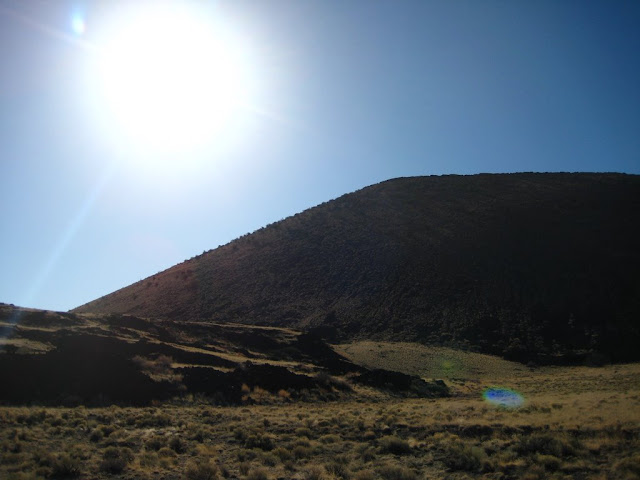
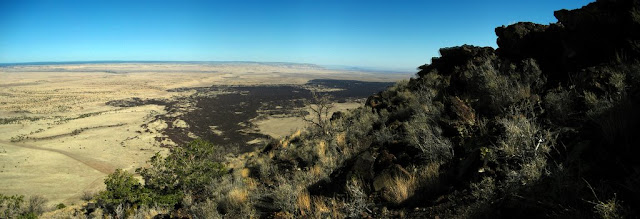
Not only is RATS showing off the best capabilities of the most successful part of the Constellation Program – the Lunar Electric Rover Concept, or LERC – but they have gone to an especially cool site, a well-preserved but little-known cinder cone volcano known as SP Mountain! As that video played, I kept thinking to myself: “that looks familiar…” Here’s my view of SP and the lava flow coming out of the base of the mountain:
SP ConeSP flow
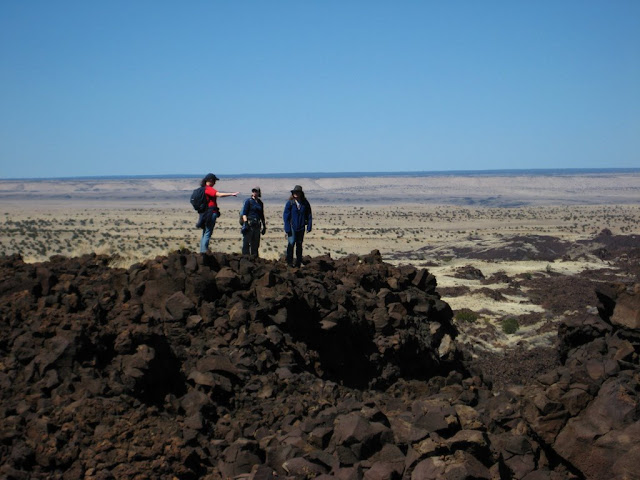
When I was there, with a class of planetary geology grad students led by Cornell Mars scientist Jim Bell, I couldn’t help but picture the rugged a’a terrain of SP flow with astronauts picking their way along. What a tremendous place to practice exploration operations!
Europa, the second Galilean moon of Jupiter, has been my favorite planetary body for a long time. The reason I like Europa so much is that it’s a world whose orbital dynamics with Jupiter, its orbital resonances with the other Galilean moons, and its own rigid-body dynamics have a strong hand in creating its surface features – and giving it the potential to harbor life. It’s one of perhaps two or three extraterrestrial places in the Solar System where we might hope to find life. Europa is also easier to get to than Enceladus or Titan. As such, I think it ought to be one of the highest-priority exploration targets for robotic space probes. (Human exploration would be nice, too, but if you think radiation exposure on the way to Mars is hard, you don’t even want to consider putting people in the Jovian system!)
Thanks to magnetometer measurements and images from the Galileo mission, it’s pretty much established at this point that Europa has an icy outer shell over a global liquid ocean, with a rocky core on the inside.* The only question is how thick that ice shell is – I’ve read estimates ranging from 10 meters to 100 kilometers, with a pretty high confidence of ones to tens of kilometers. The ice shell gives rise to a number of interesting surface features. A particularly cool sort of feature, found with global extent across Europa, is the double ridge.
A prominent double-ridge feature on Europa, most likely a crack in the icy shell
Planetary scientists have a number of models for how these double ridges form, and they generally seem to agree that the ridges mark the locations of cracks in the ice crust. One especially well-established model suggests that these cracks occur when Jupiter raises tides in Europa’s ocean – just like how the Moon raises tides in terrestrial oceans, but much stronger, because Jupiter is frakking huge compared to Earth’s moon. Europa’s ice crust bulges out over the ocean’s tidal swell and then cracks under the incredible stress. (I like to take a moment to think about the mindbogglingness of that statement: the whole moon’s surface cracks. I’ve stood on a frozen pond when a crack pings through the foot or so of ice on top of the water – Just imagine standing on Europa when this happens!) Once a crack forms, the tides don’t go away. As Europa rotates, about once every three and a half Earth days, the tides periodically lever these cracks apart and squeeze them back together again. In this model, every time the cracks gape open the subsurface ocean gets exposed to space. The surface water boils and rapidly crusts over with ice, and when the cracks get smushed closed, all this ice gets crushed up and forced to the top and bottom of the crack, forming the ridges. The ridges appear in pairs because the crack opens up again after that. These double-ridge features are mounds of crushed ice flanking passages into Europa’s ocean!†
Dr. Richard Greenberg is a planetary scientist who thinks that these cracks in the ice shell might be potential sites for life to take hold. Unlike the rest of the subsurface ocean, they get exposed to sunlight, which means that photosynthesis could take place. The periodic in-and-out forcing of the crack would also drive strong currents, which is another energy source Europan life could use. (Those aren’t the only energy sources: other possibilities include thermal gradients in the water, volcanic vents on the ocean floor, or even induction as Europa travels through the Jovian magnetic field.) Of course, that life would also have to adapt to the crack opening and closing once every 3 1/2 Earth days!‡
Europa's possible ice-fissure biosphere (from New Scientist; click for full article)
We do at least know, from the Galileo mission, that these cracks often have accompanying veneers of organic (e.g. carbon-based) molecules and salts splashed onto the ice surface. This is why the cracks appear as brown stripes in large-scale context images. The crack/veneer combination suggests that there are organic molecules and salts in the Europan ocean, and that those compounds get pumped to the surface through these cracks.
So, let’s take stock: Europa is the only extraterrestrial world with a global liquid water ocean, there is a definite possibility for life in that ocean, and these double-ridged cracks are a possible gateway into the alien biosphere.
Well, then, let’s go diving! Read on for my concept system architecture for an ambitious Europan ocean-exploring mission, which I call the Ice Fracture Explorer.