Category Archives: Science

The Biggest Science Errors in (hard) Sci-Fi

One of the problems with having just watched a whole lot of Star Trek is that, while I like a lot of the characters and plots and ideals, it’s a poster show for demonstrating some of the biggest scientific problems in modern science fiction. So, without further ado, I break a long silence to present my Top 3 Science Errors in Sci-Fi.

#1: Sensors

If you are the captain on the bridge of a Star Trek ship, you have the advantage of being well-informed beyond the limits of physical possibility. Your science and tactical officers can consult the Sensors and instantly list for you every object within a few light years. They can tell you what each object is made of. They can give you a map of a planet surface, or approach a never-encountered-before alien spaceship and produce an interior schematic. They can rattle off the number, species, sentience, and state of health of every living thing on a planet. They can tell you what systems are active on an enemy ship. They can even quote for you what the enemy ship’s computers are calculating.

Decades worth of scientific data-gathering and interpretation, happening in an instant

It might seen like “sensors” capable of many of these feats are plausible, given some of the technologies and techniques available to us today. We have telescopes that conduct all-sky surveys and see billions of light-years; so why not give Starfleet captains an immediate cosmic census? We can do spectroscopy to determine a substance’s constituent elements remotely. And we can detect electromagnetic signals, which might emanate from even the smallest electrical circuits. But what’s missing from this picture is the presence of uncertainty, noise, and time delays, all of which make measurements harder – and make the conclusions you can draw from those measurements much less certain. At the very most, when Spock or Data or Dax quotes the composition of a strange starship, they should include a measurement of probability with each component – and those probabilities should be well under 100%! Not only will that percentage depend on the quality of the instruments, the measurements, and the data processing, but there are even certain physical limits that prevent it from ever reaching 100% or even from getting to a reasonable level of confidence without a certain amount of observation time. If you want to map an alien planet, for instance, you need to spend time in orbit imaging and analyzing its entire surface, if for no other reason than that you can’t observe more than a small sliver of the planet at once!

Another important point involves the physical infrastructure required to give instruments the sensitivity they would need to do all these things with high certainty. Suppose we want to alert Captain Picard to the fact that the Borg ship is charging its weapons to fire. (And, obviously, I don’t mean Borg led by a relatable megalomaniac queen; I mean terrifying faceless drone Borg coming to assimilate you.) Presumably, the phrase “charging weapons” means that the energy in some kind of battery or capacitor bank is building up. We could, theoretically, detect photons emitted from such a system. But, first of all, I would think that the Borg shield systems like that, since they value efficiency so much – so very few photons will come out for us to detect. Second, a single photon won’t be enough for us to tell what’s going on. We need enough to get a good signal-to-noise ratio: that is, we need enough photons from the Borg weapons system to confidently say that they are from an energy buildup in that weapon system, and not from anything else. If there’s a fixed number of photons coming out of the Borg weapon, then there are basically two ways to build that confidence by measuring more photons: give your sensors a long time to measure, or catch photons from a larger area. We want to give Picard a result fast, so we’d have to go for the bigger photon-capturing. Much bigger. Especially if you want to pin down the exact location of those photon emissions: angular resolution at any given wavelength of light depends directly – and only – on the telescope baseline size. Therefore, first up on the Enterprise’s battle plan should be the deployment of a giant reflector dish. I think something with a diameter of a couple hundred kilometers should suffice!

The impossibility of Sensors as we usually see them depicted could have a huge impact on many sci-fi storylines. For instance, characters should have to make decisions on much more restricted information – or spend much more time considering their actions. Our characters will also find themselves in many more situations where they can’t solve the problems we throw them up against, simply because they don’t have enough information about the problem or they have to take too long to figure things out. There are other impacts, too. For instance, I’ve seen arguments on the web that stealth spacecraft are impossible (because any spaceship with humans in it will be at a temperature much higher than ambient space, so it will emit thermal radiation). These arguments assume the existence of Sensors, and further assume that the Sensors will always trump alien thermal management schemes. And in hard sci-fi circles, particularly in computer-game universes, there is also the concept of active versus passive Sensors: active Sensors are like radar, which bounce a signal off of enemy ships (thus making your ship easier to detect); while passive Sensors are like cameras, which just collect emissions. However, though that distinction may be meaningful, it’s not practical! Unless you really want to deploy those huge detector telescopes, you had better break out the radar if you want to locate your enemies before they fire all their missiles.

#2: Orbits

When you arrive at a planet from deep space, you want to park your spaceship. The parking space is an orbit. Contrast with deep-space maneuvering, when your spaceship can go any direction it likes any time it wants.

Well, no. Not exactly. Not at all, in fact.

Orbits aren’t just for parking – they dictate everything about moving around in space. The International Space “Station” is always moving at many thousands of kilometers per hour because of orbits. Geostationary satellites are at a really high altitude – over 35,000 km – because of orbit mechanics. We only launch space probes to Mars about once every two years because of orbits. Interplanetary space probes can only reach certain destinations with the amount of fuel they carry because of orbits.

Whenever two sci-fi spaceships meet at a planet, they aren’t going to be exactly next to each other except by design. If their orbits are inclined or eccentric relative to each other, or at different altitudes, then the ships are going to be continuously moving around relative to one another. If these ships get into a space battle, then they are likewise going to be moving around each other in arcing paths. The trajectories of the arcs will change as the ships maneuver, but there is definitely going to be constant, hectic motion, and it definitely won’t all align nicely with some arbitrary 2D plane.
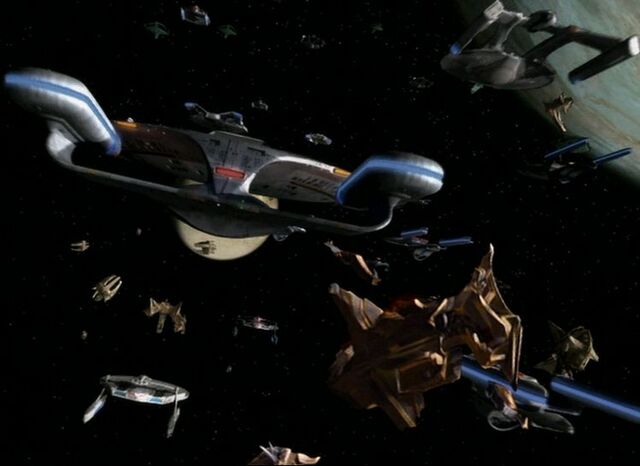
Nice neat flying-wedge-style formations in orbit?

The worst offender on this point, in my opinion, is Ender’s Game. One of the premises of the book is the argument that, in space, the enemy could attack you from any direction and at such speed that you cannot anticipate the attack; therefore, defense of a planet is impossible and everyone has to be on the attack all the time. This is an interesting idea, but it’s true only if the attacking spacecraft have unlimited power and propellant. In reality, those resources must be limited and so the attacking fleet is going to have to take some orbital trajectory to get from their planet to yours. Just like NASA planning the launch of a Mars rover, they’ve got to pick their launch window carefully – which means that you actually could predict which trajectories the attackers are more likely to use.

The mechanics of orbits matter to sci-fi stories: they are like the layout of highways and roads across a country. If some characters need to get from one planet to another, there are certain orbits they could use and certain orbits they could not. They determine how long the trip takes, and what subsequent destinations the characters can reach. And orbits keep ships moving with respect to one another along curving paths in all three spatial dimensions, making spacecraft behave in a manner that is completely unlike watercraft (or even aircraft), which is how we usually see them depicted.

#3: Co-opting a Current Science Word to Mean “Magic”

Nanotechnology. Genetic engineering. Biotechnology. Mutation. Cybernetics.

All of these words, even the more sciency-sounding ones, are often thrown around in sci-fi as synonyms for the word “magic.” My favorite examples come from Peter Hamilton’s Void Trilogy, when characters with all sorts of technological implants “manifest a quantum field function” in order to do things (unlock doors, tap into computers, fire lasers, etc). What the heck does this mean? Hamilton just strung together some cool-sounding words. His characters might as well be waving magic wands or using the Force. At least the Star Wars universe is honest about this!

The thing is, terms such as the ones I listed describe technologies that we have now and don’t mean at all what the sci-fi writers think they mean. For example: nanotechnology. Nanotechnology is the manufacturing capability to build things with sizes measured in nanometers, and it happens all the time in the electronics industry without giving anybody superpowers. What nanotechnology does give us is a ton of transistors on a silicon chip. Same for genetic engineering: we have been splicing genes and resequencing DNA for decades now – and cruder genetic engineering in the form of selective breeding goes all the way back to Gregor Mendel. You can thank genetic engineering for apples and insulin, but again – no mind-melding, magnetism-wielding, or time-winding powers.

I do not think that it’s inconceivable or wrong for writers to take the Arthur C. Clarke leap, and posit that sufficiently advanced technology is “indistinguishable from magic.” But in order for that to work, the technologies have to have either technical explanations that use concepts we can’t relate to our current understanding, or leave off the explanations entirely. Think of explaining that Droid phone to a Roman: it wouldn’t make sense to say, “Oh, you have aqueducts. Well, over time, aqueducts got better and smaller and eventually people built this handheld device which works by really good aqueducts.” That extrapolation of technology is misleading and incorrect. The “indistinguishable from magic” idea comes into play because the Roman doesn’t understand electrons or transistors or LCDs, and those terms are completely meaningless to him.

Often, terms like these are handled well – and science fiction is a tremendous vehicle for exploring the potential implications of emerging sciences. Where I have my biggest problem is when a story says something like, “after the introduction of nanotechnology in 2167, nanotech-enhanced human muscles, nerves, and brains entered the market.” Lines like that show that the writer just thought the word “nanotech” sounded cool and didn’t want to think very hard about how the theories or technology we have now would feed in to the technology of tomorrow. It’s a cop-out that doesn’t align well with either our current understanding or the effects the writer is trying to describe. Where those cases are concerned, I kind of like it better when we have “the Force” and “red matter” and other such things without any explanation.

Runners-Up

I decided on a top three based on those issues that I think have the biggest impact on sci-fi stories. There are, of course, a whole host of other science problems in most popular sci-fi.

The closest runner-up, in my mind, has to be designing spacecraft like ships – with planar decks stacked on top of one another, such that if you stand on the surface of a deck you can face in the direction of travel of the spaceship. There is no reason whatsoever to do that. In fact, if you’re interested in getting some artificial gravity, it makes much more sense to stack the decks vertically, so that the lowest deck is toward the engines and the thrust is always “up.” But if sci-fi starship designers want to really go nuts, they ought to start canting decks at angles, wrapping them around cylinders, or just having a string of cabins that the starship crew floats between. Written sci-fi is much better about all this than movies, TV, or games are. (Artificial gravity itself is something I’m willing to give sci-fi movies and TV shows a pass on, simply because I understand the production limitations and I’d rather see more innovative sci-fi come out of Hollywood than less. It can fall into the “magic” category. But it’s no excuse to design ship-style decks.)

Sound in space is also a science error, but I’m happy to let it slide for the sake of artistic license. Same goes for big fireball explosions. Some shows go a long way, stylistically, by muting or eliminating sound from their spacecraft, though!

Most sci-fi gets the idea of rocket engines way off. Orbit maneuvers – including getting onto a transfer orbit to another planet – require a change in velocity known as delta-vee. Delta-vee comes from firing a rocket engine. The more the engine fires, the more delta-vee the spaceship gets. Simple enough, but the problem lies in propellant consumption: a spaceship only has a finite amount of propellant aboard, and when you use it all up in engine burns, you can no longer move your spaceship around. So spacecraft rocket firings necessarily happen only during brief intervals, when absolutely necessary. A real spaceship will never have rocket engines on continuously in an “idle” state, or to overcome friction like a boat or airplane has to! (Electric propulsion, like ion engines, behaves a bit differently – those engines are almost always very low-thrust devices that have to be on for months, say, to get a space probe from the Earth to the Moon.) Worse, something like the Starship Enterprise would have to devote most of its mass to housing propellant reserves to accomplish many of the maneuvers we see. To get around this issue, many sci-fi universes include some kind of “reactionless” drive or other engine based on as-yet-unknown physics that can use the Clarke argument. I’m not sure why those engines need to have glowing backward-facing exhaust vents, though!

Orbit-to-surface-to-orbit shuttles are pretty bad. Barring some future magical physics, a single-stage-to-orbit vehicle is the holy grail of launch. It takes an enormous amount of fuel and propellant to escape the Earth’s gravity – far, far more in terms of mass than the rocket payload. Most launch concepts we can envision involve some component of the vehicle that doesn’t make it into space – whether it’s an expendable booster stage or a carrier aircraft that stays behind for reuse. Re-entry can be just as problematic, as the vehicle has to get rid of a ton of kinetic energy (to make a long story short, that’s what space capsules’ heat shields do). Shuttles can be obnoxiously necessary for crews of planet-hopping explorers, though…

Like shuttles, faster-than-light travel is tough. It’s the elephant in the room of most science fiction: writers are just dying to have it, but it cannot be accomplished by any means we currently know about. There are some theories out there that might give us FTL capabilities, but only under the most extreme and unrealizable conditions. (Things like…being inside a black hole and whatnot.) However, being able to move characters from planet to planet very quickly can make for richer storylines, more imaginative settings, and more exciting descriptions and visuals, and so it becomes a kind of necessary evil.

Addendum: Reader Nominations

A couple readers have commented on some other effects or technologies commonly depicted in science fiction that commit scientific faux pas.

  • Will pointed out “shields” and “force fields,” which form an impenetrable (or, at least, as penetrable as the plot requires) bubble wall around a starship. The idea of a deflector shield has its basis in scientific fact; but there is no real way to project a solid wall around your favorite spaceship that prevents matter and energy from passing through.
  • Jon mentioned that many movies and TV shows include “energy weapons” which produce blasts that travel slower than not only light, but also sound!

The Science is Real

It worries me when I see public figures, or aspiring public figures, disparaging scientific work because it is not compatible with their personal positions. The public gets to hear phrases like, “that’s only a theory,” or “that scientific theory has holes in it,” or “it’s not proven, we don’t know for sure yet;” all of which are meant to cast doubt on the validity of one scientific conclusion or another. The problem (and this is, of course, a point of subtlety that often causes proponents of science to look like they have a weaker argument in the public’s eyes) is that all those things are true for scientific findings. The good thing, though, is that none of those statements should be disparaging – if only lay people had a better understanding of the scientific process.

Scientific theories are “only” theories, yes…but “theory” is actually one of the highest terms of honor an idea can attain in the world of science. A “theory” is only accepted as such if it has graduated from the world of hypotheses after rigorous testing. A scientific theory represents the best possible idea humans can conceive of how part of the world works. And if a new theory comes along, in order to be better than the old theory, it still has to explain the same phenomena and fit the same data. Old theories often remain as subsets of new ones, rather than being discarded entirely.

Even then, when a theory represents the best understanding we have of the world, to say that it “has holes” or is “not conclusively proven” is not to say anything at all. Science is not a process of logical argument from immutable premises – it is a process of induction from observable data. We observe new data all the time, and our theories must adapt to that data if they cannot account for new observations. The most fundamental scientific theories still leave some phenomena unexplained, but that does not make them totally invalid. The theories of Newtonian or Einsteinian gravity don’t account for quantum behaviors, but knowing that does not mean that the next time I jump in the air I won’t come down to Earth again. Our best theories cannot be “proven” and cannot be “airtight” – but we can look at their track records to figure out how confident we should be in those theories. Every single time I have jumped in the air, I have fallen downward again. While the amount of observations I have are finite, and I cannot prove with 100% certainty that the next time I jump I won’t fly off into space, the best human understanding of the way the universe works says that I will be disappointed. This sort of thing – a “theory” – is what non-scientists often call a “fact.”

What I see from some public figures these days is a campaign of anti-intellectualism that I think could be extremely damaging to our society. Don’t let those scientists or experts tell you what to do; they don’t know what your problems are! Never mind that they dedicate their entire lives to studying and gaining a more complete understanding of highly specific things…so that you don’t have to. If we as a society tried to solve every problem with “common sense” and common sense alone (assume enough people have common sense to attempt that strategy…) then we would never have invented vaccines, or automobiles, or light bulbs, or computers. We would never have been able to navigate ships, cultivate barren lands, deal with chronic illnesses, or travel to the Moon. (The same thing, by the way, is true for religion.) No, to do those things requires an methodical accumulation of knowledge that stretches beyond a single lifetime…and so our society invented experts. Good thing, too!

Hand in hand with their anti-intellectualism, I see some speakers getting top billing on hungry 24-hour news networks by making intellectually dishonest  arguments. The difference between a scientist and an ideologue, as I see it, is this: When a scientist sees a data point that he or she cannot explain with the best scientific theories, then the theory has to be changed to account for all the data, both old and new, because the observations happened the way they did. But when an ideologue sees a data point that he or she cannot explain with his or her best worldview, then the worldview remains immutable and the data point is called into question. In their speech, ideologues make data and observations into matters of belief, so that eventually it sounds like the scientific theories those data support are also matters of belief. Thus, individuals can choose to make up their mind to believe, or not, in climate change, or evolution, or medicine, or gravity, or thermodynamics, or electrons. And somehow, we are to suppose that the universe will bend itself to the worldview that we choose to believe in.

By implying that scientific theories are things we can believe in or not, ideologues accomplish two important goals: first, they make the debate about the existence of the theory or even the existence of the supporting data, instead of about how our society should use or respond to the consequences of the theory; second, they turn the theory into something that they can dismiss in a few words: “oh, I don’t believe in X,” or “I’m waiting for scientists to prove Y,” without having to make a rigorous argument. How much scientific work would it take to prove a theory to an ideologue who doesn’t like its implications? Impossibly much, I think. Continue reading The Science is Real

It’s How You Use It

A couple years ago, I was at a house party in Ithaca where I met a first-year grad student who asked me what I was studying.

“Aerospace engineering,” I said.

“Cool,” he replied. “Just don’t ever work for Lockheed Martin.”

(Ha.) I asked him why not. His answer: “They build weapons.”

This student was also extremely frightened of the “Big Dog” robot, which had just exploded onto the Internet in a series of awesome demonstration videos on YouTube. Why? “Just imagine what the military will be doing with that. They’re funding it, you know.” Did he have any specific examples or concerns? No. And I pointed out how invaluable such a robot would be in, say, rugged-terrain search and rescue or disaster response efforts. But none of that mattered, this student insisted, because the project received military funding. Somehow, in his mind, if the Red Cross shelled out millions for the development of Big Dog, it would be okay – but not if that money came from the US Army.

This attitude struck me as extremely naive. (And not just because this first-year was wearing a chai.) Some of the best work in science, engineering, and medicine gets funding from the military, because the military is naturally interested in those things. But I don’t think that means that even the pacifists among us should abandon all those lines of inquiry. You see, I believe in the adage that technology is neither good nor evil – it’s how we choose to use it that defines our goodness or evilness.

I have long since come to terms with the fact that many of the engineering challenges and scientific problems that I want to solve have both military and civilian applications. I want to, for example, land robots on Europa or Titan. Doing such a thing will require precision guidance and pointing systems – exactly the same kinds of systems that could control ballistic missiles or smart bombs. Some of the same technologies that let us aim the Hubble telescope precisely enough to image galaxies billions of light-years away can aim the airborne cannons on an AC-130. The rockets that bring astronauts to the International Space Station, a peaceful, collaborative venture between many nations, operate on the same principles and use the same fuels and control systems that go into ballistic missiles. The key difference in all of these cases is in where we, the human operators of such devices, point them to go.

To take an extreme example: the most devastating weapon we are capable of producing is the nuclear warhead. It is a terrible weapon, and nobody in their right mind would tell you otherwise. Some activists out there are so vehemently set against this weapon that they oppose all use of nuclear power and all refinement of nuclear isotopes. But here’s the thing: high-grade plutonium isotopes are what power all interplanetary probes to the outer Solar System! (Beyond about Mars orbit, sunlight is too weak for solar panels to provide enough power for a spacecraft.) Our country has stopped refining high-grade plutonium, and this is actually a big problem in the planetary science community. Again, I want my Europa and Titan landers…and I can’t have them without a stash of plutonium-238!

(For those astute readers who point out that Pu-238 isn’t weapons-grade plutonium, I would argue that the refining techniques are the same. And, for good measure, here’s one of the most peaceful people ever to walk the face of the Earth explaining a constructive use of the nuclear weapons themselves. Though nowadays we view that concept as not very practical, the next iteration might be antimatter-powered rockets capable of taking humans across light-years – but these would be even more destructive if used as weapons.)

In my doctoral research, I worked on new technologies for spacecraft. Fortunately for my moral ideals, flux-pinning interfaces for modular spacecraft are something that we had a hard time coming up with direct military applications for. Nevertheless, they may exist: we thought of looking for a way to develop a device that uses flux pinning to grab onto a target spacecraft without touching it – tractor-beam style. That I am sure that DARPA would be interested in. We did even end up pursuing that idea down a related, non-flux-pinning line to a small-scale proof-of-concept demo. (Our target application was rescuing derelict or malfunctioning satellites.)

Recently, I heard an Air Force colonel refer to GPS, which is a military-developed technology, as a “weapons system.” Now that I’ve gone from university research into the commercial spacecraft industry, I contribute to systems like GPS satellites, so this observation hits close to home. How many people out there using Garmins or iPhones or Google Maps would have thought that they were using something that the military considers to be a weapons system? GPS guides aircraft, boats, and cars throughout the civilian community. It gives researchers a powerful tool to advance geoscience. (Did you know that nowadays we directly measure continental drift speeds with GPS?!) And keep in mind that GPS is what gives us the capability for automated farm equipment to efficiently produce more food, or aid workers to reach remote destinations, or emergency responders to locate missing people and map out disaster zones. I am more than happy to contribute to those endeavors!

So, do we use our knowledge of particle physics to make the most devastating weapons the world has ever known, or do we use it to power the probes that will help explain our origins and find our place in the universe? For me, the answer is clear; but it is also clear that science isn’t necessarily good or evil. (Neither are scientists, for that matter.) Making it one or the other is entirely up to human decisions.

The Television Episode Experience

I finally got a chance to watch the episode of the National Geographic Channel’s “Known Universe” that filmed partly in my Cornell research lab. The episode is about how we currently build stuff in space, and how we might build more advanced or complicated structures in the future. Naturally, my flux pinning research fits into the “future” part of the show. And, at my research adviser’s suggestion, I was the guy on camera with the host. (Probably due to my propensity for putting research stuff on YouTube!)

This whole thing was a really interesting and fun experience for me. It all started with some idle speculation on space battles, which turned into one of Gizmodo’s hottest articles in December ’09, which ended up with a Nat Geo producer calling me on the phone. To my immense grad-student pleasure, he asked me what my research was about. And ta-da, our lab got featured on one of their shows!

Kids: let this be a lesson to you about what happens when you have thoughts and put them on the Internet in a blog!

We spent the better part of a month preparing equipment in our lab for the TV shoot, and an entire working day doing the actual filming, all for a five-minute segment in the episode. I have to say, I’m impressed with how well our topic got covered in such a short time, given how long I usually spend explaining it and how much material we spent filming! There’s a lot to be said for having professional editors who want to tell your story. If you caught the episode last Thursday (it will re-run soon; I believe tomorrow at 3 PM is one slot), you saw me show the host, Johns Hopkins physicist David Kaplan, three features of magnetic flux pinning that we feel could make it the basis for a future in-space construction technology:

"Known Universe" host David Kaplan pokes at one of our levitating magnets in the lab. (Photo Credit: ©NGC)
  1. Pinned magnets and superconductors can attract one another and stick together without physically touching. David best demonstrated this when he held a superconductor in one hand and a magnet in the other, and the magnet jumped across a distance of a foot or two to lock back onto the superconductor.
  2. This effect does not necessarily require any power or control inputs. I explained at one point during filming that, although we have to supply liquid nitrogen or power a cryocooler in order to get flux pinning to work on Earth, a spacecraft might only need to shield its superconducting elements from sunlight. (That detail didn’t make it into the final segment.)
  3. Flux pinning can not only lock structures into place, but it can also form the basis for reconfigurable multiple-module space structures that change their shape in response to changing mission goals. Our research group likes to think about morphing space telescopes, planetary orbiters, or solar power satellites, but there’s no reason why human-habitable space stations are out of the question! (If you provide flexible tubes for inhabitants to get from module to module, of course.)

Continue reading The Television Episode Experience

The Dark Planets

An article appeared today on NASA.gov about the detection of “free-floating planets.” These planets may have formed around a central star, like the planets in our Solar System did, but due to some gravitational interaction during their star system’s formation the planets escaped their stars. These Jovian planets, which may outnumber stars in our galaxy, are now doomed to endlessly wander the cosmos under perpetual starry night skies.

Naturally, this notion tripped my sci-fi circuits.


This artist's conception illustrates a Jupiter-like planet alone in the dark of space, floating freely without a parent star. Image credit: NASA/JPL-Caltech

We live in an age in which new planetary systems are being discovered at an incredible rate. We are getting closer and closer to the ability to detect other Earth-like worlds around other stars. In fact, just a few days ago a study found that certain climate models of Gliese 581d (that would be potential-planet Zarmina‘s until-now-slightly-less-sexy sister) may support a liquid water cycle.

So what would it take for one of these free-flying, starless planets to be habitable?

The immediate answer that may come to you, the average person, is, “Joe, you are crazy.” But wait a moment!

All life requires is an energy input and certain chemicals, right? Well, all sorts of chemicals exist in gas planets. And there are plenty of possible energy inputs from the gas dynamics going on in their atmospheres – not to mention magnetic fields and other esoteric stuff like that that Earth life generally doesn’t incorporate into its metabolism.

But forget gas-giant balloon-life. Suppose we constrain our notion of habitability to the usual anthropocentric meaning: liquid water on a rocky surface.

In order for a rocky planet to have liquid surface water, it needs two things: heat and pressure. (Pressure so that the water doesn’t just sublimate or boil off into space, and heat so that it doesn’t freeze.) The “pressure” part we can take care of by giving our rocky world an atmosphere. However, we need a heat source – not only to keep the water from freezing, but to keep the atmosphere itself from freezing onto the planet, too. How do we get this heat source? Radioactive heating from the planet interior isn’t going to warm the surface to 273 K. Stars are all going to be too far from these planets to do any good. Emission nebulae are way too cold and rarified, even if the planet is right in the middle of them. The planet is going to pretty efficiently radiate away any heat inputs before that energy goes into heating ice to make water. (I suppose we could stick the planet right in the way of a black hole’s polar jet or some other source of hard radiation for our energy source – but then we’re back to getting really alien alien life. Fun to think about! And what happens to those alien civilizations that thrive on a dark planet bathed in X rays when their planet finishes traversing the zone of hard radiation?!)

I’m pretty convinced that liquid surface water is not going to appear on any free-flying rocky planets. Unless…

Suppose, when a Jovian planet got ejected from its birth star system, it carried its moon system away with it. Maybe some heat can come off of that gas giant and hit the moon! It’s not going to be reflected light, though, because there’s no star to provide bright enough light. No, the energy will have to come from the Jovian itself. This condition means that we’ll have to look at something like brown dwarfs: astronomical bodies that are just slightly too small to ignite under their internal pressure and turn into the hydrogen fusion furnaces that are stars. But they do have some fusion going on in their dense cores.

Take Teide 1, the first brown dwarf to have its existence confirmed. It has a surface temperature of around 2500 K, a luminosity of about 0.001 Lsun, and a radius around 0.1 Rsun. Suppose that a rocky (Earth-density) satellite orbits Teide 1 at its Roche limit, the closest orbital radius it can have without tides tearing the moon apart into a pretty but uninhabitable ring. (By a quick calculation, I get about 337,000 km for Teide 1 – coincidentally close to the Earth-Moon distance.) At that distance, the moon would receive around 1 million watts per square meter from the Jovian. If that’s the input power, the Stefan-Boltzmann law gives the output radiation of the planet in equilibrium. With a couple assumptions about albedo (Earthlike) and assuming that the moon receives incoming radiation over its cross-sectional area but radiates out over its entire surface (and that it’s the size of Earth’s Moon), my quick hand scratchings give a surface temperature near 50 K. Hmm…no liquid surface water there.

But there’s another possible heat input to a moon around a gas giant: the tides of the Jovian world.

Consider Jupiter: it has four big moons, and Jupiter raises such huge tides on these moons that the rocky mini-worlds actually flex, generating heat from friction. On Europa, this tidal heating in its central rocky part is sufficient to melt the inner bit of its water-ice coating into an ocean. Heck, scientists combing Galileo probe data just determined that tidal heating is sufficient to keep pretty much all of Io’s interior molten. That world is made of lava, with a thin crusty shell. And it’s all because the moon orbits a gas giant in a resonance with some other moons. the interaction between their orbits keeps the tidal energy coming.

So let’s give our moon some companions and an orbital resonance. Solar radiation is negligible compared to tidal heating even for Jupiter, so we know that that could give our moon liquid water…at least under the surface, like Europa.

But add an atmosphere, and you get an insulating blanket around the moon’s surface. More internal heat stays trapped on the moon’s surface instead of radiating away into space. I haven’t done the calculations, but if tidal heating can liquify rock on Io I bet it could be enough to melt Europa’s ice layer all the way through for slightly different orbital parameters. And with an atmosphere, the moon gets pressure to keep that liquid water from boiling. Like Titan. Put Titan where Io is…and what do you get? I’m not sure, but it would be really interesting. And it wouldn’t require the Sun.

Cool, huh? It certainly hasn’t been confirmed, and I don’t have a detailed model, of course, but I think the theoretical grounds exist for these free-flying dark planets to have liquid-water surfaces. Imagine vacationing on a beach next to a steaming ocean that is basically a global-scale hot spring, where it’s perpetual night and every couple (Earth) days you see the shadowy form of the gas giant loom overhead, visible more because of the stars it blocks out than from any external light source, except for the occasional immense spark of lightning through its clouds…

Yes; by three units

The Bad Astronomer has been experiencing some angst over unit systems.

Almost anyone in a technical profession can provide all sorts of complaints about systems of measurement. (I once put a notice on a lab whiteboard that read, “English units suck.”) To me, the oddest thing about all this is exactly the problem at Phil identified: intuition.

I have no everyday intuition for the metric system. I don’t have a good feel for how hot it is in Celsius; nor can I picture the difference between someone 1.4 m tall and 1.8 m tall. I don’t know how much heft a kilogram has if I pick it up in one hand. I don’t know how fast a moving car goes in kph, and I couldn’t deliver a 10 N push.

But, on the other hand, I have no intuition for English/Imperial/US units in a technical context!

I discovered this while spending a summer working for NASA. The Constellation Program, at the time, was officially on English units of measure, and I realized that I had no idea how big things were or what size forces they were experiencing or anything like that. It was a strange inversion of my everyday experience. But then – having been educated in a wonderfully self-consistent system of units, by professors who had synchronized notations – I encountered the horror of a unit that is the “pound mass.” I can understand the desire to try and match the English unit of mass (slugs) to what we usually experience in terms of force and weight, but the real kicker was that as I dug into the “lbm” I encountered inconsistent definitions of the unit. Ack! I ended up just converting everything I was given to metric, doing all the work I needed to do, and then converting it all to English when I finished.

Things were much better that way. And so one of the first things I did in Matlab at my new job was write a bunch of unit-conversion functions.

To the Moon, Again?

During a quick lunch break today, I read about H.R. 1641 on Bad Astronomy:

To direct the National Aeronautics and Space Administration to plan to return to the Moon and develop a sustained human presence on the Moon.

(Hilariously, this bill is titled the “REAL Space Act.”)

Like Phil, I think it’s interesting that this act puts a focus on national security issues. I think that’s a stretch – nobody today feels that China getting to the Moon would be as much of a threat as the Soviets getting there in the ’60s. Still, the military and security rationale for having a sustained presence in space is a powerful one. After all, while Armstrong’s first and Cernan’s last words on the Moon put peaceful exploration front and center, Kennedy’s original speech proposing the goal of “landing a man on the Moon and returning him safely to the Earth” contained, just a couple paragraphs previously, this:

Recognizing the head start obtained by the Soviets with their large rocket engines, which gives them many months of leadtime, and recognizing the likelihood that they will exploit this lead for some time to come in still more impressive successes, we nevertheless are required to make new efforts on our own. … But this is not merely a race. Space is open to us now; and our eagerness to share its meaning is not governed by the efforts of others. We go into space because whatever mankind must undertake, free men must fully share.

Got that? Free men must share! The Soviets will exploit space! As Neil deGrasse Tyson paraphrased in a speech, we chose to go to the Moon…in order to kill Commies. Beating the drums makes for a powerful emotional argument, and it’s how our government decides to do a lot of things, from Moon landings to interstate highways.

Personally speaking, I have mixed feelings about this “REAL Space Act.” On the positive side, I think bill represents the way Congress should be treating the space program: giving it lofty goals, and assuring it of funding to support those goals. Oh, what a lovely world that would be!

Still, I’m becoming more and more cynical about Congress and NASA. Congressmembers have fallen into the habit of treating NASA like a big, fat, popular-and-thus-untouchable pork barrel. For instance, in the most recent NASA authorization bill, Congress did not specify where NASA was to go…but they specified exactly what NASA was going to build to go there (a heavy-lift rocket), what technologies NASA was to use on it (solid rocket boosters), and which manufacturer was to supply them (ATK). Oh, that must have been a wonderful bill for ATK, but I have severe doubts as to how much good that approach does for the space program. Instead, I like the approach of giving the space program broad objectives and letting NASA’s engineers make engineering decisions, and this bill seems more amenable to that approach.

However, I’m not sure that going to the Moon in 10 years is a good enough objective. It took us about eight years to go from 15 minutes of human spaceflight experience to landing on the Moon…in the Sixties. With, you know, vacuum tubes and slide rules. My point is: if we really wanted to, I mean really wanted to, we could dust off old blueprints, pull out a big pile of money, and be on the Moon again two or three years from today. What this new bill lacks is something that makes it sound more like we’re going to be doing something that will qualify as a great achievement for the 21st century.

The key might be that “sustained presence.” If the goal is not just to put people on the Moon in 2022, but to have people there and keep going

That needs to be spelled out. Congress might think it too science-fictiony, but I think words like “asteroid” or “Mars” or “colony” need to get top billing here.

Attack of the Space Junk!

There is a pretty cool gallery on Gizmodo of various pieces of spacecraft and rocket debris that have fallen to Earth, intact enough to have recognizable shapes.

A fallen rocket stage in Russia

This gallery puts in perspective what we mean when we say things “burn up” in the atmosphere. The friction of re-entry generates enormous heat, usually enough to break up rockets and satellites into tiny, unrecognizable pieces. But every now and then, conditions are just right for bits of spacecraft to make it all the way down to Earth. Some of the pieces are clearly spent rocket parts, which might not have been all the way up in orbit, but a few are most definitely chunks of previously orbiting spacecraft.

This sort of thing highlights one reason why launches all have range safety officers. If there is an unrecoverable problem during a launch, standard procedure is usually to blow up the rocket. The goal of such an action is to break the vehicle up into small pieces that will be much less likely to hit things on the ground.

As usual, the physics here is something that future spacecraft designers might be able to take advantage of: clearly, some spacecraft shapes other than the standard aeroshell capsules can make it to a planet surface. This idea has inspired certain spacecraft research groups to look at developing spacecraft that can get from orbit to the ground by fluttering down benignly.

Note: the problem of orbital debris, shown in the map in that gallery, is related but very different from the issues surrounding re-entering debris.

Jovian Electrodynamics

Jupiter is one of the most useful planets for planning spacecraft trajectories, and it’s home to some of the most interesting science targets in the Solar System. However, it also happens to be one of the most dangerous planets for spacecraft.

Jupiter is so dangerous because of two things: its magnetic field, and the moon Io. You see, Io is extraordinarily volcanically active – the only known extraterrestrial body with active volcanism, in fact – and constantly spurts all sorts of particles out from its interior. The energy of Io’s eruptions gives some of these particles escape velocity, and they end up orbiting Jupiter. Jupiter’s immense magnetic field or solar radiation can then strip electrons off these particles, creating a torus of raging ions around the planet. It’s the same phenomenon as Earth’s Van Allen radiation belts, but without the nuclear explosions and, well, Jovian in scale.

Jovian radiation belts. Sort of. My Jupiter model didn't work, so this picture looks terrible.

Jupiter’s radiation belt kills spacecraft. The Galileo probe, a Jupiter orbiter, eventually died when it crashed into the planet, a protective measure to prevent it from contaminating Europa with Earth life in the event its electronics became too fried to control the spacecraft. (Galileo contrasts quite a bit with the Cassini mission to Saturn, which has been considerably extended from its main science mission!) The next mission to orbit Jupiter, Juno, is encased in a titanium radiation shield. And you can pretty much forget human exploration of Europa.

But it’s not just tempting to send robotic probes to Jupiter – it’s practically a necessity! Any spacecraft headed to the outer Solar System, or trying to do wild orbit maneuvers, needs a lot of delta v (that is, the capability to change velocity – in magnitude, direction, or both). The Ulysses spacecraft needed a bunch of delta v to kick its orbit waaaaaaay up over the sun. And New Horizons needed a ton of delta v to get out to Pluto and beyond. One efficient way to get delta v is to perform a planetary swingby, or flyby, maneuver – and you can get more delta v from a bigger planet. Jupiter is king of the planets and gives space vehicles a huge boost. So, every spacecraft that has ever gone into the outer Solar System has visited Jupiter.

That magnetic field, though. Jupiter has a magnetic moment 18,000 times as large as the Earth’s. That sort of magnetic field is useful, if a spacecraft has the hardware to take advantage of it. For instance, an electrodynamic tether: a long conductive filament stretching from the spacecraft, along which the spacecraft runs a current. (Currents through the rarefied plasma filling the Jovian orbit environment complete the circuit.) The spacecraft will then experience a force proportional to the cross product of the current along the tether and the local magnetic field. If you don’t like vector math, don’t worry – just remember that the force is perpendicular to both the tether and the planet’s magnetic field near the spacecraft (which, near the planet’s equator, will run approximately parallel to the planet’s spin axis). In Earth orbit, there have been several missions testing tether physics, with applications including both electrodynamic propulsion and harvesting power from the Earth’s magnetic field. Around Jupiter, these methods will be even more powerful.

If a spacecraft is in circular orbit around Jupiter and orients a tether parallel to its direction of travel, then the force will be either directly toward or directly away from the planet’s center. This means that the spacecraft can, by running a current through a tether, generate a force that has the effect of either enhancing or weakening gravity. So a robotic probe performing a Jupiter flyby could get a much bigger gravity-assist boost with a little help from a current-carrying tether. Or, if the current is high enough, the net force could repel the spacecraft from Jupiter, changing the direction of the delta v it picks up in the flyby. The capability for spacecraft to perform that kind of maneuver could open up more launch windows for outer Solar System missions.

Another idea is to use electrodynamic tether propulsion to keep a Jupiter orbiter out of the worst parts of the radiation belt, so that it can get lots of data on the Galilean moons. If the probe has a slightly inclined orbit, then it could vary the current in its tether over the course of each orbit so that the spacecraft pushes its semimajor axis in and out each period. With the right parameters, this non-Keplerian spacecraft trajectory would skirt the ring of hard radiation around Io’s orbital radius.

A trajectory that skates around the radiation belt

Perhaps the spacecraft has some leeway into how far into the radiation belt it can venture – or its orbit is just bigger than the “danger zone.” Then, it could follow a Keplerian orbit (affected only by gravity) some of the time and use the passage of the tether through Jupiter’s immense magnetic field to generate electricity. If engineers can balance the numbers, then such an exotic orbit might come out power-neutral over the course of each orbital period, giving spacecraft a free, and safe, way to explore Jupiter’s Galilean moons for a very long time.

Speaking of power harvesting: Jupiter is far enough from the Sun that spacecraft around there can’t really get all the power they need from solar panels. Dragging a conductive tether around and letting the planet’s magnetosphere drive charges along the length of the filament would be one way to overcome that challenge.

These are kinds of technologies that we can develop in Earth orbit and deploy in the outer Solar System, to take advantages of the resources out there and allow us to learn more about the things in our backyard. After all, the more we understand about the different regimes of our own Solar System, the more we understand about our origins – and about the possibilities that exist in planetary systems around other stars.

How to Build a Tractor Beam

Hello, Intertubes! I have been slacking off on the blog in favor of preparing my dissertation and the presentation for my defense. I know, excuses, excuses…

To keep all eighteen of my intrepid readers happy, here is a video that recently went up on my lab group’s YouTube channel:

That’s me demonstrating the physical principles that could be used to make a real-life tractor beam that can push, pull, and manipulate spacecraft. The device would work by pumping changing magnetic fields at a target spacecraft, exciting eddy currents in the spacecraft’s aluminum skin. These currents interact with the magnetic field from the tractor beam device, allowing it to push, pull, or rotate the target.

In the video, I generate these changing magnetic fields by moving a big rare-earth magnet around. On a spacecraft, a more likely tractor beam device would be a set of electromagnet coils. I calculated that, with reasonable power requirements, such a device could exert ion-engine-scale forces on a target several meters away. More powerful electromagnets would increase that range.