I spent last week in Toronto at the annual AIAA Guidance, Navigation, and Control Conference. This is a huuuuuuuuuuge conference of engineers from academia, military, and industry all presenting papers about their research. So, I got to see a lot of Powerpoint presentations. (Okay, okay, supernerds, there were some PDFs and Keynotes. But “Powerpoint” is pretty much like “Kleenex” these days.) And an awful lot of the presentation slides I saw looked something like this:
Fine, right? I mean, this is a technical venue, full of super-brainy engineers. We want the facts, ma’am, just the facts, in all their glorious mathematical detail, and style means nothing. Right?
WRONG!
The first rule anyone will ever tell you about giving any kind of presentation is to know your audience. And if I’m in the audience at a conference like this, then I’m spending a full day listening to technical talks and you have only twenty minutes to make me think that your research is as cool, interesting, or relevant as the title made it sound when I picked it out of the lineup that morning. Because I’m still holding the conference program in my hand, and I have a notepad and pen ready to jot down research ideas the last cool presentation made me think of, and I might have my laptop in my bag, so I’m not at a loss for things to do if you’re not very exciting. In other words, not only do you need to convey your technical material, but you also need to keep me interested and/or entertained, at least enough to keep me listening to your technical stuff.
It’s a tall order.
I’ve been told that I do a good presentation, though, so I’m going to share a bit of my philosophy for what a technical presentation should be like. Here are the points that I start from:
Nobody wants to see lots of equations. Some are necessary, sure, and they can be a great way to add technical gravitas, but a 20-minute presentation is a much better time to show off results, pictures, movies, hypotheses, conclusions, possibilities, tricks, and excitement. And if the conference is like GNC, requiring a paper with each presentation, then all the equations go in there, anyways. The oral presentation is for highlights, not derivations.
These presentations come in the middle of a solid block of otherwise identical presentations that are going to blur together in the audience’s minds. So, they need to be distinctive. In other words, a bit of flash and polish goes a long way. Also, attention-grabby things like pictures and movies are good, but not if they’re just thrown together in a clip-art sort of way. (There’s good attention to grab, and bad attention to grab!)
Slides are visual aids. I mean both “visual” and “aids.” Think about both of those terms: slides are supposed to be for showing the audience things. And the slides in a live presentation are not supposed to be completely independent of the presenter: you should refer to them, but you are the one giving the presentation.
As an example of my own style, allow me to go through my recent GNC presentation slides and point out my thoughts on their layout, style, and content. If you want to follow along, most of the presentation itself is here on YouTube:
When I’m not doing silly things like constructing languages, writing science fiction, or biking through the Great Smokey Mountains, I have a research job in a Cornell spacecraft engineering lab to maintain. Mostly, that stuff doesn’t go on my blog because it ends up on our research group web site or in published journal articles and conference papers. But I’ve hit a milestone, and I think it’s pretty cool.
I’m shamelessly bouncing all you readers over to the Bad Astronomy blog for this post, which is a great outline of the detective process that is planetary geology. It’s also a great illustration of how much context matters and how leaping to conclusions is…bad. AND it’s a good demonstration that, when there are several hypotheses in consideration, elements of each could be synthesized into the proper conclusion.
All things for us to keep in mind, in science and in everyday life!
(Also, way cool pictures that are reminders of TOTALLY AWESOME events in the past!)
When I wrote my original article on the physics of space battles, and the accompanying short story, I made the creative decision to speculate on how space battle technologies and tactics would play out if we built from the present day – or, at least, the very near future. The obvious thing to look at next is what a more distant future might hold – so, I’ll embrace my status as That Space Battle Physics Guy!
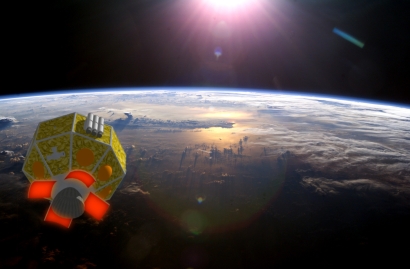
A possible near-future space fighter radiating excess heat between battles
I think that extrapolating or projecting space battle technologies forward in time is a difficult thing to do, even for the cleverest science fiction geeks. I say this for two reasons: first, aside from some general trends, it’s hard to predict exactly where technology will go in the next ten or twenty or fifty years; second, nobody gets to play this game against a live opponent – and that’s really how combat tactics and technology develop. Still, given the trends, it’s fun to speculate! Physics won’t change radically for quite some time, so we have some direction in which to proceed.
I’m going to proceed from the assumption that “spacecraft” are different from launch and reentry vehicles. Let’s take some possible combat spacecraft systems, think about the related problems that spacecraft engineers try to solve, and see what might (!) happen if the aliens wait till we have some operational space colonies before they invade…
Normally, I have great respect for Jon Stewart as an interviewer. On The Daily Show, he knows when to be serious and let his guests say their piece, but he’s also primarily a comedian rather than a journalist and so he has the freedom to call them like he sees them when he feels like it. For a great example of one of his better interviews, I like this wonderful mid-Obama-Administration talk with David Axelrod: 1, 2, and 3. However, Thursday I was rather stymied by his interview with Marilynne Robinson, about her new book on religion vs. science.
First, let me say that I thought Robinson did a terrible job making her thesis clear. It sounded to me like she was trying to say, basically, that Big Science and Big Religion are at each others’ throats when they don’t have to be. (This is, aside from the implied existence of Big Science and Big Religion, a fine idea – though not a very new one.) However, she would say things like,
people on one side of the argument have claimed the authority of science, but they have not construed an argument that satisfies the standards of science.
As soon as I heard her say that, I thought her statement begged the question: What’s “the argument?” Who, representing capital-S Science, had made an Argument to or about capital-R Religion? So far as I know, the scientific method and body of scientific knowledge is not diametrically opposed in any way to religious belief. Certainly, a scientific theory could contradict a religious tenet, but “science” and “religion” themselves are not the mutually exclusive poles of any spectrum I can think of. Nor can I think of any “argument” that the entire scientific community or body of knowledge have with the very idea of religion. I waited with bated breath to hear Stewart immediately voice my thoughts (“And what argument would that be?”), but sat in frustration as he nodded along with her, letting her define this imagined Science vs Religion debate on her own terms.
Ten years ago, a seventh-grade class did an intriguing project. The students drew pictures and wrote descriptions of what they thought scientists were like. Then the entire class visited Fermilab, a US accelerator physics lab. After the visit, the students created a new set of drawings and descriptions of scientists.
Almost all of the “before” pictures drawn by these students show a man in a white lab coat holding a test tube. Many of the scientists depicted are balding, wearing glasses, and have a shirt pocket stuffed full of pens. The accompanying written descriptions talk about people who are “kind of crazy, talking always quickly,” “a very simple person . . . simple clothes, simple house, simple personality;” someone who “never got into sports as a child; he was always trying to get his straight A grades even higher,” is “brainy and very weird,” and “has pockets full of pens and pencils.” The descriptions from female students are particularly fixated on the stereotyped image of a geeky guy in a lab coat. Many of the students described someone who does try to do good things, who tries to make the world a better place, but they are still a person who is ultra-smart in some obscure way that does not relate to the students.
The “after” drawings and descriptions were quite different. Gone were the lab coats, test tubes, and glasses. Some of the background items like desks or computers remained, but the students drew men in jeans and tee shirts and women in ordinary blouses. Suddenly, “scientists” are people who “are interested in dancing, pottery, jogging and even racquetball” and “are just like a normal person who has kids and life.” The scientist “doesn’t wear a lab coat” and “got normal grades in school.” Scientists “come in all shapes and forms,” “aren’t very different from everyone else,” “played sports, still play some sports or still watch and go to games,” “are really nice and funny people.” One of these seventh graders “even saw a person with a Bulls shirt on.”
In the new descriptions, I saw that many of the students realized that scientists were not driven to science by their intelligence, by social rejection, or by an innate need to best everyone around them in intellectual gamesmanship; but by a passion to discover, to create, to invent, to explain, and to improve our everyday lives. Scientists chose their careers because they love science and are dedicated to answering the questions they pose. And that love remains with them. They are pursuing a dream, doing what they want to do and have wanted to do for much of their lives. In the words of one student, “if you want to be a scientist, be like these wonderful people and live up to your dreams.”
Many of these students also came away with a new sense that with this passion and dedication, they could be scientists, too. While few of them put the idea in those words, a number of descriptions echoed the phrase “they are just like you and me.” Some thought that “a scientist’s job looks like a lot of fun” because “they can do whatever they want and they still get paid for it.” One girl in the class even went so far as to say “Who knows? Maybe I can be a scientist!” I was particularly glad to see the work of the girls like Amy, who started with a fairly stereotyped image of the balding, nearsighted man in a white coat, but ended up with a woman in ordinary street clothes who has a full set of hobbies along with her love of science. Even if Amy didn’t write “I could be a scientist, too,” her after-visit picture probably looks a lot more like she thought of herself in seventh grade.
The “Who’s a Scientist?” page was last updated in May 2000. Now that those students are old enough to have graduated from college, I’d love to see someone get back in touch with them to see how many pursued science in college and how many of them have gone on to advanced studies or to scientific careers!
I love the idea of this project, and I wish more schools in this country would do similar things. It would be incredibly valuable for our students to see that it’s not just brains that make a scientist, and the required brains don’t crowd out all the other qualities that make people interesting or friendly or outdoorsy or social or anything else these students might want to be. We physicists and chemists and astronomers and biologists and geologists are not merely adult versions of the stereotypical middle-school nerds!
I spent last weekend in Williamstown, MA, with my family for my sister’s Williams Dance Company performance and the super-swanky Mother’s Day brunch at the Williams Inn. (I’m allergic to chicken and turkey, so I passed over the roast duck; but I made sure to grab some brunch swordfish!)
We also went to the Sol LeWitt retrospective exhibition at Mass MoCA. LeWitt is really interesting; first, because he drew his artwork directly on gallery walls, and second, because the artwork consists mainly of a detailed set of instructions describing how to create the drawing. If one museum sells a Sol LeWitt wall drawing to another museum, then they erase the wall, give the new museum the instructions, and that museum carefully follows the plan to reconstruct the wall drawing in a new space. I found this whole process to be quite interesting. (All the images here are from the Mass MoCA web site; click to see them on the original pages.)
Wall Drawing 289, Fourth wall: twenty-four lines from the center, twelve lines from the midpoint of each of the sides, twelve lines from each corner. (Mass MoCA)
The precision and care that went into each wall drawing (some on walls that were, maybe, thirty feet wide by eight feet tall) are amazing. Each drawing is the product of work by a number of drafters, some of whom are interns and some of whom are dedicated to Sol LeWitt wall drawing. They develop methods for interpreting LeWitt’s instructions. Some of those instructions even leave parts of the implementation wholly up to the drafters.
Detail from Wall Drawing 305, the location of one hundred random specific points (Mass MoCA)
LeWitt’s method seems to revolve around abstraction – taking something observable and representing it in a symbolic way. The descriptions at Mass MoCA describe how LeWitt was interested in removing the artist from the artwork. This concept resonates for me: here I am, trained as a physicist and engineer, with my livelihood based on constructing, manipulating, and extracting results from mathematical models. Those models are based on the theories that govern physical phenomena; but they never are a full, complete description. Still, we use them to great effect in making predictions or developing new theories. The philosophy of science question here is, are the models conceptually different from the theories they describe? Or are they just a different representation of the same thing? In the same vein, is Sol LeWitt’s art the wall drawing, or the instructions? His opinion seemed to be the latter.
The other thing I ended up thinking about while strolling through the wall drawings was how the implementation of the drawings corresponded to realizations of models in the science and engineering world. We can come up with incredibly complex models for how the universe works, but when constructing a simulation or making a prediction, we often choose to use only a small part of the model. For instance, Einstein’s theory of General Relativity describes how objects move under the influence of gravity (or, equivalently, how they move through curved spacetime). But for a great many applications, Newton’s single equation for gravitational attraction between two bodies is enough: The force is attractive, proportional to the product of the masses of the bodies, and inversely proportional to the square of their separation. Then for yet another large subset of applications, the simple high-school physics expression F = -mg is quite sufficient. In a sense, both of these simplifications are realizations of General Relativity, in the presence of certain simplifications that let us “zoom in” on part of the model. When the drafters have a LeWitt wall drawing instruction sheet, they must match the instructions up to the wall space they have to work with. The instructions seems to be written in reference to relative measurements on the wall (the midpoint of the left side, the corner, the center of the wall, etc), which means that the same instructions – the same idea, the same “theory” can produce very different realizations on different walls. (And, speaking of relativity, I wonder if LeWitt ever took a look at the math behind Einstein’s theories. It would have been neat to see something like this wall drawing as viewed by an observer traveling at 0.5c!)
Not only do the spaces shape the wall drawings, but the drafters themselves may be left with choices in how to interpret and then implement LeWitt’s instructions. Take this wall drawing:
Wall Drawing 386, stars with three, four, five, six, seven, eight, and nine points, drawn with a light tone India ink wash inside, an India ink wash outside, separated by a 6-inch (15 cm) white band. (Mass MoCA)
I spent a little while thinking about that three-pointed star. Without that, it’s obvious how the progression works: the nth star is centered in the middle of each square, its points are evenly spaced about a circle, they all extend to the same radius, and the border of the star comes in between each point so that the shape is concave. But that three-pointed star breaks all those rules! It need not have – it could have been just like the four-pointed star, only with three points. Instead, it is a triangle with one concave side. Here, I do not know: was this in LeWitt’s instructions, or did a drafter determine how to construct this three-pointed star?
Some of the wall drawings definitely did have ambiguity built in. My favorite of MoCA’s drawings was 146A:
Wall Drawing 146A, all two-part combinations of arcs from corners and sides, and straight, not straight, and broken lines within a 36-inch (90 cm) grid. (Mass MoCA)
The instructions for this drawing specify that the drafters make “not straight” lines. Okay…so we define the line by what it isn’t, and leave a still-infinite space of possible lines that meet this description. The drafter can make “not straight” lines as un-straight as they like. They can make lines that wander as much as they want. They can choose to tie their “not straight” lines in to the “not straight” lines in the rest of the drawing or not. If you take a look at the timelapse video of this wall drawing being drafted, you can see how each drafter does each “not straight” line differently.
Were I Sol LeWitt, I think it would have been interesting to create a set of wall drawing instructions that contained intentional contradictions. Some drawings might have tiny contradictions, some might seem like egregious errors. What would the drafters do? Would they prioritize the instructions, and satisfy the most important ones first? Would they try to satisfy both constraints equally? Would they push back at all the instructions for the wall drawing, going for the most “average” level of meeting the instructions? That would sure be an interesting way to comment on our artistic, geometric, scientific, or philosophical methodologies. In an exhibition with many drafters and many walls, giving them all the same set of contradictory instructions would likely turn up some very interesting results!
Wall Drawing 692, continuous forms with color ink washes superimposed. (Mass MoCA)
Some of LeWitt’s later wall drawings were just plain fun. Drawing 692, above, was also one of my favorites – I liked how it gave the impression of different planes, and how the vibrant colors made the painting stand out as if with its own light. It was like looking through a windowpane onto another stained-glass window. Remember – this image doesn’t convey it, but I stood only a little taller than the second black line from the floor!
Then, of course, there were wall drawings like Splat, the intentionally impossible-to-look-at Loopy Doopy, Whirls and Twirls, and some cool experimentation with glossy and matte paints.
Wall Drawing 824, a black square divided in two parts by a wavy line. One part flat; one glossy. (Mass MoCA)
But of course, being a Williams guy, I had to like Wall Drawing 852 best of all.
Wall Drawing 852, a wall divided from the upper left to the lower right by a curvy line; left: glossy yellow; right: glossy purple. (Mass MoCA)
The Sol LeWitt Retrospective is a very cool exhibit. I didn’t always like the art at Mass MoCA, but I’ll happily recommend a trip to see this!
We’ve discussed President Obama’s plans for NASA in my research group. Things look good for us: as a team working on spacecraft technology research, looking for things that will make construction, maneuvering, and other activities in space easier, cheaper, and better, we are very happy to see the technology research arm of NASA finally getting the funding it deserves. (It’s amazingly ironic that “space age” technology means thirty-year-old tech.) However, one grad student in my group questioned the value of targeting asteroids, specifically, for exploration. Is it worth it to send people to asteroids? Do we gain anything by doing so?
I think we do, and I’m going to explain why here. But first, I want to make clear two things I am not going to do. I am not going to make a scientific case for going to asteroids. The reason why I’m not going to use science to justify asteroid missions is that we can gain scientific knowledge wherever we go. We can learn new things anywhere. I’m not going to try to prioritize that knowledge, because in the end, it’s all valuable and it’s likely that there will be breakthrough theories germinated from any field of endeavor. In addition, I am not going to make a case against returning to the Moon or going directly to the Martian surface. I am not going to list reasons opposing either of those destinations simply because I don’t think there are any. Rather, I am going to focus on the reasons why I think asteroids are exciting destinations.
Reason one: Operations on and around asteroids are extremely challenging.
On the one hand, anything in space is challenging. But asteroids may be especially tricky, mostly because we don’t yet understand what being around an asteroid would be like. We have only a few close-up pictures of asteroid surfaces, and have only touched the surface of asteroids with two robot spacecraft that I can think of. As far as we can tell, their surfaces are covered with fine regolith, perhaps like the Moon, but their odd shapes give them very strange (micro)gravity fields. Imagine you’re standing on the “side” of a tiny, potato-shaped world like Ida. Which way is down? Harder question than you might think!
243 Ida and Dactyl
NASA can simulate operations on planets and moons by visiting “analog” sites on Earth, trying out procedures in mock space suits and pretend capsules. NASA also has a wealth of free-fall experience from its operations in low Earth orbit with the Space Shuttle and Space Station. But no space agency has any experience with or ways to simulate environments like asteroids. So, not only are asteroids tricky places to be, but the only way to learn about being around asteroids is to go to an asteroid. We’ve never done or thought about this stuff before, at least not in detail. I think that’s exciting!
In particular, I think the challenge of operations around asteroids demands that we send people there. There has been a lot of talk about how the new NASA plans will leave our astronauts without jobs and focus entirely on robotic missions. Whether you think that is a good thing or not, I think it is untrue. While robotic precursor explorers will give us some inkling about what to expect, figuring out how to actually do things on asteroids (science, construction, etc) may be better achieved through an in-situ human learning process. The closest analog we have to asteroid operations is work around the outside of ISS, which we do not yet trust to robots and have tremendous experience with. Astronauts around asteroids could rapidly tell NASA Mission Operations analysts what the major differences are between an ISS spacewalk and asteroid spacewalk. At the same time, a human’s ability to learn on-site, manipulate four limbs in a coordinated manner, and perceive situations clearly and directly would be desirable qualities.
Why do we care about learning how to operate crewed missions around asteroids? Well, Reason Two is that these asteroid operations skills are transferable.
Buzz Aldrin likes to talk about Phobos. Well, if we want to go to Mars, then the first question we must answer is exactly what sort of mission profile we want to use. Options include a Moon-landing-like sortie mission, in which we put boots on the planet, bounce around picking up rocks for a couple weeks, plant a flag, and then take off for home. We could also send a mission that lasts a year or two and involves building a temporary (or permanent) base, establishing laboratories, and zipping around in rovers; this probably involves multiple launches to and from the Red Planet. Or we could go for the interesting option of picking 50 or so people and sending them to Mars, in one launch, with everything they need to be self-sufficient. The point of all this is that, depending on the mission, it might be valuable to use Phobos as a way station. And if we want to be around Phobos, we have to learn how to be around Phobos. More than that, we have to learn how to be around Phobos and be very, very far from and out of reach from Earth.
Moreover, microgravity operations around small bodies are exactly the kinds of operations that would be relevant in the asteroid belt. Or around the Jupiter Trojans. Or in Jupiter’s moon system. Or Saturn’s moon system. Or near comets. Or by near-Earth asteroids. You get the picture: small-body operations will be important for the manned exploration of the Solar System beyond the Moon and Mars, and the more capabilities we develop, the easier it will be to get to and function in exotic places.
Next, reason three: not only is there science to be done, but around asteroids, we could learn techniques that may be necessary for Earth defense.
Yeah, I’m talking about defending the planet from rogue asteroids. We certainly won’t be doing this by launching a team of misfit miners and Bruce Willis. Now, the asteroid deflection techniques we develop may or may not involve manned missions, but when we’re talking about the survival of a city – or the entire human race as we know it – why remove any tool from our kit?
The fourth reason is one that ought to appeal to space technologists out there: asteroids could provide resources for construction which are much easier to get into orbit than the resources on Earth.
Asteroids are made of useful things. Nickel-iron asteroids are composed of metals, both common and rare. Carbonaceous asteroids contain other materials. Some even have organic compounds. There is even recent evidence that many asteroids have water! These potential resources may be easy to get to, if the asteroids are rubble-piles, or the useful materials are in the asteroid regolith, or if the asteroid is entirely made of metals that can be melted or dissolved for processing.
Budding space industrialists may be disappointed, but mining asteroids for rare metals to sell on Earth isn’t likely to be economically viable. (It’s too hard to safely get those metals from the asteroids down to Earth’s surface – for instance, we would have to spend more money to launch a Space Shuttle than we would get for the mass of materials that Shuttle could bring down from orbit – a launch costs roughly $450 million, and at current prices, the Shuttle could bring down $15 million in pure silver if filled to the brim. We’d have to find asteroids made of pure gold and platinum and cram the Shuttle to make that come out positive.) However, what could be viable is mining and processing the resources on asteroids into spacecraft bodies, components, consumables, and fuels, which could be jettisoned from their parent asteroids with very little effort. This is simply because asteroids have very small escape velocities compared to planets and moons. If we could get ISRU going, it could be the great moneysaver of the space industry!
ISRU, or in-situ resource utilization, is already a hot topic of research; applications include processing lunar regolith into bricks or reacting chemicals with Martian soil to produce rocket fuels. This would be the next level of complexity: imagine landing a facility on an asteroid that grapples to the rock, bores its way down, processes the metals in the asteroid, and extrudes spacecraft pieces that are ready to assemble. Or perhaps a spacecraft that can land on an asteroid and scoop up material to refill its fuel and consumables. These abilities would let humans build whole new classes of spacecraft, capable of going further than any before. And, given the complexity of building the International Space Station, many of these activities will probably require the involvement of astronauts.
The last reason I can think of – at least, right now – why asteroids make very cool targets is that the asteroids themselves could be used as spacecraft.
The science-fiction way to do this is to find an asteroid and hollow it out with tunnels, crew compartments, fuel tanks, or big, cylindrical chambers. The excess rock and metal from the digging can be fed to mass drivers (or combined with antimatter) to propel the asteroid.
As big a fan as I would be of asteroid colonies or arkships to the outer Solar System and beyond, that’s a pretty farfetched idea at this point. However, an interesting possibility if we want to get to far-flung destinations is to locate an asteroid in an orbit that starts somewhere easy to get to and goes somewhere we want to go, and then hitch a ride. There’s an interesting class of resonant orbits called “cyclers,” which have the property that they rendezvous with two bodies of interest at least once per synodic period. For example, the so-called Aldrin cycler is an orbit trajectory that matches up with the Earth and Mars, with a travel time of 146 days between planets. All we’d have to do is get there and grab on!
We’re not likely to find an asteroid that is naturally on such an orbit, but we may locate asteroids that are on other potentially useful orbits. If we learn enough about asteroid deflection from our planetary defense studies, we might even be able to nudge asteroids onto such orbits, on purpose!
The Moon is a cool place to go. Mars is a cool place to go. Jupiter is a cool place to go. But, you know what? Asteroids are cool places to go, too. We will learn and benefit from any exploration destination. Small bodies, which come in all sorts of shapes, sizes, and compositions, may be very, very different from planets and moons. If we can learn how to use them as platforms for exploration, then perhaps we can jump off them to explore all the far reaches of the Solar System.
Stephen Hawking has been in the news recently for saying that aliens will likely be hostile to us poor Earthlings.
In a series for the Discovery Channel the renowned astrophysicist said it was “perfectly rational” to assume intelligent life exists elsewhere.
But he warned that aliens might simply raid Earth for resources, then move on.
“If aliens visit us, the outcome would be much as when Columbus landed in America, which didn’t turn out well for the Native Americans,” he said.
Prof Hawking thinks that, rather than actively trying to communicate with extra-terrestrials, humans should do everything possible to avoid contact.
He explained: “We only have to look at ourselves to see how intelligent life might develop into something we wouldn’t want to meet.”
That last statement is the source of my disagreement with him. Aliens are going to be, well, alien compared to us. They will have completely different evolutionary and cultural histories from us. They probably care about entirely different things than we do. Just about the only thing we are likely to share with aliens would be the assortments of atoms that make us up (and maybe not even that). Hawking’s last statement pertains more to the possible human reactions to finding alien species. As I said to my roommate, I can only speak for humans. In fact, I can really only speak for one human.
This is especially important because human history is littered with examples of different cultures having radically different beliefs, holding different things to be important. For example, looks at the Native Americans and their interactions with colonial Europeans. The issue wasn’t really that the colonists were more technologically advanced – in many ways, the Native cultures had superior technologies for their environment. But they had entirely different cultural values, and disease decimated the natives early on in the interaction. With aliens, we won’t even have the disease element.
So, I’m not comfortable making any statements about how aliens are likely to behave – even given human history as an example. And if the aliens do want to just pillage our Solar System for resources, they could scour 99% of them on planets other than this rock filled with spunky creatures who would be hell-bent on making life difficult for them.
The Space Shuttle mission which just undocked from the International Space Station, STS-131, has beamed down from orbit some great photos of astronauts in space. This is a wonderful chance for us stuck planetside to remind ourselves that we have people living and working in spaceships!
The Discovery crew in the Cupola
And, of course, this mission is historic for having the largest number of women simultaneously in space – four out of the thirteen total crew. Considering small-number statistics, that is pretty close to a fifty-fifty split! Here is the orbiting Bay Stater, Stephanie Wilson:
MS Wilson in the Kibo laboratory
And here’s JAXA’s Naoko Yamazaki in the Destiny laboratory at a robotics console made of lots of ThinkPads taped to the ISS wall,
MS Yamazaki in Destiny
although I think this is my favorite picture of Yamazaki!