Don’t watch the first or last seasons. Also don’t watch the season 4 finale.
Battlestar Galactica
When they escape from the planet at the beginning of the third season, HUMANS WIN. End of show.
Doctor Who
It’s supposed to be cheesy, but whenever you see something so stupidly cheesy that it totally rips apart suspension of disbelief (e.g. main characters getting abducted onto 2000s reality TV shows, ’60s robots chanting “DELETE DELETE DELETE,” etc), hold “fast forward” until it looks like something serious is happening.
Farscape
Put up with the first season until it gets under your skin. John Crichton is just as confused as you are. 4th season is optional.
Firefly
Fortunately, it got cancelled before it had a chance to go bad! Movie very optional.
Futurama
Watch it all a zillion times.
Star Trek: The Next Generation
Pay attention after Riker grows a beard. (This is a well-known effect.)
As told by Posaredes the Storyteller, this account was discovered by the great archaeological expedition of 1217, among other famously well-preserved artifacts on display in the National Museum of Geshan. Continue reading Fiction: Tareidos Beyond the Edge of the World-Ice→
(Pardon me for the hiatus. Had to fly to Houston to do some flight testing at NASA.)
I spent a pretty good weekend doing some world-building. Since discovering the maps in the first pages of The Lord of the Rings, Redwall, and the like, I have really enjoyed sketching out maps of imaginary worlds and outlining details of the cultures and histories that play out over those maps. My maps started as knockoffs of Tolkien’s (with the bad guys sequestered in a nice, rectangular wall of mountains around some barren lands) or parallel-universe versions of the terrain around my house. Since then, though, I’ve started to inject a lot more realism into the worlds I create. Want to know where the tectonic plates and prevailing winds are on my map of Oghura? I could show you!
Map of Oghura
Beyond the maps, some of my imagined cultures have fully fleshed-out languages, religions, and customs. Slowly, slowly, I’ve been compiling reference documentation on the Oghuran desert and people, the fantastical Cathedral Galaxy, and the future-universe of the Four Colonies. This weekend I was spending my time in the Cathedral Galaxy, putting together a master list of the major galactic regions and polities, along with distinguishing characteristics. Now I know a bit more about why the Imperium of the Triumvirate is split in three, how the far-from-galactic-center Traders’ Rim came to be populated by merchants and entrepreneurs, and the tumultuous history of conflict between Amseile and Shobah. I’ve also got the beginning of a couple more stories – one concerning an Imperium gladiator’s bid for freedom and another describing the Waygehn people, who evolved to sentience near the death of their star and outlived the event, leaving them homeless in the galaxy. That’s one of the most fun things about deciding to build a universe purely for short stories: I get to invent worlds, and then immediately show them off with snippets of detail!
Though the Cathedral Galaxy has some distinctly space-fantasy elements, I decided early on that it would be a universe based on hard science – though not necessarily our hard science. My short story “Conference” illustrates the point, as it shows that there are technical concepts built upon technical concepts – but at the level that Arthur C. Clarke would have described as “indistinguishable from magic.” I have no idea how the Channel Network could be set up, and building planet-size structures is clearly fantastical. (And none of you know yet what’s in The Cathedral!) But I made sure that the story was relevant to us Earthdwellers, and I lean strongly on plausible concepts to describe things like astronomical bodies or planetary orbits.
Great Galactic Map, showing major markers and the Channel Network
For example, take Heliast, the resort world on which much of “Conference” takes place. Here’s the description that conference-goers got of the world:
The tour guide explains how Heliast is an ancient world with a single moon nearly half its own size, and how that has dominated the history of the planet and made it ideal for resort paradises. A billion or so years ago, the planet spun many times under one orbit of the moon, and the energy input of ocean tides among all the planet’s archipelagoes – Heliast is over eighty percent water – gave rise to life. But nowadays, the moon orbits in tidal lockstep with one Heliast day, the prime factor contributing to the perpetual calm of its seas. The small radius of Heliast’s solar orbit leaves the planet with a reasonable day length, while the dimness of its sun places it in the liquid-water zone. Without tides, with a massive moon helping to protect the planet from asteroid impacts, and with barely any eccentricity in its orbit to create seasons, there have been few selective pressures on Heliast’s life forms. Life on the planet thus failed to diversify much, and after millions of years of evolution with few external stressors, there are now only a few ecological niches on the world. Three or four avian species, eight or ten surface-level swimmers, two or three land animals, and about six land plants are all most tourists have the chance to interact with. The rest of the planet is geological beauty for visitors to enjoy.
So, the planet’s “month” equals its “day,” but there are still many days per year and there is much liquid water on the surface. The dynamics shaped the world’s evolution. That was fun to think of! But, more and more, I am completely amazed by the strange worlds that actually exist in our own universe. Many Earth- and space-based observatories keep returning data on new exoplanet candidates, and in the last few years, the galaxy seems a lot more planet-populous than it has in the past.
This past Monday, I went to a fascinating astronomy seminar on the potential climates of Gliese 581g given by Dr. Raymond Pierrehumbert from the University of Chicago. (He’s preparing these climate models for an arXiv preprint.) Besides tying the Gleise 581 system with 55 Cancri for most number of known exoplanets around the same star (5), this planet is interesting because it falls right smack in the middle of the traditional “habitable zone,” the range of orbital radii necessary for planet surface temperatures that could support liquid surface water. Now, of course, the discovery of Gliese 581g has to be confirmed to become official – and there’s some doubt about that! – but it’s at least got scientists thinking about these dwarf-star systems in interesting ways. Continue reading World-Building and the Real Universe→
Since last February, I have been trying to get my sci-fi short story, “Conference,” published. So far, the score is 0 for 4.
Asimov’s Science Fiction sent me a form-letter rejection.
The Magazine of Fantasy and Science Fiction sent me a personalized letter. The editor wrote that “this tale didn’t quite work for me, I’m afraid,” and thanked me for sending it along. I appreciated the thought, at least.
Analog Science Fiction and Fact sent me a two-page form letter containing, basically, their submission guidelines. The editor scrawled a note at the bottom in blue pen, though: “PS: Present-tense narration tends to call excessive attention to itself and is generally best avoided unless a particular story requires it.”
I just heard back from Strange Horizons. They sent a short note that said thanks, but they decided not to publish the story.
I happen to really like this story, and I’d love to see it published. It takes place in the Cathedral Galaxy, a universe I hope to expand with many more stories, but it grew out of my experiences as a grad student. The mundane bits of researcher life. Giving a presentation to a research community. Camaraderie among grad students. Taking advantage of conferences to go sightseeing – and grinning at the crowds of other scientists doing the same. Research advisors, good and bad; on-the-ball and absent-minded. Having different impressions of a scientist from reading their papers and from actually meeting them. Reacting to the presence of the “big names” in a particular field. Even finding love within a technical community – though it certainly didn’t happen to me the way it happened to Ceren Aydomi.
So, readers, since I like this story so much, I’d like to workshop it a little. If you can, take a look. Is it too long? (It’s almost 10,000 words, which is on the big side for a short, but when I read it, it doesn’t feel too bad to me.) Does the present-tense narration bother you? Is the action too slow or too fast in places? Are the characters strong enough, and do they interact naturally enough? If you’ve been to a research conference before, how does this feel as a depiction?
Europa, the second Galilean moon of Jupiter, has been my favorite planetary body for a long time. The reason I like Europa so much is that it’s a world whose orbital dynamics with Jupiter, its orbital resonances with the other Galilean moons, and its own rigid-body dynamics have a strong hand in creating its surface features – and giving it the potential to harbor life. It’s one of perhaps two or three extraterrestrial places in the Solar System where we might hope to find life. Europa is also easier to get to than Enceladus or Titan. As such, I think it ought to be one of the highest-priority exploration targets for robotic space probes. (Human exploration would be nice, too, but if you think radiation exposure on the way to Mars is hard, you don’t even want to consider putting people in the Jovian system!)
Thanks to magnetometer measurements and images from the Galileo mission, it’s pretty much established at this point that Europa has an icy outer shell over a global liquid ocean, with a rocky core on the inside.* The only question is how thick that ice shell is – I’ve read estimates ranging from 10 meters to 100 kilometers, with a pretty high confidence of ones to tens of kilometers. The ice shell gives rise to a number of interesting surface features. A particularly cool sort of feature, found with global extent across Europa, is the double ridge.
A prominent double-ridge feature on Europa, most likely a crack in the icy shell
Planetary scientists have a number of models for how these double ridges form, and they generally seem to agree that the ridges mark the locations of cracks in the ice crust. One especially well-established model suggests that these cracks occur when Jupiter raises tides in Europa’s ocean – just like how the Moon raises tides in terrestrial oceans, but much stronger, because Jupiter is frakking huge compared to Earth’s moon. Europa’s ice crust bulges out over the ocean’s tidal swell and then cracks under the incredible stress. (I like to take a moment to think about the mindbogglingness of that statement: the whole moon’s surface cracks. I’ve stood on a frozen pond when a crack pings through the foot or so of ice on top of the water – Just imagine standing on Europa when this happens!) Once a crack forms, the tides don’t go away. As Europa rotates, about once every three and a half Earth days, the tides periodically lever these cracks apart and squeeze them back together again. In this model, every time the cracks gape open the subsurface ocean gets exposed to space. The surface water boils and rapidly crusts over with ice, and when the cracks get smushed closed, all this ice gets crushed up and forced to the top and bottom of the crack, forming the ridges. The ridges appear in pairs because the crack opens up again after that. These double-ridge features are mounds of crushed ice flanking passages into Europa’s ocean!†
Dr. Richard Greenberg is a planetary scientist who thinks that these cracks in the ice shell might be potential sites for life to take hold. Unlike the rest of the subsurface ocean, they get exposed to sunlight, which means that photosynthesis could take place. The periodic in-and-out forcing of the crack would also drive strong currents, which is another energy source Europan life could use. (Those aren’t the only energy sources: other possibilities include thermal gradients in the water, volcanic vents on the ocean floor, or even induction as Europa travels through the Jovian magnetic field.) Of course, that life would also have to adapt to the crack opening and closing once every 3 1/2 Earth days!‡
Europa's possible ice-fissure biosphere (from New Scientist; click for full article)
We do at least know, from the Galileo mission, that these cracks often have accompanying veneers of organic (e.g. carbon-based) molecules and salts splashed onto the ice surface. This is why the cracks appear as brown stripes in large-scale context images. The crack/veneer combination suggests that there are organic molecules and salts in the Europan ocean, and that those compounds get pumped to the surface through these cracks.
So, let’s take stock: Europa is the only extraterrestrial world with a global liquid water ocean, there is a definite possibility for life in that ocean, and these double-ridged cracks are a possible gateway into the alien biosphere.
Well, then, let’s go diving! Read on for my concept system architecture for an ambitious Europan ocean-exploring mission, which I call the Ice Fracture Explorer.
When I wrote my original article on the physics of space battles, and the accompanying short story, I made the creative decision to speculate on how space battle technologies and tactics would play out if we built from the present day – or, at least, the very near future. The obvious thing to look at next is what a more distant future might hold – so, I’ll embrace my status as That Space Battle Physics Guy!
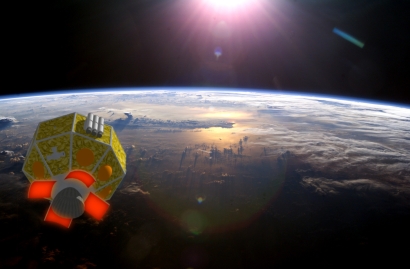
A possible near-future space fighter radiating excess heat between battles
I think that extrapolating or projecting space battle technologies forward in time is a difficult thing to do, even for the cleverest science fiction geeks. I say this for two reasons: first, aside from some general trends, it’s hard to predict exactly where technology will go in the next ten or twenty or fifty years; second, nobody gets to play this game against a live opponent – and that’s really how combat tactics and technology develop. Still, given the trends, it’s fun to speculate! Physics won’t change radically for quite some time, so we have some direction in which to proceed.
I’m going to proceed from the assumption that “spacecraft” are different from launch and reentry vehicles. Let’s take some possible combat spacecraft systems, think about the related problems that spacecraft engineers try to solve, and see what might (!) happen if the aliens wait till we have some operational space colonies before they invade…
One of my friends recently dumped his collection of “Farscape” on me, and I just finished up with the finale miniseries yesterday.
Farscape splash
I think the show got off to a slow start. It took me a good number of episodes to really get into it – (was Crichton’s big scientific theory that catapulted him across the universe really the gravity assist plus atmospheric drag?!) – but, I have to hand it to the writers and actors of this show. They hooked me. This show worked really well for me in a lot of ways that many other recent sci-fi shows didn’t. I’d rank this one over Firefly. (It still doesn’t beat Galactica – maybe it was better than seasons 3.5-4.0, though.) At its heart, Farscape falls into the “Star Trek”-style journey-through-strange-worlds genre, but with a liberal chunk of the lost-in-space, half-a-dozen-of-us-cooped-up-in-a-boat, and epic-plot-arc stuff thrown in there. But it’s got a very different take. It’s kind of the anti-“Voyager.”
The thing I really love most about this show has to be John Crichton. I don’t think I have ever met a character who felt this much like a real live human being ripped out of contemporary society and into strange situations. It’s not just that he’s always trying to rationalize things into a perspective that he (and we) will be comfortable with. Sometimes John meets situations that he’s not comfortable with, even after re-expressing them in American slang, and sometimes he just has to throw his hands up and scream at the universe. He is always amazed to discover that his alien friends and their ship Moya have previously unknown capabilities, and sometimes he gets frustrated when they can’t magically pull themselves out of any situation. His constant stream of pop culture references really added something to the whole effect (he nicknames a bunch of aliens Skeksis in one episode, calls an alien planet Dagobah, and goes into one scene of the miniseries finale with a reference to “Butch Cassidy and the Sundance Kid”). Sometimes it seems like a parody of contemporary sci-fi, though whenever I think back on that, I have a pretty hard time coming up with how I might react in those situations, and Crichton seems much more understandable! It was also a good way of getting out of the “Didn’t you guys ever watch the show?!” problem highlighted in “Galaxy Quest.”
As the protagonist of the show, the writers did a great job with Crichton, but the rest of the rotating cast of characters also stood out in my mind. While one core group stays with the show from beginning to end, there are at least eight characters I can name offhand who get picked up partway or dropped off at some point. Sometimes Moya picks someone up for just a few episodes before dropping them at the nearest planet, sometimes they show up again later, sometimes they join the crew, sometimes they convince a member of the crew to leave. The same is true of the antagonists of the show – meaning that sometimes one character would be an adversary, and sometimes an ally, depending on the situation at hand. Even the crew of Moya, thrown together by accident, isn’t always working towards the same goal. One episode that stands out in my mind as really showing off the ensemble cast – and the actors – was “Out of Their Minds,” in which the crew gets repeatedly zapped between each others’ bodies. That may sound hackneyed (how many times has Star Trek used that mechanic?) but the actors did a phenomenal job of playing each others’ characters in a way that was instantly recognizable. And, going back to my comments on Crichton, he had some of the typical reactions one might expect of a contemporary guy in that situation….
The alien races on the show were pretty wonderful, too. For starters, “Farscape” goes way beyond the funny-forehead phenomenon (though that does happen from time to time – for budgetary reasons, I forgive them). We see a lot of complicated prosthetics and animatronics, many of which look surprisingly lifelike; and, of course, this is so because all the aliens came out of the amazing Jim Henson Creature Shop! But there was more than the quality of the alien puppets and “Fifth Element”-esque costumes. Most of the time, when we met an alien species, we met individuals of that species with several different points of view, political opinions, or faction memberships. This show definitely didn’t follow the Star Trek trope of homogenized alien species that all share the same trait. No, the Farscape universe is populated with neither absolute good nor absolute evil, but instead with…people.
I really enjoyed the way the show handles the Crichton/Aeryn relationship. If you haven’t seen the show, I’m really not spoiling anything if I tell you that the romantic tension between these two characters is a major plot mover. That’s obvious from the moment Aeryn appears. And, of course, for this to be an episode TV show, they need to have a very difficult, tumultuous relationship that doesn’t quite reach closure until the series ends. But these two have a difficult relationship for what seem like very good reasons, and Farscape played with some really interesting ways to get the two of them together and apart again. And more than that, the characters actually get frustrated by this dynamic, too! Like when Crichton and Aeryn seemed to be going somewhere at the end of one episode, and the next one picked up with nothing happening – just after I started to wonder as an audience member, “hey, what’s going on between them?” Crichton actually went up to Aeryn to askher that very question. It’s like this show was actually playing with reality, by turning a lens on the typical television plot devices.
Finally, several of the episodes were memorable for their cinematography. I haven’t seen other sci-fi shows really play with the way they’re being shot to try and tie things together – the SF Farscape seems to have the most in common with in this regard is “The Fifth Element.” Yeah, Battlestar went for a “documentary feel” and all that, but I’m not just talking about a style for the show as a whole. There are some great dream sequences and some episodes in which the point of view of the characters really comes out in their editing.
I’m feeling bittersweet about Farscape now. Bitter, because I missed it while it was on, I’ve blown through it all, and it’s not around any more. But sweet, because that was a pretty good evening diversion for a couple months, it was a great show, it handled itself well, and it ended in a satisfying way.
My blog had been trucking along with a reliable readership of perhaps a dozen people, when, suddenly, after a slightly stream-of-consciousness post about the physics of space combat, Gizmodo asked to reprint the material from my blog. It was never my intention to get so much attention – but apparently that article turned into the most-commented content on Gizmodo that week! I got lots of questions and comments and emails after that and noticed lots more pingbacks on my blog entries afterward.
I couldn’t help but think, “Wow, if only my research activities would generate this sort of interest! I’m trying to build tractor beams and wrote up my experiences from Vomit Comet flights. How is that not cool enough?!” At least I got to abuse my 15 seconds of Internet fame to plug NASA a bunch!
Well, just a couple weeks ago, Karl Haro von Mogel from the University of Wisconsin, Madison, contacted me to interview me for his radio show, “The Inoculated Mind,” which airs on the student radio station in Madison. This was my first on-air interview, and I had a lot of fun with Karl! You can listen to a podcast of the show on his web site. It sounds from the beginning of his show that Karl and I would get along nicely, and then a little before halfway through he plays the interview. If I sound excited, it’s for good reason!
Many thanks to Karl for having me on his show, and for chatting with me about my research as well as the sci-fi stuff! (Oh, what the heck, my research is practically about science fiction, too!) And great use of Battlestar Galactica music and lead-in with the science of Avatar’s unobtainium!
And, of course, a link to the short story Karl brought up: High Orbit. Enjoy!
Just as a freebie, after the jump I am going to list several common questions and comments I got after Gizmodo picked up my initial blog, and respond to them a little bit. I am falling for exactly the issue that Phil Plait identified in his comment on my post – this could go on ad infinitum! So I’m done with this post now, but if you want even more about space battle physics, click here: Continue reading revenge of space combat physics→
Phil Plait of Bad Astronomy posted a few days ago about caved-in lava tubes on the Moon. This isn’t really new news, but it’s still pretty darned cool news. He posted some images of the cave. However, I found a major, glaring error in the LROC image data.
I fixed it.
Lava cave - fixed!
Seriously, though…those sites are perfect premade Moon base locations. Imagine a team of astronauts putting an inflatable dome over the hole in the roof, belaying down there, putting inflatable endcaps a few tens of meters down the lava tube in each direction, spraying expandable foam sealant into all the crevasses, and using some ISRU atmosphere generators to pump the tube full of oxygen.