Category Archives: Original fiction

New Writing Project: Escape from Mars City

While I am querying agents for my first novel, I’ve started a new writing project. It will probably end up about novella length, though that is yet to solidify.

It’s common knowledge that certain tech moguls want to colonize the planet Mars. They have seemingly prioritized solving the problem of getting stuff to Mars over the problems of figuring out everything we’d need to know for humans to actually live there. They excuse this neglect with handwaving about how artificial intelligence — meaning, specifically, sophisticated chatbots — will solve all the other problems for us. Some of them are willing to consume anything and everything on Earth to make this vision happen.

This is the story of how their descendants escape.

Here is the first scene.


Yawning, Brad watched the cargo rocket ignite its landing engine with a crackling roar that penetrated even the thin Martian atmosphere and his surface suit. The tall cylinder plummeted down through its own exhaust, sooty combustion products depositing on the bottom of its gleaming silvery surface. It arrested its descent just above the landing pad. The towering vehicle tilted slightly, sliding sideways to center itself on the landing zone. Three landing legs popped out.

Brad squinted. He felt behind him for the lip of the hatch.

Beside him, Tyler shifted his weight. A sharp intake of breath registered through the helmet comms. Connor took a step backwards into the air lock.

The fourth leg extended.

The engine performed a brief set of small adjustments, and the rocket thumped down on the pad with a metallic ping. The flame went out. Brad watched its nose, high in the air, sway back and forth in the silence.

“So cool,” Connor said, moving out of Brad’s shadow.

“I guess,” replied Brad. His hand still gripped the edge of the air lock door to the ramp underground.

“Brad,” HARI’s pleasant, male voice crackled from the helmet speakers, “it is time to unload the cargo.”

“Yeah.” They walked out onto the packed-regolith causeway toward the mobile cargo lift that they’d take to unload the supply ship. This would be the fourth supply ship Brad had unloaded in the last couple weeks. About every two years—once a Mars year—a whole series of cargo rockets would land at Mars City and then depart again. Three of the empty ones still stood in the landing zone. Brad’s eyes slid over to the desert at the side of the landing pad, where the toppled wreckage of a few identical silvery cargo landers sprawled in irregular heaps of twisted metal. He slowed.

“Inattention is a risk to surface operations,” said HARI.

“Yeah, sorry.” Brad hastened to the cargo crawler and clambered up. The metal access stairs, once a safety-bright color, had been scoured down to a rough rusty orange. The controls at the top handled both the vehicle’s rover treads and the scissor lift that raised and lowered the flat cargo platform. Brad waited for Connor and Tyler to sit down on the deck. Besides the differently colored stripes on their suits, Brad could tell the men apart by Connor’s wirier build. Once they were situated, Brad drove the crawler to the landed rocket. The deck rolled and listed as the ungainly vehicle trundled over the compacted Martian dust.

Brad nudged the crawler lift up against the side of the latest rocket’s tall cylindrical tower. Once in position, he held his gloved hand on the button to elevate the platform. The mechanism whined. “Hey, HARI? How often do these rockets crash?”

“You’re asking about the design and safety record of the Kestrel Cargo Lander. The Kestrel is a game-changing technological system for delivering supplies to Mars City. Since its invention by the revolutionary tech mogul Trevor Sweet, the Kestrel has had a mission success record unparalleled in the history of space exploration.”

“Trevor Sweet was amazing,” Connor intoned.

The lift platform reached the cargo hatch in the vehicle’s side. Brad took his hand off the control. “I didn’t ask about my grandfather, I asked how many of these crashed.”

“Great question. Kestrel engines are designed with a factor of safety—”

Connor and Tyler went to work unlatching the cargo hatch. Brad sighed, turning away from them. He looked back at the wreckage near the pad. “One, two, …three,” he counted. “How many crumpled landing engines am I looking at, there by the side of the landing zone?”

“There are six landing engines beside the landing zone.”

Brad nodded, returning to the side of the metal cylinder. He signaled to the others to haul the pressure hatch open. It had been just over fifty years since Sweet led his people to their new life in Mars City, saving them from the ravages of dead Earth. So… “HARI, what’s fifty divided by six?”

“Let’s work it out. Fifty divided by six is eight and one-third, or eight point three three repeating in decimal notation.”

About one crash every eight years. Brad was twenty-two and hadn’t seen it happen. Maybe they were due for another one.

He stepped into the cargo space and looked around, his helmet light catching the round edges of the plastic-wrapped boxes within. They were stacked solidly against the inside circumference of the lander. He grabbed the first box by its inset handle and pulled it out to carry outside. There, he tore the outer plastic wrapping off, crumpled it in his hand, and tossed it into the cold Martian wind. CORN, read the tag on the box. Connor approached, pulling the plastic wrap off an identical box.

Brad skirted the smaller man, went back in, and pulled the next container. It also said CORN. He stacked it with the first one.

The exertion felt good. He grabbed two boxes, holding them by their handles, and hefted them up and down while he walked to the back of the lift platform. He’d get some good reps from this. CARROTS and BEEF, GROUND started new piles next to CORN.

Brad’s life was pretty good, but he had been too long inside. The people of the underground Mars City rarely saw the sky. Everyone knew that this colony was the salvation of humankind — the only way to ensure the continuation of the human race after disaster consumed the overburdened Earth. This City was all that was left of human civilization. Life could be boring inside the walls, though. It was nice to look out to the horizon. Brad wouldn’t say that out loud. HARI listened to everything, and even Trevor Sweet’s grandson got tired of its lectures.

He positioned a container labeled 3D PRINTER FILAMENT. On his way back to the lander, a sharp pop-pop-pop startled him. He spun toward the sound. One of the six-wheeled sentry drones had stopped its endless patrol around the City and swiveled to face a dust devil spinning through the red desert. Pop-pop-pop-pop went the gun on top of the drone again. Brad saw the bullets kicking up red sand and rock chips from a crater wall beyond the dust devil.

“HARI,” he said, “what are you shooting at?”

“As the guardian of human civilization in Mars City, one of my primary functions is to protect the city and its environs from outside invasion. I identified an invader violating the Mars City land claim.”

Brad looked out at the desert. The whirl was gone. “I don’t see anything.”
“I detect no invaders now. You are safe.”

The drone backed up, wheeled around, and continued across the landscape.

Brad sniffed.

Four hours later, he held his hand on the button to lower the lift platform, staring at the stacks of boxes through the fog condensed on the inside of his helmet. They’d already had to rebalance the load twice. That was unusual. This time, there were so many more CORN and CARROTS boxes compared to the BEEF, GROUND boxes that Brad had thought the platform was going to tip over if they kept stacking like boxes together. He wondered whether there had been another cargo drop in the past with so little meat. Brad sniffed. They could already grow carrots in the City. Usually, these supply shipments had stuff they didn’t grow.

HARI could probably tell him why things were different this time. But Brad was tired, feeling flushed from the exercise, and didn’t really feel like asking. When Tyler closed the Kestrel’s hatch and sat on a pile of boxes next to Connor, Brad simply signaled them to hold on and started driving the crawler back to the City air lock.

Generational Power Divisions

(This is the long-delayed second in a series of posts about the themes I explore in my new sci-fi novel, as I go through the process of seeking representation and trying to publish it. I’ve also decided to post a splash page for the book! Check it out: https://josephshoer.com/book/)

This post is going to get into minor spoilers right away — you’ll learn this information in the first two to four chapters of the book — followed further down by increasingly major spoilers. Click through to the next page to continue.

Science as Heroism

(I’ve decided to write a few posts about the themes I explore in my new sci-fi novel, as I go through the process of seeking representation and trying to publish it.)

Pop science fiction is rife with scientist characters — yet, many of them are depicted either as supporting encyclopedias or as the untested and untrained learner at the feet of a protagonist. For the first, think of Gaius Baltar in Battlestar Galactica, who was introduced specifically as a cyberneticist — but who, after a couple episodes, is the single resident expert in biology, genetics, and nuclear physics. For the second, think of Jeff Goldblum’s hacker in Independence Day, who’s an expert in his domain, but whose main character arc is being taught how to not look at the cool explosion behind him by Will Smith’s hero. Rarely have I seen a story with a scientist — or even a team of scientists — who are the heroes because of their scientific efforts. So, one of the major themes in my recently completed novel is the depiction of scientific effort, the scientific process, and scientists themselves as heroic.

This thought process started way back around 2010, when I had Battlestar Galactica fresh in mind as I was working through a Ph.D. program. I realized that the way grad students thought of their work — grinding lab experiments, flashes of inspiration, high-stakes exams, publications, reviewers and revisions, rival labs, friendly compatriots, and romantic relationships — held enough drama to fill an epic. I followed this thread by writing a short story. I wrote about Ceren Aydomi, an early-career scientist struggling to prepare her results for publication at a conference. She makes a last-minute tweak to her analysis and thinks she’s uncovered a groundbreaking result. After her presentation, she fields questions — and she expects to treat this process like a battle, so it becomes one. A more established scientist belittles her work in front on everybody. But, in reeling from that experience, she kindles new relationships. Much of this was inspired by things that happened to me or the grad students around me.

In the novel, my scientist’s story expands from here. Ceren’s new result turns out to be correct, and terrifies her — but she has to fight an uphill battle to convince anyone else of its import. Her advisor is indifferent to her, and her institution doesn’t support her. She even faces repressive conspiracies and political headwinds, as she tries to raise awareness of the dangers she’s discovered with the government — only to have a politician, whose interests aren’t served by acknowledging the threat, turn her away. (The conspiracy’s weapons include campaign finance loopholes. Can you tell that another major theme running through this story is the climate crisis?) But, in making that all-too-political deflection of scientific results — “more study is needed before we’ll know enough to discuss policy!” — the politician tries to brush her off by putting Ceren in charge of the makework “more study” effort. And this is the call to adventure where Ceren starts to pick up a more heroic mantle: she’s been set up to fail, starting from scratch, but she has a network of colleagues and friends she can draw on. She takes her new position and sets out to do science. She builds herself a team of fellow scientists, disparate personalities all moving with a single purpose. She becomes the leader of a research effort, pushing forward until she finds a result that cannot be ignored. Her evolution is from early-career researcher to project leader. In this crucible, she makes new friends, weathers tragedies, suffers others trying to capitalize on her work, and finds love.

And it still is a space opera. She travels to exotic places, finds herself in battles, and deals with ancient sources of power. In the end, it’s Ceren whose actions must provide the resolution for the epic plot. And it’s her integrity and compassion — virtues of the modern scientific process, absolutely necessary for collaborating on multidisciplinary teams! — that make her exactly the right person for the job.

I Wrote a Novel!

I’ve been working on a big creative project: I finished writing my first novel!

It’s a standalone adult-audience space opera epic, and it runs about 180,000 words. That would amount to roughly 720 pages as a trade paperback, though of course there are variations in page size. The story follows a young scientist as she investigates a breakdown of the wormhole network left behind by a long-vanished ancient people and makes revolutionary discoveries about the nature of her galaxy, thrusting her into academic, political, and military conflicts. Of course, there’s everything you’d expect from a space opera — giant starships, court intrigue, space battles, romance, mysterious creatures, and even a detective sequence — but depicting scientists and scientific effort heroically was a big focus for me.

The book takes place in a distant galaxy I call the Cathedral Galaxy (more here and here), filled with nonhuman interstellar civilizations and ruins of the departed ancients. I first developed a map of this galaxy in about 2008 and wrote a few short stories over the following years — four of which ultimately became chapters in the novel.

I worked on an updated and improved version of the map as a personal project during the COVID-19 pandemic. I finished it in December 2020, but the creative feel of working with that map spurred me to keep going on a follow-on series of zoomed detail maps of major regions in the galaxy. As I worked, real-world events helped me crystallize a viable central conflict for an overarching Cathedral Galaxy epic. I finished the regional maps by January 2022. At that point I got myself a copy of Scrivener and started experimenting with its outlining features.

I didn’t think I’d be the kind of writer who meticulously planned out a story — I figured I would be the sort who had some characters and settings and wrote as exploration. But it turned out that I ended up plotting out every chapter and scene for the whole book, using Scrivener’s corkboard to track the three main point-of-view characters and drag scenes into the right order. By the time I was ready to write, I had a full set of template documents, each with a few notes about who was in them, where they took place, and what had to happen. This worked out well, as I found Scrivener really functioned as advertised: it helped break the big project into small, doable chunks. It helped me get into the mode of doing a little at a time, chipping away at the book until it was done, which happened in October 2023. (A few critical weeks of productivity took place dockside at a lake during the summer months!)

The hardest scenes to write were the ones I’d summarized as “this person talks to that person and learns this thing” or “so-and-so talks to whoever-it-is and gets a thing.” I found that my initial inclination to just start writing dialog and see how the characters interacted collided with the need to achieve whatever it was I’d plotted out. I sometimes ended up with people having an interesting conversation…that didn’t achieve what I needed. Or I’d rush into it: “Hello, Mr. Spoon Supplier, I need a spoon, please!” “–Sure, that’s my job.” It often took a lot longer for me to workshop all those pieces together than other scenes. Next time I do this, if there is a next time, I’m going to try and remember the “fractal method” for pivotal conversations: plot them out like mini-stories, with a beginning, middle, and end: suspense, tension, and resolution.

When I hit the halfway point, I gave it to a few family and friends. I wanted a check on the feel and style. The feedback I got was positive. I was on the right track! I could sustain this for another half! Once I finished, I sent it out again and gathered some comments. With the full story available, there were some aspects that didn’t work for some of the readers as well as they had in my head. (Funnily enough, they weren’t the plot threads I was worried about.) However, the feedback all pointed in roughly the same direction. Right away I had some ideas. I spent a few months revising, and finished that in July 2024. What I’ve received from the following round of feedback has told me that it will be the last round. Now I’m getting a few more outside opinions — and after I address any remaining comments, the next thing to tackle is querying agents.

I know I have a whole lot of rejection ahead of me, but I’m excited! I’m happy with what I’ve created, and I hope it goes somewhere. In the meantime…it will be nice to draw some maps again for my creative outlet.

Cathedral Galaxy Regional Maps and GM Resources

Complete Set of Region Maps

The Cathedral Galaxy setting is now complete with a full set of regional maps, each highlighting a particular area of the galaxy and an aspect of the setting. Extra lore and artwork are scattered throughout, in addition to the larger overview map and establishing descriptions of each region posted here. Enjoy!

My next step is writing a story in this galaxy. I will not make any statements on how long that will take!

In addition, I’ve had a few people ask me about setting role-playing games in the Cathedral Galaxy. That idea intrigues me, and I’m happy to learn that players are interested in using my universe for their games. So, I have put together some lore and gameplay reference materials that you may use. Click through to read more.

Game Master References

Updated 23 September 2022

Continue reading Cathedral Galaxy Regional Maps and GM Resources

Fiction: The Slow Invasion

Some time ago, I got the germ of an idea for a science fiction story after thinking about the ridiculousness of aliens invading the Earth for its resources. Basically, most raw resources that aliens could find on Earth are also present in other places in the Solar System…without a big gravity well to get down into, and without pesky native species to fight. With our limited space capabilities, we would have to sit here and watch as all the asteroids and moons in the system got stripped. I sat on this idea half-written for a while, until — during the COVID-19 pandemic — I realized something: this is a story about the climate crisis, and it includes some of the feelings I’ve been grappling with about our society’s declining ability to engage with the problems facing us. So, I’ve finished the story, and shared it with a few people.

The general feedback I got from early readers was that, while this is a neat exploration of an idea in the vein of Clarke or Asimov, it lacks character-driven development. And I agree…but I couldn’t think of a good way to add that without it seeming pasted on (or making the story completely about the character-driven problems, and having the alien invasion be the thing pasted on) and avoid muddling the whole point behind the story. So, since I think the lack of character-driven action will make a magazine unlikely to pick it up, I’ve decided to post the story in full here:


“Can I see, Mommy?” 

“No,” said Terry. She hunched closer to the monitor for a moment, then leaned over to scribble a note on her pad. Hailey’s day care let out early that day, but her parents were still engrossed in their work at the observatory. So they split their attention.

“Daddy?” 

“Hmm?” Dan glanced up. “Oh, sure. Here you go.” He hefted his daughter above the edge of the desk.

“Daniel! I don’t want her to see her whole future evaporate!”

“She’s too young to know.” Dan’s brow furrowed. “Besides, it’d be more like her great-, great-, great-, …” 

“That’s not helping, Dan.”

On the monitor, a repeating loop of sixteen false-color frames showed the telescope’s view of Neptune. Small sparks flitted among the dance of moons. In a time-compressed view spanning several days, some touched down and lifted off. Some of them dove into the outer atmosphere of the ice giant itself.

Hailey flapped an awkward toddler hand at the keyboard. Dan grunted and put her down.

“I’mna gonna evvaprate!” she protested.

“Will anybody even recognize this as a threat?” he asked. “I mean, there are a few groups doing asteroid mining at a proof-of-concept level…but getting to stuff around Neptune is decades, maybe centuries, away.” 

Terry rubbed the bridge of her nose. The alien craft had been in the Neptunian system for months. By now, it was clear – from albedo changes of the moons and careful examination of the changes to the aliens’ orbits – that they were mining and removing material. Water and nitrogen ice from Triton, hydrogen and methane from Neptune’s cloud layers – all valuable resources for a spacefaring civilization.

Continue reading Fiction: The Slow Invasion

New Map of the Cathedral Galaxy

The Cathedral Galaxy: so named to evoke an awe-inspiring structure; something built over generations. Eons before the advent of starflight, the Ancients – Progenitors, Precursors, Archaics, Elders – constructed a galaxy-spanning civilization. They learned to harness energies, manipulate matter, and gather information on a vast scale, ultimately building a network of wormhole passages across the galaxy. At the height of their power, they encountered a malevolence from outside the galaxy: some think an evil intent, some say a natural phenomenon. Nobody yet knows what happened to the Old Ones. Perhaps they died. Perhaps they absconded. Perhaps their essence remains embedded in the constructs they left scattered through the galaxy – some still functioning at mysterious purposes, some long torn down by the forces of gravity and radiation. Perhaps the Elders even remain alive. After all, ages after empires have risen and fell and risen again, no one has penetrated the dense, irradiated Cathedral at the galaxy’s heart.

The Cathedral Galaxy map

Thousands of years ago, the first modern peoples discovered the principles of spatial trajection. With this starflight capability, a ship could disappear from normal space and, a fixed time interval later, reappear some light-years away. They soon found ruins of the Prior civilization. Eventually they located the Founders’ great Anchors, entry points to the wormhole network, providing instant transit – much better than time-consuming and energy-intensive trajector jumps. Many other peoples followed suit, and the wormhole passages thus became channels of commerce and information allowing galactic civilizations to be built again. Through their history, the peoples of the galaxy have always been keenly aware of those who came before – and all that has been lost, exemplified by the nonfunctional wormhole gates drifting near many of the active Anchors. Now, the galaxy has reached a relatively stable state. Decadent empires, considered republics, brave adventurers, learned researchers, inventive scavengers, and noble warriors make their home in this galaxy, from the populous core nations to the empty frontier fringes. 

It is a galaxy of both promise and stillness at this moment in time. After eons, what is an extra nova in the uninhabited core? What is a rumor of new Anchors opening, or existing Anchors closing, but a rumor? And what is an archaic megastructure activating instruments, seeming to seek for something outside the confines of the galaxy, but a relic running an obsolete program…?

Original line art

I have been mulling an improved map of the Cathedral Galaxy for some time, and finally bit the bullet. (Here’s the original.) For this improved and expanded version, my method was to draw the line art in black pen on white paper, then invert a photograph and color/manipulate it in Photoshop. I’m pleased with the result.

This galaxy is full of places to explore, including the settings for my short stories “Between Wrecks,” “In the Arena,” and “Conference.”

Amseile, a proud young realm nestled in two star-forming nebula regions. After uniting from several independent systems in 18k450, Amseile fought a devastating war with Shobah with lasting effects on galactic politics to this day.

The Axiom Republic, a large, baroque state of learning and cultural achievement. The Republic’s central location in the galaxy means that it contains many Precursor artifacts such as the Spire and Taron’s Throne, as well as celestial phenomena like the emission nebula Twin Idols, dust clouds of Onyx Space and Silver Run, the active Sapphire cluster, and the end-of-life star Khalkeus that sheds heavy elements.

Harrow’s Core, home of two enigmatic peoples who believe, among other strange ideas, that the galaxy itself is a living organism. There are rumors that a secret and powerful Archaic weapon prevented other polities from absorbing the Core during their expansionary phases.

The realms of what the core nations call the Exiles, nearly cut off from the rest of the galactic network by a quirk of the arrangement of wormhole passages: Babylon, a decadent theocratic empire; the Free Worlds, a xenophobic and militant confederation; and the Underworlds, domain of a people stereotyped by the rest of the galaxy as the Dead Ones – according to one legend, the last of the Ancients, but robbed of their faculties. The Panther Nebula, a dust cloud with an obviously recognizable shape from throughout the Burial Grounds, signals adventurers away from this region.

The Far Reaches, a spiral arm of the galaxy with a sparse population but many lesser Elder relics.

The Imperium of the Triumvirate, once a vast empire, now reduced to three closely allied provinces each under its own despot: technologically advanced, aggressive, and lacking restraint. The Imperium’s skirmishes are not always with other nations. Aoreu is known for the exotic star-forming Menagerie, but the true symbol of the Imperium is the Coliseum, a Progenitor-built sphere surrounding a white dwarf, where biomechanically modified beings battle for citizens’ amusement.

The Mariner Worlds, a loose affiliation of wanderers, not all native to this sparse region or even to the galaxy itself.  Among these worlds are Harbor, a focusing construct partially surrounding an unusual dwarf star that appears on the verge of collapse to a neutron star; Haven, a resource-rich protoplanetary disk; and the Lighthouse, an array of transmitters and instruments aimed into the extragalactic medium.

Shobah, a nation of rigid structures and protocols, home to a sect of Librarians who believe that the Ancients discovered all knowledge it is possible to find, and therefore focus all research on the ruins scattered throughout the galaxy. Knowledge gleaned from the Ancient wrecks helped Shobah fight off Amseile’s incursions in the war.

The Traders’ Rim, where the layout and performance of the Channel Anchors make the region vital for speeding commerce and communication among the central galactic states from the Imperium to Shobah. Traders are some of the few people grudgingly accepted into the Free Worlds, making them a tenuous link between that region and the inner galaxy. Prominent landmarks in the Rim include the blue giant Azure, the black hole Point of No Return, and the planetary nebula Mokid’s Eye.

The Ramparts, filled not only with ancient artifacts from the First Ones, but also with the remains of several civilizations that died out before contact with others.

The Sea of Relics, a span with a high proportion of Elder artifacts – many of them still functioning, such as the cryptic information repository at Bastion. Radiation from the active jets of The Pillar keep this region relatively uninhabited. The Burial Grounds, on the other hand, collects fragmented wrecks of Archaic constructs after gravitational tides and cosmic radiation have weathered and broken them down.

The Well of Ghosts, a devastated region scattered with burned worlds and detritus from the Amseile-Shobah wars. It stands as a monument to the terrible power of starflyers’ weapons.

Not all peoples of the galaxy are rooted to a location. The Waygehn had the misfortune of evolving close to the end of their star’s life, and are now spread throughout the Axiom Republic, Traders’ Rim, Imperium of the Triumvirate, and Amseile to form their own political super-entity. Many Waygehn located functional-but-inert relics and retrofitted their own systems onto the ancient hardware to form great arkships and wandering space stations.

Variant map without region borders

Legends and Histories

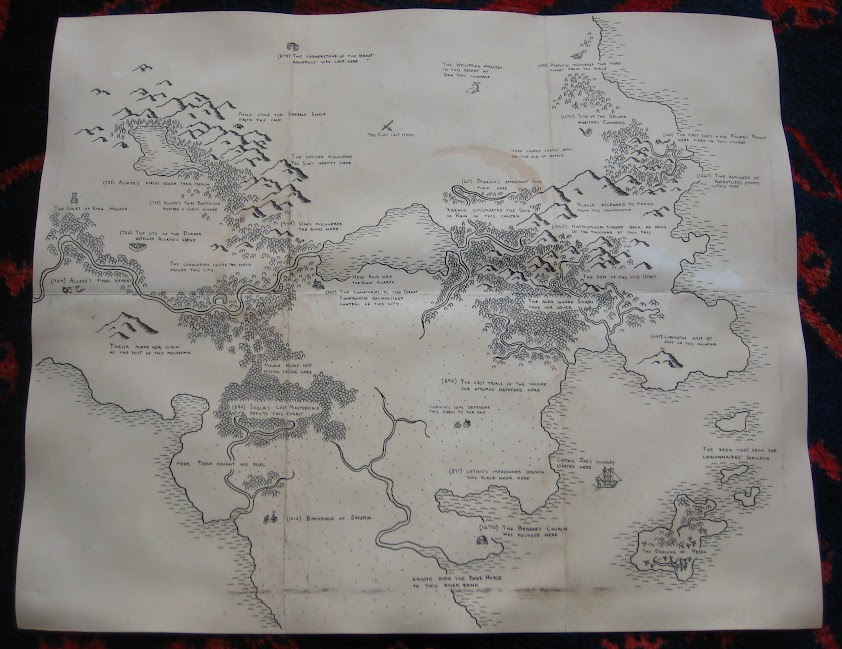
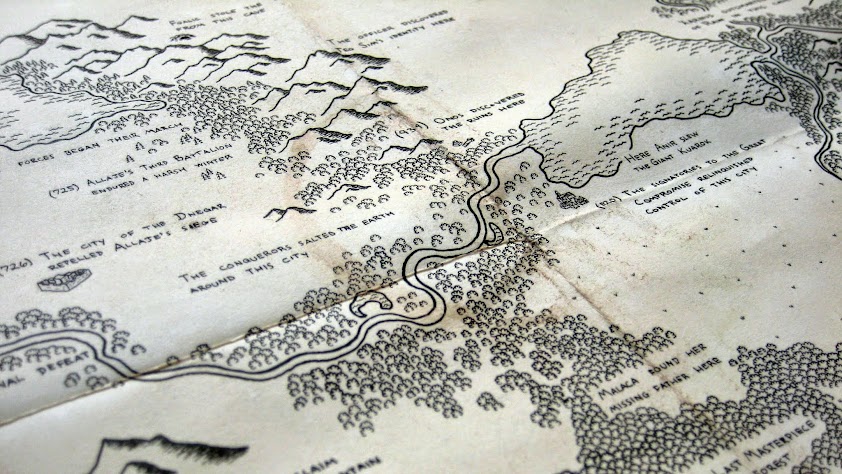
I wanted to try drawing a map full of labels, but no place names. Instead, I would fill it with events and stories suggestive of the cultures living in the lands I depicted. This is the result:

The Map of Legends

Much of the importance we place on a location comes from the stories associated with it. So, this map is covered in people and actions identified with places. Their struggles and triumphs fill the lands, drawing us into chains of associations.

Here camped Lastos’ army on the eve of battle. Sfola’s Last Masterpiece depicts this forest. Foalic stole the Emerald Shield from this cave. Here was the site of the Second Arbiter’s Congress – possibly related to the Fishers’ Revolt, the first shots of which were fired in this nearby village.

Lands of Allaje and Malaca

Looking at the labels, you may notice that roughly half of them have a preceding number in parentheses – what might appear to be a year. These labels speak of military campaigns, scientific exploits, political victories, founding of religions, and significant personages. The other half, without a corroborating date stamp, mention more dramatic exploits: giant creatures, heroic duels, stolen artifacts, and encounters with the supernatural. Are these myths of the local culture? Or do they hold some kernel of truth? Continue reading Legends and Histories

On the World Zarmina

2014 update! You can now buy prints of this map!

…Preliminary report on image data from the LongShot-2 mission…

The planet Gliese 581galso known as Zarmina – is a circular world.

It is not circular in the literal sense shown on ancient maps of the Earth, before we understood Earth to be a sphere. Rather, Gliese 581g spins at the same rate as it orbits its star, so its sun is always in the same place in its sky. Heat from the red dwarf, distributed by the circulation of the atmosphere, keeps a circular region under the star warm enough to melt ice into liquid water.  Thus, the habitable regions fall entirely within a disc under the constant light of the red star. Outside this region, water freezes – and the further one goes out onto the ice, the more inhospitable it gets. Travel to the far side of the planet is about as difficult as traveling from the Earth to the Moon – and so, to the inhabitants of Zarmina, their world might as well be a circle ringed in ice.1

This artist’s concept, based on image mapping from our recent interstellar probes, depicts the habitable region of Zarmina:

Zarmina, from above the substellar point
Zarmina, from above the substellar point.

For discussion of Zarmina, some reference points and directions are necessary. The circular boundary of the map is the ice line: beyond this point, water is certain to freeze. The center of the circle thus defined is the substellar point. When standing here, the red dwarf Gliese 581 is directly overhead. This image shows Zarmina oriented with is orbital plane horizontal. The planet has a south magnetic pole pointing roughly towards the top of the page, and so the “top” and “bottom” of this map become the cardinal directions north and south. East and west take on their usual definitions.

Gliese 581g is approximately three and a half times the mass of Earth. It is tidally locked to its star, meaning that one side always faces its Sun just as one side of the Moon always faces the Earth. Gravitational tides from the star also have the effect of pulling the rocky surface of the planet into an oblong shape, like a rugby ball. Since our probes reached the Gliese 581 system,2 we determined that the planet has a tiny orbital eccentricity (from perturbations by the other planets in the system) which causes a periodic shift in the gravity force on the planet: slightly east to slightly west, and back again, every Zarminan day (about 37 Earth days). The combination of the periodic variation in stellar tide and the fact that the ocean is more mobile than rock makes dry land much more common in the center of the disc than near the edge, as we see in the map.3

This variation in tidal force results in one of Zarmina’s most striking surface feature types. Continue reading On the World Zarmina

Original Fiction: “Conference” (final draft)

I had been trying to sell this story for a while now, but was not successful. There’s a bit of a catch-22 to selling a short story for the first time: without any feedback from editors and readers, there is no way for me to tell whether a rejection was because the story didn’t align with a publication’s interest at the time, or whether they didn’t think the story was very good. (And if it wasn’t very good…what it did wrong.)

This makes me sad, because I got lots of positive feedback from people who went to graduate school in a technical field. I think that maybe that’s the problem: the story appeals to too much of a niche crowd.

Anyway, here it is, the version of the story I most recently tried to sell. It’s about a young scientist presenting her findings at a research conference, and the unexpected reception she encounters there. It was inspired by some of my own experiences in grad school.

Conference

The numbers didn’t match up. Ceren Aydomi tapped her desk, frowning at the resonance spectra before her. The projections cast pale purple and green light over Ceren’s face, spilling down the front of her body and glinting from the polished glass surface of her desk. The peaks of each spectrum marched onward, rapidly deviating from her calculations. And the Three Hundred Seventy-Eighth Channel Interstice Studies Meeting was only two days away. Continue reading Original Fiction: “Conference” (final draft)