Decadal surveys and other prioritizations of potential NASA exploration missions often rank one thing very highly: a sample-return mission from Mars. However, I think there are some much more scientifically interesting, technologically challenging, and engaging to the public mission proposals out there. This is one: a Titanian UAV!
The idea is to send an airborne vehicle to Saturn’s moon Titan which would fly around the moon, observing surface features from its high vantage point. A powered flyer, as opposed to a balloon, has the advantage of being able to travel to a specific location: such as the moon’s liquid lakes!
The proposal team uses some clever mission planning approaches to handle the limitations of the aircraft: for example, using glide phases to hoard power for downlink sessions. Their nominal mission duration is one year: a year of exploring another planet from the air, a year of images and science data depicting a world of lakes, rivers, ice, and rain. The full proposal is online here.
I find the idea exciting, and I hope that NASA’s governing councils soon prioritize exploration of those extraterrestrial locations most likely to harbor life – like Europa, Enceladus, and Titan.
One of the problems with having just watched a whole lot of Star Trek is that, while I like a lot of the characters and plots and ideals, it’s a poster show for demonstrating some of the biggest scientific problems in modern science fiction. So, without further ado, I break a long silence to present my Top 3 Science Errors in Sci-Fi.
#1: Sensors
If you are the captain on the bridge of a Star Trek ship, you have the advantage of being well-informed beyond the limits of physical possibility. Your science and tactical officers can consult the Sensors and instantly list for you every object within a few light years. They can tell you what each object is made of. They can give you a map of a planet surface, or approach a never-encountered-before alien spaceship and produce an interior schematic. They can rattle off the number, species, sentience, and state of health of every living thing on a planet. They can tell you what systems are active on an enemy ship. They can even quote for you what the enemy ship’s computers are calculating.
Decades worth of scientific data-gathering and interpretation, happening in an instant
It might seen like “sensors” capable of many of these feats are plausible, given some of the technologies and techniques available to us today. We have telescopes that conduct all-sky surveys and see billions of light-years; so why not give Starfleet captains an immediate cosmic census? We can do spectroscopy to determine a substance’s constituent elements remotely. And we can detect electromagnetic signals, which might emanate from even the smallest electrical circuits. But what’s missing from this picture is the presence of uncertainty, noise, and time delays, all of which make measurements harder – and make the conclusions you can draw from those measurements much less certain. At the very most, when Spock or Data or Dax quotes the composition of a strange starship, they should include a measurement of probability with each component – and those probabilities should be well under 100%! Not only will that percentage depend on the quality of the instruments, the measurements, and the data processing, but there are even certain physical limits that prevent it from ever reaching 100% or even from getting to a reasonable level of confidence without a certain amount of observation time. If you want to map an alien planet, for instance, you need to spend time in orbit imaging and analyzing its entire surface, if for no other reason than that you can’t observe more than a small sliver of the planet at once!
Another important point involves the physical infrastructure required to give instruments the sensitivity they would need to do all these things with high certainty. Suppose we want to alert Captain Picard to the fact that the Borg ship is charging its weapons to fire. (And, obviously, I don’t mean Borg led by a relatable megalomaniac queen; I mean terrifying faceless drone Borg coming to assimilate you.) Presumably, the phrase “charging weapons” means that the energy in some kind of battery or capacitor bank is building up. We could, theoretically, detect photons emitted from such a system. But, first of all, I would think that the Borg shield systems like that, since they value efficiency so much – so very few photons will come out for us to detect. Second, a single photon won’t be enough for us to tell what’s going on. We need enough to get a good signal-to-noise ratio: that is, we need enough photons from the Borg weapons system to confidently say that they are from an energy buildup in that weapon system, and not from anything else. If there’s a fixed number of photons coming out of the Borg weapon, then there are basically two ways to build that confidence by measuring more photons: give your sensors a long time to measure, or catch photons from a larger area. We want to give Picard a result fast, so we’d have to go for the bigger photon-capturing. Much bigger. Especially if you want to pin down the exact location of those photon emissions: angular resolution at any given wavelength of light depends directly – and only – on the telescope baseline size. Therefore, first up on the Enterprise’s battle plan should be the deployment of a giant reflector dish. I think something with a diameter of a couple hundred kilometers should suffice!
The impossibility of Sensors as we usually see them depicted could have a huge impact on many sci-fi storylines. For instance, characters should have to make decisions on much more restricted information – or spend much more time considering their actions. Our characters will also find themselves in many more situations where they can’t solve the problems we throw them up against, simply because they don’t have enough information about the problem or they have to take too long to figure things out. There are other impacts, too. For instance, I’ve seen arguments on the web that stealth spacecraft are impossible (because any spaceship with humans in it will be at a temperature much higher than ambient space, so it will emit thermal radiation). These arguments assume the existence of Sensors, and further assume that the Sensors will always trump alien thermal management schemes. And in hard sci-fi circles, particularly in computer-game universes, there is also the concept of active versus passive Sensors: active Sensors are like radar, which bounce a signal off of enemy ships (thus making your ship easier to detect); while passive Sensors are like cameras, which just collect emissions. However, though that distinction may be meaningful, it’s not practical! Unless you really want to deploy those huge detector telescopes, you had better break out the radar if you want to locate your enemies before they fire all their missiles.
#2: Orbits
When you arrive at a planet from deep space, you want to park your spaceship. The parking space is an orbit. Contrast with deep-space maneuvering, when your spaceship can go any direction it likes any time it wants.
Well, no. Not exactly. Not at all, in fact.
Orbits aren’t just for parking – they dictate everything about moving around in space. The International Space “Station” is always moving at many thousands of kilometers per hour because of orbits. Geostationary satellites are at a really high altitude – over 35,000 km – because of orbit mechanics. We only launch space probes to Mars about once every two years because of orbits. Interplanetary space probes can only reach certain destinations with the amount of fuel they carry because of orbits.
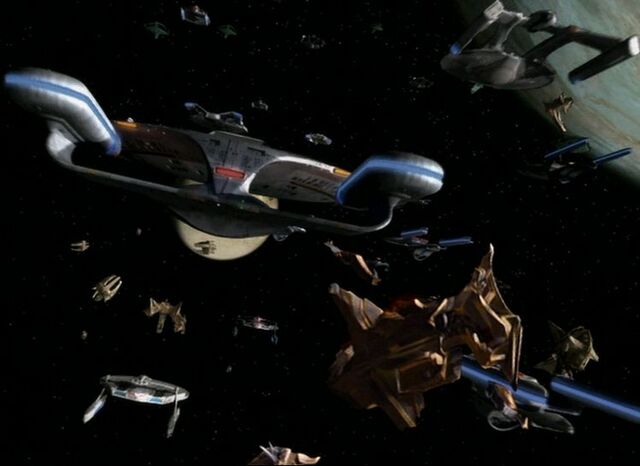
Whenever two sci-fi spaceships meet at a planet, they aren’t going to be exactly next to each other except by design. If their orbits are inclined or eccentric relative to each other, or at different altitudes, then the ships are going to be continuously moving around relative to one another. If these ships get into a space battle, then they are likewise going to be moving around each other in arcing paths. The trajectories of the arcs will change as the ships maneuver, but there is definitely going to be constant, hectic motion, and it definitely won’t all align nicely with some arbitrary 2D plane.
Nice neat flying-wedge-style formations in orbit?
The worst offender on this point, in my opinion, is Ender’s Game. One of the premises of the book is the argument that, in space, the enemy could attack you from any direction and at such speed that you cannot anticipate the attack; therefore, defense of a planet is impossible and everyone has to be on the attack all the time. This is an interesting idea, but it’s true only if the attacking spacecraft have unlimited power and propellant. In reality, those resources must be limited and so the attacking fleet is going to have to take some orbital trajectory to get from their planet to yours. Just like NASA planning the launch of a Mars rover, they’ve got to pick their launch window carefully – which means that you actually could predict which trajectories the attackers are more likely to use.
The mechanics of orbits matter to sci-fi stories: they are like the layout of highways and roads across a country. If some characters need to get from one planet to another, there are certain orbits they could use and certain orbits they could not. They determine how long the trip takes, and what subsequent destinations the characters can reach. And orbits keep ships moving with respect to one another along curving paths in all three spatial dimensions, making spacecraft behave in a manner that is completely unlike watercraft (or even aircraft), which is how we usually see them depicted.
#3: Co-opting a Current Science Word to Mean “Magic”
All of these words, even the more sciency-sounding ones, are often thrown around in sci-fi as synonyms for the word “magic.” My favorite examples come from Peter Hamilton’s Void Trilogy, when characters with all sorts of technological implants “manifest a quantum field function” in order to do things (unlock doors, tap into computers, fire lasers, etc). What the heck does this mean? Hamilton just strung together some cool-sounding words. His characters might as well be waving magic wands or using the Force. At least the Star Wars universe is honest about this!
The thing is, terms such as the ones I listed describe technologies that we have now and don’t mean at all what the sci-fi writers think they mean. For example: nanotechnology. Nanotechnology is the manufacturing capability to build things with sizes measured in nanometers, and it happens all the time in the electronics industry without giving anybody superpowers. What nanotechnology does give us is a ton of transistors on a silicon chip. Same for genetic engineering: we have been splicing genes and resequencing DNA for decades now – and cruder genetic engineering in the form of selective breeding goes all the way back to Gregor Mendel. You can thank genetic engineering for apples and insulin, but again – no mind-melding, magnetism-wielding, or time-winding powers.
I do not think that it’s inconceivable or wrong for writers to take the Arthur C. Clarke leap, and posit that sufficiently advanced technology is “indistinguishable from magic.” But in order for that to work, the technologies have to have either technical explanations that use concepts we can’t relate to our current understanding, or leave off the explanations entirely. Think of explaining that Droid phone to a Roman: it wouldn’t make sense to say, “Oh, you have aqueducts. Well, over time, aqueducts got better and smaller and eventually people built this handheld device which works by really good aqueducts.” That extrapolation of technology is misleading and incorrect. The “indistinguishable from magic” idea comes into play because the Roman doesn’t understand electrons or transistors or LCDs, and those terms are completely meaningless to him.
Often, terms like these are handled well – and science fiction is a tremendous vehicle for exploring the potential implications of emerging sciences. Where I have my biggest problem is when a story says something like, “after the introduction of nanotechnology in 2167, nanotech-enhanced human muscles, nerves, and brains entered the market.” Lines like that show that the writer just thought the word “nanotech” sounded cool and didn’t want to think very hard about how the theories or technology we have now would feed in to the technology of tomorrow. It’s a cop-out that doesn’t align well with either our current understanding or the effects the writer is trying to describe. Where those cases are concerned, I kind of like it better when we have “the Force” and “red matter” and other such things without any explanation.
Runners-Up
I decided on a top three based on those issues that I think have the biggest impact on sci-fi stories. There are, of course, a whole host of other science problems in most popular sci-fi.
The closest runner-up, in my mind, has to be designing spacecraft like ships – with planar decks stacked on top of one another, such that if you stand on the surface of a deck you can face in the direction of travel of the spaceship. There is no reason whatsoever to do that. In fact, if you’re interested in getting some artificial gravity, it makes much more sense to stack the decks vertically, so that the lowest deck is toward the engines and the thrust is always “up.” But if sci-fi starship designers want to really go nuts, they ought to start canting decks at angles, wrapping them around cylinders, or just having a string of cabins that the starship crew floats between. Written sci-fi is much better about all this than movies, TV, or games are. (Artificial gravity itself is something I’m willing to give sci-fi movies and TV shows a pass on, simply because I understand the production limitations and I’d rather see more innovative sci-fi come out of Hollywood than less. It can fall into the “magic” category. But it’s no excuse to design ship-style decks.)
Sound in space is also a science error, but I’m happy to let it slide for the sake of artistic license. Same goes for big fireball explosions. Some shows go a long way, stylistically, by muting or eliminating sound from their spacecraft, though!
Most sci-fi gets the idea of rocket engines way off. Orbit maneuvers – including getting onto a transfer orbit to another planet – require a change in velocity known as delta-vee. Delta-vee comes from firing a rocket engine. The more the engine fires, the more delta-vee the spaceship gets. Simple enough, but the problem lies in propellant consumption: a spaceship only has a finite amount of propellant aboard, and when you use it all up in engine burns, you can no longer move your spaceship around. So spacecraft rocket firings necessarily happen only during brief intervals, when absolutely necessary. A real spaceship will never have rocket engines on continuously in an “idle” state, or to overcome friction like a boat or airplane has to! (Electric propulsion, like ion engines, behaves a bit differently – those engines are almost always very low-thrust devices that have to be on for months, say, to get a space probe from the Earth to the Moon.) Worse, something like the Starship Enterprise would have to devote most of its mass to housing propellant reserves to accomplish many of the maneuvers we see. To get around this issue, many sci-fi universes include some kind of “reactionless” drive or other engine based on as-yet-unknown physics that can use the Clarke argument. I’m not sure why those engines need to have glowing backward-facing exhaust vents, though!
Orbit-to-surface-to-orbit shuttles are pretty bad. Barring some future magical physics, a single-stage-to-orbit vehicle is the holy grail of launch. It takes an enormous amount of fuel and propellant to escape the Earth’s gravity – far, far more in terms of mass than the rocket payload. Most launch concepts we can envision involve some component of the vehicle that doesn’t make it into space – whether it’s an expendable booster stage or a carrier aircraft that stays behind for reuse. Re-entry can be just as problematic, as the vehicle has to get rid of a ton of kinetic energy (to make a long story short, that’s what space capsules’ heat shields do). Shuttles can be obnoxiously necessary for crews of planet-hopping explorers, though…
Like shuttles, faster-than-light travel is tough. It’s the elephant in the room of most science fiction: writers are just dying to have it, but it cannot be accomplished by any means we currently know about. There are some theories out there that might give us FTL capabilities, but only under the most extreme and unrealizable conditions. (Things like…being inside a black hole and whatnot.) However, being able to move characters from planet to planet very quickly can make for richer storylines, more imaginative settings, and more exciting descriptions and visuals, and so it becomes a kind of necessary evil.
Addendum: Reader Nominations
A couple readers have commented on some other effects or technologies commonly depicted in science fiction that commit scientific faux pas.
Will pointed out “shields” and “force fields,” which form an impenetrable (or, at least, as penetrable as the plot requires) bubble wall around a starship. The idea of a deflector shield has its basis in scientific fact; but there is no real way to project a solid wall around your favorite spaceship that prevents matter and energy from passing through.
Jon mentioned that many movies and TV shows include “energy weapons” which produce blasts that travel slower than not only light, but also sound!
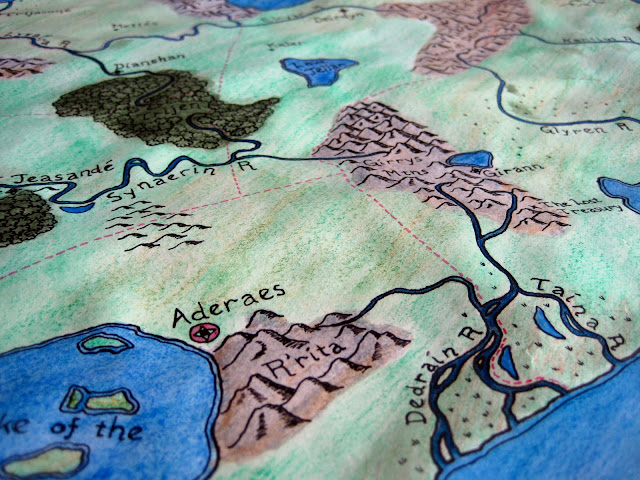
I know I’ve liked to draw fantastical maps for a long time now. So, I should not have been surprised at how much fun I had producing a fancy version of a map for a world I’ve been working with for several years. I figured out techniques for drawing the shorelines, forests, and mountain ranges that I think were very successful. I used a lot of watercolor pencil washes, with india ink for lines.
Map of the Southern Continent
Still, though I like it as an image, the product isn’t a perfect map. I made the decision to try and put in all the physical features before any points of interest of placenames, with the intention of doing so in an overlay. None of my scratch tests for such labels worked very well; I ended up putting labels on the map in postprocessing on my computer. Not ideal, but at the same time, it came out okay.
I had such a great time producing the map over the course of a couple of weeks worth of coming home from work, making dinner, and then throwing NPR on while I sat down with my pen and ink. (It was a very meditative sort of endeavor.) I have also been keen on trying to improve the map. Fortunately for me, Fiancée loved the thing and requested that I produce a similar map based on a template which she supplied to me. Well, then. I didn’t need a second excuse to start.
Map of Faerie
I worked primarily from the template; but I had leave to make some modifications such as putting detail on coastlines or changing river courses to be more realistic. I stuck with the same general techniques that worked so well for me on the first map.
This time, though, I planned a bit better. I noted the positions of the physical features; but I also included the major landmarks and indicated to myself where text labels would go. When I inked in the forests and mountains on this map, I left myself spaces for the labels. I practiced ink lettering on scrap paper, came up with a font style that I thought would be fitting, and this time put hand-lettered placenames directly on the paper.
A nicely labeled forest
I will be the first to admit that I didn’t succeed in all instances – this paper absorbed the ink in a very different way depending on whether there was a good base layer of pencil in place – but I like the results, in general. You can also see that this time I have added some carmine red ink to my repertoire, to add accents or denote features on the map (here, provincial boundaries from the template map). Another set of new features comes from a few special points of interest on the map. I will comment that inking a small symbol, such as crossed swords, on a large paper map comes with a particular set of challenges: ink is almost impossible to remove without leaving evidence, and so once I set about drafting such a symbol on the final image, I was committed to it! After all, I’d hate for one badly botched, critical item to ruin the whole work. (Happily, little goofs in the mountains and such simply add to the character of such an image!)
City and Battlefield
Just for grins, I threw on some other embellishments around the coastlines. You know: sea monsters and such. I’m particularly happy with this little guy.
Big fish
I still have the map in my apartment and I’m thinking about whether I should add some kind of border, but I think I’m just going to let Fiancée mat and frame it however she likes.
Now I’ve just got to think about what cartographic project to do next…
Ah, I’ve only been out a few months, but I already miss some things about being in grad school! For instance, I miss all the crazy brainstorming of new and wild space systems, missions, and technologies. No doubt you, dear reader, also miss my crazy brainstorming: after all, that is how I ended up writing blogs about space battles or missions to Europa or what the Earth would look like with rings or the science of Avatar. Now I have an industry job where people tend to care more about “affordability” and “reliability” and “performance,” than they do about harebrained schemes to drop space probes into the Europan ocean.
But, fear not, intrepid reader who has been sticking it out hoping for another crazy notion to appear here! You see, my research group at Cornell is still working at churning out wild ideas. And you can participate!
Check out this message from Zac, who was starting his Ph.D. as I was on my way out:
Zac has set up a page on KickStarter, which you can jump to by visiting KickSat.org. The idea behind KickSat is to make a bare-bones 10x10x10 cm CubeSat which contains hundreds or thousands of microchip-sized satellites called Sprites and will deploy them all in low Earth orbit. The KickStarter platform means that, if you want, you can sponsor your very own Sprite – Zac has even defined a sponsorship level at which you get to write your own flight code for the tiny spacecraft to run in orbit!
The spacecraft, which each could fit comfortably in the palm of your hand, are very simplistic as far as spacecraft go – they consist of solar cells to charge a little bank of capacitors, a teeny TI processor for a brain, and a little antenna. These are proof-of-concept spacecraft, and are actually derived from three test units which my lab group sent up to the Space Station on the last launch of the Space Shuttle Endeavour! In the future, they hope to integrate other sensors onto the chips to give Sprites more capabilities. One of the ideas batted around during lab meetings that I consider a personal favorite: put “lab-on-chip” detectors on a Sprite to look for characteristic organic compounds (like nucleic acids!) and program them to simply send a chirp back if they get a positive result. Send a million Sprites to Mars, and listen to the peeps – and then you know where on the Red Planet the next big flagship mission has just got to go!
Imagine if you got the shot at writing the flight code. If you could put a solar cell in space and make it beep, what could you measure? How creative can you get in getting the Sprite’s whisper of a radio signal to carry information? Could you receive enough data to tell how fast the chip is spinning and seeing the Sun, or how much average power it has to work with, or how long it lasts before an errant proton from the solar wind blasts your Sprite out of the sky? The chance to put your own code on a spacecraft, even such a simplistic one, offers a lot of learning opportunities.
(Incidentally: one question that Zac and his research advisor, Dr. Mason Peck, get a lot is some variation on: “Hey, paint flecs moving at orbital velocity are enough to crash through the Space Shuttle windows. Aren’t these Sprites going to become dangerous space junk?” The answer is that yes, the Sprites could be hazardous as long as they are in orbit; but the orbit that KickSat will reach is going to be within just enough of the Earth’s atmosphere that all the Sprites will get dragged down in a couple days. The special property Sprites have that influences this fast orbital decay – and other effects – is a high surface-area-to-mass ratio.)
KickSat has already reached its minimum fundraising goal to start building hardware. However, the project is still looking for more backers to secure a commercial launch opportunity, which will offer more certainty than applying for a free launch program through NASA. But if Zac gets to about $300,000 of funding, he thinks that will be enough to start looking at new technologies to shrink the Sprite chips down to even smaller sizes – and offer even more capability in the future!
Cool stuff. I’m glad to see the Cornell Space Systems Design Studio keeping the wild space ideas flowing!
I’ve been very critical of NASA lately, and similar criticism to mine has been trickling out of the space blog community and into major news outlets. So, in all fairness, I would like to offer up some much more constructive thoughts.
If I suddenly became Dictator of NASA Authorization and Appropriation, this is what I would do: First, I would decouple the portions of the NASA budget that deal with science and with human spaceflight. Next, I would double (or triple!) both budgets. And then I would put the budget on a schedule in which it gets re-authorized every decade, rather than every year.
Finally, I would give NASA a mission for human spaceflight.
One finds many challenges in trying to come up with a solid mission for human space exploration. The mission must be simply stated, so that it is easily grasped by the community at large, has simple criteria for success, and gives scientists, engineers, and administrators maximum creative leeway. The mission must also have clear, tangible benefits to the public at large in order to maintain broad-based support. Finally, and perhaps most challenging, the ideal mission for the program should be one that leads to a self-perpetuating endeavor of exploration. Those of us who see value in spaceflight want to go out and explore, and keep exploring, instead of reaching a goal and turning back, victory in hand.
In the political climate of the early 1960’s, reaching the Moon was the right mission. NASA was all about proving that our democratic society and civilian exploration program could beat the pants off our rivals’ soviet society and militarized rocket program. It was about spurring the development of high technology in this country. It was about national pride. It was about proving that we could do something awe-inspiring.
I think that we could use some of those initiatives again, but that our current society will not support a simple destination in space as a goal. I think that people today want to see immediate results from the exploration effort. They want to see a space program that pays for itself by giving them something to hold in their hand.
Paramount to the long-term success of this mission is its ability to survive success. In many ways, this is NASA’s problem. It went to the Moon, and the public began to question the need to go to the Moon any more. When the Apollo program ended, instead of a NASA that looked out to the next horizon, its reach diminished. Now NASA is in a position where its mission gets redefined too quickly for it to accomplish any goal. The space community squabbles over whether the exploration goal should be the Moon, or Mars, or an asteroid. But I think we need a fundamentally new kind of goal: Often, the idea of a mission for NASA gets confused with the idea of a specific destination or a specific spacecraft program, but a “mission” is broader than both. The problem is that NASA needs a focused effort, and that effort has to be harnessed in such a way that achievement of its goals perpetuates the mission instead of becoming a bygone climax.
I think the mission should be pushing the human presence out into the Solar System. And so here is what I would suggest for NASA’s human exploration goal:
Build and launch a human-carrying space vehicle, using no materials from the Earth, within the next 15 years.
That’s it. No engineering decisions, no restrictions on technology; a broad statement of an extremely big idea, simply stated. Oh, we can haggle over the precise wording or the timeframe, but I think this is it: the space exploration goal that could revitalize the space program.
You see, the goal I am setting is for a capability. I want to see humans figure out how to exploit space in an efficient and effective manner, and to prove it, I want to see them build a spacecraft in space. I don’t care where this happens: a crater foundry on the Moon, a near-Earth asteroid shipyard in an elliptical orbit, scaffolds on Utopia Planitia on Mars. Nor do I care where this spacecraft goes when it is launched. What I care about is this: in the process of achieving the goal I have stated, the space program is going to have to create an industrial and technological base, in space, that we don’t have at present. New technologies and products are going to come out of the space program on a weekly basis. The space program will create a foundation that our wider society can move onto. In other words, I want to see the space program create new industries, and I want it to drag them along with it into space and establish them firmly there. Think of this idea like spurring on an East India Trading company for space. So, I want to target the science and engineering of in-situ resource utilization and develop it into a discipline that will let human beings truly develop space.
Merely arriving at an asteroid – or even arriving at Mars – could be accomplished using technologies we have at our disposal right now. There are engineering challenges, to be sure; but we could potentially knock many of them off by optimizing known solutions. We only need put forward the effort and resources. Building something from scratch in space, though, will require some substantial new developments! Materials science, field medicine, robotics, chemistry, computing, electrical power generation, thermal management – all would likely have to jump forward in leaps and bounds. Tangible benefits would come out of such a program in many other disciplines, as well. I want average people getting to see and use devices that spin out of the space program at a pace that matches their expectations of high-tech fields. I want these devices and technologies making obvious differences and improvements to life on Earth: increasing our efficiency, reducing carbon emissions, making power more cheaply and more cleanly available, getting medicine into remote areas, growing food in truly sustainable ways to better support our populations – all things that are major problems in the world today, and all things that would have to happen to support a space-based industry.
I feel that it is very important for the timeframe on this goal to be ambitious. The reason is that I want to see space exploration become a high-tech industry again. It used to be – in the 1960’s, 70’s, and early 80’s. However, the most successful space programs and vehicles since then tend to be extremely conservative. For example: it used to be the case that the space program invented computer technology specifically for its new vehicles; now, the computers on spacecraft typically lag behind the state of the art by a decade or more. This is fine for the private sector if we care only about the bottom line of a single satellite, but it’s not good for long-term performance and I think our national space program should be reaching beyond those concerns. I feel strongly that the risks of new space technologies are often overestimated; but on top of that, I think we should be willing to take more risks with our astronauts! We should be filling our NASA missions with “firsts,” because only by doing so can we lay the groundwork for following developments. With that in mind, I would set a goal that requires entirely new engineering strategies and impose a deadline that forces rapid maturation of technology.
As the space program cranks out “firsts” related to building this ship, I want to see NASA taking full advantage of mass media. I want a Twitter feed posting pictures of spaceships under construction. I want the news showing astronauts each week, at least, doing things that look new: prospecting and mining on asteroids or the Moon, assembling huge structures, showing off how they support life in deep space with few resources from Earth. We should see astronauts, mission controllers, and engineers as heroes – as the people helping usher in new discoveries.
If the space program were to adopt my suggested goal, I can only speculate a little on how it would play out. I think asteroids would likely be the most obvious source for raw materials for the spacecraft – or might even be made into the spacecraft itself, if hollowed out in the classic sci-fi paradigm. I think that whatever asteroid or asteroids we choose to target would need vast solar power collectors to establish infrastructure. Closed-loop life support systems would likely be a key component of the set-up. And the space program would need a way to taxi astronauts up to space and back, as well as out to the asteroids and back. To do that, NASA would need to take advantage of affordable launch services from private companies and also develop or sponsor a fleet of interplanetary shuttlecraft. In all, I see the possibility for a lot of dramatic achievements – ending with a stirring first launch of the new spacegoing vessel from its drydock, of course!
Elon Musk announced that a SpaceX is developing the Falcon 9 and Dragon into a fully reusable launch vehicle/capsule system. In short, they are actually going to go for making the Falcon 9 live up to it’s namesake.
I can’t help but contrast this animated system with the SLS announcement from NASA. It illustrates my criticism of recent NASA policy perfectly: at Congress’s behest, the space agency has stopped innovating.
It’s not a super-heavy-lift launch vehicle that will enable expansion of the human exploration program beyond flags-and-footprints missions or the long-term development of space. Instead, it’s the fantastically easier access to space afforded by a rapidly reusable launch system like that presented by Musk. The control technology and hardware for such a system exists already; I hope to see test flights in a few years. With only a little luck, they’ll happen before the first SLS is supposed to take off.
I was thinking about NASA’s new launch vehicle plans, and I decided to dig through some of the data in the public record and crunch a few numbers on launch vehicle performance. Specifically, payload mass to orbit.
I am proceeding from my favorite space-system-engineering assumption, which is that we can take more than one launch to build a spacecraft. Thus, the payload mass to orbit on a single launch is not the most important metric for a launch vehicle. I care equally about how frequently the launcher flies. So I crawled through launch dates and came up with numbers for the average (and peak) payload masses various launch systems delivered to low Earth orbit on an annual basis. (For example, between January and November 1985, the Space Shuttle launched a total of nine times, and in no continuous one-year period did the Shuttle launch 10 or more times, so I multiplied the Shuttle’s payload capacity by 9 to get the peak annual payload to orbit figure.)
Here’s what I came up with:
Launch System
Mass to LEO, Single Launch
Mass to LEO, Avg Annual
Mass to LEO, Peak Annual
Saturn V
119,000
258,927
476,000
Space Shuttle
24,000
84,019
219,600
Atlas V
29,420
169,107
205,940
Delta IV Heavy
23,000
15,119
23,000
Titan IV
21,680
47,337
108,400
Ariane V ES/ECA
21,000
47,049
147,000
Space Launch System
170,000
170,000
170,000
All masses are in kilograms, and for the SLS I used the “evolved” 2021 configuration of the vehicle and the projection that it will likely fly once per year. Averages are over the course of the entire available service lifetime for the vehicle.
My points are these:
While the Saturn V is still the behemoth of launch no matter how you slice it, some of the other systems come surprisingly close in certain metrics. Even though SLS will boost more than the venerable Saturn, it’s more of an incremental improvement – and the Saturn launched more frequently in its heyday than SLS is likely to. Cost information on the Saturn V (either total cost per launch or cost per kilogram) is a little tricky to come by; I don’t think there are good estimates, so it’s hard to see how that stacks the deck. I suspect that the Saturn V’s cost per launch would hurt it in this comparison.
Historically, the Space Shuttle has already outperformed the projected mass to LEO of the fully evolved SLS. It didn’t always, but there were a couple year-long periods when I did count 9 STS launches/year. By the peak annual mass to LEO metric, then, SLS is a step back from the Shuttle.
The commercial Atlas V is essentially already as good at putting mass in orbit as the SLS will be, on average. And its peak annual mass to LEO is 35 metric tons higher.
My biggest point, however, still is that if you count cumulative launch capacity over several launches, you can get enough material into orbit to build some really big things. We could have NASA developing self-contained habitats and interplanetary spacecraft without developing any new NASA launch systems.
Today, the group of Senators with a stake in the space program and NASA administrator Gen Charles Bolden had a press conference to announce key decisions related to the design of the Senate Space Launch System, or SLS. To summarize:
The SLS is going to be based on a LH/LOx-fueled core, powered by 5 Space Shuttle Main Engines at the base and some Saturn V-derived engines on the second stage.
The SLS is likely going to have strap-on solid rocket boosters, derivatives of (if not exactly the same production models as) the Space Shuttle’s booster rockets.
The SLS will carry the Orion MPCV capsule.
The first targeted flight of the SLS is supposed to be in the late 2010’s.
NASA is supposed to paint it to look like a Saturn V. Saturn V Saturn V remember those? those were awesome, when you think of the Senate Space Launch System, think of a Saturn V.
Blatant paint job, huh?
I did not have high hopes for this announcement, because I am not a fan of the idea that NASA must have a heavy-lift rocket. I think that the premise the SLS is based on, that a super-heavy-lift rocket is a requirement for deep-space exploration, is flawed. To me, the SLS looks like the kind of rocket I would build if my goal was to send two or three people to an asteroid to plant flags and footprints, and then come home, and then let the space program atrophy away until nobody cares about it any more.
I think that, instead, NASA ought to leverage everything it learned from the Shuttle program about building things in space and construct a fleet of in-space vehicles, out of parts that could be launched on smaller, cheaper vehicles – such as Falcon 9’s or Atlas 5’s. These vehicles would remain in space for their entire lives, so that they don’t ever have to lug a massive heat shield all the way to Mars and back or anything like that. Every time we want to send another crew into deep space, we need only launch a new fuel tank and supplies – instead of a whole new spacecraft!
The SLS hardly represents a bold leap forward for NASA. Heavier and heavier lift is not so much of a challenge in innovation as it was in the ’60’s – and even the SLS is only fractionally more powerful than a Saturn V. It is supposed to use Saturn-V-derived (read: 50-year-old) engines on one stage and Shuttle-derived (read: 40-year-old) engines on the other. NASA artists went to great lengths to evoke the Saturn V in concept art of the SLS – but to me, that’s a bad omen. It demonstrates how much NASA has stagnated at the whims of Congress.
Worse, according to the New York Times, there are internal NASA documents showing that if the NASA budget remains flat, this rocket won’t have any manned flights until 2021 or beyond. And the NASA budget this year – in the very same appropriations process that generated the SLS – went down. I fear that Congress failed to learn the lessons of the Constellation program: that if you don’t fund a project like this, it will gobble up money from all the other science and technology and space research and missions NASA is supposed to be doing; and if all NASA’s eggs end up in one basket like that, then it really just takes that one project going over budget and coming in behind schedule to topple the whole thing.
I was pleasantly surprised by one bit of good news here, at least: the Senate has backed off a bit on over-specifying the SLS design. Allowing NASA to spec out a LH/LOx core rocket and put out the boosters for competitive bids is a Very Good Thing; previously, Congressional rumblings sounded like the rocket had all been awarded to ATK already. I worried about that because ATK has built itself a track record of running very behind schedule and over budget on NASA rockets, and a liquid-fueled design will be much more efficient than a solid rocket could ever achieve.
On the whole, the story wasn’t as bad as I thought is was going to be. However, I’m finding it harder and harder to be optimistic about the future of NASA with a project like SLS present. My prediction: SpaceX is going to come up with a Falcon 9 Heavy that totally outshines the SLS in capability, cost, and speed of delivery – and I can only hope that, before too many resources get sunk into the Big, Dumb Rocket, Congress wises up and says to itself, “hey, why don’t we just buy a bunch of those?”
The sooner Congress does so, though, the better – because that will give NASA more leeway to build the interplanetary spacecraft that I really want!
Okay. It’s 10 September 2011, and I am 9/11’ed out.
Our nation experienced a tremendous tragedy on that day, and it deserves remembrance and reflection, but I am amazed at the extent to which the concept of “9/11” has been inflated and distorted in politics and the media. Our national sense of victimization has been used to justify all sorts of policies and actions, many of which I feel run counter to the ideals this nation stands for. After a decade, I wonder why our leaders and pundits have had such a hard time getting past the “every day is September 12th” mentality.
To me, the day of the attacks on 11 September 2001 demonstrated how we could come together as a nation under one flag, with common goals, common spirits, and common sympathies. Our divisions and distinctions meant very little on that day: instead, we were all Americans. 12 September 2001 was a powerful day in our nation’s history.
Since then, though, our reaction to the attacks has come to represent, to me, a series of national failures.
I look at the people who responded to the 9/11 attacks – people who demonstrated exceptional stoicism and heroism, people whose concern for their fellow countrymen and women overcame fears for their personal safety, people whose faith in their comrade responders gave them the strength to move towards danger rather than away from it. The thought that there were firefighters streaming into those towers and up the stairs until the moment they collapsed is truly astounding. And yet, to this day, our politicians bicker and dither on whether our nation should do some part to help support those who came to our aid in our darkest hour.
The whole nation of America has internalized the notion that we are victims of 9/11. People far from New York City feel that they, too, were directly attacked – a testament to New York City as a lasting icon of America and American ideals. Yet in the years since, I’ve seen neoconservatives in the punditry vilify the families of the people who lost their lives on 9/11, for whatever reason, while they are happy to simultaneously use the specter of 9/11 to justify who-knows-what actions, from torture to spying to invasion.
The United States went to war, twice, with the sentiment of September 12th. We have killed and died in the Middle East, and spent an amount of national treasure that makes the 2009 stimulus look like small change. Yet whether these wars made us more secure from terrorist attacks like those on 9/11 is still an issue for debate – and likely we will not know the answer to that question without the hindsight of history. In the end, it was not an invasion of Afghanistan or Iraq* that brought the true perpetrators of the 9/11 attacks to justice, but a small commando raid nine years after the fact – essentially, an international police action. And in the meantime, al-Qaeda was happy to put out announcements boasting about how much sympathy our invasion of Iraq had garnered for their cause. That it took us so much time, effort, resources, and lives to learn how to properly fight this ill-defined “war on terror” is disheartening to me.
During the time between 11 Sep 01 and the invasion of Iraq, I think that we as a nation began to confuse the concepts of patriotism and jingoism. There was a philosophy in the public sphere suggesting that to question the actions of the American government, and especially to question the justifications for invading another Middle-Eastern country, was not patriotic. Questioning torture was unpatriotic. Questioning whether Saddam Hussein had weapons of mass destruction was unpatriotic. In the words of our President, “You are either with us, or you are with the terrorists.” I believe that attitude damaged us as a nation, and a decade later, its effects on our politics reverberate with us to this day.
Most sickening to me is the backlash we have seen against American Muslims. This nation was founded on ideals of religious freedom – the thirteen original colonies refused to ratify the Constitution until it included protections against religious persecution, which have been enshrined in the First Amendment. America has always stood for the idea that anyone could come here and become anything that they wanted, even if it took us years to accept that that sentiment really did apply to everyone. We have learned: we learned from Irish immigrants and Asian immigrants, we learned from the Civil Rights Movement among African-Americans, we are still learning from the gay rights movement and from Hispanic immigration. The lesson we learn each time, though, is the same: we are all American. To see us take a step backwards by inventing hatreds against a people seemed, in a nutshell, profoundly un-American. It is not “in poor taste” to build a mosque in New York City – it is a triumph of American ideals over the philosophy of al-Qaeda. Let us never forget that, while the hijackers used Islam to justify their actions, Timothy McVeigh used Thomas Jefferson to justify his. Any person, philosophy, or religion can be taken out of context and distorted to justify a wide range of behaviors. So let Americans stop vilifying Islam because of the attacks.
I have to admit that perhaps this view of the legacy of 9/11 comes from my own reactions on the day itself. I felt angry and upset, but the events seemed remote to me and my feelings ended up…displaced. You see, on the morning of 11 September 2001, I was a senior in a Massachusetts high school, and sitting in calculus class when a runner came from the main office to deliver a note to the teacher. She read it and, while the students joked about who had to go to the office now, she mouthed “oh, my God” to herself. The students could all tell how much her mood had shifted, and we asked what happened.
At this point, I feel the need to reiterate that while we were in school, we were the senior class. Some of my classmates were old enough to vote. Some of them were old enough to join the military. We asked the teacher what the note was about and she put it aside, looked at us, and said the words: “This is way too important for you to know about.”
That was my school’s mentality: hide the events of the day from the students. It didn’t work at all. The vice principal pulled one of classmates out of the room to give him a brief sketch of events and tell him that his sister, in New York city, was all right – he promptly shared what little he knew with everyone in the room. Some students were pulled out of school by their parents, and before they left, they explained whatever they had gleaned about why. One of my friends used the cafeteria pay phone (barely anyone had a cell phone at the time!) to call home; someone in his family narrated the TV news to him, and he related it to the cafeteria at large. The net effect was that, at various times throughout the morning, students thought that there had been as many as a few dozen airplanes hijacked, or that maybe there had been a failure of the air traffic control system such that there were ten airline crashes at once in Pennsylvania, or that the White House and Pentagon had been blown up. I, for one, simply could not believe that the World Trade Center towers could have possibly collapsed, and my mind was filled with visions of them toppling sideways and crushing other buildings.
I was pissed off at the school – because at the time, I wasn’t just a nice, responsible, honors student who felt he could have handled this information. I also happened to be the Cadet Commander of the local Civil Air Patrol squadron. I had emergency services qualifications. On 9/11, after air traffic was grounded, the only aircraft in American airspace belonged to the military and to the Civil Air Patrol. Members of my squadron boarded their aircraft to fly blood for transfusions to New York City. One of my squadronmates was actually on the phonewith NORAD to negotiate flight paths for those small Cessnas. Some of the first aerial reconnaissance photos of Ground Zero, giving emergency workers the ability to assess the damage and plan rescue and recovery efforts, came from CAP missions. I was angry at the school, because I could have helped. In some small way, I could have made a difference to the response efforts. In retrospect, I feel guilty that I didn’t just march down to the main office, show them my CAP ID, and demand to call the squadron commander.
I feel that it’s likely that my impotency on that day colored my reactions to the attacks in general, and fueled my frustration as I watch our national policymakers and news organizations struggle to come to grips with the conflicting ideas that America is the most powerful nation in the world and that a dozen bigoted zealots can cause us so much harm. Over time, their struggle has produced the policy failures I alluded to earlier.
But I harbor hope for the future. Slowly, our national debate is evolving, and I am sure that eventually the “9/12 mentality” will become a much smaller part of our discourse. We are starting to pick up the pieces from our wars abroad, and starting to focus on the shape of our policies at home. At some point, we may stop using the September 11th attacks to define what is and is not American. After all, the children who are too young to remember the events of 9/11 are in middle school now.
It is time for us, as a nation, to move on. Let us remember the courage and sacrifice of that day, and let us go forward with the memory of those who lost their lives to make this country a better place for their families.
On that final note, I will leave you with this poignant video:
* Yes, most of the argument for war against Iraq did not explicitly invoke 9/11. However, remember that one of the justifications presented to the American people in the run-up to the Iraq invasion was that the 9/11 hijackers had met with high-level Iraqi officials. Even without that explicit link, I doubt that the invasion authorization would have passed Congress, or passed muster with the American people, without the events of 11 Sep 01.
Elantris is Brandon Sanderon’s debut fantasy novel. It has a blurb from Orson Scott Card on its cover, to the gist that this is the finest fantasy in who knows long to catch Card’s notice. As my sister put it, this author must have died when he got that.
It’s an impressive debut, and certainly only of the more imaginative fantasies I’ve read. I really enjoy it when an author is able to construct a self-consistent, concrete world without falling into the overused Tolkeinian tropes. (You can’t see it, but right now I’m staring pointedly at every Vulcan-eared archer elf and bearded miner dwarf that has ever existed ever.) It certainly borrows from other fantasy mainstays, and it has a lot of commonality with some other things I’ve seen – Sabriel and its sequels, the Edeard storyline of Peter Hamilton’s Void Trilogy, even A Game of Thrones (though I actually like the characters in Elantris) – but Elantris is constructed in a very unique way.
The plot takes place in a land where the eponymous city was once the seat of magical powers that let its citizens live however they pleased, without worrying about any basic necessities or threat of invasion. A key aspect of the city’s magic was that only Elantrians could perform it – but anyone, anywhere in the kingdom, could suddenly find themselves struck by the transformation into an Elantrian. The culture of the kingdom is simultaneously elitist and egalitarian, and no one goes hungry or suffers from illness. And so life goes on, until one day a disaster strips the Elantrians of their power and turns the city, along with all its magical people, into decaying ruins. The remaining population of the kingdom throws down their now-impotent rulers and locks them all within Elantris’ walls, and the mercantile class become robber barons to impose their own feudal rule on the kingdom. Still…anyone, anytime can be struck by the transformation – but now they are shunned, despised, and imprisoned inside the fallen city.
The novel follows three key characters ten years after the disaster takes place. Raoden, popular heir to the new throne of the kingdom, finds himself turned into an Elantrian and immediately begins to unravel the mysteries surrounding the ruin after his father tosses him into the city. Sarene, a twist on the classic tomboy princess, is en route from another kingdom to join Prince Raoden in a political marriage when his transformation hits; with him declared dead, the treaty governing the kingdoms’ alliance makes their marriage binding as she remains ignorant of his true fate. She must get to know her new homeland while politically maneuvering to safeguard both kingdoms – as the alliance was an important move to present a united front against a third aggressor nation. Meanwhile, Hrathen, a high priest of that third nation, has quietly infiltrated the kingdom and seeks to convert its populace to his religion before his Emperor loses patience and decides to destroy them all.
A word of warning: minor spoilers follow. But I promise that they are tiny.
One of the things I particularly liked about this novel is how self-consistent the mechanism for doing Elantrian magic is. This magic is not vaguely defined – nobody “searches out with their feelings,” nobody “embraces the power rushing through them,” nobody practices the perfect flick of their magic wand. After reading this book, I realized that now I know how to do Elantrian magic, if I lived in this world. Going a step further, we readers actually get to see how research into magic would work in Elantris – that is, how to discover and construct new spells. It’s a very open-ended system, and very specifically defined, lending this fantasy an air of….well, perhaps “realism” isn’t the right word, so let’s go with “concreteness.” All this isn’t frivolous: the basis for and technique of Elantrian magic becomes a major plot point. And with us readers given the tools to follow along, I found myself able to solve the puzzle of Elantris before the characters did. (Fortunately, they were not very far behind!)
In fact, I’d have to say that this is one of the most economical novels I’ve read: Sanderson introduces very little into the book that doesn’t become important in some way or another. This is generally good, but at the same time, sometimes it makes events in the plot seem a little too easy to see coming. Of course the prince and princess eventually get together; of course the high priest’s overzealous acolyte causes his downfall; of course the autistic child we briefly meet has a super-important role to play in the book’s climax. This is not to say that there aren’t plenty of twists that are surprising – there are – or characters who die tragic deaths – there are those, too – or even unexpected relationships that develop – that also happens. It’s kind of amazing just how many events got packed into this book, for its relatively small size. I think I enjoyed the book more for being able to piece things together on my own: in a way, that proves the logic and consistency underlying Sanderson’s world and shows that his few basic principles go a lot further to move the plot along than a sudden “aha, reader! I bet you weren’t expecting me to throw THIS at you!” sort of forced “twist.”
Sanderson creates a colorful cast of secondary characters, but for the most part he seems to enjoy exploring the relationships that develop between them more than he likes looking at how the characters might evolve. In the cases of Sarene and Raoden, in particular, the plot is an affirmation of being true to oneself in the face of an adverse situation or heckling from others. They come out of their experiences richer, but that is more because they shaped the world around them than the reverse. Hrathen, though, is a much more interesting case: over the course of the plot we see him struggle with his faith in an attempt to reconcile its “convert or die” mentality with his personal belief that he is genuinely trying to help the people of the kingdom. The particular manner of his fall and transformation at the climax is a little surprising, yet makes perfect sense – like much of this book. Sadly, Hrathen’s part in the climax of the plot is also the subject of the novel’s most moralizing speechifying; Sanderson manages to stop just after making his point, though, before he gets overbearing.
The author closes Elantris not with a complete triumph of good over evil, but with the balance of power restored. Elantris leaves the door wide open for a sequel, with antagonists clearly still extant in Sanderson’s world and new facets of Elantrian (or other) magic yet to be learned. I will be happy to find out what those facets are when I can. For now, though, Elantris is a fine standalone novel that provides a fresh look at a lot of fantasy themes in a thoroughly imagined universe.