Category Archives: Social commentary

Climbing

It seems that being at Williams College again for only a weekend is enough to prompt a little self-reflection.

Hopkins Gate
Hopkins Gate

I returned to my alma mater for the 2013 commencement exercises. The graduating seniors seemed like a powerhouse of innovation, leadership, and social change. The commencement speaker, Billie Jean King, stood up for gender equality through her career in professional sports. One of the honorary degree recipients, Deogratias Niyizonkiza, went from being a refugee to founding hospitals that provide medical care in impoverished nations. Another honorary degree went to Annie Lennox, who, at a pre-commencement event, condemned material and celebrity culture and spoke about how her visits to Africa inspired her to HIV/AIDS activism.

What, I thought, am I doing to improve the world we live in? Sure, I don’t have the influence power of Lennox – who did acknowledge the irony that her celebrity status and material security enable her to drive activism – but my chosen career is all about building spaceships. What does that do to make the Earth a better place?

I truly believe that it helps. That I am serving a fundamental good.

Imagine this: a group of people have fallen into a hole in the ground. The hole is too deep to get out of, and resources at the bottom of the hole are very scarce. The situation is bleak. What are they to do? Those with liberal inclinations may feel that they can best solve their problems by banding together and coordinating their efforts: cultivating moss and vines on the wall of the hole for sustenance, helping each other out when sickness strikes, and sharing the water that collects in nooks and crannies. The conservatively minded among them might instead think that each denizen of the hole should try to improve their lot individually – if some parts of the hole get more sunlight and water than others, and so some of the people are richer than others, then so be it – because that improves the standing of the people as a whole and the well-off individuals may devote some of their hard-won resources to assist others.

I think that both of these approaches are important ways to improve conditions in the hole. But I also think that there’s another thing that the people in the hole can do.

They can climb out.

They can get together and hoist a representative from among their number higher, and higher, until that person can plant his or her hands on the lip of the hole and breach the horizon.

The struggle to climb out is crucial to meaningful existence inside the hole. Without the idea that the people can climb out, what are they improving life inside the hole for? There needs to be a goal – but more than that, the goal needs to advance. It helps to set the goal high, because in striving to achieve it, we might learn more about our environs and ourselves, and find other ways to improve conditions – ways that we might not have seen at all if we hadn’t started to climb. The people in the hole don’t know what lies above, so they will need to give their climber provisions – and so might develop new and improved ways to cultivate, prepare, or preserve food. They might need hoists to get their climber up to ground level – and so might design mechanisms and machines that save labor in other activities.

Most important of all: once out of the hole, the climber can come back to relate what they see…or to help others follow.

I build spacecraft. I don’t feed the hungry, or clothe the needy, or heal the sick – at least, not to much more or less an extent than the average middle-class person does. I don’t volunteer in the Peace Corps, or tutor in sub-Saharan Africa, or assist in impoverished clinics. I build space ships.

Because of spacecraft and the space industry, though, we have a global positioning system that allows those aid workers to get where they need to go. We have a global communications network that allows those volunteers to coordinate their activities from the most wired national capitals to the remotest wastelands. We have weather data that improves our ability to predict storms, droughts, floods, and climate. We have pictures of the Earth that show us the lay of the land, and how the land is changing.

Because of spacecraft and the space industry, we learn how to make more efficient solar power generators. We learn how to stretch out thin resources into expanded capabilities. We learn basic scientific facts about other worlds, giving us more lenses through which we can look at our own. We learn to build more and more precise scientific instruments. We learn to build more robust and effective machines. Sometimes, we put a human being on one of our spacecraft, and we learn even more. We learn to be better climbers.

I’m only one person, and I can’t do everything to help. I do what I can. One thing I can do is to keep moving the goalposts outward. I can keep us climbing.

To see the fruits of these efforts, I can look everywhere: from the precision medical device on my belt to the way we fundamentally think about the Earth as a planet, the influence of space exploration and industry manifests itself.

We need problem-solvers on Earth. I’m glad to see them. Alongside them, though, to keep making the world a better place, we need climbers.

I know I’m not the first person to say this. I also hope I’m not the last. But, you know, sometimes it needs saying.
Quantitative Revolution

We’re going through an interesting sort of revolution in America. One after another, various disciplines are realizing (or, it’s coming out publicly that they have realized) that math is useful for stuff.

Wherever there is data available, a scientific, quantitative approach allows people to do two things. First, they can use existing data to develop a model which fits all the available observations. Next, they can in turn use the model to predict future behavior. And if people can make predictions, they can try to make decisions. Influence outcomes. Optimize certain results.

An obvious place for such an approach is the world of high finance, a discipline which is totally steeped in numbers and data – and completely focused on the very quantitative problem of maximizing a return and minimizing loss – but for a long time apparently ignored statistical modeling. People successfully applied statistical analysis, and ended up doing very well…but there was a backlash. Here’s an interview where a reporter complains that trying to optimize stock market gains somehow mis-values the stock market, at least according to his conception of value.

Geez. Those…those…physicists. They use models based on data of past performance, then try and predict future performance…and worst of all, they keep getting their predictions right!

(I want to note that if someone has a problem with the idea that these “quants” have privatized tremendous gains and socialized tremendous losses, that’s not a problem with their approach. It’s an issue with the goals of their models, and whether those goals are morally justified is a separate question from whether the approach works to satisfy the goals.)

We also have a ton of data available in the world of professional sports. Commentators make it their business to know – and inform viewers – whether or not this is the guy who gets on base with a ground-rule double on an overcast Tuesday more than any other player with an odd jersey number when the pitcher throws a 96-mile-an-hour fastball. In fact, this revolution I’m referring to might even be called the Moneyball effect. After all, that movie brought this idea forward in the popular consciousness.

Most recently – and certainly most dramatically – we have people who build statistical models on political poll data. Despite a constant media barrage insisting that the 2012 election was a dead-heat horse-race fifty-fifty hyphenated-adjective toss-up, these poll wonks stubbornly viewed their data scientifically, constructed careful algorithmic models, and predicted a much more certain, though far less entertaining, outcome. There was quite a backlash against these predictive models, at first, though the backlash seems to have been driven by either ideological preconceptions or a misunderstanding of the statistics: a poll showing two candidates with a 51-49% split doesn’t mean that the likelihood of each candidate winning is 51% or 49%. In true Hari Seldon-like fashion, the models aren’t predicting what single voters do or making decisions for us; but with an aggregate of people, they can make astonishingly good predictions. In many ways, this was the biggest story to come out of the 2012 American elections: scientific thinking and mathematical methods actually work!

This notion seems revolutionary, in each field it has touched so far. That appearance is what I find most surprising! Science has given humanity an entire body of knowledge. We can predict the behavior of quantum particles. We can determine whether there are planets orbiting other stars. We can forecast snowfall to within a few inches of accuracy a week in advance. We can find out what the feathers on a dinosaur look like. We can reconstruct Pangaea in a computer. And all the predictive mathematical models that allow scientists to do those things also give us cell phones, Angry Birds, medications, contact lenses, and all sorts of other goodies. Science isn’t just something that happens in isolated labs – it gets out into the world. And quantitative thinking isn’t magical wizardry – it is a tool that anyone with the will to apply themselves can learn.

This is a lesson that I hope we take to heart.

The Most Important Issue

I’ve seen some political surveys recently that ask respondents to pick the most important issue to them from a predefined list, and I’ve never had any of these lists include what I think is the most important issue facing our country right now. This is probably because it’s hard to condense my issue into a pithy phrase. Generally, I would go for a choice such as “science and technology policy” or “research, innovation, and education,” but items like those almost never appear in the poll options.

We live in a fast-moving world, and I am concerned about the United States’ ability to keep up. Perennial stories crop up in the news of how US students’ test scores are falling in science and math, how high technology is moving to India and China, how other countries are committing increasing resources to clean energy, space stations, or Moon probes. Companies in the US are much more focused on next-quarter profits than they are on research and development. Congressmembers routinely attack the National Science Foundation and National Institute of Health for wasting taxpayer money by spending it on basic research. In such a climate, I am worried about whether, in the next decade or two, the US will cede global leadership to other countries. The problem isn’t just money, but also the level of public awareness, understanding, and engagement of the work coming out of places like the NSF and NASA.

This is not just an idealistic policy issue – it’s also an education issue, economic issue, and national security issue. Do we want to create high-paying, rewarding jobs? We can do so by investing in high-tech infrastructure. Do we want American companies to innovate? We need to make sure they have incentives for longer-term R&D. Do we want our transportation systems to be safe from terrorist threats? Then we need intensive research on efficient and sensible ways to identify concealed weapons. Do we want true energy security for the long haul? Then we need to pursue technological solutions for renewable or clean energy sources. Do we want our military to remain effective and safe? Then we need to give our soldiers, sailors, and airmen the latest technologies. Do we want our children to be able to compete in the global marketplace when they grow up and start looking for work? We need to equip them with the best tools we can. And do we want our policymakers to make informed and well-considered decisions about all these issues? Then we need to make sure they are well-educated about science and technology, too!

I want candidates for office to advocate enhanced support for the NSF, NIH, Department of Energy, and NASA. I want them to stand for infrastructure investments. I want them to speak highly of science and engineering scholarship or fellowship programs. I want them to care about basic research. I want them to commit federal dollars to programs that clearly enhance our capabilities and quality of life, but corporations won’t pursue because of their myopic short-term goals. I want them to openly consult the smartest people they can find when considering these issues.

That’s what I think is the most important issue in America. Science and technology policy. Science and math education. High-tech infrastructure. Secure energy. The value of intelligence and critical thinking. In short: the future. Continue reading The Most Important Issue

They’ve Still Got It

I pulled my car into my lot today, and as I walked over to the mailbox, I passed three young kids from the apartment complex. One of them asks me, “do you work for NASA?!

(There’s a NASA meatball sticker on my car bumper.)

“I used to,” I told them.

“Wow! What did you do when you worked for NASA?”

“You know the new Moon rover?” I reply. “It has six legs with wheels on the ends, and a bubble on top for the astronauts to sit in.”

“Yeah!”

“I helped work on the suspension system for those wheels – so the rover can climb over big rocks while it drives.” My hands were crabbing their way over imaginary Moon boulders.

“That is so cool!

People in this country generally fall into two categories: those who love NASA, and those who think NASA needs to be even more ambitious and capable than it already is. In media, the phrase “NASA scientist” lends a researcher more weight than the simple moniker “scientist.” NASA means achievement, technical wizardry, and the impossible made possible. The entire organization is about the best and brightest coming together to make small steps into giant leaps.

NASA doesn’t fly people on its own spacecraft any more, and one of the greatest NASA heroes just departed the Earth for the last time. But the mere mention of the Space Agency still enthralls these kids in my parking lot. Let’s make sure that legacy continues.


People’s Reactions to the MSL Landing System Bother Me

On 5 August, the Mars Science Laboratory Curiosity will attempt its landing on the Red Planet.

MSL is an exciting mission, the biggest rover we’ve ever sent to Mars, packed full of science experiments and capabilities, and it’s going to start things off with a daring landing detailed in this NASA PR video:

I highly recommend fullscreen...

For more information about MSL, I strongly suggest these blogs.

Something that bugs me about MSL, though, is how every time the Internet hears about it, there’s a slew of commentary about how terrible an idea the landing system is. (For a good example, look at the comments on Gizmodo’s blurb about the above video.) People wonder why the system has to be so complex, sometimes asking what happened to the “KISS” (“Keep It Simple, Stupid!”) philosophy of engineering. Others lament how risky the landing system seems. Still more wonder why Curiosity can’t bounce down like the Sojourner or MER rovers did. I’ve even heard some of the mission scientists express reservations about the “skycrane” part of the landing process.

This thing is, each stage of this landing system was driven by engineering requirements. The guys at JPL didn’t just think one day, “hey, you know what would be cool? Landing by rappelling from a jetpack!” This is, in fact, the best solution that the engineers came up with for landing something as massive as the Curiosity rover on Mars.

Let’s look for a moment each successive step in the process:

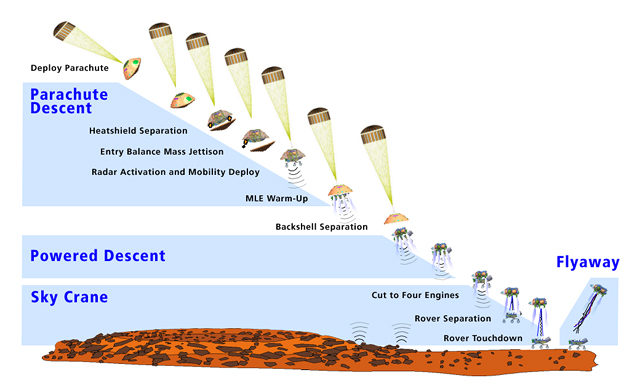
  1. The heat shield. A lander screams in towards Mars at several kilometers per second – more than orbital velocity. Then we want to get it through an atmosphere, and, really, there’s no choice in the matter: as soon as we hit the atmosphere, we get friction with air molecules. A lot of friction. Friction that superheats our spacecraft. So, we’d better put a heat shield on our vehicle!
  2. The parachute. The heat shield gets our spacecraft down to about Mach 2, but if we were to rely on it the whole time we wouldn’t slow down enough before smacking into the Martian surface. We’ve got to get the speed of our vehicle down, and one of the obvious (and lightweight!) ways to do this is by deploying a parachute. (This is actually the part of the process that boggles my mind the most. Deploying a parachute at Mach 2! Yikes! Yet this is what our last three Martian rovers have all done, successfully.)
  3. Jettisoning things. After we deploy the parachute, the heat shield is just dead weight pulling us down. We want to get the most out of our parachute that we can, so we drop the heat shield away with some pyrotechnic charges. When we don’t need the parachute any more, we’ll similarly cut it loose.
  4. Retro-rockets. Mars’ atmosphere is so thin that even the combination of a capsule heat shield and a parachute doesn’t slow the probe down enough to land safely! Earth’s atmosphere – about a hundred times thicker than Mars’ – is fine for this. We can stuff astronauts in a capsule that rides the parachute all the way down, and doesn’t even need to drop its heat shield. But on Mars, even after the parachute gets our falling vehicle to terminal velocity, we still need to do something to slow it down! So we fire some rockets downward, killing off the rest of our speed. And the rover hangs in midair, about twenty meters above the planet surface. Up until this point, the MSL and MER landing sequences are basically the same.
  5. Rappelling. Finally, we need a way to get down that last few meters to the surface. On the Pathfinder, Spirit, and Opportunity vehicles, we popped airbags out on all sides of the lander and just let them go, inspiring egg-drop competition participants everywhere. But Curiosity is simply too big for this to work: it would be like taking our egg drop and substituting a paperweight for the egg. The rover would squish the balloons, still smashing itself against the hard ground. Another option might have been to have MSL sitting on a platform which descends on rockets all the way to the surface, like Phoenix or the Viking landers did. But the platform you would need to do that properly would end up being big enough that you’d have to go tell the JPL robot-builders to make a smaller rover. So instead, we just lower the rover down on a rope, and as soon as the rover registers touchdown, we fly the rocket platform away.

The controllers we will need to get the skycrane to work are really nothing to fear. They are not fundamentally different from the controllers that keep launch rockets pointing up when our probes leave Earth in the first place. But beyond the general terms, analogous robotic piloting happens all over on Earth – from military drones to quadrotors in research labs. As a dynamics and control engineer, I think this design would have been a challenge – but easily within our capabilities. And in terms of overall complexity, this isn’t any worse than, say, a Space Shuttle launch, or the entirely robotic X37-B.

More fundamentally, though, what bothers me about all the criticism and concern about the MSL landing system is one of philosophy. We should be giving wild ideas a shot – experimental technologies, unconventional science experiments, risky missions. That is how we advance the state of the art: by pushing the envelope. If that means that once in a while our rockets explodes or our space probe smashes into a planet, then so be it. I have no problem with seeing NASA try something innovative a fail once in a while!

You see, we didn’t ever start with the Right Stuff. We learn the Right Stuff. And this is how we learn. We simply need to be willing to accept that fact if we want to go forwards.

What’s the Value of Liberal Arts?

There was an NPR article today about how the pressures of the economy are casting some doubt on the value of liberal arts colleges and liberal arts education.

I have a bit of an opinion on this, since I went to the best liberal arts college in the nation and I found gainful employment in my field immediately after I finished with graduate school.

To me, the argument about the value of a liberal arts college seems a bit silly. After all, a huge percentage – if not the majority – of the members of my Williams class majored in physics, biology, chemistry, math, psychology, computer science, or economics – all very practical things that translate directly to various industries and enterprises. A liberal arts college is a tremendous place to study those disciplines: science is a collaborative and inquisitive endeavor, and learning to work with an expert to thoroughly understand scientific principles gave me a much better experience than I think I would have received in the back of a hundreds-seat auditorium getting lectured by a TA.

But Williams did more than give me an incredibly solid grounding in physics, which I could then take towards a doctorate and career in spacecraft engineering. While I studied physics, in very demanding and rigorous classes, I also studied linguistics. And studio art. And history. And even political science. All these things did more than make me a “more well-rounded person.” Study of these subjects gave me exposure to ideas, concepts, and frameworks to help me put all sorts of things in context. So now, when I hear political candidates talk about America’s founders, or invading Iran, or health policy, I have a relevant understanding to evaluate their statements against. When I read about the economy, I have a basic understanding of the principles that govern the situation we face. When I read a good book, or see an engaging film, or view a piece of artwork, I can appreciate the efforts the artists put into those things and understand how they have the effects they do on me. In short: I have gained more than a narrow, vocational perspective on the world – I can approach many subjects from many angles. This is not merely a good thing for its own sake, but it also helps me in my chosen vocation. I’ve used my rudimentary skills as an artist and my experience with writing (Williams grads know what I’m talking about!) quite frequently as an engineer. If this also means that I have a few still lives and unfinished manuscripts in my apartment, well, that’s just icing on the cake.

For the same reasons that I appreciate having a liberal arts background in my academic training, I also appreciate that we have “pure” liberal arts majors in our society. We need historians, writers, artists, filmmakers, and musicians in our society. We need them to remember, curate, create, and teach their liberal arts so that we can keep churning out well-rounded, multi-talented workers instead of narrowly focused drones.

Antitechnocracy

A reporter from This American Life did something interesting for today’s broadcast: she brought together a ninth-grade global warming skeptic and the executive director of the National Earth Science Teachers Association together in the show studio for a discussion. (Audio available here.) The dialogue was reasoned and civil. In quick summary: the scientist presented the skeptic with the best evidence available and went through the logical arguments, from temperature/CO2 correlations to ice core measurements. The skeptic then asked, “well, what about the following things?” – and presented some common climate-change-skeptic arguments (for example, why has there been higher snowfall in recent years in some places). The scientist went through each, point by point, and explained the science behind each and whether or not that science was relevant to the overall climate picture (for example, warmer temperatures allow the atmosphere to hold more water vapor, giving the higher snowfall – and, besides, our day-to-day weather experience is separable from the trend of the climate).

At the end, the reporter asked the skeptic how convincing the evidence was. Did she buy it? In short: no. She said that she could see how the scientist’s explanations could account for all the data, but… The ninth-grader then said something very astute here. This is a similar situation to the debates between scientists and educators and creationists. You have some people who can be convinced, and some who accept the theory, but then there are also some people who won’t buy the scientific results no matter what. In other words, when we want to believe something, we tend to believe it. Regardless of evidence.

Next, the reporter asked the ninth-grader if the scientist could do something to sway her opinion, and what that would be. The ninth-grader thought for a moment, and decided that if she just had all the arguments from both sides laid out in front of her, and she got to make her own decision, then she would be more likely to accept the scientific consensus.

I have mixed feelings about that conclusion. On the one hand, I would like to laud this ninth-grader for her desire to weigh all the evidence and arguments and make an informed decision. (I definitely want to laud her for her presence and attitude on the radio. She was quite reasonable and did a great job expressing herself.) But, on the other hand, the scientist was right to point out that when we are trying to account for the behavior of the universe, our belief has no bearing on reality. And, if this ninth-grader really wants to make all her decisions and form all her opinions this way…she’s got several lifetimes of study, schooling, and degree programs ahead of her.

I wonder to what extent this sort of attitude is systemic in American society. Politicians and pundits challenge scientific findings on the basis of belief, politics, “common sense,” and “gut feelings.” School board candidates get elected by saying that they will “stand up to the experts.” We are supposed to feel that we live in a free country, that everybody’s opinion is valid, and that anyone can make a decision on any issue. While I think that everyone has (and should have) that potential, I am not comfortable with the recent anti-expertise trend that I think may result from that philosophy.

Let me provide a concrete example: suppose I go to the emergency room because there is something going dramatically wrong with my body. I don’t want to try to suss out a diagnosis using only common sense, and I don’t want a doctor who will base his medical decisions on similarly fuzzy impressions. I want the best doctor. I want an expert doctor. I want a doctor who knows all the details of the human body, how drugs and lab tests and surgical procedures work and interact, and how all that knowledge applies to my situation. Similarly, if I have a legal problem, I want an expert defense lawyer – because, though I have the right to defend myself and I’m decent at expressing my opinions, I know that a competent prosecutor could run circles around me. Heck, if I have a car problem, even though I’m an engineer for a living and I learned all about combustion cycles and the principles of mechanics in my physics classes, I want an expert mechanic to fix my problems. I’m a smart and capable guy, but I don’t have the time or desire to become an expert in all these things – so I rely on other people.

“Common sense” is great for some things, such as solving interpersonal problems. But common sense didn’t get us to the Moon, or win the World Wars, or invent the modern computer, or eradicate smallpox. Expertise did those things, and many more.

In the case of climate change, the expert scientists have long held a consensus conclusion. Most of the arguments denying global warming come from politicians and commentators. If we all were willing to go through the effort of learning the scientific process, learning the techniques and tricks that scientists use to produce their results, combing through and analyzing the data, and weighing our conclusions against other studies, then this debate wouldn’t be happening the way it is. Nor would it be happening so if we accepted the conclusions of those experts who did devote their lives to all that data analysis and research. But it seems that Americans all want to make their own decisions on the matter – that they want to think that their beliefs, rather than data-driven conclusions, describe the way the universe works.

After the data is analyzed, though, there is an important role for common sense to play: determining the policy actions, if any, informed by expert conclusions. If economic conservatives want to accept that climate change is happening, but adopt the position that we should not take any action to prevent it, then I can respect that viewpoint as intellectually honest even if I disagree. But when such people deny climate change entirely, well…I wonder what kinds of doctors they want treating them.

The Science is Real

It worries me when I see public figures, or aspiring public figures, disparaging scientific work because it is not compatible with their personal positions. The public gets to hear phrases like, “that’s only a theory,” or “that scientific theory has holes in it,” or “it’s not proven, we don’t know for sure yet;” all of which are meant to cast doubt on the validity of one scientific conclusion or another. The problem (and this is, of course, a point of subtlety that often causes proponents of science to look like they have a weaker argument in the public’s eyes) is that all those things are true for scientific findings. The good thing, though, is that none of those statements should be disparaging – if only lay people had a better understanding of the scientific process.

Scientific theories are “only” theories, yes…but “theory” is actually one of the highest terms of honor an idea can attain in the world of science. A “theory” is only accepted as such if it has graduated from the world of hypotheses after rigorous testing. A scientific theory represents the best possible idea humans can conceive of how part of the world works. And if a new theory comes along, in order to be better than the old theory, it still has to explain the same phenomena and fit the same data. Old theories often remain as subsets of new ones, rather than being discarded entirely.

Even then, when a theory represents the best understanding we have of the world, to say that it “has holes” or is “not conclusively proven” is not to say anything at all. Science is not a process of logical argument from immutable premises – it is a process of induction from observable data. We observe new data all the time, and our theories must adapt to that data if they cannot account for new observations. The most fundamental scientific theories still leave some phenomena unexplained, but that does not make them totally invalid. The theories of Newtonian or Einsteinian gravity don’t account for quantum behaviors, but knowing that does not mean that the next time I jump in the air I won’t come down to Earth again. Our best theories cannot be “proven” and cannot be “airtight” – but we can look at their track records to figure out how confident we should be in those theories. Every single time I have jumped in the air, I have fallen downward again. While the amount of observations I have are finite, and I cannot prove with 100% certainty that the next time I jump I won’t fly off into space, the best human understanding of the way the universe works says that I will be disappointed. This sort of thing – a “theory” – is what non-scientists often call a “fact.”

What I see from some public figures these days is a campaign of anti-intellectualism that I think could be extremely damaging to our society. Don’t let those scientists or experts tell you what to do; they don’t know what your problems are! Never mind that they dedicate their entire lives to studying and gaining a more complete understanding of highly specific things…so that you don’t have to. If we as a society tried to solve every problem with “common sense” and common sense alone (assume enough people have common sense to attempt that strategy…) then we would never have invented vaccines, or automobiles, or light bulbs, or computers. We would never have been able to navigate ships, cultivate barren lands, deal with chronic illnesses, or travel to the Moon. (The same thing, by the way, is true for religion.) No, to do those things requires an methodical accumulation of knowledge that stretches beyond a single lifetime…and so our society invented experts. Good thing, too!

Hand in hand with their anti-intellectualism, I see some speakers getting top billing on hungry 24-hour news networks by making intellectually dishonest  arguments. The difference between a scientist and an ideologue, as I see it, is this: When a scientist sees a data point that he or she cannot explain with the best scientific theories, then the theory has to be changed to account for all the data, both old and new, because the observations happened the way they did. But when an ideologue sees a data point that he or she cannot explain with his or her best worldview, then the worldview remains immutable and the data point is called into question. In their speech, ideologues make data and observations into matters of belief, so that eventually it sounds like the scientific theories those data support are also matters of belief. Thus, individuals can choose to make up their mind to believe, or not, in climate change, or evolution, or medicine, or gravity, or thermodynamics, or electrons. And somehow, we are to suppose that the universe will bend itself to the worldview that we choose to believe in.

By implying that scientific theories are things we can believe in or not, ideologues accomplish two important goals: first, they make the debate about the existence of the theory or even the existence of the supporting data, instead of about how our society should use or respond to the consequences of the theory; second, they turn the theory into something that they can dismiss in a few words: “oh, I don’t believe in X,” or “I’m waiting for scientists to prove Y,” without having to make a rigorous argument. How much scientific work would it take to prove a theory to an ideologue who doesn’t like its implications? Impossibly much, I think. Continue reading The Science is Real

It’s How You Use It

A couple years ago, I was at a house party in Ithaca where I met a first-year grad student who asked me what I was studying.

“Aerospace engineering,” I said.

“Cool,” he replied. “Just don’t ever work for Lockheed Martin.”

(Ha.) I asked him why not. His answer: “They build weapons.”

This student was also extremely frightened of the “Big Dog” robot, which had just exploded onto the Internet in a series of awesome demonstration videos on YouTube. Why? “Just imagine what the military will be doing with that. They’re funding it, you know.” Did he have any specific examples or concerns? No. And I pointed out how invaluable such a robot would be in, say, rugged-terrain search and rescue or disaster response efforts. But none of that mattered, this student insisted, because the project received military funding. Somehow, in his mind, if the Red Cross shelled out millions for the development of Big Dog, it would be okay – but not if that money came from the US Army.

This attitude struck me as extremely naive. (And not just because this first-year was wearing a chai.) Some of the best work in science, engineering, and medicine gets funding from the military, because the military is naturally interested in those things. But I don’t think that means that even the pacifists among us should abandon all those lines of inquiry. You see, I believe in the adage that technology is neither good nor evil – it’s how we choose to use it that defines our goodness or evilness.

I have long since come to terms with the fact that many of the engineering challenges and scientific problems that I want to solve have both military and civilian applications. I want to, for example, land robots on Europa or Titan. Doing such a thing will require precision guidance and pointing systems – exactly the same kinds of systems that could control ballistic missiles or smart bombs. Some of the same technologies that let us aim the Hubble telescope precisely enough to image galaxies billions of light-years away can aim the airborne cannons on an AC-130. The rockets that bring astronauts to the International Space Station, a peaceful, collaborative venture between many nations, operate on the same principles and use the same fuels and control systems that go into ballistic missiles. The key difference in all of these cases is in where we, the human operators of such devices, point them to go.

To take an extreme example: the most devastating weapon we are capable of producing is the nuclear warhead. It is a terrible weapon, and nobody in their right mind would tell you otherwise. Some activists out there are so vehemently set against this weapon that they oppose all use of nuclear power and all refinement of nuclear isotopes. But here’s the thing: high-grade plutonium isotopes are what power all interplanetary probes to the outer Solar System! (Beyond about Mars orbit, sunlight is too weak for solar panels to provide enough power for a spacecraft.) Our country has stopped refining high-grade plutonium, and this is actually a big problem in the planetary science community. Again, I want my Europa and Titan landers…and I can’t have them without a stash of plutonium-238!

(For those astute readers who point out that Pu-238 isn’t weapons-grade plutonium, I would argue that the refining techniques are the same. And, for good measure, here’s one of the most peaceful people ever to walk the face of the Earth explaining a constructive use of the nuclear weapons themselves. Though nowadays we view that concept as not very practical, the next iteration might be antimatter-powered rockets capable of taking humans across light-years – but these would be even more destructive if used as weapons.)

In my doctoral research, I worked on new technologies for spacecraft. Fortunately for my moral ideals, flux-pinning interfaces for modular spacecraft are something that we had a hard time coming up with direct military applications for. Nevertheless, they may exist: we thought of looking for a way to develop a device that uses flux pinning to grab onto a target spacecraft without touching it – tractor-beam style. That I am sure that DARPA would be interested in. We did even end up pursuing that idea down a related, non-flux-pinning line to a small-scale proof-of-concept demo. (Our target application was rescuing derelict or malfunctioning satellites.)

Recently, I heard an Air Force colonel refer to GPS, which is a military-developed technology, as a “weapons system.” Now that I’ve gone from university research into the commercial spacecraft industry, I contribute to systems like GPS satellites, so this observation hits close to home. How many people out there using Garmins or iPhones or Google Maps would have thought that they were using something that the military considers to be a weapons system? GPS guides aircraft, boats, and cars throughout the civilian community. It gives researchers a powerful tool to advance geoscience. (Did you know that nowadays we directly measure continental drift speeds with GPS?!) And keep in mind that GPS is what gives us the capability for automated farm equipment to efficiently produce more food, or aid workers to reach remote destinations, or emergency responders to locate missing people and map out disaster zones. I am more than happy to contribute to those endeavors!

So, do we use our knowledge of particle physics to make the most devastating weapons the world has ever known, or do we use it to power the probes that will help explain our origins and find our place in the universe? For me, the answer is clear; but it is also clear that science isn’t necessarily good or evil. (Neither are scientists, for that matter.) Making it one or the other is entirely up to human decisions.

Call Me Dr. Twit

After much pressure from my girlfriend, I’ve signed up for a Twitter account. I’m going to use the account to echo posts here on Quantum Rocketry.

It’s not a communication medium I really see a lot of value in; if I want to convey information I would much, much, much, much rather do so here, where I have more than 140 characters to develop an idea, in context, without conforming to the soundbite-based, ultra-distilled, headline-only view of things that seems to be the current trend on the Internet. (There goes my liberal arts background, shouting opinions at anyone who will listen!)  And if I feel like being silly and inane, I’d rather do that on a narrowcast medium like Facebook, where my silliness will go to my friends who know what to expect and how to interpret such activity, instead of a broadcast medium like Twitter.

But, though I shall continue my rebellion, I finally got an account anyway. (And I just have to continue my rebellion against all the people who instantly must check everything on their smartphones instead of interacting with me when I’m right in front of their faces!) It is jpshoer. This is 10% to allow further Twitter-based interaction with ‘netizens who read this blog, and 90% because a Twitter account is a requisite for NASA Tweet-ups.

Just remember, kids: one of the few things I think are more stupid than Twitter is the word “tweep,” so don’t call me that.