All posts by josephshoer

Build the Community Center

I don’t often put up posts about non-space politics on this blog, especially now that I have a smidgen of internet fame to my name. However, there’s something going on now that is both important and something I feel strongly about. I’m talking about all this manufactured controversy in the punditry surrounding the Islamic community center in New York City, and I am putting this post up because I strongly support the center’s construction. I have three main reasons for supporting the community center.

Reason numero uno is that there is no rational connection between this community center and the terror attacks of 9/11. Protesting its construction is pretty much equivalent to protesting the construction of churches south of the Mason-Dixon line because the KKK used to lynch people down there. The protesters and pundits are committing the logical fallacy of the sweeping generalization: the 9/11 hijackers were Muslim, therefore all Muslims are potentially to be feared. This is an extremely dangerous attitude, and it brings me to…

Reason number two: I was raised Jewish. My temple Hebrew school curriculum devoted a full year to education on the dangers of bigotry, prejudice, and otherwise singling out any ethnic, racial, or religious group. Certainly, that education focused on the experiences of Jewish people, but the lessons we discussed were broadly applicable. I have internalized many of my experiences from growing up and living as a member of a cultural minority, and I respect the needs for other minorities to practice their beliefs and gather as a community. Such things should not be made unpleasant by the actions of the cultural majority. More than that, the cultural diversity of our country should be celebrated – it is what makes us great!

It’s very easy for hate speech to come out of this, as the protesters stir up emotions. After all, their entire argument is based on emotion: even when the pundits backpedal as hard as they can to avoid sounding bigoted, they end up calling the community center’s location things like “tasteless” – forgetting that, in this sense, “taste” varies from person to person and is based on emotional responses. Even such mild-seeming criticism can lead to prejudice and bigotry. Now, I’m certainly not saying that I think the United States is on a slippery slope to an imitation Holocaust. I don’t think that is true at all. But I know that pogroms and bigotry happened well before that, and what some of the protesters are saying while assembled in a mob near the Islamic center makes me nervous. As a Jew, when I say “never again,” I don’t just mean myself.

Reason Number Three is that I am an American. I am patriotic. I believe in the American system of government and American ideals. I also think about those ideals. The founders of this country were products of the Enlightenment and the internecine prejudices of Europe; they were wise enough to know that their new country should be established without a single state religion and with built-in acceptance of all the various faiths in all the original thirteen colonies. (Remember that, in those days, the various strains of Christianity were considered as disparate and irreconcilable as Hinduism and Judaism. The colonists came from a Europe that periodically tore itself to pieces over differences between Catholic and Protestant groups – and that was between faiths that agree on basic things like who’s a god and who isn’t!) If the framers of our Constitution had wanted America to be a Christian nation, I’d think they would want to be much more obvious about it, to make sure that their intentions were clear as time passed: while Judeo-Christian philosophy certainly influenced the Constitution, that document contains exactly zero references to God, Jesus, or Christianity.Nor does it refer to any other religion.

Even a general lack of endorsement of one religion over another wasn’t enough for the newly founded states, though. Think back to high school history classes: the states refused to ratify the Constitution before the inclusion of a Bill of Rights, and the very first amendment that they demanded specifically prohibits the federal government from establishing a state religion. Not only that, but it grants individuals the right to practice any religion they like, and to assemble together for any purpose, including practice of religion. So not only is the community building this Islamic center well within their rights to do so, but we ought to celebrate what they are doing – they are exercising rights that do not exist in many countries but that we, as Americans, gladly extend to our citizens. We ought to give thanks to the founders of our country and the legislatures of the original thirteen colonies for giving us so many rights, rather than protesting the exercise of these Constitutional rights!

As a final note, let me mention that other supporters of the community center include the mayor of New York City and the families of 9/11 victims. You know, the people actually affected by the presence of the community center, and the people most likely to have a negative emotional response to it. The pundits on Fox News are using the Islamic center as a political football to try and drum up support for reactionary candidates, and I think they ought to be ashamed of their actions. Not only do they come across as prejudiced, but they seem very un-American to me. Of course, this is America – so they can keep right on saying what they’re saying. That’s one of the sticky points about any debate like this. At the very least, though, I can hope that with all the information available out there, the general populace will think critically about what’s going on before succumbing to emotional reactions.

The Ice Fracture Explorer

Europa, the second Galilean moon of Jupiter, has been my favorite planetary body for a long time. The reason I like Europa so much is that it’s a world whose orbital dynamics with Jupiter, its orbital resonances with the other Galilean moons, and its own rigid-body dynamics have a strong hand in creating its surface features – and giving it the potential to harbor life. It’s one of perhaps two or three extraterrestrial places in the Solar System where we might hope to find life. Europa is also easier to get to than Enceladus or Titan. As such, I think it ought to be one of the highest-priority exploration targets for robotic space probes. (Human exploration would be nice, too, but if you think radiation exposure on the way to Mars is hard, you don’t even want to consider putting people in the Jovian system!)

Thanks to magnetometer measurements and images from the Galileo mission, it’s pretty much established at this point that Europa has an icy outer shell over a global liquid ocean, with a rocky core on the inside.* The only question is how thick that ice shell is – I’ve read estimates ranging from 10 meters to 100 kilometers, with a pretty high confidence of ones to tens of kilometers. The ice shell gives rise to a number of interesting surface features. A particularly cool sort of feature, found with global extent across Europa, is the double ridge.

A prominent double-ridge feature on Europa, most likely a crack in the icy shell

Planetary scientists have a number of models for how these double ridges form, and they generally seem to agree that the ridges mark the locations of cracks in the ice crust. One especially well-established model suggests that these cracks occur when Jupiter raises tides in Europa’s ocean – just like how the Moon raises tides in terrestrial oceans, but much stronger, because Jupiter is frakking huge compared to Earth’s moon. Europa’s ice crust bulges out over the ocean’s tidal swell and then cracks under the incredible stress. (I like to take a moment to think about the mindbogglingness of that statement: the whole moon’s surface cracks. I’ve stood on a frozen pond when a crack pings through the foot or so of ice on top of the water – Just imagine standing on Europa when this happens!) Once a crack forms, the tides don’t go away. As Europa rotates, about once every three and a half Earth days, the tides periodically lever these cracks apart and squeeze them back together again. In this model, every time the cracks gape open the subsurface ocean gets exposed to space. The surface water boils and rapidly crusts over with ice, and when the cracks get smushed closed, all this ice gets crushed up and forced to the top and bottom of the crack, forming the ridges. The ridges appear in pairs because the crack opens up again after that. These double-ridge features are mounds of crushed ice flanking passages into Europa’s ocean!

Dr. Richard Greenberg is a planetary scientist who thinks that these cracks in the ice shell might be potential sites for life to take hold. Unlike the rest of the subsurface ocean, they get exposed to sunlight, which means that photosynthesis could take place. The periodic in-and-out forcing of the crack would also drive strong currents, which is another energy source Europan life could use. (Those aren’t the only energy sources: other possibilities include thermal gradients in the water, volcanic vents on the ocean floor, or even induction as Europa travels through the Jovian magnetic field.) Of course, that life would also have to adapt to the crack opening and closing once every 3 1/2 Earth days!

Europa's possible ice-fissure biosphere (from New Scientist; click for full article)

We do at least know, from the Galileo mission, that these cracks often have accompanying veneers of organic (e.g. carbon-based) molecules and salts splashed onto the ice surface. This is why the cracks appear as brown stripes in large-scale context images. The crack/veneer combination suggests that there are organic molecules and salts in the Europan ocean, and that those compounds get pumped to the surface through these cracks.

So, let’s take stock: Europa is the only extraterrestrial world with a global liquid water ocean, there is a definite possibility for life in that ocean, and these double-ridged cracks are a possible gateway into the alien biosphere.

Well, then, let’s go diving! Read on for my concept system architecture for an ambitious Europan ocean-exploring mission, which I call the Ice Fracture Explorer.

Continue reading The Ice Fracture Explorer

My Presentation Philosophy

Hello again, Blogosphere!

I spent last week in Toronto at the annual AIAA Guidance, Navigation, and Control Conference. This is a huuuuuuuuuuge conference of engineers from academia, military, and industry all presenting papers about their research. So, I got to see a lot of Powerpoint presentations. (Okay, okay, supernerds, there were some PDFs and Keynotes. But “Powerpoint” is pretty much like “Kleenex” these days.) And an awful lot of the presentation slides I saw looked something like this:

Fine, right? I mean, this is a technical venue, full of super-brainy engineers. We want the facts, ma’am, just the facts, in all their glorious mathematical detail, and style means nothing. Right?

WRONG!

The first rule anyone will ever tell you about giving any kind of presentation is to know your audience. And if I’m in the audience at a conference like this, then I’m spending a full day listening to technical talks and you have only twenty minutes to make me think that your research is as cool, interesting, or relevant as the title made it sound when I picked it out of the lineup that morning. Because I’m still holding the conference program in my hand, and I have a notepad and pen ready to jot down research ideas the last cool presentation made me think of, and I might have my laptop in my bag, so I’m not at a loss for things to do if you’re not very exciting. In other words, not only do you need to convey your technical material, but you also need to keep me interested and/or entertained, at least enough to keep me listening to your technical stuff.

It’s a tall order.

I’ve been told that I do a good presentation, though, so I’m going to share a bit of my philosophy for what a technical presentation should be like. Here are the points that I start from:

  1. Nobody wants to see lots of equations. Some are necessary, sure, and they can be a great way to add technical gravitas, but a 20-minute presentation is a much better time to show off results, pictures, movies, hypotheses, conclusions, possibilities, tricks, and excitement. And if the conference is like GNC, requiring a paper with each presentation, then all the equations go in there, anyways. The oral presentation is for highlights, not derivations.
  2. These presentations come in the middle of a solid block of otherwise identical presentations that are going to blur together in the audience’s minds. So, they need to be distinctive. In other words, a bit of flash and polish goes a long way. Also, attention-grabby things like pictures and movies are good, but not if they’re just thrown together in a clip-art sort of way. (There’s good attention to grab, and bad attention to grab!)
  3. Slides are visual aids. I mean both “visual” and “aids.” Think about both of those terms: slides are supposed to be for showing the audience things. And the slides in a live presentation are not supposed to be completely independent of the presenter: you should refer to them, but you are the one giving the presentation.

As an example of my own style, allow me to go through my recent GNC presentation slides and point out my thoughts on their layout, style, and content. If you want to follow along, most of the presentation itself is here on YouTube:

Continue reading My Presentation Philosophy

Research update: Multibody Dynamics Simulator

When I’m not doing silly things like constructing languages, writing science fiction, or biking through the Great Smokey Mountains, I have a research job in a Cornell spacecraft engineering lab to maintain. Mostly, that stuff doesn’t go on my blog because it ends up on our research group web site or in published journal articles and conference papers. But I’ve hit a milestone, and I think it’s pretty cool.

I hand-coded, from scratch, a multibody dynamics simulation package for Matlab. Continue reading Research update: Multibody Dynamics Simulator

Planetary Geology: A Detective Game

…full of unsolved yet soluble mysteries!

Mysterious craters on Mars

I’m shamelessly bouncing all you readers over to the Bad Astronomy blog for this post, which is a great outline of the detective process that is planetary geology. It’s also a great illustration of how much context matters and how leaping to conclusions is…bad. AND it’s a good demonstration that, when there are several hypotheses in consideration, elements of each could be synthesized into the proper conclusion.

All things for us to keep in mind, in science and in everyday life!

(Also, way cool pictures that are reminders of TOTALLY AWESOME events in the past!)

Projecting Space Battle Physics

When I wrote my original article on the physics of space battles, and the accompanying short story, I made the creative decision to speculate on how space battle technologies and tactics would play out if we built from the present day – or, at least, the very near future. The obvious thing to look at next is what a more distant future might hold – so, I’ll embrace my status as That Space Battle Physics Guy!

A possible near-future space fighter radiating excess heat between battles

I think that extrapolating or projecting space battle technologies forward in time is a difficult thing to do, even for the cleverest science fiction geeks. I say this for two reasons: first, aside from some general trends, it’s hard to predict exactly where technology will go in the next ten or twenty or fifty years; second, nobody gets to play this game against a live opponent – and that’s really how combat tactics and technology develop. Still, given the trends, it’s fun to speculate! Physics won’t change radically for quite some time, so we have some direction in which to proceed.

I’m going to proceed from the assumption that “spacecraft” are different from launch and reentry vehicles. Let’s take some possible combat spacecraft systems, think about the related problems that spacecraft engineers try to solve, and see what might (!) happen if the aliens wait till we have some operational space colonies before they invade…

Continue reading Projecting Space Battle Physics

I like this “cinematic” trend in video games

I’ve been a fan of Blizzard Entertainment since their WarCraft II days. I must admit that I’m unusual in that respect – because the thing I liked most was Blizzard’s storylines. Don’t get me wrong, the gameplay was great – I loved sneaking those ghosts into Terran Confederacy bases, blasting my way through enemy defenses with a Protoss carrier group, or overrunning the towns of Azeroth with necromancers and skeletons. But I really appreciated the time Blizzard put into the single-player campaigns and the storylines behind them.  Even with a standard real-time strategy-game God’s-eye view of the battlefield, I would imagine what the Terran frontier towns on Mar Sara were like, imagine Kerrigan making her last stand against the Zerg onslaught, or picture Tassadar on the bridge of his command carrier, surrounded by his most trusted warriors as he led them to their heroic end.

Blizzard isn’t alone in this, of course. For all its repetitive gameplay, Assassin’s Creed tried to be as much like playing inside a movie as it could (it’s only a matter of time until someone takes a similar engine to make the Bourne Identity video game, and that will be awesome). The Star Wars universe became an interactive movie with The Force Unleashed, especially on the Wii, which let players wave their hands through the air to control the Force (at least, in a rudimentary way). But besides the gameplay elements, The Force Unleashed is a great example for having production values right up there with movies – that game had some of the best concept art I’ve ever seen, the story was clearly thought out and compelling, and the acting was very well done. Speaking of acting, video games were once the realm of C-list voiceovers, but now we now have the likes of Martin Sheen voicing characters in Mass Effect 2 – which had a tremendous cinematic trailer, enough to make me wish for an XBox.

I really like this trend. It makes video games into – gasp – a reputable medium for storytelling. I don’t think this format will ever replace books or movies, but it can certainly come up right beside them as a way to tell an interesting tale, describe compelling characters, teach us something about human interactions, and make the audience think.

Oh – what prompted this sudden post, you ask? Easy:

Not only is this an insanely high-production-value cinematic trailer, but it is clearly investing the StarCraft II story with a great deal of emotional content. Yeah, sure, it’s emotional content I’ve seen in movies/books/TV before – what is important to my point here is that the last time we saw this stuff, in the original StarCraft, it was from a standard RTS top-down perspective with voiceovers on little moving head-and-shoulders portraits of Kerrigan and Raynor. Now we see it as if it’s got a film director behind it. And now all the gamers get immersed in not only the plot but the characters’ experiences and sensations. Exciting stuff for storytellers!

Smoky Mountains Report

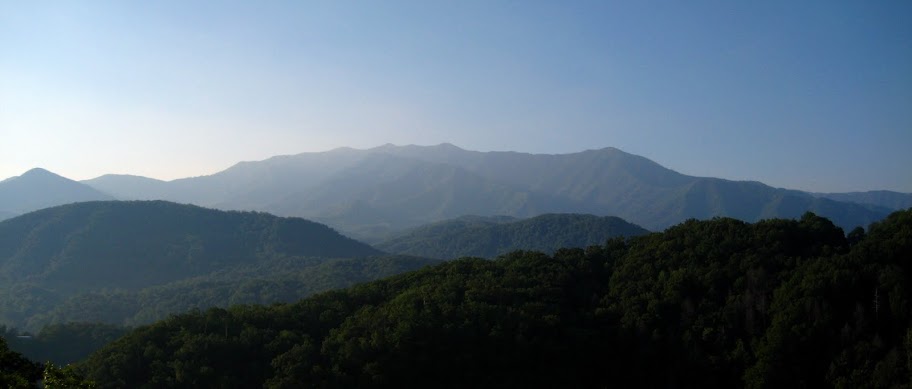
I spent the week of the Fourth of July with my girlfriend’s family in Gatlinburg, Tennessee, right next to the Great Smoky Mountains National Park. I have driven through the southeastern United States twice, but never had a chance to get out of the car and look around much, so I was very happy to add a new area of the country to the places I’ve visited and go take a look at my 7th National Park. (Everglades, Zion, Grand Canyon, Mesa Verde, Bryce Canyon, and Petrified Forest were the previous six.) We landed in Nashville Airport, made a valiant attempt to dodge all the country music, picked up our rental car, and then drove though the countryside for four hours before coming in to Gatlinburg, driving up a mountain, and arriving at her family’s swanky rental cabin. (I shall skip over describing the übercheesiness that is Gatlinburg itself.) An impressive view greeted us out the back porch…

Gatlinburg

They don’t call them the Smoky Mountains for nothing. It was pretty hazy most of the time I was there, so we got a lot of views of faded ridgelines marching off into the distance, covered by lush deciduous forests. Of course, as this was a family event, we spent most of our time in that cabin and generally had a great time. But my girlfriend and I managed to make two highly successful jaunts into Smoky Mountains NP.

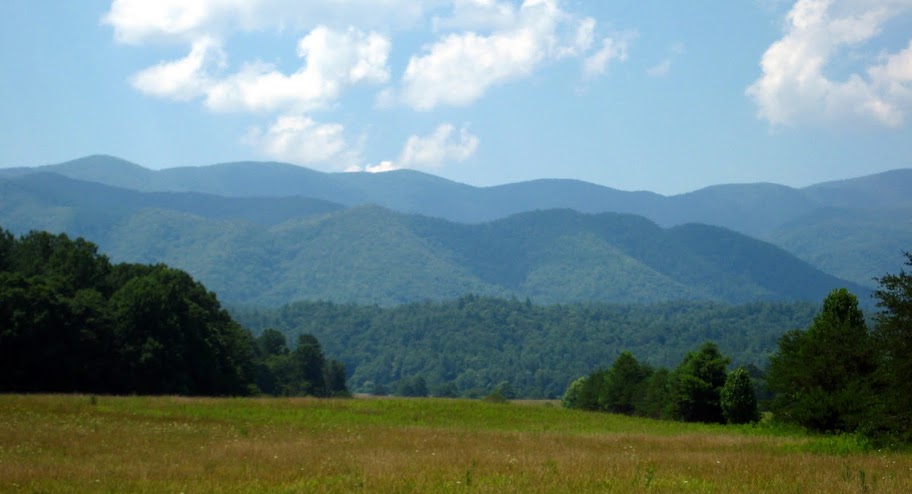
The first was a bike around the 11-mile Cades Cove Loop Road. This loop starts at a visitor center an hour’s drive into the park and circumnavigates a flat expanse of farmland in the middle of the mountains. Even the drive in was fun – it reminded me quite a bit of the drive from my home to Williams on Rt. 2, on the part around the Mohawk Trail. Makes sense – the Berkshires and Appalachians formed in similar orogenies, though the scales were far different. Anyway, a farming community has existed in Cades Cove since the first settlers made it that far west and persists today. The loop road winds along what were – to an Ithaca biker – gentle hills and afforded us a lot of panoramic views as well as some brief visits to historic buildings. (The Park Service calls the Loop Road a “moderately difficult” bike. That was definitely on account of the condition of the rental bikes, and that they tell you not to use the front derailleur – I think the one on my girlfriend’s bike was actually disabled. Fortunately, I had my multitool….)

View from the Cades Cove Loop Road

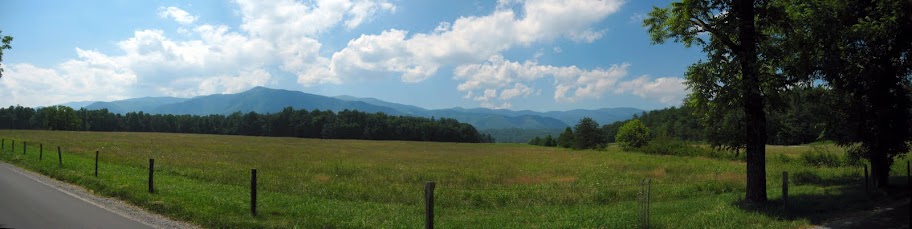
There were quite a few panoramic views from the road. Cars and cyclists share the road, and despite the many pullouts, traffic was slow as the people in cars paused to take photos. I was happy to be a bit more mobile and flexible!

Cades Cove panorama

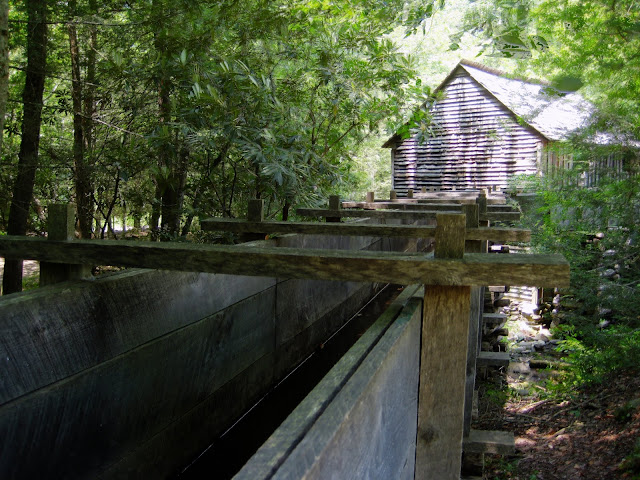
At the far end of the loop was another visitor center built near the old farming community’s mill – which looked very picturesque among all the trees! I had a fun time playing with the CDHK high-dynamic-range script on my little Canon point-and-shoot to get a picture of the half-shaded, half-sunlit mill building:

Cades Cove mill

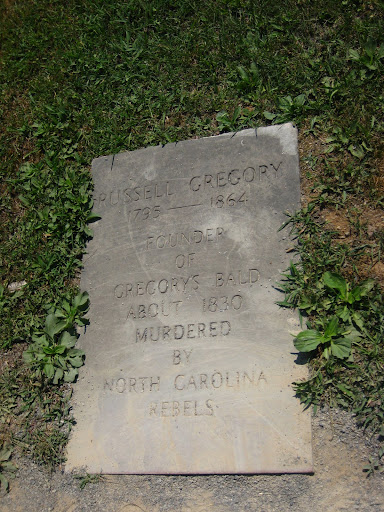
Inside the mill, they sell corn meal ground at the site. Of course, we weren’t going to hump any of that out the remaining 5 miles on our clunker rental bikes! After pausing awhile for lunch – which gave us an opportunity to improve my blood sugar, the water level in our bottles, and the worst of the derailleur problems on our bikes – we set off again. I was most interested in the scenery of Cades Cove, as after seeing one or two of the historic old houses, you’ve pretty much seen ’em all. However, there were still interesting historical tidbits to be had. Here’s a pretty cool grave we found in the cemetery around the Primitive Baptist Church:

Murdered by Rebs!

Our bike tour finished with a close encounter. On the way back, all the cars on the road suddenly jammed up, with occasional people pointing out of rolled-down windows. I cast a look off to one side and spotted a BEAR. I skidded to a stop, and it turned out to be a mother black bear with two cubs, rooting around in the shrubbery. They had warned us about bears at the visitor center, but I took those warning in the same way I take any warning about animals in parks – yeah, yeah, okay, if I see a bear I’ll be sure to keep that stuff in mind! Little did I know that they give these warning in the Smoky Mountains because you will probably run into bears. I took some grainy movies before they got too close for us to do anything but get back on the bikes and get going. We had no windows to roll up!

After the Cades Cove bike, we collapsed at the lodge. The next day, though, we were feeling intrepid enough to be looking at hikes in the park, and based on the description alone we picked out Chimney Tops trail. This was a big win.

Chimney Tops is a 2-mile trail to the summit of a mountain right next to LeConte Peak, the highest point in the park. The last mile of the two gets steeper and steeper, ending with a bare-rock climb. I, my girlfriend, and her cousin were very excited as we set off.

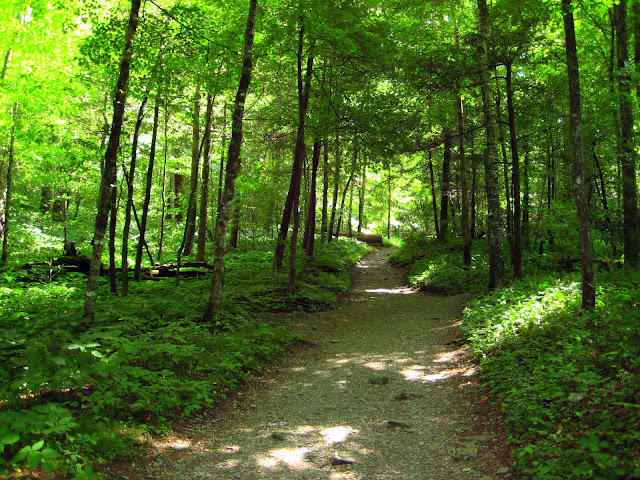
One of the first things to strike my about this hike was how lush everything was. I’m used to forests that consist large of trees and ground cover, like those in New England. Whenever I see a different forest ecosystem things seem a little funny to me. So far, the weirdest to me has been the ponderosa pine forest around the Grand Canyon, which consists of huge ponderosas and nothing else. Well, Smoky Mountains National Park is at the other extreme: solid green growing things from ground level up to the canopy.

Chimney Tops Trail

(Other great examples here and here.) We even managed to spot a Jordan’s Red-Cheeked Salamander in all that foliage – a salamander species found only in this National Park! Shortly thereafter, we almost had another encounter with a black bear, as we saw some fellow hikers hoof it down the trail to us and tell us that they were doubling back a bit to avoid a bear that had burst out of the undergrowth right in front of them. We didn’t see the bear – only some wet footprints a few minutes later.

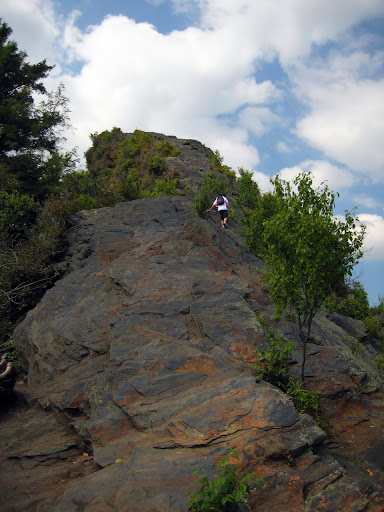
Chimney Tops Trail reminded me a little bit of Angel’s Landing in Zion National Park – though the climates, geology, and trails had plenty of differences, of course – in that it ends with hikers climbing out onto a spur of rock that sticks out into a valley. So, as the hike got steeper and steeper, eventually it turned into this!

Scaling the summit

Pausing at a convenient stopping point partway up those rocks, I turned to one side and snapped the following panorama, a preview of what we saw at the very top.

Panorama near the top

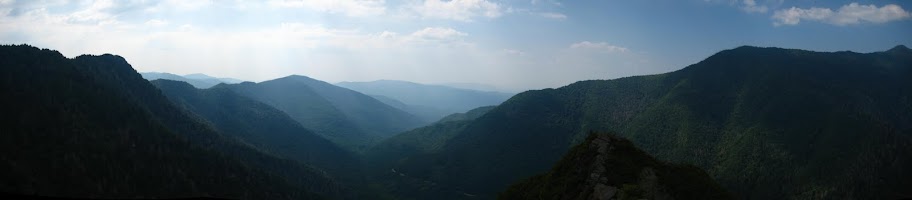
Finally, after a bit of exciting scrabbling, we got to wedge ourselves into some crevices at the top and have a good look around. Scenic! (Click to panoramify.)

Chimney Tops summit panorama

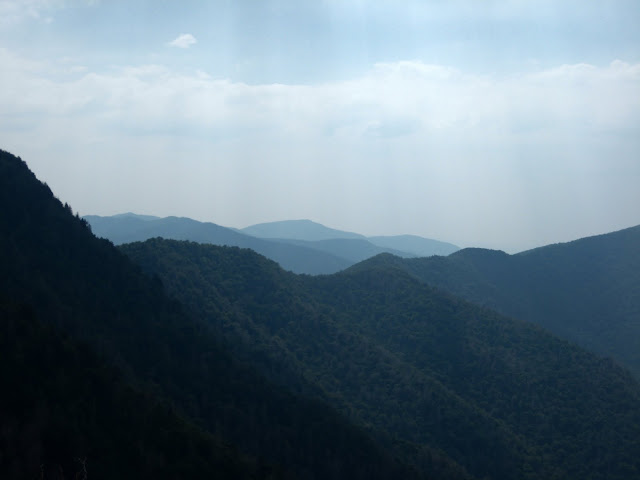
Have I mentioned that I love my little Canon SD1000, which fits in my pocket, has a nice panorama mode, and lets me take HDR photos with CHDK? In fact, the HDR tricks I’ve been playing with were wonderful up on Chimney Tops, because they let me combine exposures to get some good shots of the progressively faded mountain ridges staggering off into the distance over the near hills. One such example:

HDR of mountain ridges

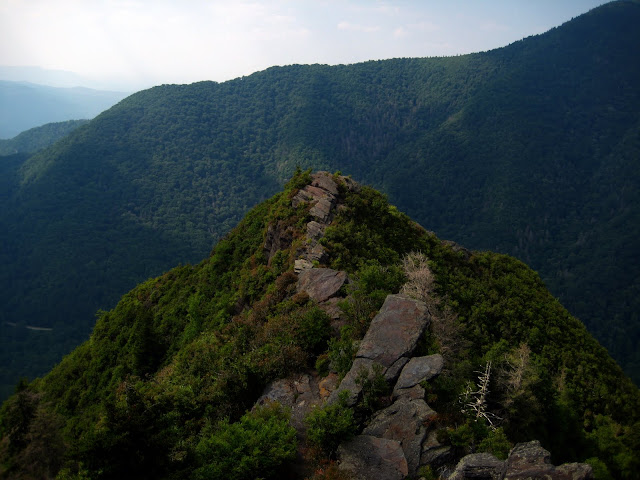
And another, capturing the tip of the mountain spur forming the Chimney Tops:

HDR mountain rock spur

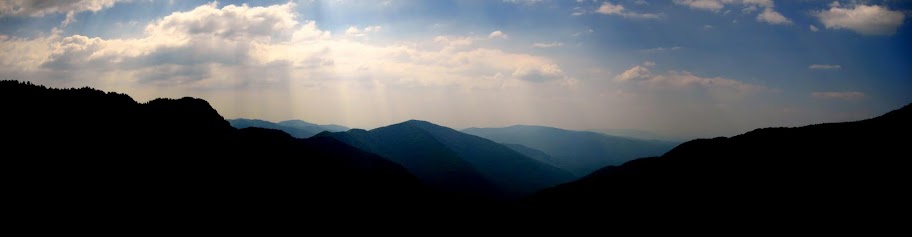
Under the shade of the trees it had been nice and cool, but as we came out onto the bare rocks it warmed up. As we snacked, sitting on the mountain, the sun was flirting with the edges of some clouds. Coupled with the haze and humidity, this meant that we got a pretty nice optics show of sunbeams blazing down on the distant mountains. I tried to capture some of that with my camera, too, but found it about as difficult as the one time I was in a position to photograph the aurora borealis. Still, I got a few nice images!

Smoky Mountain sunbeams

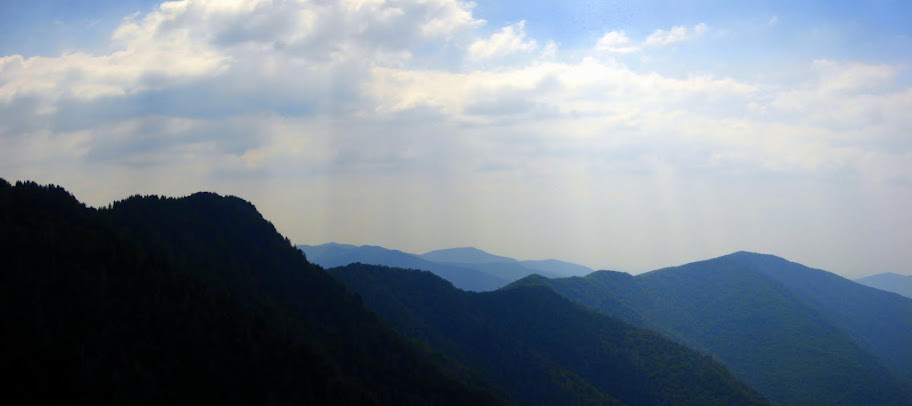
I even figured out how to postprocess the living heck out of one panorama to bring out the sunbeams without totally destroying the rest of the image. I quite like the result, below! You’ll want to click on this one.

Smoky Mountains sunbeams

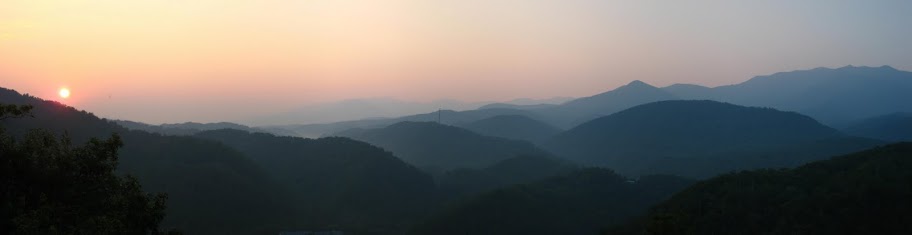
Maybe next time, I’ll have to try and time that hike for sunset or sunrise!

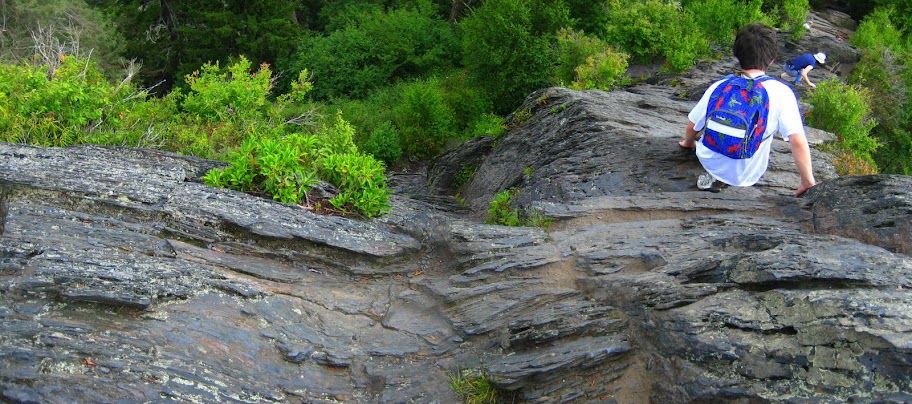
After a good deal of gawking, it was time to head back. Of course, climbing up the rocks and climbing down the rocks are two different problems, and we were a bit slower picking our way down the steep surfaces. This is the best picture I got that gives a real sense of going down. Notice all the deformation in the tilted stratigraphy, with girlfriend and her cousin for scale. (The runner-up is this photo.)

Going down!

I’ve gotta say that the Smoky Mountains were definitely worth a visit, and I’d happily recommend Chimney Tops as a good morning or afternoon hike. I like hiking, and I like our National Parks, so I was happy for the chance to get to see another in an area of the country I haven’t been to.That’s one of the things I like best about the United States: we’ve got so much stuff within our borders, but everyone uses the same money, understands English, and follows the same road signs. And sometimes we even feel like protecting what we have, so we can go into these spectacular places!

Gatlinburg ridges at sunrise

See all my pictures on Picasa – I had fun tweaking them all on the plane back to Ithaca!

NASA, High Technology, and Me

You know why I’m most excited about President Obama’s proposed budget for NASA? High-powered technology research programs. Hey, our space program really ought to be synonymous with high tech!

At an industry forum today hosted by NASA’s Office of the Chief Technologist, several new research programs, open challenges, and collaborative initiatives got rolled out – and my research group’s projects were, literally, a poster child for NASA!

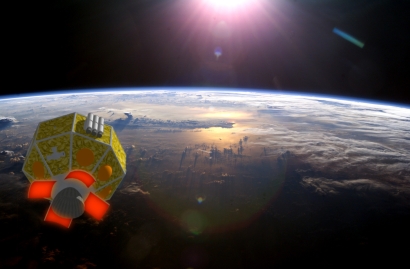
In this presentation on small spacecraft technologies, you can see a picture of Cornell’s CUSat spacecraft on page 5…concept pictures and graphs that I developed for my flux-pinned spacecraft project on pages 7 and 15…a picture of me in front of the Zero-G aircraft in page 15, along with a picture of my labmates with our equipment in microgravity…and the citation slide lists this post on my blog.

I’m thrilled – as a guy who’s passionate about space exploration and passionate about combining weird physics and radical engineering to make sci-fi technologies into reality, I’m really psyched to see innovative programs like NIAC come back from their funding graves and a new NASA focus on enabling technologies that will help make our space exploration dreams into exciting realities.

Time for space enthusiasts to lobby hard for the new budget on Capitol Hill!

Science vs Religion on The Daily Show

Normally, I have great respect for Jon Stewart as an interviewer. On The Daily Show, he knows when to be serious and let his guests say their piece, but he’s also primarily a comedian rather than a journalist and so he has the freedom to call them like he sees them when he feels like it. For a great example of one of his better interviews, I like this wonderful mid-Obama-Administration talk with David Axelrod: 1, 2, and 3. However, Thursday I was rather stymied by his interview with Marilynne Robinson, about her new book on religion vs. science.

First, let me say that I thought Robinson did a terrible job making her thesis clear. It sounded to me like she was trying to say, basically, that Big Science and Big Religion are at each others’ throats when they don’t have to be. (This is, aside from the implied existence of Big Science and Big Religion, a fine idea – though not a very new one.) However, she would say things like,

people on one side of the argument have claimed the authority of science, but they have not construed an argument that satisfies the standards of science.

As soon as I heard her say that, I thought her statement begged the question: What’s “the argument?” Who, representing capital-S Science, had made an Argument to or about capital-R Religion? So far as I know, the scientific method and body of scientific knowledge is not diametrically opposed in any way to religious belief. Certainly, a scientific theory could contradict a religious tenet, but “science” and “religion” themselves are not the mutually exclusive poles of any spectrum I can think of. Nor can I think of any “argument” that the entire scientific community or body of knowledge have with the very idea of religion. I waited with bated breath to hear Stewart immediately voice my thoughts (“And what argument would that be?”), but sat in frustration as he nodded along with her, letting her define this imagined Science vs Religion debate on her own terms.

This struck me as dangerous. Continue reading Science vs Religion on The Daily Show