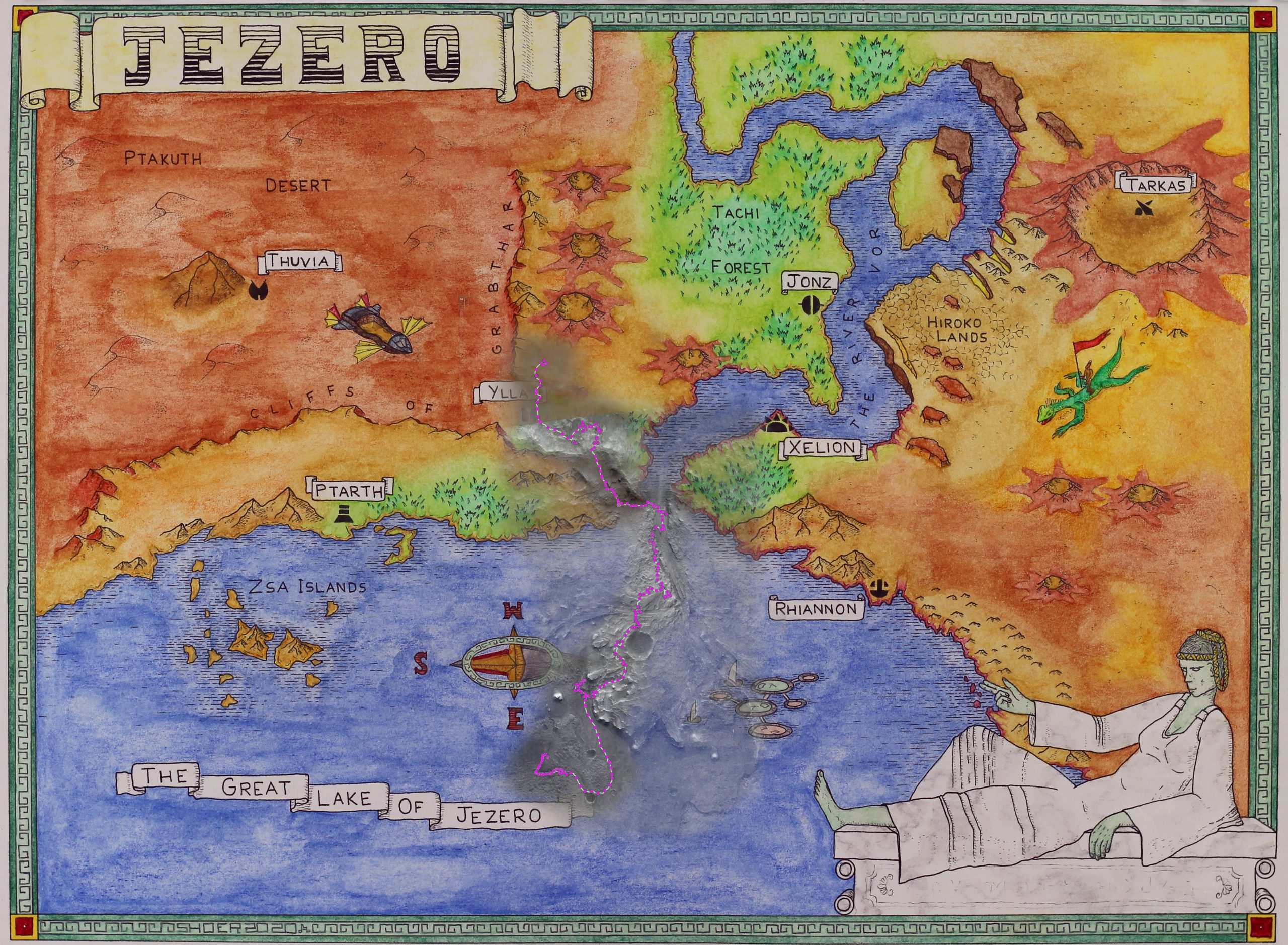
Something today possessed me to look back at my Jezero crater map and overlay the Perseverance rover’s actual track onto it. Here’s the robot’s progress up out of the lake and into the Ylla hinterlands! It may eventually reach the Tachi Forest.
Pulp-style fantastical map of Jezero Crater on Mars, with a trail of dots marking actual locations the Perseverance rover visited through the end of May 2026.
I drew this map in an intentional pulpy, sword-and-planet style with many references to Martian stories from science fiction. (Sometimes with my own spelling variations to obfuscate a little.) Thuvia is the Princess of Mars from Edgar Rice Burroughs’ tales. The patterned ground of the Hiroko Lands is named after a character from Kim Stanley Robinson’s Mars Trilogy. Jonz is a reference to the Martian Manhunter from DC Comics. Tachi is the original name of the Rocinante from The Expanse. And the Zsa Islands are after The Queen of Outer Space, an in-joke targeted at a very small audience.
An element of real science to this map is that I did base the water level on information I found for the predicted appearance when the lake was full. When I originally drew this map, I was a little disappointed that the rover landing ellipse was fully in the water; the main science target was the river delta formed by sediment flowing into the lake. But I knew the plan was for the rover to climb. I oriented the composition looking up toward the river, to suggest that progression. I’m thrilled to see that, by now, the rover has climbed its way up the delta and into the lake’s surrounding highlands, right in the middle of my composition.
While I am querying agents for my first novel, I’ve started a new writing project. It will probably end up about novella length, though that is yet to solidify.
It’s common knowledge that certain tech moguls want to colonize the planet Mars. They have seemingly prioritized solving the problem of getting stuff to Mars over the problems of figuring out everything we’d need to know for humans to actually live there. They excuse this neglect with handwaving about how artificial intelligence — meaning, specifically, sophisticated chatbots — will solve all the other problems for us. Some of them are willing to consume anything and everything on Earth to make this vision happen.
This is the story of how their descendants escape.
Here is the first scene.
Yawning, Brad watched the cargo rocket ignite its landing engine with a crackling roar that penetrated even the thin Martian atmosphere and his surface suit. The tall cylinder plummeted down through its own exhaust, sooty combustion products depositing on the bottom of its gleaming silvery surface. It arrested its descent just above the landing pad. The towering vehicle tilted slightly, sliding sideways to center itself on the landing zone. Three landing legs popped out.
Brad squinted. He felt behind him for the lip of the hatch.
Beside him, Tyler shifted his weight. A sharp intake of breath registered through the helmet comms. Connor took a step backwards into the air lock.
The fourth leg extended.
The engine performed a brief set of small adjustments, and the rocket thumped down on the pad with a metallic ping. The flame went out. Brad watched its nose, high in the air, sway back and forth in the silence.
“So cool,” Connor said, moving out of Brad’s shadow.
“I guess,” replied Brad. His hand still gripped the edge of the air lock door to the ramp underground.
“Brad,” HARI’s pleasant, male voice crackled from the helmet speakers, “it is time to unload the cargo.”
“Yeah.” They walked out onto the packed-regolith causeway toward the mobile cargo lift that they’d take to unload the supply ship. This would be the fourth supply ship Brad had unloaded in the last couple weeks. About every two years—once a Mars year—a whole series of cargo rockets would land at Mars City and then depart again. Three of the empty ones still stood in the landing zone. Brad’s eyes slid over to the desert at the side of the landing pad, where the toppled wreckage of a few identical silvery cargo landers sprawled in irregular heaps of twisted metal. He slowed.
“Inattention is a risk to surface operations,” said HARI.
“Yeah, sorry.” Brad hastened to the cargo crawler and clambered up. The metal access stairs, once a safety-bright color, had been scoured down to a rough rusty orange. The controls at the top handled both the vehicle’s rover treads and the scissor lift that raised and lowered the flat cargo platform. Brad waited for Connor and Tyler to sit down on the deck. Besides the differently colored stripes on their suits, Brad could tell the men apart by Connor’s wirier build. Once they were situated, Brad drove the crawler to the landed rocket. The deck rolled and listed as the ungainly vehicle trundled over the compacted Martian dust.
Brad nudged the crawler lift up against the side of the latest rocket’s tall cylindrical tower. Once in position, he held his gloved hand on the button to elevate the platform. The mechanism whined. “Hey, HARI? How often do these rockets crash?”
“You’re asking about the design and safety record of the Kestrel Cargo Lander. The Kestrel is a game-changing technological system for delivering supplies to Mars City. Since its invention by the revolutionary tech mogul Trevor Sweet, the Kestrel has had a mission success record unparalleled in the history of space exploration.”
“Trevor Sweet was amazing,” Connor intoned.
The lift platform reached the cargo hatch in the vehicle’s side. Brad took his hand off the control. “I didn’t ask about my grandfather, I asked how many of these crashed.”
“Great question. Kestrel engines are designed with a factor of safety—”
Connor and Tyler went to work unlatching the cargo hatch. Brad sighed, turning away from them. He looked back at the wreckage near the pad. “One, two, …three,” he counted. “How many crumpled landing engines am I looking at, there by the side of the landing zone?”
“There are six landing engines beside the landing zone.”
Brad nodded, returning to the side of the metal cylinder. He signaled to the others to haul the pressure hatch open. It had been just over fifty years since Sweet led his people to their new life in Mars City, saving them from the ravages of dead Earth. So… “HARI, what’s fifty divided by six?”
“Let’s work it out. Fifty divided by six is eight and one-third, or eight point three three repeating in decimal notation.”
About one crash every eight years. Brad was twenty-two and hadn’t seen it happen. Maybe they were due for another one.
He stepped into the cargo space and looked around, his helmet light catching the round edges of the plastic-wrapped boxes within. They were stacked solidly against the inside circumference of the lander. He grabbed the first box by its inset handle and pulled it out to carry outside. There, he tore the outer plastic wrapping off, crumpled it in his hand, and tossed it into the cold Martian wind. CORN, read the tag on the box. Connor approached, pulling the plastic wrap off an identical box.
Brad skirted the smaller man, went back in, and pulled the next container. It also said CORN. He stacked it with the first one.
The exertion felt good. He grabbed two boxes, holding them by their handles, and hefted them up and down while he walked to the back of the lift platform. He’d get some good reps from this. CARROTS and BEEF, GROUND started new piles next to CORN.
Brad’s life was pretty good, but he had been too long inside. The people of the underground Mars City rarely saw the sky. Everyone knew that this colony was the salvation of humankind — the only way to ensure the continuation of the human race after disaster consumed the overburdened Earth. This City was all that was left of human civilization. Life could be boring inside the walls, though. It was nice to look out to the horizon. Brad wouldn’t say that out loud. HARI listened to everything, and even Trevor Sweet’s grandson got tired of its lectures.
He positioned a container labeled 3D PRINTER FILAMENT. On his way back to the lander, a sharp pop-pop-pop startled him. He spun toward the sound. One of the six-wheeled sentry drones had stopped its endless patrol around the City and swiveled to face a dust devil spinning through the red desert. Pop-pop-pop-pop went the gun on top of the drone again. Brad saw the bullets kicking up red sand and rock chips from a crater wall beyond the dust devil.
“HARI,” he said, “what are you shooting at?”
“As the guardian of human civilization in Mars City, one of my primary functions is to protect the city and its environs from outside invasion. I identified an invader violating the Mars City land claim.”
Brad looked out at the desert. The whirl was gone. “I don’t see anything.” “I detect no invaders now. You are safe.”
The drone backed up, wheeled around, and continued across the landscape.
Brad sniffed.
Four hours later, he held his hand on the button to lower the lift platform, staring at the stacks of boxes through the fog condensed on the inside of his helmet. They’d already had to rebalance the load twice. That was unusual. This time, there were so many more CORN and CARROTS boxes compared to the BEEF, GROUND boxes that Brad had thought the platform was going to tip over if they kept stacking like boxes together. He wondered whether there had been another cargo drop in the past with so little meat. Brad sniffed. They could already grow carrots in the City. Usually, these supply shipments had stuff they didn’t grow.
HARI could probably tell him why things were different this time. But Brad was tired, feeling flushed from the exercise, and didn’t really feel like asking. When Tyler closed the Kestrel’s hatch and sat on a pile of boxes next to Connor, Brad simply signaled them to hold on and started driving the crawler back to the City air lock.
Update 18 June 2024: As discussed in the comments, a reader pointed out that I was misinterpreting the indication of the month of the year, and Lego’s instructions are correct. I’ve struck out the incorrect portions of this post. (And I’ve corrected the model on my desk.)
When I saw that Lego was releasing an orrery, I knew that I had to get my hands on it — for work! I deal with new space mission concepts around the Moon with some regularity, and you have no idea how often I find myself thinking, okay, that lamp is the Sun and my hat is the Earth, so the spacecraft has to point its solar panels over there — but then the Earth moves, so it has to point over there now…. A functional desk orrery would actually come in handy! Well, I’ve finally purchased and built Lego set #42179: Planet Earth and Moon in Orbit.
Here’s what I think of the model and how well it captures the real motions of the Sun-Earth-Moon system.
My job is to explore space. The work I do, day to day, involves figuring out how to get space probes to exotic parts of our Solar System, so that scientists can investigate the inner workings of the planets and flesh out their understanding of humans’ place in it.
One of the strangest things to me about my job is that I agree with almost none of the reasons popular in space media for why this is an important and worthwhile endeavor. National prestige? No, I would be happy to work with scientists who aren’t funded by the US government. Finding resources in space for us to exploit on Earth? Nope, not only is that not what science is doing but I think it would be ultimately unproductive. Inspiring the next generation to pursue STEM careers and fill a supposed “STEM gap?” Heck no — I was inspired to study STEM in order to explore space, not to help a tech company sell surveillance or to fill up jobs in the military-industrial complex.
I explore space, I want to explore space, because I want to be part of something greater than myself. I want my work to help build a monument of scientific achievement that will stand for generations. I want to reach, to dream, to aspire, to learn, and to create. I want to explore space for the same reasons an artist or a poet wants to do what they do.
I think people in my field are afraid to say that. The reason is, I suspect, because we fear the obvious rejoinder: why are you wasting time and resources on that when we have so many problems to solve here on Earth?
My answer has been that it’s not a binary choice: We can feed the hungry, and have poets. We can heal the sick, and have art. We can make a better life for people on Earth, and explore space. But more than that, I think it is part of the measure of a society what we aspire to do and create for tomorrow, not just how we react to the events of yesterday. That’s why I explore space, and why I think it’s important that we — our nation, our society — continue to explore space.
But looking back over the last few years, I have a problem.
I have been completely caught off guard, emotionally and intellectually, by the approach my society is actually taking.
We faced a national disaster in the form of the COVID-19 pandemic, and we collectively decided, nah, we’re just not going to bother to do anything about this. A million people died as a result, most of them easily preventable deaths.
The looming crisis of catastrophic climate change is turning into a global disaster before our eyes, with wildfires, heat waves, hurricanes, floods, and other events rapidly racking up body counts and property damage, threatening our way of life in the near future with everything from decreased production to reduced military effectiveness to food shortages to logistical challenges that will dwarf anything we saw in 2020, and we collectively decided, well, I guess you’ve just got to get what you can while you can. So much for the next generation.
Inequity is a scourge on our national economic effectiveness, not to mention inhumane to those experiencing it, and we have collectively decided, if the worst-off among us have no bread to eat, then it’s on them to find cake. Just so long as the rest of us can’t see them.
Madmen enter our schools with devices designed to make human bodies explode, kill innocent children and young adults, and our society has decided, oh, well, too bad, and we hold a moment of silence while we wait for the next one to happen. Meanwhile, we traumatize kids with intrusive security measures and drills that will remain ineffective so long as we keep fetishizing access to violence. The recurring Onion headline is so biting because it is an exact measure of the depth of our failure.
We are, to put it simply, no longer a nation that tries to solve its problems at all. What solution-oriented programs we have continue only on inertia, not because we are trying to improve the parts of our society that need attention. What aspirational efforts we have also seem to continue on inertia, not because of a national drive to be better. So here I am, attached to a vestigial aspirational effort and arguing that we could do both while our society around me is deciding to do neither.
We got here because one of America’s major political parties has spent decades pushing a message that boils down to the insistence that government should not solve problems, or heck, government should not do anything except for a few legacy activities that benefit the relatively privileged. As a result, we have built a system where we don’t help the sick, we don’t help the poor, we don’t plan for the future, we don’t create opportunities, we don’t innovate, we don’t address the root causes of crime or oppression, we don’t educate our kids, we don’t even keep our kids safe from harm. And these things seem to have become our national values, so that enough voters feel a patriotic and political obligation to continue not solving the problems that face all of us. Now, only those of us who started with money have a chance.
I fear for the future because we live in a nation where that same party can win most state and federal representation with less than half the vote, is actively working to secure power regardless of future vote outcomes, and is willing to deploy violence and intimidation if it doesn’t get its way. For a brief window, though, we have a chance to ask ourselves: Is this really the kind of society we want to be? We really want to be the society who rearranges deck chairs on the Titanic, because oh, well, this is what being ‘Merican is, and we don’t want to see the iceberg so we just won’t?
It didn’t used to be.
I wish we could aspire again.
I wish we could solve basic national problems again.
The fact that we have collectively decided not to is so frustrating to me because it cuts right to my self-image.
The only thing I know of to do in response is vote for Democrats, and press them to safeguard our democracy.
The Cathedral Galaxy setting is now complete with a full set of regional maps, each highlighting a particular area of the galaxy and an aspect of the setting. Extra lore and artwork are scattered throughout, in addition to the larger overview map and establishing descriptions of each region posted here. Enjoy!
My next step is writing a story in this galaxy. I will not make any statements on how long that will take!
In addition, I’ve had a few people ask me about setting role-playing games in the Cathedral Galaxy. That idea intrigues me, and I’m happy to learn that players are interested in using my universe for their games. So, I have put together some lore and gameplay reference materials that you may use. Click through to read more.
The Cathedral Galaxy: so named to evoke an awe-inspiring structure; something built over generations. Eons before the advent of starflight, the Ancients – Progenitors, Precursors, Archaics, Elders – constructed a galaxy-spanning civilization. They learned to harness energies, manipulate matter, and gather information on a vast scale, ultimately building a network of wormhole passages across the galaxy. At the height of their power, they encountered a malevolence from outside the galaxy: some think an evil intent, some say a natural phenomenon. Nobody yet knows what happened to the Old Ones. Perhaps they died. Perhaps they absconded. Perhaps their essence remains embedded in the constructs they left scattered through the galaxy – some still functioning at mysterious purposes, some long torn down by the forces of gravity and radiation. Perhaps the Elders even remain alive. After all, ages after empires have risen and fell and risen again, no one has penetrated the dense, irradiated Cathedral at the galaxy’s heart.
The Cathedral Galaxy map
Thousands of years ago, the first modern peoples discovered the principles of spatial trajection. With this starflight capability, a ship could disappear from normal space and, a fixed time interval later, reappear some light-years away. They soon found ruins of the Prior civilization. Eventually they located the Founders’ great Anchors, entry points to the wormhole network, providing instant transit – much better than time-consuming and energy-intensive trajector jumps. Many other peoples followed suit, and the wormhole passages thus became channels of commerce and information allowing galactic civilizations to be built again. Through their history, the peoples of the galaxy have always been keenly aware of those who came before – and all that has been lost, exemplified by the nonfunctional wormhole gates drifting near many of the active Anchors. Now, the galaxy has reached a relatively stable state. Decadent empires, considered republics, brave adventurers, learned researchers, inventive scavengers, and noble warriors make their home in this galaxy, from the populous core nations to the empty frontier fringes.
It is a galaxy of both promise and stillness at this moment in time. After eons, what is an extra nova in the uninhabited core? What is a rumor of new Anchors opening, or existing Anchors closing, but a rumor? And what is an archaic megastructure activating instruments, seeming to seek for something outside the confines of the galaxy, but a relic running an obsolete program…?
Original line art
I have been mulling an improved map of the Cathedral Galaxy for some time, and finally bit the bullet. (Here’s the original.) For this improved and expanded version, my method was to draw the line art in black pen on white paper, then invert a photograph and color/manipulate it in Photoshop. I’m pleased with the result.
Amseile, a proud young realm nestled in two star-forming nebula regions. After uniting from several independent systems in 18k450, Amseile fought a devastating war with Shobah with lasting effects on galactic politics to this day.
The Axiom Republic, a large, baroque state of learning and cultural achievement. The Republic’s central location in the galaxy means that it contains many Precursor artifacts such as the Spire and Taron’s Throne, as well as celestial phenomena like the emission nebula Twin Idols, dust clouds of Onyx Space and Silver Run, the active Sapphire cluster, and the end-of-life star Khalkeus that sheds heavy elements.
Harrow’s Core, home of two enigmatic peoples who believe, among other strange ideas, that the galaxy itself is a living organism. There are rumors that a secret and powerful Archaic weapon prevented other polities from absorbing the Core during their expansionary phases.
The realms of what the core nations call the Exiles, nearly cut off from the rest of the galactic network by a quirk of the arrangement of wormhole passages: Babylon, a decadent theocratic empire; the Free Worlds, a xenophobic and militant confederation; and the Underworlds, domain of a people stereotyped by the rest of the galaxy as the Dead Ones – according to one legend, the last of the Ancients, but robbed of their faculties. The Panther Nebula, a dust cloud with an obviously recognizable shape from throughout the Burial Grounds, signals adventurers away from this region.
The Far Reaches, a spiral arm of the galaxy with a sparse population but many lesser Elder relics.
The Imperium of the Triumvirate, once a vast empire, now reduced to three closely allied provinces each under its own despot: technologically advanced, aggressive, and lacking restraint. The Imperium’s skirmishes are not always with other nations. Aoreu is known for the exotic star-forming Menagerie, but the true symbol of the Imperium is the Coliseum, a Progenitor-built sphere surrounding a white dwarf, where biomechanically modified beings battle for citizens’ amusement.
The Mariner Worlds, a loose affiliation of wanderers, not all native to this sparse region or even to the galaxy itself. Among these worlds are Harbor, a focusing construct partially surrounding an unusual dwarf star that appears on the verge of collapse to a neutron star; Haven, a resource-rich protoplanetary disk; and the Lighthouse, an array of transmitters and instruments aimed into the extragalactic medium.
Shobah, a nation of rigid structures and protocols, home to a sect of Librarians who believe that the Ancients discovered all knowledge it is possible to find, and therefore focus all research on the ruins scattered throughout the galaxy. Knowledge gleaned from the Ancient wrecks helped Shobah fight off Amseile’s incursions in the war.
The Traders’ Rim, where the layout and performance of the Channel Anchors make the region vital for speeding commerce and communication among the central galactic states from the Imperium to Shobah. Traders are some of the few people grudgingly accepted into the Free Worlds, making them a tenuous link between that region and the inner galaxy. Prominent landmarks in the Rim include the blue giant Azure, the black hole Point of No Return, and the planetary nebula Mokid’s Eye.
The Ramparts, filled not only with ancient artifacts from the First Ones, but also with the remains of several civilizations that died out before contact with others.
The Sea of Relics, a span with a high proportion of Elder artifacts – many of them still functioning, such as the cryptic information repository at Bastion. Radiation from the active jets of The Pillar keep this region relatively uninhabited. The Burial Grounds, on the other hand, collects fragmented wrecks of Archaic constructs after gravitational tides and cosmic radiation have weathered and broken them down.
The Well of Ghosts, a devastated region scattered with burned worlds and detritus from the Amseile-Shobah wars. It stands as a monument to the terrible power of starflyers’ weapons.
Not all peoples of the galaxy are rooted to a location. The Waygehn had the misfortune of evolving close to the end of their star’s life, and are now spread throughout the Axiom Republic, Traders’ Rim, Imperium of the Triumvirate, and Amseile to form their own political super-entity. Many Waygehn located functional-but-inert relics and retrofitted their own systems onto the ancient hardware to form great arkships and wandering space stations.
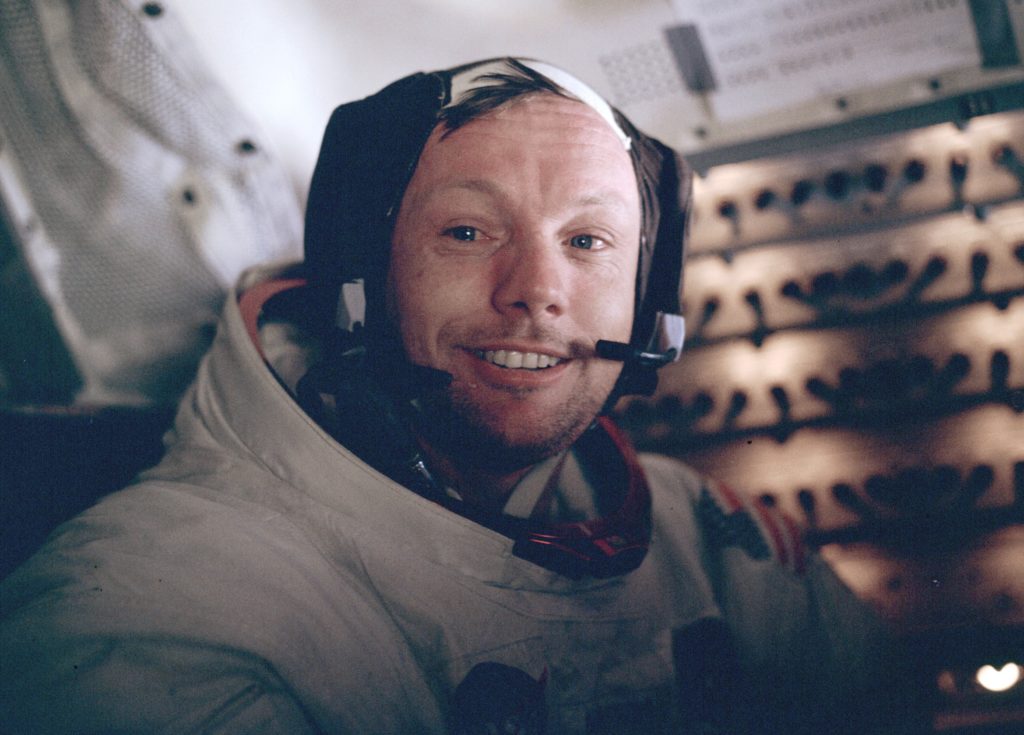
Neil Armstrong, in the LM after his historic lunar EVA with Buzz Aldrin
As I write this, it is 50 years to the moment after the Lunar Module Eagle ascended from the surface of the Moon, carrying a victorious Neil Armstrong and Buzz Aldrin up to their rendezvous with crewmate Mike Collins in the Command Module Columbia. Although I am too young to have personal memories of this event, I’ve been following the mission on its 50th anniversary through the web site Apollo in Real Time. It’s been exciting, and I, like many others involved in the space industry, have been driven introspective.
Why did we send Apollo 11 to the Moon, and why should we keep sending people to explore space?
The first question is all about geopolitics. The United States sent Apollo 11 to land on the Moon because the country wanted a very public way to demonstrate the superiority of its technical capabilities over the Soviet Union. The deep political worry at the time was that the USSR would not only beat the US to the Moon, but that they would emplace weapons there that the US could not counter-target — messing up the strike and counter-strike strategies underlying the insanity of mutually assured destruction. So, the US also decided to conduct its lunar landing in a way that would establish a specific set of norms for space exploration activities: We do this on behalf of all the people of Earth. We are here for science and knowledge. We show the world everything we do, as we do it. We come in peace, for all mankind. Apollo 11 literally left a model of an olive branch on the Moon.
But now the race is long over, and the norms established are taken for granted (if we remember them). Why continue? I find this a difficult question for me to answer — partly because I don’t believe several of the common arguments to be very compelling. Those arguments are science, spinoff technology, and inspiration.
Science is the easiest to dispense: our robotic probes reach across the Solar System, relaying extensive data back to scientists on Earth. The time, effort, and expense of sending a human mission to, say, Mars, absolutely dwarfs the cost of a robotic science mission. As an example, a recent report estimated the cost of a 2037 Mars mission as $120 billion (not including some other significant developments like a precursor lunar landing); the NASA Science Mission Directorate puts a cost cap of about $600 million on Discovery-class missions like the InSight lander, meaning we could send 200 robotic missions for the cost of one human mission. We would have to make sure that the science output of a human mission is at least 200 times better than the science of a robotic mission, and I’m not sure that’s a case one can make. Likewise, while space exploration, and human spaceflight in particular, has produced a great deal of technology that we now use on Earth in engineering, science, medicine, and daily life — those “spin-off technologies” are, almost by definition, ancillary benefits of a development program that had a different objective. This isn’t a bad thing (and NASA investment is far better at spinning off technology than, say, military investment)…but if we as a society have the goal of getting those technologies, we would just fund their development in the first place, rather than hoping that useful spin-offs come out of another program.
It seems to me like inspirational power is the most common reason cited to continue human spaceflight activities. Here, for example, is the current NASA administrator on Twitter:
Whenever someone tells me that the United States needs to inspire more students to study scientific and engineering fields, I want to ask them: What comes after this great inspiration? When a student says that NASA activities make them want to study math and science — are we, as a nation, going to invest in a technical education system to support their ambitions? Because, right now, we do not; those students are left hanging with the means already at their family’s disposal. And then suppose that these inspired students do get a degree in science or engineering: what do they do with it? Supposedly there has been a “STEM shortage” for years, but I do not see it materializing in a shower of job offers for recent graduates. Where are the university science departments desperate to fill vacant professorships? Where is the bipartisan call to expand the civil services of NASA, NOAA, NSF, CDC, and other national scientific agencies? Where are the private research and development organizations with a backlog of open lab positions to fill? Where are the engineering firm recruiters waiting eagerly outside the doors of college engineering buildings? Our lack of national investment in technology, research, and development belies our stated goals. And, in the vacuum, our previously inspired students are off to Google and Facebook to tweak the algorithms for selling users’ private data to advertisers.
My engineer’s brain struggles with the fact that I can come up with other rationales for human spaceflight, but they seem somehow squishier than the arguments above — the ones I don’t find very resonant after a little thought. After all, the arguments I described so far seem quantifiable: number of undergraduate degrees awarded in STEM fields. Number of scientific papers written by human spaceflight researchers. Number of commercialized technologies. Maybe the solution is to look at the problem with something other than an engineer’s brain.
I think the purpose of human spaceflight should be to expand human life out into the Solar System.
I also think that the reason we don’t often hear this statement articulated is that spaceflight proponents (especially NASA staff) don’t believe this argument will resonate with the public, but I believe they are wrong about that.
People get invested with spaceflight when the engineers, scientists, and astronauts involved connect spaceflight with human experience. Look at Neil Armstrong’s contemplative words as he took his first steps on the Moon. Look at Chris Hadfield singing “Space Oddity” aboard his own tin can. Look at the engineers at JPL whooping as a robot touches down on Mars. And look at the way these things catch the public eye, in a way that a purely technical accomplishment does not. Human experience has a value all its own — despite seeing the pictures and reading about the scientific results, I still want to ask the surviving Apollo astronauts, what was it like?! No, really, what was it like, on the Moon? I think it is worth having people living and working in space, for the sake of connecting the awesome experience of our cosmos to our humanity, and for creating an enduring example of what humans can achieve when we pull together and decide to build something.
Ultimately, I want to see permanent human habitation in space and on other planets. Beyond the romantic notions, there are some simple economic drivers that ought to push us in that direction. Any economic model that assumes growth, on a finite planet, is going to run into trouble eventually — and considering some of the anticipated resource shortages connected to the climate crisis, that point may come sooner than we think. (For another thing, with the world’s most powerful militaries blindly chasing “capabilities” in a way that brings us ever closer to nuclear war, I’d feel a lot more comfortable for the future of humanity if some of us were outside their reach.) No place that we’ve yet discovered will be as amenable to human life as the Earth, even in the face of climate crisis or asteroid impact, but that fact does not mean that we won’t eventually need to have humans off the Earth’s surface.
Now, if that’s really the winning justification for human spaceflight — having humans living in space and developing a culture that connects back to people on Earth — then that implies some changes to NASA’s objectives. Instead of having astronauts “learn to live and work in space,” NASA ought to get people actually living and working in space. This brings to light another reason why we may not see human habitation put forward as the reason for human spaceflight: I am asking for a major, concerted effort on NASA’s part; one that emphasizes long-term approaches to human spaceflight and spacecraft at the expense of the Apollo short-term race approach. We should be looking at regular launches to low Earth orbit, major development effort on in-situ resource utilization, designing and building large habitats that are amenable to long-term human life and work, and allowing a great deal of autonomy to the people in space. But, just as it’s nearly impossible for the US government to close unneeded military bases, it’s proven impossible to reorient NASA from the same kinds of work that has been done at each NASA field center for decades, going all the way back to the 1960s.
Which brings us, of course, to the reason why no humans have set foot on the Moon since the Apollo program: politicians like to have NASA, but they don’t like the implications of having NASA do things. Having NASA do things requires allocation (and re-allocation) of resources. They’ve tried to have it both ways, for decades, by splitting the difference. And we’re left trying to justify the space program as it is, with unconvincing arguments, instead of having a rationale behind the total human spaceflight endeavor and building a space program to satisfy that rationale.
Having a resonant driving force behind human spaceflight could help NASA maintain consistent direction in the decades to come. Do I have the winning argument? I really don’t know. But one thing’s for sure: the arguments we’ve been using so far aren’t working very well, if holding human spaceflight to steady progress is the goal.
I recently read a fascinating book – a diary of a man who spent about a year on a space station. In his journal, he expresses his excitement about learning to live and work in space. He’s proud of the opportunity to represent his country, and he enjoys sharing his accomplishments with international visitors to the crew. He learns to appreciate the automated systems on the next-generation spacecraft sent for resupply. He grows – and eats – plants in space. He worries about ennui, and at one point enjoys playing a practical joke on ground control with a monster mask. He particularly enjoys exercising on the treadmill and observing earth’s geology. His dream is to perform a spacewalk, and he achieves that goal.
You might think I’m referring to astronaut Mark Kelly’s hashtag-YearInSpace. But I’m not.
The man is Valentin Lebedev, and the book is “Diary of a Cosmonaut.” The mission is Salyut-7. The year is 1982.
I found the book quite interesting to compare to recent events in spaceflight. For one thing, the similarity between Lebedev’s Soviet mission and Kelly’s #YearInSpace was uncanny. I’m not even kidding about the monster mask – it came up to the Salyut station with French cosmonaut-visitor Jean-Loup Chrétien. Lebedev’s translator wrote the phrase “learn to live and work in space” even then, back in the early 1980s.
What sticks in my head, though, are the ways the Salyut-7 mission differ from a contemporary NASA International Space Station Expedition. In 1982, the Soviet Union was not able to communicate with their stations over the full length of the orbit. As a result, the two-cosmonaut crew had a much greater degree of autonomy than NASA affords a modern mission. Lebedev and his commander made their own decision to extend their spacewalk. They often decide which scientific experiments to do. They determine much of their own exercise regimen, and they arrange the interior of their station to their liking. These are behaviors that NASA must learn – re-learn, really – if they truly want to send humans out to “live and work” beyond Earth orbit. Especially at Mars, where real-time communication back and forth with mission control is not feasible.
This is not to say that everything was better on Salyut than on ISS. At one point, the two cosmonauts smell something burning – fire is an immediate existential danger on a spacecraft. They’re out of communications with the control center, so the cosmonauts grab a fire extinguisher and go hunting for the source on their own. They find the source of the smell – a component overheating – and take care of the problem. Then, they decidenot to tell ground control. Wouldn’t want to worry them! In another instance, the cosmonauts are rearranging supplies and equipment on their station when they find that a refrigeration unit won’t fit behind a panel. So: they get out a saw, and start cutting the metal panel. (Somebody thought they would need a saw?!) I’m all for astronauts learning to build and repair things in space, but this activity leads the cosmonaut to make the logical complaint. Metal shavings float everywhere, and one goes in his eye. (Fortunately, his companion is able to remove it, ending that cringeworthy episode.)
There’s a lot the modern NASA could learn from these programs of the past: they were steeped in ingenuity and piloted by independent souls who really had the Right Stuff. But there’s also a lot we have learned: to plan thoroughly, to account for then-unknown contingencies, and to sustain a human presence in space for continuous years. What amazes me most, though, is how, over thirty years later, the broad architecture of life on a space station and the research program in space is the same. We need a next step. Centrifugal gravity, closed-loop life support, agriculture in space: We know the kinds of technologies we need to do to truly enable life and work in space. If only NASA would do it.
“The Martian:” Yeah, Martian dust storms are nothing. Yeah, Rich Purnell could’ve explained his maneuver to the NASA top brass with about six acronyms and the phrase “gravity assist.” Yeah, real-life-JPL has almost nothing to do with human space exploration. And yeah, that blow-up-the-Hermes thing is a completely harebrained and terrible idea.
I’ll give the movie a pass on all those counts, because it’s a good story, it gets most things right, and it puts technical problem-solving front and center. But here’s what really drives me nuts about “The Martian:”
“The Martian” highlights what NASAmustdo, but is not doing, in order to get people to Mars.
The Hermes
NASA must build interplanetary transfer craft optimized for deep-space travel, like the Hermes, not single-use capsules designed mostly for reentering Earth’s atmosphere like Orion.
NASA must invest significant research and development effort into “in-situ resource utilization,” such as the robotic manufacture of the fuels and propellants the MAV uses for Mars ascent.
NASA must develop closed-loop life support systems, like Mark Watney has in the water reclaimer and the oxygenator.
NASA must learn to grow food on Mars, instead of trying to send every supply with their astronauts in a single mission.
NASA must build vehicles that provide their crew with artificial gravity, by rotating, to counteract the bone loss effects of long-duration spaceflight.
NASA must learn to let its astronauts solve their own problems when they are twenty light-minutes away from Mission Control.
Most of all, NASA must try a lot of ideas, and they must be willing to see some of those ideas fail, in order to accomplish their ultimate goals.
What astronauts on Mars should be doing
Right now, NASA’s plans for getting people to Mars revolve around a series of activities designed to “learn how to live and work in space.” These activities include astronaut Scott Kelly’s hashtag-YearInSpace mission and the Asteroid Redirect Mission.
Commander Kelly’s mission has the goal of learning how the human body responds to a long duration spaceflight. At the end of his mission, Kelly will be tied for the fifth-longest duration spaceflight. We already have much experience with long spaceflights. Our friends in Russia have even more. So we already know pretty much everything that’s going to happen to him. What’s more, we know ways to mitigate those adverse effects. We need, for example, something to simulate gravity. Like a spacecraft with a centrifuge. That’s a solution science fiction – including “The Martian” – has taken for granted for decades, though NASA has no obvious plans to build true long-duration space vehicles for its crews. They will go to Mars floating in the cramped zero-g environs of an Orion capsule.
NASA also isn’t looking seriously at growing food to keep their crews fed in space. At a conference last March, I learned that all the Mars exploration reference missions involve taking all the food the crew needs for their entire travel, exploration, and return mission. That takes a huge amount of payload mass. Mark Watney did a much better job – and saved a lot of weight – by turning a few potatoes into food for a year. He got fresh vegetables, something his colleagues on the Hermes didn’t even have. Rover data shows that plants could grow on Mars, and creating a spacefaring civilization obviously depends on our ability to feed astronauts – so, again, why not look at the obvious solutions?
The big idea that “The Martian” demonstrates is human ingenuity and problem-solving. To NASA, though, that’s a problem. NASA doesn’t want astronauts tearing components apart and putting them back together like Mark Watney does. They want to have astronauts follow a checklist that has been tested, verified, and validated on the ground in several dozen ways. That philosophy is so pervasive in NASA that agency officials talk about how they need the Asteroid Redirect Mission to “test” solar-electric propulsion – a technology that NASA itself has been using in flight missions since 1998. If NASA really wants to go to Mars, it’s going to have to learn to be more like “The Martian:” being willing to take risks, try new ideas, and give its astronauts leeway to make decisions.
That’s what drives me nuts about “The Martian.” It depicts the space program that I’ve been hungering for for thirty years…and I’m afraid I won’t see such a thing for thirty more, at least.
I have been enjoying “The Expanse” series by James Corey. It’s a space opera set a couple hundred years from now, after humans have colonized and populated the moon, Mars, the asteroid belt, and outer planet moons. Spaceships journey between these worlds, complex engineering projects remake asteroids into habitable stations, and space navies boost from place to place to fight space pirates. I think it’s great because it captures what I wish for humanity’s future: that we will go out and colonize other worlds, that we will be able to undertake engineering projects for the greater good, and that we will become robust enough to weather grand challenges – things we see in the world today as global warming, income inequality, nuclear proliferation, and the like. In many ways, the first three books are about the tension between such grand visions and idealism, and politics and profiteering.
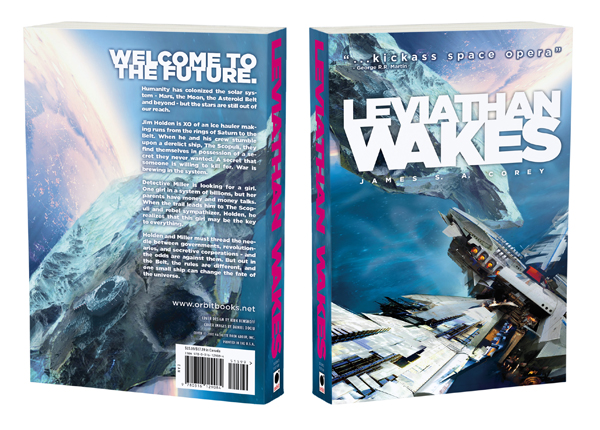
Leviathan Wakes cover, from Orbit
The books are soon going to be a TV series, and I am very much looking forward to see its depiction of space and space travel. (With the exception of parts of the first book, wherein Corey tried to write something horror-ish by being as gross as he could think to be. Whatever. Those are not the good parts of the book.) Corey steered clear of many sci-fi tropes that would have a big impact on the appearance of the series – no artificial gravity here! – and he made sure to build aspects of spacecraft engineering and operations into the cultures he depicted. For example, “Belters” nod and shrug with whole-arm gestures, so that they can be seen when wearing a suit. A good chunk of the books take place in zero gravity. Hopefully that will translate to the screen!
I’m going to take a look at some of the spacecraft engineering concepts in “The Expanse.” Let’s start with the most science-fictional, and therefore least plausible:
The Epstein Drive
Corey very quickly establishes that the powerhouse of his whole solar-system-wide civilization is the “Epstein Drive,” which is some kind of fusion engine for boosting spaceships around. It allows craft to thrust continuously from one planet or asteroid to another, accelerating constantly for half the trip and then decelerating constantly for the second half. This trajectory allows relatively quick travel times between worlds. Conveniently for crew health, and for TV production, the engine also provides “thrust gravity” inside the spaceship. Ships are therefore designed with decks in “stacks” above the engine with a ladder or lift giving crew access between decks, like in a skyscraper.
A fusion engine isn’t a crazy idea, especially not for a civilization a couple hundred years in the future. The problem is propellant. No matter how powerful or efficient your engine is, you will always need to be chucking propellant out the back to sustain this kind of thrust profile.
Picture this: you’re sitting in the middle of a frozen pond. The ice is perfectly frictionless, so you can’t walk or crawl or anything to get back to solid ground. What you do have is a bag full of baseballs. If you throw a baseball away from you, then you have given it some amount of momentum (mass times velocity). Your body gets an equal and opposite amount of momentum: you start sliding in the direction opposite your throw, but much more slowly than the baseball (because its mass is small while yours is big). Great! You have a way to get to shore. But you don’t want to wait out this long slide, so you throw another baseball. This speeds you up a little. Another throw speeds you up a little more. You can keep throwing baseballs until you decide that you’re going fast enough that you can wait it out. That’s basically how spacecraft work now: they thrust for a little, and then coast for a long period of time until they get to their next destination. But what if you wanted to keep thrusting the whole time? You will need more baseballs. Lots more baseballs. You are going to have to keep throwing them, constantly, to keep accelerating yourself.
Writing that a spaceship has a fusion drive instead of a chemical rocket is like replacing yourself in this analogy with a major league baseball pitcher. They will put more momentum into each pitch, and so they’ll go faster across the ice. In other words, their thrust is more efficient. But they will still run out of baseballs at some point, and then they must coast without thrust. The spaceship must stop its burn, cease thrust gravity, and wait several more months before getting to their destination. In the end, high thrust – and, with it, appreciable thrust gravity – should only be active for a short time in any space voyage through the Expanse. As we are learning with ion propulsion nowadays, it can often be most efficient to run at a low level of thrust, but sustain that for a very long time. But that doesn’t give our characters a convenient floor to stand on! So Corey put the word “Epstein” in front of “fusion drive.” “Epstein,” in this case, is short for “magic.” It’s a kind of magic that lets Corey have thrust without propellant, so that he can simultaneously achieve short (astronomically speaking) travel times and keep his crew in thrust gravity.
For a more physically realistic depiction of relationship between fuel, propellant, and thrust, consider Neal Stevenson’s spaceship Ymir in Seveneves.
The Way Ships Move
In the Expanse universe, spaceships are flipping around all the time to vector their engines in the correct direction to change their velocity. And we often read references to what the thrusters are doing on ships. This is all good. But the ships don’t really move the way real spacecraft move.
First of all, orbits barely enter the picture. One scene in Leviathan Wakes involves a character plotting out the likely trajectories of a certain ship, but other than that, the characters can go just about anywhere they want to go as long as they have a good ship to call theirs. Absent the Epstein “magic,” that behavior isn’t really plausible.
Second, though, is that Corey imagines his spaceships rotate themselves around in the same way just about all science fiction authors do: with thrusters. That’s not what most modern spacecraft do! They actually use wheels. Spin a wheel clockwise, and Newton’s third law kicks in: there’s an equal and opposite reaction. The spacecraft spins counterclockwise. Devices that function as I just described are, therefore, called reaction wheels. Other wheel-based devices that take advantage of gyroscopic torques can give satellites quite a lot of agility – without using any propellant. I suspect that the reason why these realistic actuators don’t often appear in science fiction is that there are no obvious cues to their operation: no thruster spurts, no blue glows shining out of emitters, nothing. The ship just starts to rotate.
I was happy to read that Corey’s spaceships are all native to space. There are not many cases where a ship lands, and in those cases, it’s always a small one. The heroes’ ship does once, on Ganymede. With surface gravity comparable to Earth’s moon, that’s not such a stretch for a fusion-drive starship.
28 June 15 Edit: Darn it, I just started Cibola Burn and about the fourth thing that happens is that the Rocinante lands on an Earth-size planet and immediately takes off again. Minus points for that!
The Battles
Space combat plays a big role in the plot of the Expanse books. And it’s a generally great depiction of space combat! Lots of the tactics and technologies are grounded in plausible physics. Ships shoot missiles and guns at each other, the effective range of a torpedo is determined by how close your ship needs to be to make sure the enemy ship doesn’t have time to shoot your torpedo down, the crew all gets into space suits at the beginning of the battle, there’s a ton of electronic warfare activity, and the battles wax and wane in intensity as the spaceships maneuver and orbit.
I’ve long thought that the most effective weapons in a space battle would be simple kinetic slugs or flak shells. My reasoning is simple: the speeds of objects in space are fast enough that a relatively small piece of junk can easily blast a hole through sensitive components. This is exactly why present-day spacecraft engineers – like me – worry about micrometeoroid strikes, space debris, and the Kessler syndrome. In the Expanse, the ships all fire torpedoes or guns at each other. And the results of weapon strikes are devastating: it only takes one torpedo or a few well-placed railgun slugs to take out a ship. Ships blast electronic garble at each other to screw up their targeting systems, but in the end the best defense is not getting hit – so we see the pilot do a lot of evasive maneuvering. I think this is all on the right track from a physics standpoint, though a real space battle with “Expanse-style” ships would probably take a lot longer, involve more orbit dynamics, and require a lot more computerized coordination.
There are two rather implausible elements to the battles. First is the Epstein Drive, which makes the combatants’ maneuvering matter a lot more than orbit dynamics. Second is the “juice,” a drug cocktail that keeps people alive and functioning when exposed to high gee forces. As a way to deal with high gees, the “juice” is just about as good a science-fictiony way to do it as any other, including immersing people in fluid as in The Forever War or inventing some kind of mythological inertial dampener. In the end, though, humans are squishy, precious cargo, and fighting full-on battles with them inside your spaceships doesn’t make a whole lot of sense.
Stealthy Spaceships
(There are some minor spoilers in this section!)
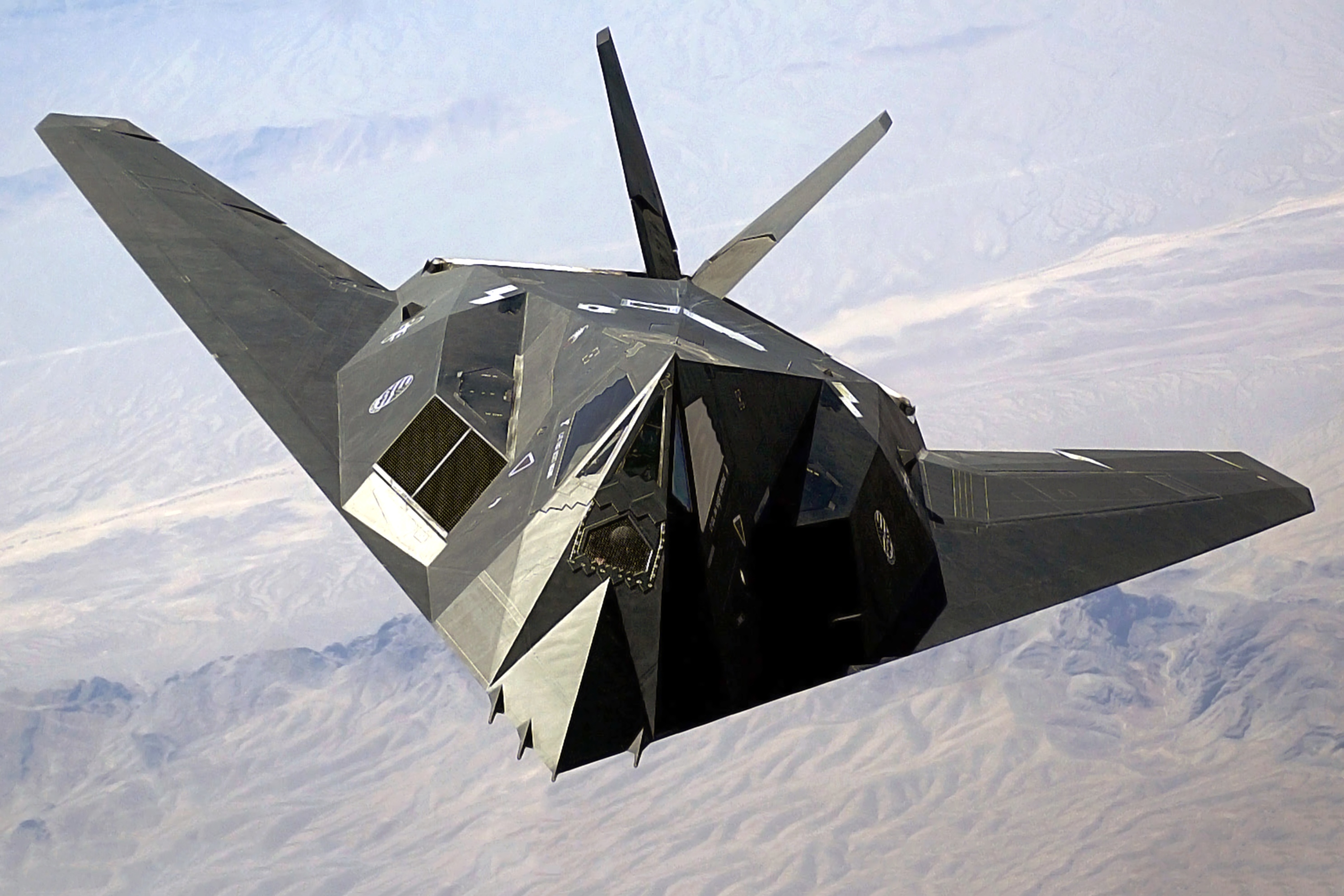
A plot point early on in the first book, Leviathan Wakes, revolves around the appearance of a stealth spaceship. This doesn’t involve any cloaking devices like in the Star Trek universe. Rather, a few spaceships avoid detection by (1) being painted black, which hides them in the visible spectrum, (2) having surfaces that absorb or scatter radar, which hides them in radio wavelengths, and (3) radiating heat out the side of the ship facing away from the enemy, which hides them in infrared. Much as it might give some people heartburn, this is all fairly plausible! The first two points are easy to imagine based on what we know about about the present-day Air Force. Though its not as familiar to the general public, the third item is actually something that comes up all the time in spacecraft design: especially if your satellite has sensitive electronics – like an infrared telescope – the design will include coolers, heaters, baffles, insulation, and radiators designed to emit heat in directions pointing both away from the precious detectors and away from the sun. Even the International Space Station has radiators that rotate to keep them pointing away from the sun most of the time. (The reason is that if the radiators face the sun, they’ll start to absorb heat into the station instead of emitting it out!) Such a “thermal management system” could be designed to, with the other stealth elements, give one side of a spacecraft the appearance of a cool, black spot indistinguishable from the rest of empty space.
A stealth spaceship wouldn’t be easy to build, and it wouldn’t be perfectly invisible – just harder to detect than normal to a lone adversary. And, in fact, both those points are relevant to the spaceships in the Expanse. One crewmember is able to spot a stealth ship on his sensors, but he doesn’t know what it is or how to respond to it. And that’s really all it takes for the stealth ship to accomplish its mission, after all! The very difficulty of constructing a stealth spacecraft actually makes the stealthiness more effective. The characters who cannot conceive that somebody could field a stealth spaceship end up more prone to falling prey to it.
Spaceship stealth makes an appearance other times, as well. At least twice in the series, the heroes’ ship hides itself by masquerading as something it’s not.
Spin Gravity
Lots of space stations in the Expanse, including some embedded in asteroids, spin to provide their inhabitants with centrifugal “gravity.” This is an idea that’s been around the aerospace and science fiction communities for decades, and Corey executes it well. In fact, one of the things I enjoy about the books is how the plot moves between the different environments of planetary gravity, low lunar gravity, spin gravity, and (“Epstein”-based though it may be) thrust gravity. The different gravitational environments contribute to different cultures, and they put the characters in interesting and different situations. If the TV series sticks to the books, we’re going to see low-gee gunfights and damage control teams solving problems in microgravity. Regularly.
All the stations with spin gravity are large, which is the right choice. It means they don’t have to spin at a dizzying rate to get a comfortable level of gs for their inhabitants. There is another benefit, in that the weird non-intuitive kinematics of rotations – Coriolis forces – have less of an effect the larger the rotating space station. These effects can be truly weird, and it can be hard even for physicists to bookkeep all the terms correctly to model them. Something that might happen if you were standing in a spinning space station is that if you drop something, you will actually see it follow a curving path to the floor, and it won’t land at your feet. You will also see it fall at a different speed than you would expect based on the gravity you experience. (I’m planning to write something up separately to go into all the details.)
Anyway, suffice it to say that spin gravity is a strange environment and Corey, like most science fiction writers, doesn’t go into all the details. But spin is the right idea for giving gravity to spacefarers, and I can’t wait to see how the visual effects team on the Expanse interprets all the spinning structures.
All in all, I’m thinking that The Expanse will be good for science fiction on TV. It will be a show with a time period a bit closer to us than, say, Star Trek. And the show will have a wide diversity of environments to challenge the characters. I am looking forward to seeing their depictions of spacecraft and how they move around in space!