RSS .92| RSS 2.0| ATOM 0.3
 

Woah wait, what?!

April 19th, 2012

If you follow space news, you’ve likely seen one of the articles on this event. Woah!

I’ve like to contribute just a couple things to the wild speculation at this point. The MIT Technology Review article concludes that asteroid mining is the only possible thing of interest in space – but really, that is just one writer’s blog. I want to point outthat there are other possibilities:

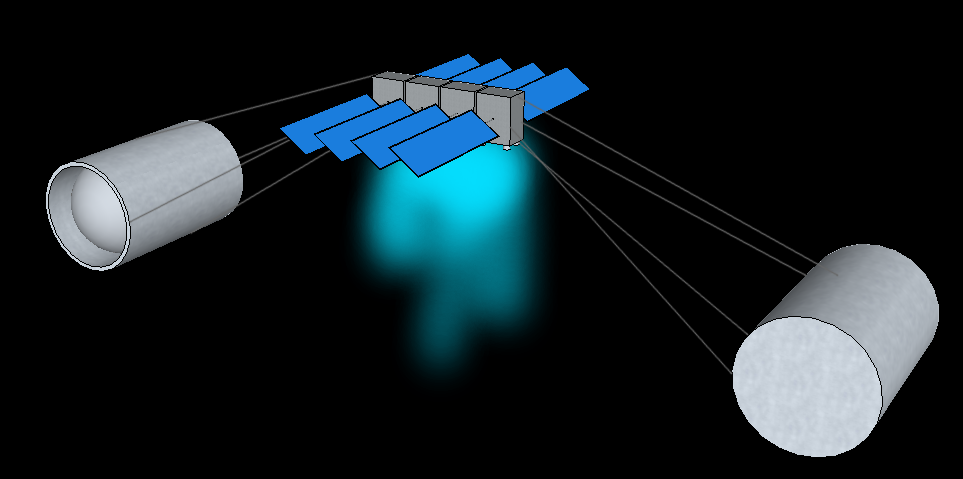
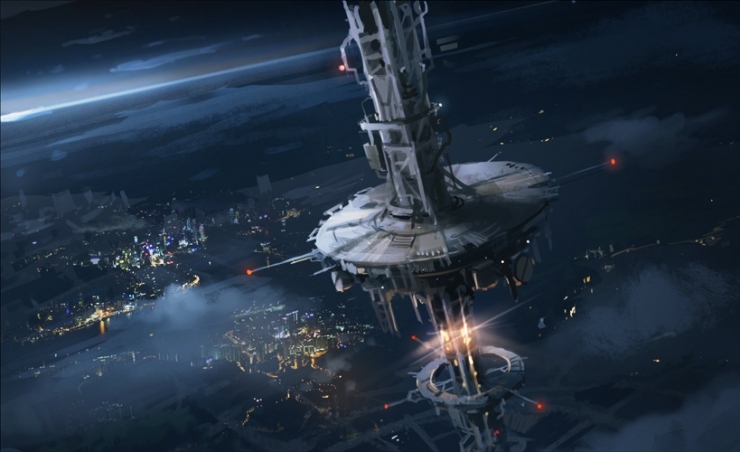
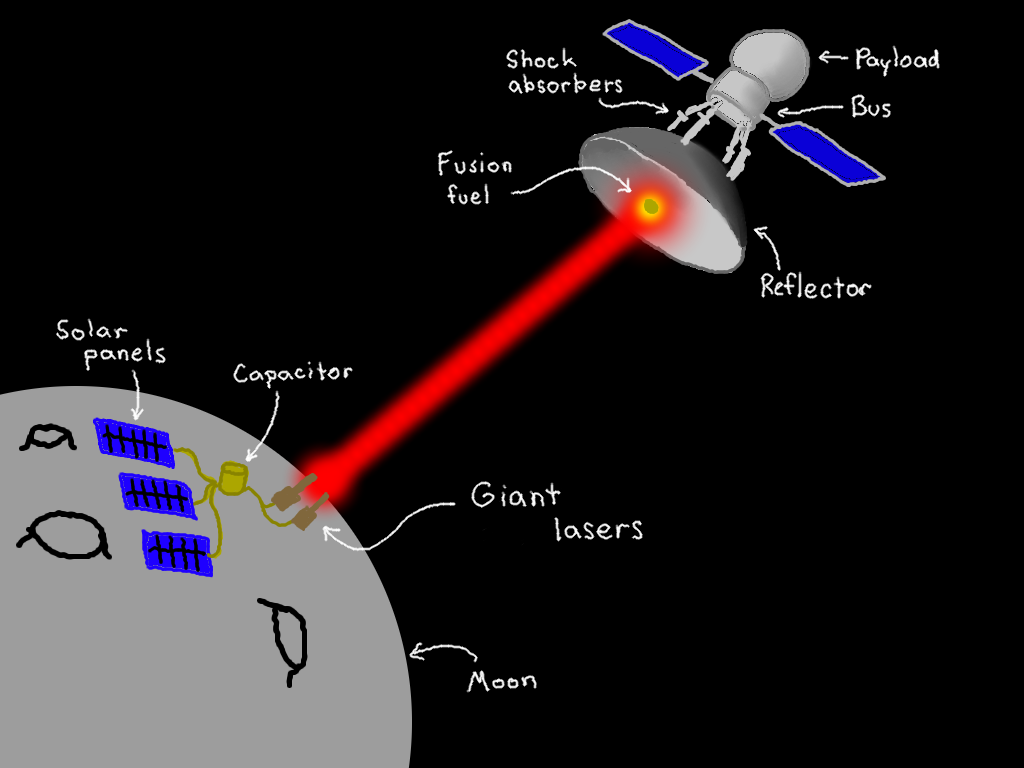
  • Space-based solar power systems: either a constellation of satellites or a system of stations on the lunar surface that collect solar energy and beam it back to Earth, with the potential to provide inexpensive (after the initial investment!), reliable electricity to anywhere on the globe. Phil Plait at Bad Astronomy correctly identified this as a possibility. Tom Jones’ involvement makes me think this possibility less likely, though.


  • Lunar mining: not only are there potential resources on asteroids,  but there are some on our nearest planetary neighbor! While the Moon had higher gravity than an asteroid – requiring a little more than a token kick to lift return vehicles – its proximity makes it a more reachable target.


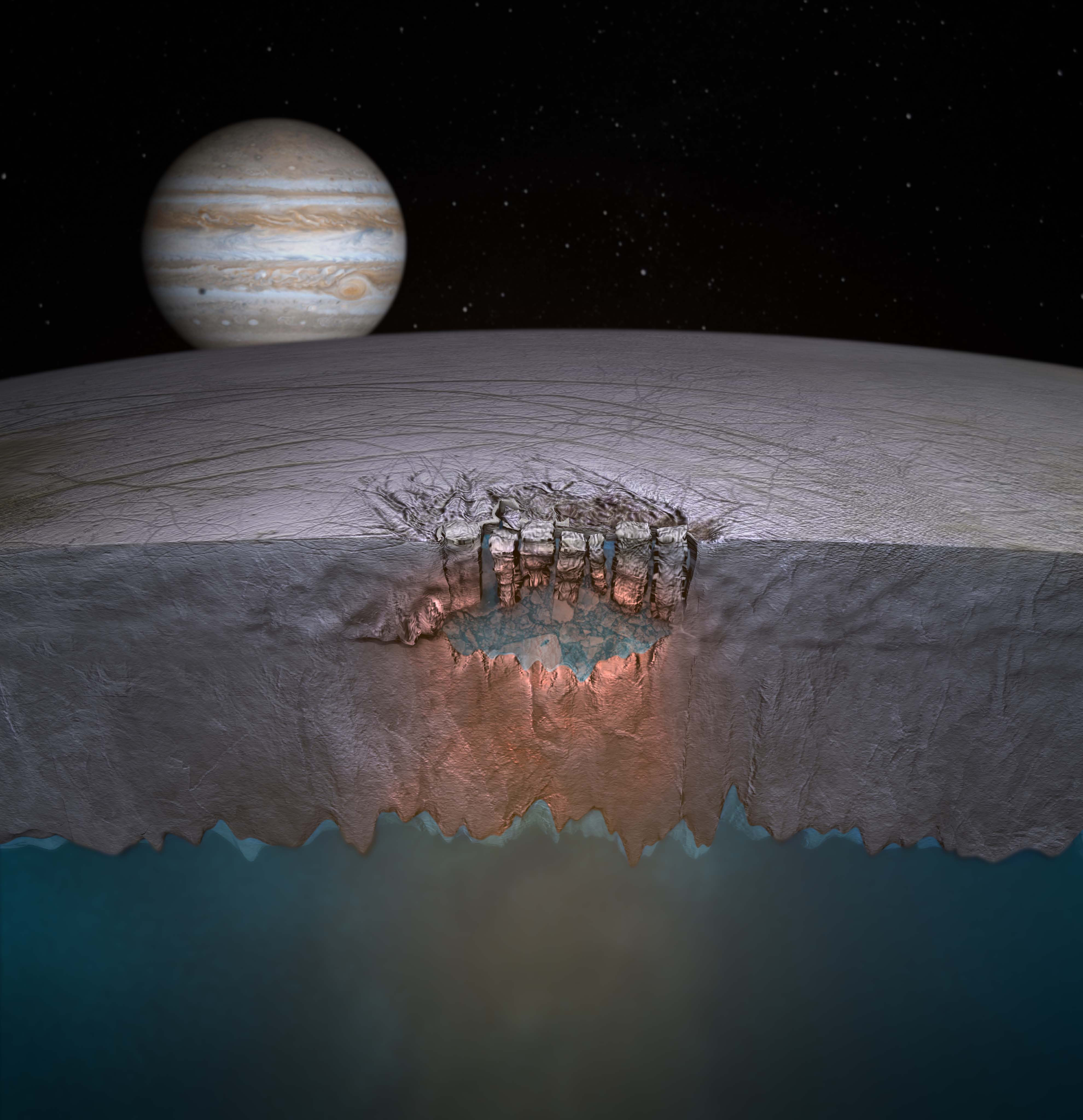
  • Water mining: outer solar system moons are often covered with water ice laced with minerals or organic compounds. A robot could land on the surface, cut out blocks of ice, and thenshove them Earthward.  I’m not sure there is an economic case for this activity, but I wouldn’t rule it out as a bad idea for all time.


My bet is that they are going for asteroids or the Moon, but I think space power systems are a potential line of business for Planetary Resources. Maybe they plan on becoming a general space-based utility company! 


In the Arena

February 10th, 2012

Well, since I just had some discussion about orbits and other fundamental physical concepts in science fiction, here’s a short scene I’ve been sitting on. It’s set in the Cathedral Galaxy, and I’m not quite sure what I want to do with it yet.

~

The Kite stretches his solar wings wide, spanning over five hundred meters. He fans out his array of electromagnetic membranes, thermal structures, transceiver antennae, and weapon emitters, flourishing. The Kite’s voice booms out over the electromagnetic spectrum, mingling with the others in the Coliseum, as they announce themselves to the assembled spectators:

“In salute, we die and live by the will of the Imperium!”

The Kite pulls one solar wing out from the light flux to tack. He wheels around, scanning and assessing his competitors. He catalogues their capabilities but pays special attention to their faces – distended from all the grafts and alterations, stone-gray and glassy-eyed from the environmental treatments, yet still faces. The younger competitors growl and sneer at him, while the more experienced repay his cool appraisal in kind. Today, The Tiger and The Worm worry him.

Silence falls across the EM bands, leaving The Kite with only the intermittent discharges from the Coliseum walls. His stomach (though no longer really a stomach) lurches in anticipation. A moment drags on in the flickering silvery shell of the Coliseum, buried in the sparse mist of an orange nebula. This could be the day, thinks The Kite, when I die. Again.

The call:“Begin!”

The Kite pulses an electromagnetic field, launching himself away from the spherical inner surface of the Coliseum. The others do the same. Read the rest of this entry »


Flying to Titan

January 2nd, 2012

Decadal surveys and other prioritizations of potential NASA exploration missions often rank one thing very highly: a sample-return mission from Mars. However, I think there are some much more scientifically interesting, technologically challenging, and engaging to the public mission proposals out there. This is one: a Titanian UAV!

The idea is to send an airborne vehicle to Saturn’s moon Titan which would fly around the moon, observing surface features from its high vantage point. A powered flyer, as opposed to a balloon, has the advantage of being able to travel to a specific location: such as the moon’s liquid lakes!

The proposal team uses some clever mission planning approaches to handle the limitations of the aircraft: for example, using glide phases to hoard power for downlink sessions. Their nominal mission duration is one year: a year of exploring another planet from the air, a year of images and science data depicting a world of lakes, rivers, ice, and rain. The full proposal is online here.

I find the idea exciting, and I hope that NASA’s governing councils soon prioritize exploration of those extraterrestrial locations most likely to harbor life – like Europa, Enceladus, and Titan.


Kick Yourself into Orbit!

October 26th, 2011

Ah, I’ve only been out a few months, but I already miss some things about being in grad school! For instance, I miss all the crazy brainstorming of new and wild space systems, missions, and technologies. No doubt you, dear reader, also miss my crazy brainstorming: after all, that is how I ended up writing blogs about space battles or missions to Europa or what the Earth would look like with rings or the science of Avatar. Now I have an industry job where people tend to care more about “affordability” and “reliability” and “performance,” than they do about harebrained schemes to drop space probes into the Europan ocean.

But, fear not, intrepid reader who has been sticking it out hoping for another crazy notion to appear here! You see, my research group at Cornell is still working at churning out wild ideas. And you can participate!

Check out this message from Zac, who was starting his Ph.D. as I was on my way out:

Zac has set up a page on KickStarter, which you can jump to by visiting KickSat.org. The idea behind KickSat is to make a bare-bones 10x10x10 cm CubeSat which contains hundreds or thousands of microchip-sized satellites called Sprites and will deploy them all in low Earth orbit. The KickStarter platform means that, if you want, you can sponsor your very own Sprite – Zac has even defined a sponsorship level at which you get to write your own flight code for the tiny spacecraft to run in orbit!

The spacecraft, which each could fit comfortably in the palm of your hand, are very simplistic as far as spacecraft go – they consist of solar cells to charge a little bank of capacitors, a teeny TI processor for a brain, and a little antenna. These are proof-of-concept spacecraft, and are actually derived from three test units which my lab group sent up to the Space Station on the last launch of the Space Shuttle Endeavour! In the future, they hope to integrate other sensors onto the chips to give Sprites more capabilities. One of the ideas batted around during lab meetings that I consider a personal favorite: put “lab-on-chip” detectors on a Sprite to look for characteristic organic compounds (like nucleic acids!) and program them to simply send a chirp back if they get a positive result. Send a million Sprites to Mars, and listen to the peeps – and then you know where on the Red Planet the next big flagship mission has just got to go!

Imagine if you got the shot at writing the flight code. If you could put a solar cell in space and make it beep, what could you measure? How creative can you get in getting the Sprite’s whisper of a radio signal to carry information? Could you receive enough data to tell how fast the chip is spinning and seeing the Sun, or how much average power it has to work with, or how long it lasts before an errant proton from the solar wind blasts your Sprite out of the sky? The chance to put your own code on a spacecraft, even such a simplistic one, offers a lot of learning opportunities.

(Incidentally: one question that Zac and his research advisor, Dr. Mason Peck, get a lot is some variation on: “Hey, paint flecs moving at orbital velocity are enough to crash through the Space Shuttle windows. Aren’t these Sprites going to become dangerous space junk?” The answer is that yes, the Sprites could be hazardous as long as they are in orbit; but the orbit that KickSat will reach is going to be within just enough of the Earth’s atmosphere that all the Sprites will get dragged down in a couple days. The special property Sprites have that influences this fast orbital decay – and other effects – is a high surface-area-to-mass ratio.)

KickSat has already reached its minimum fundraising goal to start building hardware. However, the project is still looking for more backers to secure a commercial launch opportunity, which will offer more certainty than applying for a free launch program through NASA. But if Zac gets to about $300,000 of funding, he thinks that will be enough to start looking at new technologies to shrink the Sprite chips down to even smaller sizes – and offer even more capability in the future!

Cool stuff. I’m glad to see the Cornell Space Systems Design Studio keeping the wild space ideas flowing!


Now THIS is What I’m Talking About

September 30th, 2011

Elon Musk announced that a SpaceX is developing the Falcon 9 and Dragon into a fully reusable launch vehicle/capsule system. In short, they are actually going to go for making the Falcon 9 live up to it’s namesake.

I can’t help but contrast this animated system with the SLS announcement from NASA. It illustrates my criticism of recent NASA policy perfectly: at Congress’s behest, the space agency has stopped innovating.

It’s not a super-heavy-lift launch vehicle that will enable expansion of the human exploration program beyond flags-and-footprints missions or the long-term development of space. Instead, it’s the fantastically easier access to space afforded by a rapidly reusable launch system like that presented by Musk. The control technology and hardware for such a system exists already; I hope to see test flights in a few years. With only a little luck, they’ll happen before the first SLS is supposed to take off.


The Dark Planets

May 19th, 2011

An article appeared today on NASA.gov about the detection of “free-floating planets.” These planets may have formed around a central star, like the planets in our Solar System did, but due to some gravitational interaction during their star system’s formation the planets escaped their stars. These Jovian planets, which may outnumber stars in our galaxy, are now doomed to endlessly wander the cosmos under perpetual starry night skies.

Naturally, this notion tripped my sci-fi circuits.


This artist's conception illustrates a Jupiter-like planet alone in the dark of space, floating freely without a parent star. Image credit: NASA/JPL-Caltech

We live in an age in which new planetary systems are being discovered at an incredible rate. We are getting closer and closer to the ability to detect other Earth-like worlds around other stars. In fact, just a few days ago a study found that certain climate models of Gliese 581d (that would be potential-planet Zarmina‘s until-now-slightly-less-sexy sister) may support a liquid water cycle.

So what would it take for one of these free-flying, starless planets to be habitable?

The immediate answer that may come to you, the average person, is, “Joe, you are crazy.” But wait a moment!

All life requires is an energy input and certain chemicals, right? Well, all sorts of chemicals exist in gas planets. And there are plenty of possible energy inputs from the gas dynamics going on in their atmospheres – not to mention magnetic fields and other esoteric stuff like that that Earth life generally doesn’t incorporate into its metabolism.

But forget gas-giant balloon-life. Suppose we constrain our notion of habitability to the usual anthropocentric meaning: liquid water on a rocky surface.

In order for a rocky planet to have liquid surface water, it needs two things: heat and pressure. (Pressure so that the water doesn’t just sublimate or boil off into space, and heat so that it doesn’t freeze.) The “pressure” part we can take care of by giving our rocky world an atmosphere. However, we need a heat source – not only to keep the water from freezing, but to keep the atmosphere itself from freezing onto the planet, too. How do we get this heat source? Radioactive heating from the planet interior isn’t going to warm the surface to 273 K. Stars are all going to be too far from these planets to do any good. Emission nebulae are way too cold and rarified, even if the planet is right in the middle of them. The planet is going to pretty efficiently radiate away any heat inputs before that energy goes into heating ice to make water. (I suppose we could stick the planet right in the way of a black hole’s polar jet or some other source of hard radiation for our energy source – but then we’re back to getting really alien alien life. Fun to think about! And what happens to those alien civilizations that thrive on a dark planet bathed in X rays when their planet finishes traversing the zone of hard radiation?!)

I’m pretty convinced that liquid surface water is not going to appear on any free-flying rocky planets. Unless…

Suppose, when a Jovian planet got ejected from its birth star system, it carried its moon system away with it. Maybe some heat can come off of that gas giant and hit the moon! It’s not going to be reflected light, though, because there’s no star to provide bright enough light. No, the energy will have to come from the Jovian itself. This condition means that we’ll have to look at something like brown dwarfs: astronomical bodies that are just slightly too small to ignite under their internal pressure and turn into the hydrogen fusion furnaces that are stars. But they do have some fusion going on in their dense cores.

Take Teide 1, the first brown dwarf to have its existence confirmed. It has a surface temperature of around 2500 K, a luminosity of about 0.001 Lsun, and a radius around 0.1 Rsun. Suppose that a rocky (Earth-density) satellite orbits Teide 1 at its Roche limit, the closest orbital radius it can have without tides tearing the moon apart into a pretty but uninhabitable ring. (By a quick calculation, I get about 337,000 km for Teide 1 – coincidentally close to the Earth-Moon distance.) At that distance, the moon would receive around 1 million watts per square meter from the Jovian. If that’s the input power, the Stefan-Boltzmann law gives the output radiation of the planet in equilibrium. With a couple assumptions about albedo (Earthlike) and assuming that the moon receives incoming radiation over its cross-sectional area but radiates out over its entire surface (and that it’s the size of Earth’s Moon), my quick hand scratchings give a surface temperature near 50 K. Hmm…no liquid surface water there.

But there’s another possible heat input to a moon around a gas giant: the tides of the Jovian world.

Consider Jupiter: it has four big moons, and Jupiter raises such huge tides on these moons that the rocky mini-worlds actually flex, generating heat from friction. On Europa, this tidal heating in its central rocky part is sufficient to melt the inner bit of its water-ice coating into an ocean. Heck, scientists combing Galileo probe data just determined that tidal heating is sufficient to keep pretty much all of Io’s interior molten. That world is made of lava, with a thin crusty shell. And it’s all because the moon orbits a gas giant in a resonance with some other moons. the interaction between their orbits keeps the tidal energy coming.

So let’s give our moon some companions and an orbital resonance. Solar radiation is negligible compared to tidal heating even for Jupiter, so we know that that could give our moon liquid water…at least under the surface, like Europa.

But add an atmosphere, and you get an insulating blanket around the moon’s surface. More internal heat stays trapped on the moon’s surface instead of radiating away into space. I haven’t done the calculations, but if tidal heating can liquify rock on Io I bet it could be enough to melt Europa’s ice layer all the way through for slightly different orbital parameters. And with an atmosphere, the moon gets pressure to keep that liquid water from boiling. Like Titan. Put Titan where Io is…and what do you get? I’m not sure, but it would be really interesting. And it wouldn’t require the Sun.

Cool, huh? It certainly hasn’t been confirmed, and I don’t have a detailed model, of course, but I think the theoretical grounds exist for these free-flying dark planets to have liquid-water surfaces. Imagine vacationing on a beach next to a steaming ocean that is basically a global-scale hot spring, where it’s perpetual night and every couple (Earth) days you see the shadowy form of the gas giant loom overhead, visible more because of the stars it blocks out than from any external light source, except for the occasional immense spark of lightning through its clouds…


Jovian Electrodynamics

March 10th, 2011

Jupiter is one of the most useful planets for planning spacecraft trajectories, and it’s home to some of the most interesting science targets in the Solar System. However, it also happens to be one of the most dangerous planets for spacecraft.

Jupiter is so dangerous because of two things: its magnetic field, and the moon Io. You see, Io is extraordinarily volcanically active – the only known extraterrestrial body with active volcanism, in fact – and constantly spurts all sorts of particles out from its interior. The energy of Io’s eruptions gives some of these particles escape velocity, and they end up orbiting Jupiter. Jupiter’s immense magnetic field or solar radiation can then strip electrons off these particles, creating a torus of raging ions around the planet. It’s the same phenomenon as Earth’s Van Allen radiation belts, but without the nuclear explosions and, well, Jovian in scale.

Jovian radiation belts. Sort of. My Jupiter model didn't work, so this picture looks terrible.

Jupiter’s radiation belt kills spacecraft. The Galileo probe, a Jupiter orbiter, eventually died when it crashed into the planet, a protective measure to prevent it from contaminating Europa with Earth life in the event its electronics became too fried to control the spacecraft. (Galileo contrasts quite a bit with the Cassini mission to Saturn, which has been considerably extended from its main science mission!) The next mission to orbit Jupiter, Juno, is encased in a titanium radiation shield. And you can pretty much forget human exploration of Europa.

But it’s not just tempting to send robotic probes to Jupiter – it’s practically a necessity! Any spacecraft headed to the outer Solar System, or trying to do wild orbit maneuvers, needs a lot of delta v (that is, the capability to change velocity – in magnitude, direction, or both). The Ulysses spacecraft needed a bunch of delta v to kick its orbit waaaaaaay up over the sun. And New Horizons needed a ton of delta v to get out to Pluto and beyond. One efficient way to get delta v is to perform a planetary swingby, or flyby, maneuver – and you can get more delta v from a bigger planet. Jupiter is king of the planets and gives space vehicles a huge boost. So, every spacecraft that has ever gone into the outer Solar System has visited Jupiter.

That magnetic field, though. Jupiter has a magnetic moment 18,000 times as large as the Earth’s. That sort of magnetic field is useful, if a spacecraft has the hardware to take advantage of it. For instance, an electrodynamic tether: a long conductive filament stretching from the spacecraft, along which the spacecraft runs a current. (Currents through the rarefied plasma filling the Jovian orbit environment complete the circuit.) The spacecraft will then experience a force proportional to the cross product of the current along the tether and the local magnetic field. If you don’t like vector math, don’t worry – just remember that the force is perpendicular to both the tether and the planet’s magnetic field near the spacecraft (which, near the planet’s equator, will run approximately parallel to the planet’s spin axis). In Earth orbit, there have been several missions testing tether physics, with applications including both electrodynamic propulsion and harvesting power from the Earth’s magnetic field. Around Jupiter, these methods will be even more powerful.

If a spacecraft is in circular orbit around Jupiter and orients a tether parallel to its direction of travel, then the force will be either directly toward or directly away from the planet’s center. This means that the spacecraft can, by running a current through a tether, generate a force that has the effect of either enhancing or weakening gravity. So a robotic probe performing a Jupiter flyby could get a much bigger gravity-assist boost with a little help from a current-carrying tether. Or, if the current is high enough, the net force could repel the spacecraft from Jupiter, changing the direction of the delta v it picks up in the flyby. The capability for spacecraft to perform that kind of maneuver could open up more launch windows for outer Solar System missions.

Another idea is to use electrodynamic tether propulsion to keep a Jupiter orbiter out of the worst parts of the radiation belt, so that it can get lots of data on the Galilean moons. If the probe has a slightly inclined orbit, then it could vary the current in its tether over the course of each orbit so that the spacecraft pushes its semimajor axis in and out each period. With the right parameters, this non-Keplerian spacecraft trajectory would skirt the ring of hard radiation around Io’s orbital radius.

A trajectory that skates around the radiation belt

Perhaps the spacecraft has some leeway into how far into the radiation belt it can venture – or its orbit is just bigger than the “danger zone.” Then, it could follow a Keplerian orbit (affected only by gravity) some of the time and use the passage of the tether through Jupiter’s immense magnetic field to generate electricity. If engineers can balance the numbers, then such an exotic orbit might come out power-neutral over the course of each orbital period, giving spacecraft a free, and safe, way to explore Jupiter’s Galilean moons for a very long time.

Speaking of power harvesting: Jupiter is far enough from the Sun that spacecraft around there can’t really get all the power they need from solar panels. Dragging a conductive tether around and letting the planet’s magnetosphere drive charges along the length of the filament would be one way to overcome that challenge.

These are kinds of technologies that we can develop in Earth orbit and deploy in the outer Solar System, to take advantages of the resources out there and allow us to learn more about the things in our backyard. After all, the more we understand about the different regimes of our own Solar System, the more we understand about our origins – and about the possibilities that exist in planetary systems around other stars.


How to Build a Tractor Beam

February 3rd, 2011

Hello, Intertubes! I have been slacking off on the blog in favor of preparing my dissertation and the presentation for my defense. I know, excuses, excuses…

To keep all eighteen of my intrepid readers happy, here is a video that recently went up on my lab group’s YouTube channel:

That’s me demonstrating the physical principles that could be used to make a real-life tractor beam that can push, pull, and manipulate spacecraft. The device would work by pumping changing magnetic fields at a target spacecraft, exciting eddy currents in the spacecraft’s aluminum skin. These currents interact with the magnetic field from the tractor beam device, allowing it to push, pull, or rotate the target.

In the video, I generate these changing magnetic fields by moving a big rare-earth magnet around. On a spacecraft, a more likely tractor beam device would be a set of electromagnet coils. I calculated that, with reasonable power requirements, such a device could exert ion-engine-scale forces on a target several meters away. More powerful electromagnets would increase that range.


REAL Space Legos!

January 11th, 2011

So, MAKE Magazine has this on their current cover:

That’s a Lego Mindstorms NXT computer and other Lego pieces on a spacecraft. “Cool!” my labmate and I thought upon seeing this. “Satellites made out of Legos!”

Well, it turns out that the article says this is a picture of a functional satellite prototype made out of Legos by a group at NASA’s Ames Research Center. (The same group that recently launched a spacecraft that used a cell phone for its computer system!) But, you know…why not? Why not make a satellite out of Legos? I think this would be a great idea!

What would it take?

The physical structure of a Lego-brick satellite would have to withstand the rigors of a launch into space. This involves accelerating the satellite and subjecting it to heating from friction as the rocket climbs, among other things. Space Mission Analysis and Design, Third Edition, gives the following “typical values” for acceleration and thermal requirements of satellites in a launch vehicle:

  • Acceleration: 5-7 g, but up to 4,000 g shocks during stage separation and other events.
  • Temperature: 10-35°C (but the inner wall of a Delta II fairing could get up to ~50°C).

The acceleration requirements, though that shock value sounds drastic, may not be too much of a problem. G-hardening is potentially easily accomplished by potting components in epoxy.  Modern cell phones, for instance, are rated to several thousand g‘s so that they work even after you drop them. A good epoxy applied to all the joints in the Lego spacecraft structure, and probably around the whole structure after it’s completed for good measure, could go a long way toward preventing this from happening during launch!

I’m more worried about the thermal requirements. Lego bricks are made out of acrylonitrile butadiene styrene, which seems like it starts getting deformed due to heat at about 65°C. That 50°C Delta II fairing seems a bit close for comfort! Plus, the temperature of some Lego blocks sitting in direct sunlight in space could climb above this value very rapidly – and lots of transitions between daylight and shadow would cause the parts to expand and contract thermally, working the pieces apart if they aren’t well-secured with epoxy. However, the Lego satellite could be wrapped in something like aerogel or MLI blankets to mitigate the thermal challenges. Somewhat.

Another challenge is survivability of the computer system in the space radiation environment. With no atmosphere to absorb radiation, a cosmic ray could hit the spacecraft and trigger a single-event upset, or “bit flip,” that switches the value of a bit from 1 to 0 or vice-versa. This kind of thing happens to spacecraft computers all the time and corrupts data, so spacecraft computers engage in a lot of error-checking. But the same cosmic rays can also burn out a bit, so that the computer can never read its value again – or even burn out a trace in an integrated circuit so that the circuit fails! That sort of thing would definitely be a problem for a Lego spacecraft, and would shorten the life of the computer substantially unless we did some radiation hardening of the NXT. A simple way to harden it would be to encase it in some metal, but that adds mass, which is always at a premium on spacecraft. However, another strategy is to simply accept that the spacecraft will have a short life in orbit!

…Because, after all, what would be the purpose of launching a satellite made of Legos? It would be to show that commercially available materials are sufficient for at least some space applications, without the millions of dollars of investment in robustness and fault tolerance that the spacecraft industry generally demands. If the satellite’s mission can be accomplished in a few days and the lifetime of the craft is a week, then why should all of its components be certified for years of operation in orbit? Perhaps we could, instead, come up with much cheaper – or much riskier – satellite designs. We could try out new materials, new components, and new mechanisms without designing them never to fail. Instead, we accept a few failures as learning experiences, and move ahead with the designs that work.

Legos are, at least, a fun place to start. Perhaps most importantly, they are easy to get into the classroom, so that students can think about building the structure, thermal, power, electrical, and payload systems into a functional satellite – and can re-arrange or re-format those systems at will. But hey – when they’re done, why not launch?!


World-Building and the Real Universe

October 20th, 2010

(Pardon me for the hiatus. Had to fly to Houston to do some flight testing at NASA.)

I spent a pretty good weekend doing some world-building. Since discovering the maps in the first pages of The Lord of the Rings, Redwall, and the like, I have really enjoyed sketching out maps of imaginary worlds and outlining details of the cultures and histories that play out over those maps. My maps started as knockoffs of Tolkien’s (with the bad guys sequestered in a nice, rectangular wall of mountains around some barren lands) or parallel-universe versions of the terrain around my house. Since then, though, I’ve started to inject a lot more realism into the worlds I create. Want to know where the tectonic plates and prevailing winds are on my map of Oghura? I could show you!

The Barovin Mountains are this world's ancient Himalayas. The desert is in the rain shadow of the Red Mountains - though it wasn't always, which explains some of the Oghuran-Kalatchali history!

Map of Oghura

Beyond the maps, some of my imagined cultures have fully fleshed-out languages, religions, and customs. Slowly, slowly, I’ve been compiling reference documentation on the Oghuran desert and people, the fantastical Cathedral Galaxy, and the future-universe of the Four Colonies. This weekend I was spending my time in the Cathedral Galaxy, putting together a master list of the major galactic regions and polities, along with distinguishing characteristics. Now I know a bit more about why the Imperium of the Triumvirate is split in three, how the far-from-galactic-center Traders’ Rim came to be populated by merchants and entrepreneurs, and the tumultuous history of conflict between Amseile and Shobah. I’ve also got the beginning of a couple more stories – one concerning an Imperium gladiator’s bid for freedom and another describing the Waygehn people, who evolved to sentience near the death of their star and outlived the event, leaving them homeless in the galaxy. That’s one of the most fun things about deciding to build a universe purely for short stories: I get to invent worlds, and then immediately show them off with snippets of detail!

Though the Cathedral Galaxy has some distinctly space-fantasy elements, I decided early on that it would be a universe based on hard science – though not necessarily our hard science. My short story “Conference” illustrates the point, as it shows that there are technical concepts built upon technical concepts – but at the level that Arthur C. Clarke would have described as “indistinguishable from magic.” I have no idea how the Channel Network could be set up, and building planet-size structures is clearly fantastical. (And none of you know yet what’s in The Cathedral!) But I made sure that the story was relevant to us Earthdwellers, and I lean strongly on plausible concepts to describe things like astronomical bodies or planetary orbits.

Great Galactic Map, showing major markers and the Channel Network

For example, take Heliast, the resort world on which much of “Conference” takes place. Here’s the description that conference-goers got of the world:

The tour guide explains how Heliast is an ancient world with a single moon nearly half its own size, and how that has dominated the history of the planet and made it ideal for resort paradises. A billion or so years ago, the planet spun many times under one orbit of the moon, and the energy input of ocean tides among all the planet’s archipelagoes – Heliast is over eighty percent water – gave rise to life. But nowadays, the moon orbits in tidal lockstep with one Heliast day, the prime factor contributing to the perpetual calm of its seas. The small radius of Heliast’s solar orbit leaves the planet with a reasonable day length, while the dimness of its sun places it in the liquid-water zone. Without tides, with a massive moon helping to protect the planet from asteroid impacts, and with barely any eccentricity in its orbit to create seasons, there have been few selective pressures on Heliast’s life forms. Life on the planet thus failed to diversify much, and after millions of years of evolution with few external stressors, there are now only a few ecological niches on the world. Three or four avian species, eight or ten surface-level swimmers, two or three land animals, and about six land plants are all most tourists have the chance to interact with. The rest of the planet is geological beauty for visitors to enjoy.

So, the planet’s “month” equals its “day,” but there are still many days per year and there is much liquid water on the surface. The dynamics shaped the world’s evolution. That was fun to think of! But, more and more, I am completely amazed by the strange worlds that actually exist in our own universe. Many Earth- and space-based observatories keep returning data on new exoplanet candidates, and in the last few years, the galaxy seems a lot more planet-populous than it has in the past.

This past Monday, I went to a fascinating astronomy seminar on the potential climates of Gliese 581g given by Dr. Raymond Pierrehumbert from the University of Chicago. (He’s preparing these climate models for an arXiv preprint.) Besides tying the Gleise 581 system with 55 Cancri for most number of known exoplanets around the same star (5), this planet is interesting because it falls right smack in the middle of the traditional “habitable zone,” the range of orbital radii necessary for planet surface temperatures that could support liquid surface water. Now, of course, the discovery of Gliese 581g has to be confirmed to become official – and there’s some doubt about that! – but it’s at least got scientists thinking about these dwarf-star systems in interesting ways. Read the rest of this entry »