For the new year, I decided to expand the next batch of agents I’d query to represent my space opera novel. I’m excited to get this book out there; its themes of heroic scientific collaboration in the face of problems left by older generations and oligarchs seem awfully relevant these days. For no particular reason, I was querying about three agents at a time, and waiting for them all to respond (or for their typical response interval to elapse) before sending out the next batch. I’d done a few main batches, plus a few opportunistic queries to agents open for a limited time. They’ve almost all sent form rejections — only one felt like something customized — and almost all of them are a variation of “I just didn’t connect with the story.” This time, I thought, I would send out half a dozen queries at once. I found a few agents who looked like excellent matches. I was optimistic.
In their submission form, the last agent I queried finally gave me an indication that I might have something wrong with my strategy: my book is too long.
The novel comes in at about 181,000 words. In an attempt to search our extremely stupid and polluted information ecosystem for the length of a typical sci-fi novel, I turned up a large number of similarly named web sites with almost identical wording — strongly suspicious of chatbot slop pages — that all gave slightly different answers. The total range of answers is about 40,000 – 200,000 words (which mine fits in!), with an approximate most common answer of 80,000 – 150,000 (which it doesn’t, but isn’t too far outside). If that’s even useful information, given, you know, slop. The only hard cutoffs I have found are in award criteria, like the Nebula Award, which says a novella is 17,500 – 40,000 words and a novel is >40,000, with no upper limit.
To put this in perspective, I visited my bookshelf. In mass market paperback format (yes, yes, I know), my novel would be a bit over 600 pages. Long, but not out of family with many of the sci-fi and fantasy books on my shelf. It’s definitely an epic. I meant it to be. And compared to other SF epics, mine seems to be on the shorter side of the median. Peter F. Hamilton regularly turned out 800-plus-pagers. Ben Bova goes long. C. S. Friedman’s (awesome) debut novel, In Conquest Born, is 590 pages. It sure seemed like my length would be acceptable relative to comparable stuff.
Through a friend-of-a-friend connection to a well-regarded, established author, I finally got the piece of information I was missing: agents have a difficult time selling debut novels over about 100,000 words to publishers in the current market. The problem isn’t that my novel is over 100, it’s that it’s over 100 and it’s my first and today is different than when Friedman started. Even if my story does grab an agent’s attention, the agent’s job is then to sell it, and the buyers won’t be buying.
Well, darn. If I had known that, rather than continuing to operate under the impression that everybody gets rejected a bunch and eventually I would get this in front of someone who gravitated toward my concept, I wouldn’t have kept cluttering up agents’ inboxes and wasting everybody’s time. Anyway, now I know: I probably have a (for now) unsellable book that I am trying to get out into the wild. I spent yesterday kicking myself that I only realized this just after sending out a new batch of queries, so I’ve accidentally scratched off a half dozen promising agents for this project. I will let those stand; my understanding is that if I retract them, it would be a faux pas to submit the same novel again, even reworked.
So, what am I going to do now?
First option to consider: darlingcide. Can I cut subplots out of my epic, focus it in, and get to the target length?
I don’t think that works. I identified some scenes and subplots I could delete. But this would change the way the story works — instead of seeing a pivotal character’s evolution, readers would just see them pop in for an occasional apparent deus ex machina action to move the plot along. It would lose immersion and scope. But most importantly: I could probably get the book down to 150,000 words this way, if I worked hard at it. But under 100,000? No, that would have to be something structured entirely differently. My barometer here is the feedback I’ve received: my test readers have all given me positive feedback, nobody says the book bogged down in any particular place, and nobody says it felt too long. While I could try to cut it, I would have to approach the story completely differently than it is now and I would end up with a completely different project on my hands, one that would necessarily strike readers very differently. I’m not really interested in messing with success.
Next option: Fortuitously, I structured my book with an explicit division — Part 1 and Part 2. When I was plotting the novel out, it divided neatly that way in my head. Part 1 ends on a cliffhanger, and in terms of word count, would be in the 80,000s. This puts the second part in the 90,000s. In terms of size, that’s perfect.
I wrote it as a single, standalone story. That was just my preference for how it felt to me (both to write and to read). But I have no objection to dividing it into two volumes. What I’m unsure about it whether this is more saleable to publishers or not. They want debut SF authors to come in under 100,000 words. Is it harder to sell a book with a cliffhanger ending? Is it easier to sell that, knowing that the follow-up is already written? Is it harder to sell the sequel, given that it doesn’t stand on its own without the first part? I don’t know these answers. That is market analysis that’s opaque to me. Clearly, I need an agent!
What this does, though, is give me an approach. I can rewrite my query letter for just the first part, 80,000-something words, and state that I have the second ready to go. I can reformulate my synopsis to focus on the first part, and have a closing final paragraph to say “in the conclusion, which is already written, these broad strokes will occur.”
Then I need to find a bunch of new agents to query. And maybe one of my half-dozen outstanding new queries will come back, and ask me if my story splits in two!
I just have to come up with a new title for that first part. “A More Glorious Dawn” will go better with Part 2.
(This is the long-delayed second in a series of posts about the themes I explore in my new sci-fi novel, as I go through the process of seeking representation and trying to publish it. I’ve also decided to post a splash page for the book! Check it out: https://josephshoer.com/book/)
This post is going to get into minor spoilers right away — you’ll learn this information in the first two to four chapters of the book — followed further down by increasingly major spoilers. Click through to the next page to continue.
Almost one year ago, I announced here that I’d written a sci-fi novel. Since then, after finishing a last round of edits and finally — for the very first time — reading the complete book myself, I’ve been querying agents to represent me to a traditional publisher.
I picked up some advice on how to parse Manuscript Wishlist, and wrote a basic query letter with a plot summary and description of my themes. Every time I set out to put something together for the next likely-seeming agent, I’d customize to that agent. It seemed like each time, I ended up creating something a little new. Biographic material. A clip of the first ten pages. A standalone plot summary. A target audience description. I’m working on my one-sentence pitch right now. (This is currently hovering around: “After a scientist accidentally discovers the ancient force behind her galaxy’s looming disaster, she fights through academia, politics, and finally space battles to save her civilization.”) I save all the material from each query to make future queries easier.
And there will be future queries — my first round have all come back with the agents declining. I’m sure they’re all form letters, though they all sound gracious. One of them actually came back in less than a week. The longest couple took about seven weeks to reply.
I still have plenty more agents on the list, and am full of hope that the novel I now call “A More Glorious Dawn” will ultimately find a publishing home. Its depiction of the heroic effort of science in pursuit of making the world a better place seems more and more timely. For now, I keep putting one foot in front of the other.
I’ve been working on a big creative project: I finished writing my first novel!
It’s a standalone adult-audience space opera epic, and it runs about 180,000 words. That would amount to roughly 720 pages as a trade paperback, though of course there are variations in page size. The story follows a young scientist as she investigates a breakdown of the wormhole network left behind by a long-vanished ancient people and makes revolutionary discoveries about the nature of her galaxy, thrusting her into academic, political, and military conflicts. Of course, there’s everything you’d expect from a space opera — giant starships, court intrigue, space battles, romance, mysterious creatures, and even a detective sequence — but depicting scientists and scientific effort heroically was a big focus for me.
The book takes place in a distant galaxy I call the Cathedral Galaxy (more here and here), filled with nonhuman interstellar civilizations and ruins of the departed ancients. I first developed a map of this galaxy in about 2008 and wrote a few short stories over the following years — four of which ultimately became chapters in the novel.
I worked on an updated and improved version of the map as a personal project during the COVID-19 pandemic. I finished it in December 2020, but the creative feel of working with that map spurred me to keep going on a follow-on series of zoomed detail maps of major regions in the galaxy. As I worked, real-world events helped me crystallize a viable central conflict for an overarching Cathedral Galaxy epic. I finished the regional maps by January 2022. At that point I got myself a copy of Scrivener and started experimenting with its outlining features.
I didn’t think I’d be the kind of writer who meticulously planned out a story — I figured I would be the sort who had some characters and settings and wrote as exploration. But it turned out that I ended up plotting out every chapter and scene for the whole book, using Scrivener’s corkboard to track the three main point-of-view characters and drag scenes into the right order. By the time I was ready to write, I had a full set of template documents, each with a few notes about who was in them, where they took place, and what had to happen. This worked out well, as I found Scrivener really functioned as advertised: it helped break the big project into small, doable chunks. It helped me get into the mode of doing a little at a time, chipping away at the book until it was done, which happened in October 2023. (A few critical weeks of productivity took place dockside at a lake during the summer months!)
The hardest scenes to write were the ones I’d summarized as “this person talks to that person and learns this thing” or “so-and-so talks to whoever-it-is and gets a thing.” I found that my initial inclination to just start writing dialog and see how the characters interacted collided with the need to achieve whatever it was I’d plotted out. I sometimes ended up with people having an interesting conversation…that didn’t achieve what I needed. Or I’d rush into it: “Hello, Mr. Spoon Supplier, I need a spoon, please!” “–Sure, that’s my job.” It often took a lot longer for me to workshop all those pieces together than other scenes. Next time I do this, if there is a next time, I’m going to try and remember the “fractal method” for pivotal conversations: plot them out like mini-stories, with a beginning, middle, and end: suspense, tension, and resolution.
When I hit the halfway point, I gave it to a few family and friends. I wanted a check on the feel and style. The feedback I got was positive. I was on the right track! I could sustain this for another half! Once I finished, I sent it out again and gathered some comments. With the full story available, there were some aspects that didn’t work for some of the readers as well as they had in my head. (Funnily enough, they weren’t the plot threads I was worried about.) However, the feedback all pointed in roughly the same direction. Right away I had some ideas. I spent a few months revising, and finished that in July 2024. What I’ve received from the following round of feedback has told me that it will be the last round. Now I’m getting a few more outside opinions — and after I address any remaining comments, the next thing to tackle is querying agents.
I know I have a whole lot of rejection ahead of me, but I’m excited! I’m happy with what I’ve created, and I hope it goes somewhere. In the meantime…it will be nice to draw some maps again for my creative outlet.
I have been enjoying “The Expanse” series by James Corey. It’s a space opera set a couple hundred years from now, after humans have colonized and populated the moon, Mars, the asteroid belt, and outer planet moons. Spaceships journey between these worlds, complex engineering projects remake asteroids into habitable stations, and space navies boost from place to place to fight space pirates. I think it’s great because it captures what I wish for humanity’s future: that we will go out and colonize other worlds, that we will be able to undertake engineering projects for the greater good, and that we will become robust enough to weather grand challenges – things we see in the world today as global warming, income inequality, nuclear proliferation, and the like. In many ways, the first three books are about the tension between such grand visions and idealism, and politics and profiteering.
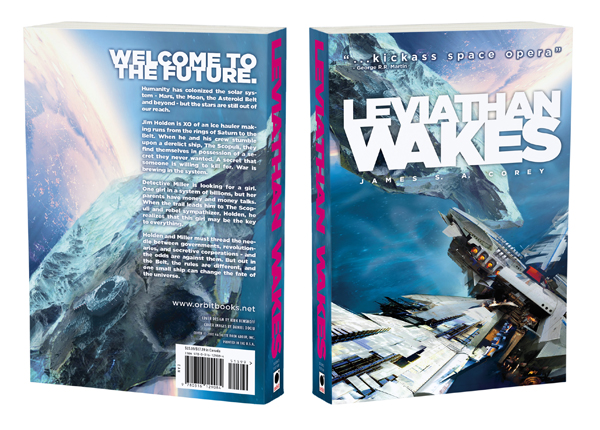
Leviathan Wakes cover, from Orbit
The books are soon going to be a TV series, and I am very much looking forward to see its depiction of space and space travel. (With the exception of parts of the first book, wherein Corey tried to write something horror-ish by being as gross as he could think to be. Whatever. Those are not the good parts of the book.) Corey steered clear of many sci-fi tropes that would have a big impact on the appearance of the series – no artificial gravity here! – and he made sure to build aspects of spacecraft engineering and operations into the cultures he depicted. For example, “Belters” nod and shrug with whole-arm gestures, so that they can be seen when wearing a suit. A good chunk of the books take place in zero gravity. Hopefully that will translate to the screen!
I’m going to take a look at some of the spacecraft engineering concepts in “The Expanse.” Let’s start with the most science-fictional, and therefore least plausible:
The Epstein Drive
Corey very quickly establishes that the powerhouse of his whole solar-system-wide civilization is the “Epstein Drive,” which is some kind of fusion engine for boosting spaceships around. It allows craft to thrust continuously from one planet or asteroid to another, accelerating constantly for half the trip and then decelerating constantly for the second half. This trajectory allows relatively quick travel times between worlds. Conveniently for crew health, and for TV production, the engine also provides “thrust gravity” inside the spaceship. Ships are therefore designed with decks in “stacks” above the engine with a ladder or lift giving crew access between decks, like in a skyscraper.
A fusion engine isn’t a crazy idea, especially not for a civilization a couple hundred years in the future. The problem is propellant. No matter how powerful or efficient your engine is, you will always need to be chucking propellant out the back to sustain this kind of thrust profile.
Picture this: you’re sitting in the middle of a frozen pond. The ice is perfectly frictionless, so you can’t walk or crawl or anything to get back to solid ground. What you do have is a bag full of baseballs. If you throw a baseball away from you, then you have given it some amount of momentum (mass times velocity). Your body gets an equal and opposite amount of momentum: you start sliding in the direction opposite your throw, but much more slowly than the baseball (because its mass is small while yours is big). Great! You have a way to get to shore. But you don’t want to wait out this long slide, so you throw another baseball. This speeds you up a little. Another throw speeds you up a little more. You can keep throwing baseballs until you decide that you’re going fast enough that you can wait it out. That’s basically how spacecraft work now: they thrust for a little, and then coast for a long period of time until they get to their next destination. But what if you wanted to keep thrusting the whole time? You will need more baseballs. Lots more baseballs. You are going to have to keep throwing them, constantly, to keep accelerating yourself.
Writing that a spaceship has a fusion drive instead of a chemical rocket is like replacing yourself in this analogy with a major league baseball pitcher. They will put more momentum into each pitch, and so they’ll go faster across the ice. In other words, their thrust is more efficient. But they will still run out of baseballs at some point, and then they must coast without thrust. The spaceship must stop its burn, cease thrust gravity, and wait several more months before getting to their destination. In the end, high thrust – and, with it, appreciable thrust gravity – should only be active for a short time in any space voyage through the Expanse. As we are learning with ion propulsion nowadays, it can often be most efficient to run at a low level of thrust, but sustain that for a very long time. But that doesn’t give our characters a convenient floor to stand on! So Corey put the word “Epstein” in front of “fusion drive.” “Epstein,” in this case, is short for “magic.” It’s a kind of magic that lets Corey have thrust without propellant, so that he can simultaneously achieve short (astronomically speaking) travel times and keep his crew in thrust gravity.
For a more physically realistic depiction of relationship between fuel, propellant, and thrust, consider Neal Stevenson’s spaceship Ymir in Seveneves.
The Way Ships Move
In the Expanse universe, spaceships are flipping around all the time to vector their engines in the correct direction to change their velocity. And we often read references to what the thrusters are doing on ships. This is all good. But the ships don’t really move the way real spacecraft move.
First of all, orbits barely enter the picture. One scene in Leviathan Wakes involves a character plotting out the likely trajectories of a certain ship, but other than that, the characters can go just about anywhere they want to go as long as they have a good ship to call theirs. Absent the Epstein “magic,” that behavior isn’t really plausible.
Second, though, is that Corey imagines his spaceships rotate themselves around in the same way just about all science fiction authors do: with thrusters. That’s not what most modern spacecraft do! They actually use wheels. Spin a wheel clockwise, and Newton’s third law kicks in: there’s an equal and opposite reaction. The spacecraft spins counterclockwise. Devices that function as I just described are, therefore, called reaction wheels. Other wheel-based devices that take advantage of gyroscopic torques can give satellites quite a lot of agility – without using any propellant. I suspect that the reason why these realistic actuators don’t often appear in science fiction is that there are no obvious cues to their operation: no thruster spurts, no blue glows shining out of emitters, nothing. The ship just starts to rotate.
I was happy to read that Corey’s spaceships are all native to space. There are not many cases where a ship lands, and in those cases, it’s always a small one. The heroes’ ship does once, on Ganymede. With surface gravity comparable to Earth’s moon, that’s not such a stretch for a fusion-drive starship.
28 June 15 Edit: Darn it, I just started Cibola Burn and about the fourth thing that happens is that the Rocinante lands on an Earth-size planet and immediately takes off again. Minus points for that!
The Battles
Space combat plays a big role in the plot of the Expanse books. And it’s a generally great depiction of space combat! Lots of the tactics and technologies are grounded in plausible physics. Ships shoot missiles and guns at each other, the effective range of a torpedo is determined by how close your ship needs to be to make sure the enemy ship doesn’t have time to shoot your torpedo down, the crew all gets into space suits at the beginning of the battle, there’s a ton of electronic warfare activity, and the battles wax and wane in intensity as the spaceships maneuver and orbit.
I’ve long thought that the most effective weapons in a space battle would be simple kinetic slugs or flak shells. My reasoning is simple: the speeds of objects in space are fast enough that a relatively small piece of junk can easily blast a hole through sensitive components. This is exactly why present-day spacecraft engineers – like me – worry about micrometeoroid strikes, space debris, and the Kessler syndrome. In the Expanse, the ships all fire torpedoes or guns at each other. And the results of weapon strikes are devastating: it only takes one torpedo or a few well-placed railgun slugs to take out a ship. Ships blast electronic garble at each other to screw up their targeting systems, but in the end the best defense is not getting hit – so we see the pilot do a lot of evasive maneuvering. I think this is all on the right track from a physics standpoint, though a real space battle with “Expanse-style” ships would probably take a lot longer, involve more orbit dynamics, and require a lot more computerized coordination.
There are two rather implausible elements to the battles. First is the Epstein Drive, which makes the combatants’ maneuvering matter a lot more than orbit dynamics. Second is the “juice,” a drug cocktail that keeps people alive and functioning when exposed to high gee forces. As a way to deal with high gees, the “juice” is just about as good a science-fictiony way to do it as any other, including immersing people in fluid as in The Forever War or inventing some kind of mythological inertial dampener. In the end, though, humans are squishy, precious cargo, and fighting full-on battles with them inside your spaceships doesn’t make a whole lot of sense.
Stealthy Spaceships
(There are some minor spoilers in this section!)
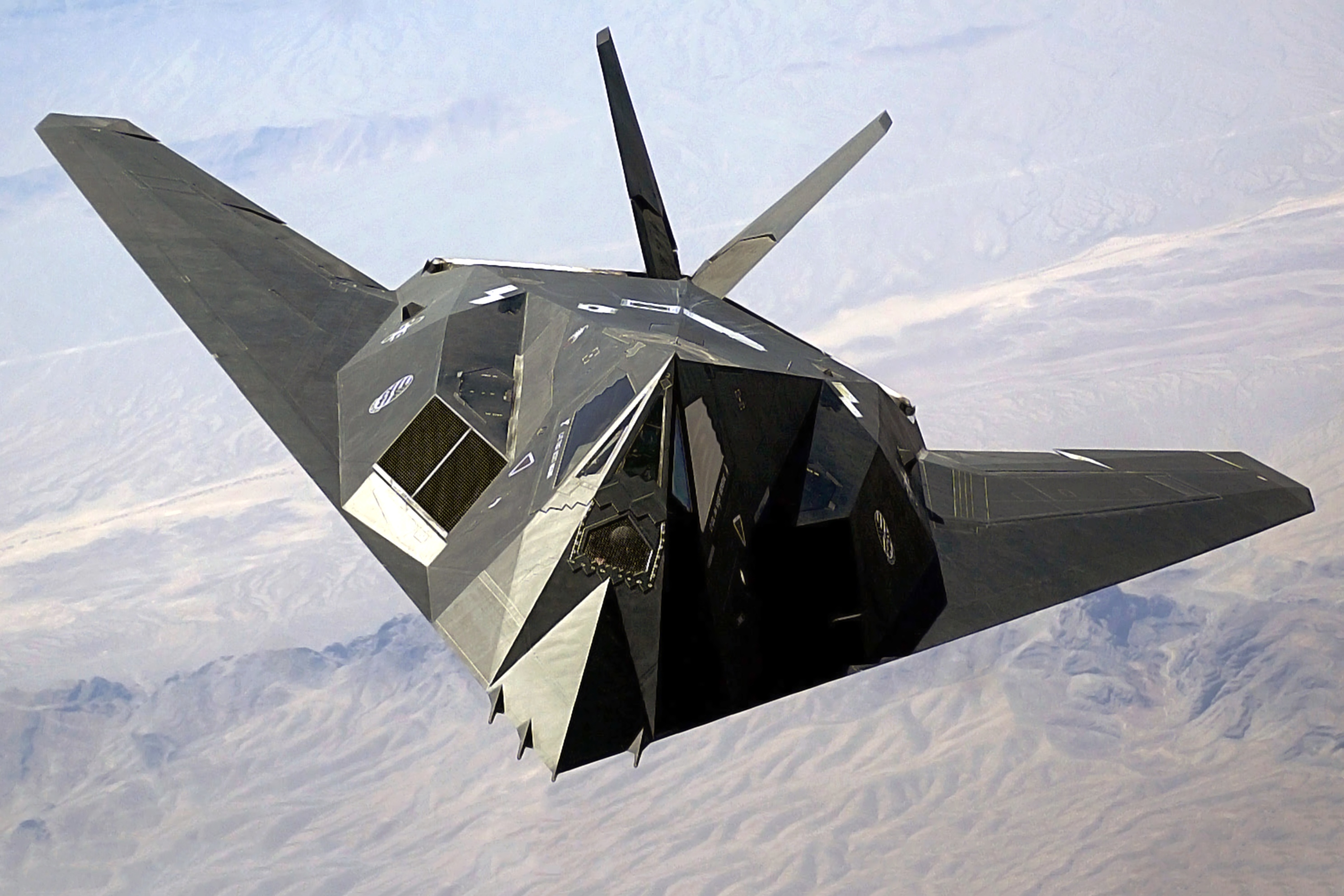
A plot point early on in the first book, Leviathan Wakes, revolves around the appearance of a stealth spaceship. This doesn’t involve any cloaking devices like in the Star Trek universe. Rather, a few spaceships avoid detection by (1) being painted black, which hides them in the visible spectrum, (2) having surfaces that absorb or scatter radar, which hides them in radio wavelengths, and (3) radiating heat out the side of the ship facing away from the enemy, which hides them in infrared. Much as it might give some people heartburn, this is all fairly plausible! The first two points are easy to imagine based on what we know about about the present-day Air Force. Though its not as familiar to the general public, the third item is actually something that comes up all the time in spacecraft design: especially if your satellite has sensitive electronics – like an infrared telescope – the design will include coolers, heaters, baffles, insulation, and radiators designed to emit heat in directions pointing both away from the precious detectors and away from the sun. Even the International Space Station has radiators that rotate to keep them pointing away from the sun most of the time. (The reason is that if the radiators face the sun, they’ll start to absorb heat into the station instead of emitting it out!) Such a “thermal management system” could be designed to, with the other stealth elements, give one side of a spacecraft the appearance of a cool, black spot indistinguishable from the rest of empty space.
A stealth spaceship wouldn’t be easy to build, and it wouldn’t be perfectly invisible – just harder to detect than normal to a lone adversary. And, in fact, both those points are relevant to the spaceships in the Expanse. One crewmember is able to spot a stealth ship on his sensors, but he doesn’t know what it is or how to respond to it. And that’s really all it takes for the stealth ship to accomplish its mission, after all! The very difficulty of constructing a stealth spacecraft actually makes the stealthiness more effective. The characters who cannot conceive that somebody could field a stealth spaceship end up more prone to falling prey to it.
Spaceship stealth makes an appearance other times, as well. At least twice in the series, the heroes’ ship hides itself by masquerading as something it’s not.
Spin Gravity
Lots of space stations in the Expanse, including some embedded in asteroids, spin to provide their inhabitants with centrifugal “gravity.” This is an idea that’s been around the aerospace and science fiction communities for decades, and Corey executes it well. In fact, one of the things I enjoy about the books is how the plot moves between the different environments of planetary gravity, low lunar gravity, spin gravity, and (“Epstein”-based though it may be) thrust gravity. The different gravitational environments contribute to different cultures, and they put the characters in interesting and different situations. If the TV series sticks to the books, we’re going to see low-gee gunfights and damage control teams solving problems in microgravity. Regularly.
All the stations with spin gravity are large, which is the right choice. It means they don’t have to spin at a dizzying rate to get a comfortable level of gs for their inhabitants. There is another benefit, in that the weird non-intuitive kinematics of rotations – Coriolis forces – have less of an effect the larger the rotating space station. These effects can be truly weird, and it can be hard even for physicists to bookkeep all the terms correctly to model them. Something that might happen if you were standing in a spinning space station is that if you drop something, you will actually see it follow a curving path to the floor, and it won’t land at your feet. You will also see it fall at a different speed than you would expect based on the gravity you experience. (I’m planning to write something up separately to go into all the details.)
Anyway, suffice it to say that spin gravity is a strange environment and Corey, like most science fiction writers, doesn’t go into all the details. But spin is the right idea for giving gravity to spacefarers, and I can’t wait to see how the visual effects team on the Expanse interprets all the spinning structures.
All in all, I’m thinking that The Expanse will be good for science fiction on TV. It will be a show with a time period a bit closer to us than, say, Star Trek. And the show will have a wide diversity of environments to challenge the characters. I am looking forward to seeing their depictions of spacecraft and how they move around in space!
Elantris is Brandon Sanderon’s debut fantasy novel. It has a blurb from Orson Scott Card on its cover, to the gist that this is the finest fantasy in who knows long to catch Card’s notice. As my sister put it, this author must have died when he got that.
It’s an impressive debut, and certainly only of the more imaginative fantasies I’ve read. I really enjoy it when an author is able to construct a self-consistent, concrete world without falling into the overused Tolkeinian tropes. (You can’t see it, but right now I’m staring pointedly at every Vulcan-eared archer elf and bearded miner dwarf that has ever existed ever.) It certainly borrows from other fantasy mainstays, and it has a lot of commonality with some other things I’ve seen – Sabriel and its sequels, the Edeard storyline of Peter Hamilton’s Void Trilogy, even A Game of Thrones (though I actually like the characters in Elantris) – but Elantris is constructed in a very unique way.
The plot takes place in a land where the eponymous city was once the seat of magical powers that let its citizens live however they pleased, without worrying about any basic necessities or threat of invasion. A key aspect of the city’s magic was that only Elantrians could perform it – but anyone, anywhere in the kingdom, could suddenly find themselves struck by the transformation into an Elantrian. The culture of the kingdom is simultaneously elitist and egalitarian, and no one goes hungry or suffers from illness. And so life goes on, until one day a disaster strips the Elantrians of their power and turns the city, along with all its magical people, into decaying ruins. The remaining population of the kingdom throws down their now-impotent rulers and locks them all within Elantris’ walls, and the mercantile class become robber barons to impose their own feudal rule on the kingdom. Still…anyone, anytime can be struck by the transformation – but now they are shunned, despised, and imprisoned inside the fallen city.
The novel follows three key characters ten years after the disaster takes place. Raoden, popular heir to the new throne of the kingdom, finds himself turned into an Elantrian and immediately begins to unravel the mysteries surrounding the ruin after his father tosses him into the city. Sarene, a twist on the classic tomboy princess, is en route from another kingdom to join Prince Raoden in a political marriage when his transformation hits; with him declared dead, the treaty governing the kingdoms’ alliance makes their marriage binding as she remains ignorant of his true fate. She must get to know her new homeland while politically maneuvering to safeguard both kingdoms – as the alliance was an important move to present a united front against a third aggressor nation. Meanwhile, Hrathen, a high priest of that third nation, has quietly infiltrated the kingdom and seeks to convert its populace to his religion before his Emperor loses patience and decides to destroy them all.
A word of warning: minor spoilers follow. But I promise that they are tiny.
One of the things I particularly liked about this novel is how self-consistent the mechanism for doing Elantrian magic is. This magic is not vaguely defined – nobody “searches out with their feelings,” nobody “embraces the power rushing through them,” nobody practices the perfect flick of their magic wand. After reading this book, I realized that now I know how to do Elantrian magic, if I lived in this world. Going a step further, we readers actually get to see how research into magic would work in Elantris – that is, how to discover and construct new spells. It’s a very open-ended system, and very specifically defined, lending this fantasy an air of….well, perhaps “realism” isn’t the right word, so let’s go with “concreteness.” All this isn’t frivolous: the basis for and technique of Elantrian magic becomes a major plot point. And with us readers given the tools to follow along, I found myself able to solve the puzzle of Elantris before the characters did. (Fortunately, they were not very far behind!)
In fact, I’d have to say that this is one of the most economical novels I’ve read: Sanderson introduces very little into the book that doesn’t become important in some way or another. This is generally good, but at the same time, sometimes it makes events in the plot seem a little too easy to see coming. Of course the prince and princess eventually get together; of course the high priest’s overzealous acolyte causes his downfall; of course the autistic child we briefly meet has a super-important role to play in the book’s climax. This is not to say that there aren’t plenty of twists that are surprising – there are – or characters who die tragic deaths – there are those, too – or even unexpected relationships that develop – that also happens. It’s kind of amazing just how many events got packed into this book, for its relatively small size. I think I enjoyed the book more for being able to piece things together on my own: in a way, that proves the logic and consistency underlying Sanderson’s world and shows that his few basic principles go a lot further to move the plot along than a sudden “aha, reader! I bet you weren’t expecting me to throw THIS at you!” sort of forced “twist.”
Sanderson creates a colorful cast of secondary characters, but for the most part he seems to enjoy exploring the relationships that develop between them more than he likes looking at how the characters might evolve. In the cases of Sarene and Raoden, in particular, the plot is an affirmation of being true to oneself in the face of an adverse situation or heckling from others. They come out of their experiences richer, but that is more because they shaped the world around them than the reverse. Hrathen, though, is a much more interesting case: over the course of the plot we see him struggle with his faith in an attempt to reconcile its “convert or die” mentality with his personal belief that he is genuinely trying to help the people of the kingdom. The particular manner of his fall and transformation at the climax is a little surprising, yet makes perfect sense – like much of this book. Sadly, Hrathen’s part in the climax of the plot is also the subject of the novel’s most moralizing speechifying; Sanderson manages to stop just after making his point, though, before he gets overbearing.
The author closes Elantris not with a complete triumph of good over evil, but with the balance of power restored. Elantris leaves the door wide open for a sequel, with antagonists clearly still extant in Sanderson’s world and new facets of Elantrian (or other) magic yet to be learned. I will be happy to find out what those facets are when I can. For now, though, Elantris is a fine standalone novel that provides a fresh look at a lot of fantasy themes in a thoroughly imagined universe.
It’s interesting to re-read a book that made a huge impression on me the first time around. Some of them seem less exciting, while some hold up amazingly well upon multiple reads. (The best example I can think of for the latter case: Dune. Despite identifying the traitorous character by name on page 28, before we ever set foot on the eponymous planet, Herbert still surprised me with the betrayal…and when I re-read the book six months later, it happened again. I was getting all, “Aha! The Atreides are figuring it out! Duke Leto has a chance, maybe he’ll get away this time oh NOOOOOOOO” but I digress.)
The first time I read C. S. Friedman’s In Conquest Born, I was incredibly impressed. I immediately classed the book as one of my favorite science fiction novels. On my mental tally, it went right up there with Dune.
The novel explores the kinds of societies and personalities that might evolve in an environment of endless conflict. Two interstellar nations, the Azean Star Empire and the Braxin Holding, have been locked in a galactic-scale war for such a long time that, though the original antagonism is recorded, none of the combatants really care why the war started in the first place. The war has become a way of life for both sides, and both cultures have evolved along parallel – but mutually exclusive – courses in response to the war and to each other. The Azeans, determined to make themselves into the perfect fighting race, have started genetically engineering themselves – gunning not just for a specific “ideal” phenotype but for telepathic abilities, which the Braxins specifically abhor. The elitist Braxaná rulers of the Holding sought to preserve, by all the means at their disposal, the ancient warrior culture that first brought them to successful dominance over the other tribes of their planet; they hope that their traditions and ideals will carry them to victory in future conflicts as well. As Zatar puts the distinction between Empire and Holding: “While your people developed Civilization, we developed Man.”
In that environment, both nations accidentally produce a representative who embodies everything their culture has been evolving towards. The first half of the novel chronicles the formative years for Anzha lyu Mitethe, in Azea, and Zatar of the Braxaná. They both become renowned commanders in the Endless War. At almost the exact midpoint of the book, they meet each other in a room – and in the second half, the galactic war becomes an obsessive personal vendetta for both characters. They seek to manipulate their societies’ political and military goals towards their personal objective of destroying their counterpart.
The story is both epic and intimate, with references to more than enough planets, cultures, species, and events to establish a credible universe. Like Friedman’s other science fiction, major themes include self-discovery, the interplay of sexuality and power, and descriptions of characters and cultures that are neither fully good or evil.
Maddeningly, Conquest was Friedman’s first novel and not only did she send the manuscript to a publisher unsolicited, but that publisher accepted it.
On this 40th anniversary of his launch to the Moon, Buzz Aldrin wrote an excellent opinion piece in today’s Washington post. (Speaking of the anniversary, check out the HD restored videos of the landing on NASA’s web site!) Reading it motivated me to go to the Augustine Commission‘s web site and leave them the following comment:
I have had dreams of space ever since I can remember, and grew up watching documentaries about the space program of the 1960’s. Now, I am pursuing a Ph.D. in aerospace engineering – and am working at NASA JSC this summer. I just turned 25 years old.
In my opinion, my generation has lost the focus on science and exploration – but we have more of a fixation on the latest and greatest high-tech gadgetry than anyone before us. We line up to get new smartphones and mp3 players, and then line up again to get the very latest model when it’s released. We are focused on the “new.” To us, who grew up with the Space Shuttle, the International Space Station, and the legacy of Apollo, the Constellation program does not look “new.” We look at the plans for Orion, Altair, and Ares, and think, “If the mission of NASA is to go to the Moon, why don’t we just dust off the old blueprints for the Saturn V and Apollo CM/LM and get there in just as long as it takes to build those things, instead of by 2020?” My generation has grown up seeing an ever-shorter development cycle on high-tech products. This leads us to wonder how getting *back* to the Moon from our current Shuttle/ISS position is going to take more than a decade, when in the social tumult and limited technology of the 1960’s America went from no human spaceflight to landing men on the Moon in less than a decade. We want to see something NEW, and we want to see if SOON. Something that looks like technology has evolved from the Apollo, Space Shuttle, and ISS stepping-stones rather than backpedaling from Shuttle and ISS. To us, that evolution looks like it is much more like SpaceShipOne than Orion.
If I may be so bold as to offer a suggested solution, I would say that, first, NASA needs a strategic focus on doing something obviously new, something that obviously leverages the latest technologies, something with obvious returns to our lives on Earth. NASA should be pioneering new technologies and actively exploring the Solar System. To me, this means human colonization of Mars, with all the development for a self-sustaining habitat and all the spinoffs to green high tech that entails. My generation is ever more concerned about social justice, energy policy, efficiency, and climate change; and given the similar challenges facing manned spacecraft, this is a perfect opportunity for NASA. In today’s Washington Post, Buzz Aldrin articulates a case for Martian exploration under a Unified Space Vision far better than I could: http://www.washingtonpost.com/wp-dyn/content/article/2009/07/15/AR2009071502940.html
Second, NASA needs to look to new technologies and techniques in accomplishing its goals. Something experimental, something with a high rate of return. It would be fine if it requires a higher up-front investment if it lowers costs in the long term, unlike the Constellation architecture. To that end, I think funding should be restored to NASA programs developing next-generation lifting-body reusable spacecraft rather than capsule spacecraft. NASA needs to show that it can do more than what Scaled Composites did with a $20 million budget. The next-generation spacecraft could even leverage existing Constellation development by using Ares rockets and Shuttle boosters to achieve orbit. The focus should be on correcting the expenses and inefficiencies of the Space Shuttle, not entirely abandoning the architecture of that highly capable spacecraft.
Thank you.
If you are similarly motivated to support the space program and get ourselves kicked up out of low-Earth orbit, leave a comment yourself.
It is definitely beyond the scope of the Commission to designate a specific technical solution, but I had to throw in a plug for my favorite next-gen spacecraft idea. The concept comes from, again, Buzz Aldrin, and I first read about it in his novel The Return, which I picked up at a recent Ithaca library book sale. The basic idea is this:
Take two or three Space Shuttle solid rocket boosters. Modify the SRBs into lifting bodies, put little wings on them, or change the parachutes to paragliders. Then leverage existing UAV technology for all its worth to turn the SRBs into “flyback boosters” that return automatically to their launch site, where they can immediately go into refurbishment between flights. Voila: no ocean recovery means instant savings.
Now take those two or three flyback boosters and put them on something like an existing Atlas V/Centaur booster. (I favor using the Ares design here.) This liquid-fueled booster would be expendable, and provide sustained thrust through the second stage to get the payload into orbit. Of course, the payload could be much bigger than a typical Atlas V payload, such as MRO, thanks to the additional SRB-derived boosters.
Finally, what goes on top of this 2 1/2 stage booster? A manned spaceraft that’s half Space Shuttle and half SpaceShipOne. It would be a craft purely for orbital and reentry operations, so it needn’t be as large as the Shuttle, which incudes powerful main engines for the ascent to orbit. This craft could probably fit a small crew compartment and cargo bay along with an orbital maneuvering system; however, there’s a lot of sense to having a separate crewed version and cargo version. The key thing is that the aerodynamics of the spaceraft body need to be designed with a nice, smooth reentry in mind, and allow the craft to be piloted back to an airstrip. Leverage composites (a great new technology that matured mostly after the Shuttle was first designed) for all they are worth, and again, avoid the expensive water landing.
The result should be something with the range of capabilities of the Shuttle, lots of reusability, little expense compared to both STS and expendable systems, and a pretty big safety factor. I plan to run through some of the calculations when I get back to Ithaca, but I imagine that Space Shutle-sized crews or substantial cargo lifts should be possible.