Random Post: Moon wood for the Dutch
RSS .92| RSS 2.0| ATOM 0.3
 

Small Web Update

January 7th, 2012

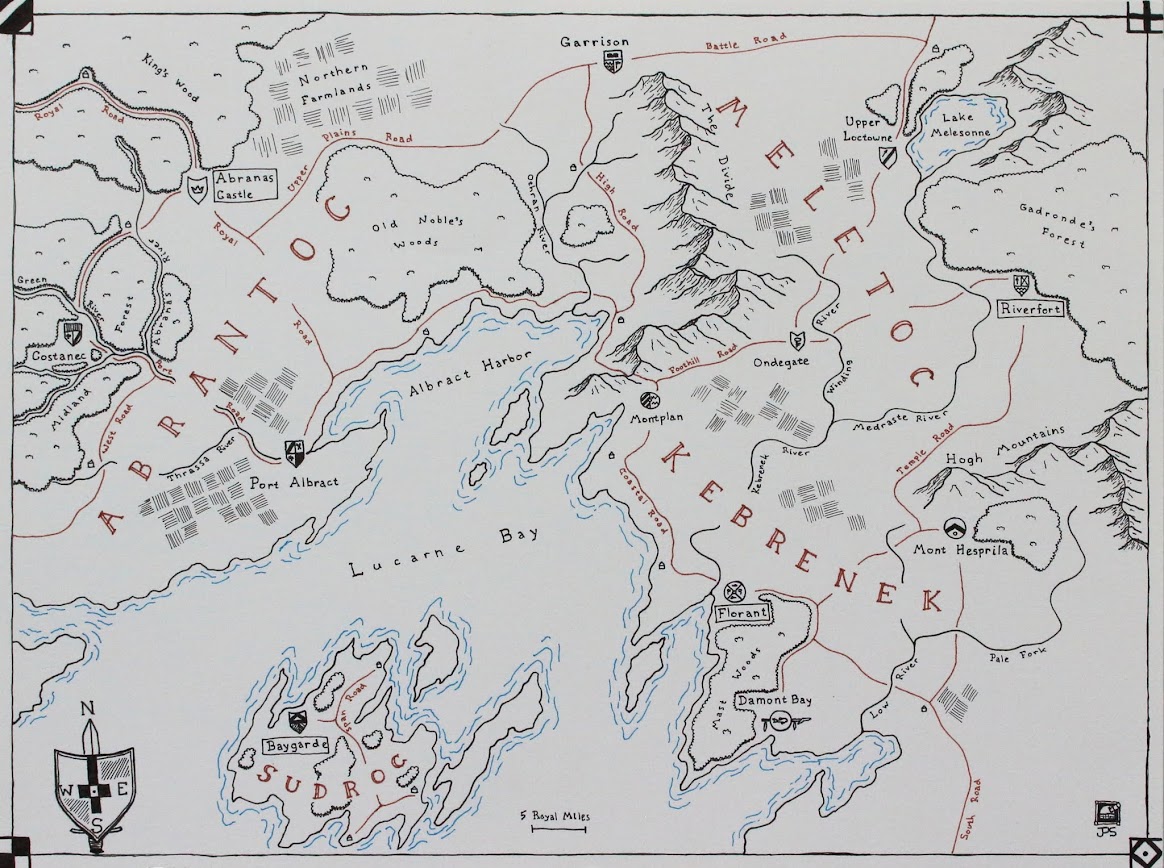
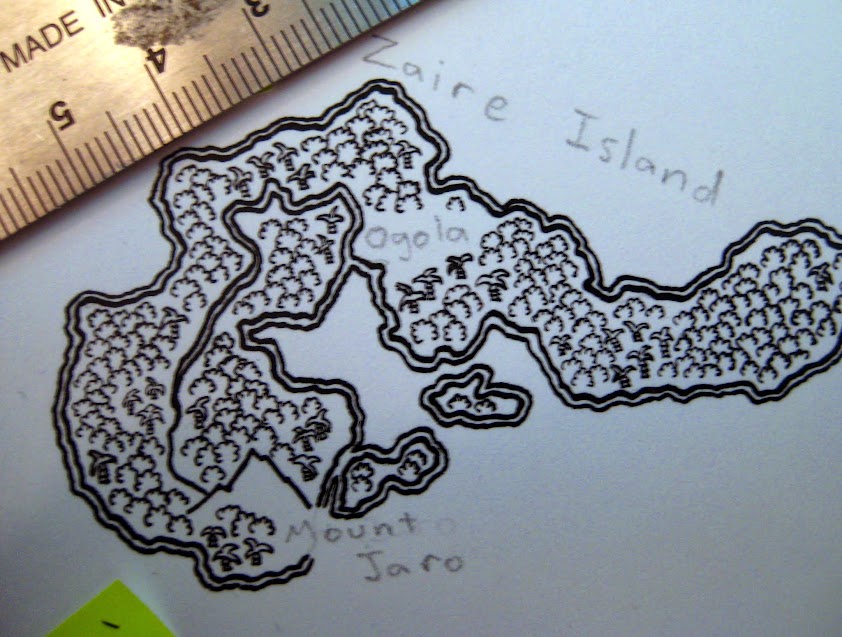
I’ve been doing a fair number of fantasy maps lately, taking pictures of them, and putting them on the Internet. So, I’ve decided to give them their own section on my images page, and their own Picasa album.  There’s even a new one in the album!

New map! New language!

Fantastic Cartography Again

October 30th, 2011

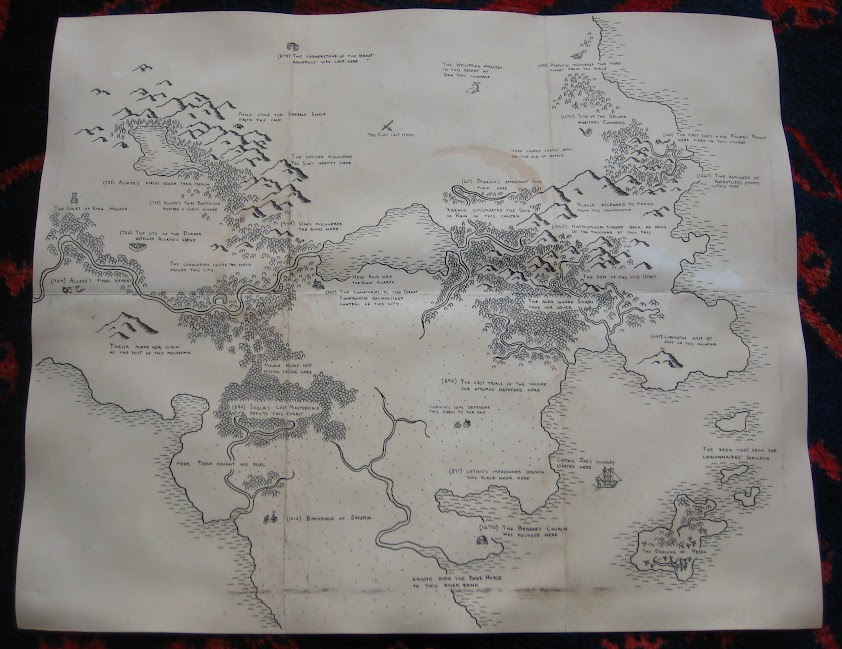
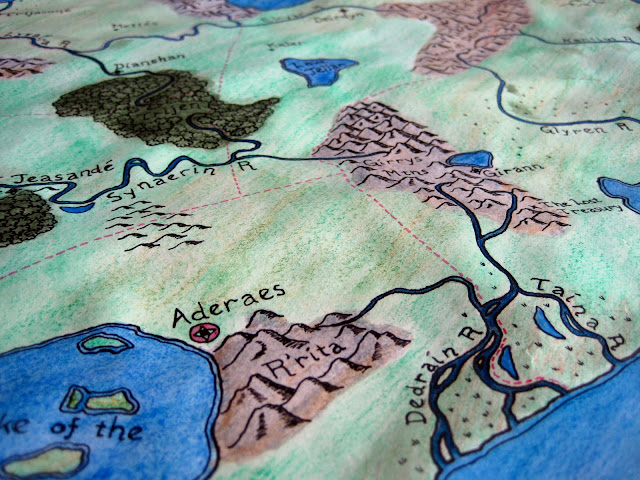
I know I’ve liked to draw fantastical maps for a long time now. So, I should not have been surprised at how much fun I had producing a fancy version of a map for a world I’ve been working with for several years. I figured out techniques for drawing the shorelines, forests, and mountain ranges that I think were very successful. I used a lot of watercolor pencil washes, with india ink for lines.

Map of the Southern Continent

Still, though I like it as an image, the product isn’t a perfect map. I made the decision to try and put in all the physical features before any points of interest of placenames, with the intention of doing so in an overlay. None of my scratch tests for such labels worked very well; I ended up putting labels on the map in postprocessing on my computer. Not ideal, but at the same time, it came out okay.

I had such a great time producing the map over the course of a couple of weeks worth of coming home from work, making dinner, and then throwing NPR on while I sat down with my pen and ink. (It was a very meditative sort of endeavor.) I have also been keen on trying to improve the map. Fortunately for me, Fiancée loved the thing and requested that I produce a similar map based on a template which she supplied to me. Well, then. I didn’t need a second excuse to start.

Map of Faerie

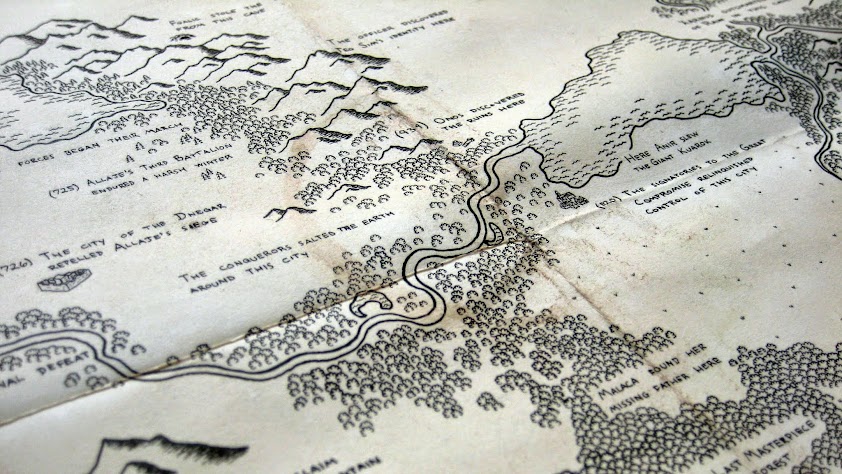
I worked primarily from the template; but I had leave to make some modifications such as putting detail on coastlines or changing river courses to be more realistic. I stuck with the same general techniques that worked so well for me on the first map.

This time, though, I planned a bit better. I noted the positions of the physical features; but I also included the major landmarks and indicated to myself where text labels would go. When I inked in the forests and mountains on this map, I left myself spaces for the labels. I practiced ink lettering on scrap paper, came up with a font style that I thought would be fitting, and this time put hand-lettered placenames directly on the paper.

A nicely labeled forest

I will be the first to admit that I didn’t succeed in all instances – this paper absorbed the ink in a very different way depending on whether there was a good base layer of pencil in place – but I like the results, in general. You can also see that this time I have added some carmine red ink to my repertoire, to add accents or denote features on the map (here, provincial boundaries from the template map). Another set of new features comes from a few special points of interest on the map. I will comment that inking a small symbol, such as crossed swords, on a large paper map comes with a particular set of challenges: ink is almost impossible to remove without leaving evidence, and so once I set about drafting such a symbol on the final image, I was committed to it! After all, I’d hate for one badly botched, critical item to ruin the whole work. (Happily, little goofs in the mountains and such simply add to the character of such an image!)

City and Battlefield

Just for grins, I threw on some other embellishments around the coastlines. You know: sea monsters and such. I’m particularly happy with this little guy.

Big fish

I still have the map in my apartment and I’m thinking about whether I should add some kind of border, but I think I’m just going to let Fiancée mat and frame it however she likes.

Now I’ve just got to think about what cartographic project to do next…


Review: “Elantris”

September 6th, 2011

Elantris is Brandon Sanderon’s debut fantasy novel. It has a blurb from Orson Scott Card on its cover, to the gist that this is the finest fantasy in who knows long to catch Card’s notice. As my sister put it, this author must have died when he got that.

It’s an impressive debut, and certainly only of the more imaginative fantasies I’ve read. I really enjoy it when an author is able to construct a self-consistent, concrete world without falling into the overused Tolkeinian tropes. (You can’t see it, but right now I’m staring pointedly at every Vulcan-eared archer elf and bearded miner dwarf that has ever existed ever.) It certainly borrows from other fantasy mainstays, and it has a lot of commonality with some other things I’ve seen - Sabriel and its sequels, the Edeard storyline of Peter Hamilton’s Void Trilogy, even A Game of Thrones (though I actually like the characters in Elantris) - but Elantris is constructed in a very unique way.

The plot takes place in a land where the eponymous city was once the seat of magical powers that let its citizens live however they pleased, without worrying about any basic necessities or threat of invasion. A key aspect of the city’s magic was that only Elantrians could perform it – but anyone, anywhere in the kingdom, could suddenly find themselves struck by the transformation into an Elantrian. The culture of the kingdom is simultaneously elitist and egalitarian, and no one goes hungry or suffers from illness. And so life goes on, until one day a disaster strips the Elantrians of their power and turns the city, along with all its magical people, into decaying ruins. The remaining population of the kingdom throws down their now-impotent rulers and locks them all within Elantris’ walls, and the mercantile class become robber barons to impose their own feudal rule on the kingdom. Still…anyone, anytime can be struck by the transformation – but now they are shunned, despised, and imprisoned inside the fallen city.

The novel follows three key characters ten years after the disaster takes place. Raoden, popular heir to the new throne of the kingdom, finds himself turned into an Elantrian and immediately begins to unravel the mysteries surrounding the ruin after his father tosses him into the city. Sarene, a twist on the classic tomboy princess, is en route from another kingdom to join Prince Raoden in a political marriage when his transformation hits; with him declared dead, the treaty governing the kingdoms’ alliance makes their marriage binding as she remains ignorant of his true fate. She must get to know her new homeland while politically maneuvering to safeguard both kingdoms – as the alliance was an important move to present a united front against a third aggressor nation. Meanwhile, Hrathen, a high priest of that third nation, has quietly infiltrated the kingdom and seeks to convert its populace to his religion before his Emperor loses patience and decides to destroy them all.

A word of warning: minor spoilers follow. But I promise that they are tiny.

One of the things I particularly liked about this novel is how self-consistent the mechanism for doing Elantrian magic is. This magic is not vaguely defined – nobody “searches out with their feelings,” nobody “embraces the power rushing through them,” nobody practices the perfect flick of their magic wand. After reading this book, I realized that now I know how to do Elantrian magic, if I lived in this world. Going a step further, we readers actually get to see how research into magic would work in Elantris – that is, how to discover and construct new spells. It’s a very open-ended system, and very specifically defined, lending this fantasy an air of….well, perhaps “realism” isn’t the right word, so let’s go with “concreteness.” All this isn’t frivolous: the basis for and technique of Elantrian magic becomes a major plot point. And with us readers given the tools to follow along, I found myself able to solve the puzzle of Elantris before the characters did. (Fortunately, they were not very far behind!)

In fact, I’d have to say that this is one of the most economical novels I’ve read: Sanderson introduces very little into the book that doesn’t become important in some way or another. This is generally good, but at the same time, sometimes it makes events in the plot seem a little too easy to see coming. Of course the prince and princess eventually get together; of course the high priest’s overzealous acolyte causes his downfall; of course the autistic child we briefly meet has a super-important role to play in the book’s climax. This is not to say that there aren’t plenty of twists that are surprising – there are – or characters who die tragic deaths – there are those, too – or even unexpected relationships that develop – that also happens. It’s kind of amazing just how many events got packed into this book, for its relatively small size. I think I enjoyed the book more for being able to piece things together on my own: in a way, that proves the logic and consistency underlying Sanderson’s world and shows that his few basic principles go a lot further to move the plot along than a sudden “aha, reader! I bet you weren’t expecting me to throw THIS at you!” sort of forced “twist.”

Sanderson creates a colorful cast of secondary characters, but for the most part he seems to enjoy exploring the relationships that develop between them more than he likes looking at how the characters might evolve. In the cases of Sarene and Raoden, in particular, the plot is an affirmation of being true to oneself in the face of an adverse situation or heckling from others. They come out of their experiences richer, but that is more because they shaped the world around them than the reverse. Hrathen, though, is a much more interesting case: over the course of the plot we see him struggle with his faith in an attempt to reconcile its “convert or die” mentality with his personal belief that he is genuinely trying to help the people of the kingdom. The particular manner of his fall and transformation at the climax is a little surprising, yet makes perfect sense – like much of this book. Sadly, Hrathen’s part in the climax of the plot is also the subject of the novel’s most moralizing speechifying; Sanderson manages to stop just after making his point, though, before he gets overbearing.

The author closes Elantris not with a complete triumph of good over evil, but with the balance of power restored. Elantris leaves the door wide open for a sequel, with antagonists clearly still extant in Sanderson’s world and new facets of Elantrian (or other) magic yet to be learned. I will be happy to find out what those facets are when I can. For now, though, Elantris is a fine standalone novel that provides a fresh look at a lot of fantasy themes in a thoroughly imagined universe.


The Map

August 7th, 2011

I have come into the possession of a most extraordinary object, which I procured rather fortuitously before the auction of goods from an insolvent boutique on the East Boulevard. I do not know how long it lay, disused and uncared-for, in a dusty drawer at that establishment, or when the boutique acquired it. The artifact in question is a curious map of the southern continent. I have scrutinized the place names and cross-referenced the markers corresponding to cities and towns with the atlases and charts in the City Library, and I have determined that this map dates from approximately 530 A.E. It covers the area from the North Barovin Mountains in its upper-left extremity, to historic Vorsvenbal in the south and all of South Brenin, Kalatchal, and part of Olahira to the east.

The dòm Gurand Map

The famous dòm Gurand Map of our southern continent does not only provide interesting historical and societal context, but contains some surprisingly accurate geographic information. One can examine the map for geological purposes, for evidence of historical wind patterns, and for characteristics of the climate of the year 530. Drainage areas of rivers are readily apparent, for instance, and the cartographer has captured some of the different qualities in the mountain ranges. Read the rest of this entry »


Review: In Conquest Born

July 29th, 2011

It’s interesting to re-read a book that made a huge impression on me the first time around. Some of them seem less exciting, while some hold up amazingly well upon multiple reads. (The best example I can think of for the latter case: Dune. Despite identifying the traitorous character by name on page 28, before we ever set foot on the eponymous planet, Herbert still surprised me with the betrayal…and when I re-read the book six months later, it happened again. I was getting all, “Aha! The Atreides are figuring it out! Duke Leto has a chance, maybe he’ll get away this time oh NOOOOOOOO” but I digress.)

The first time I read C. S. Friedman’s In Conquest Born, I was incredibly impressed. I immediately classed the book as one of my favorite science fiction novels. On my mental tally, it went right up there with Dune.

The novel explores the kinds of societies and personalities that might evolve in an environment of endless conflict. Two interstellar nations, the Azean Star Empire and the Braxin Holding, have been locked in a galactic-scale war for such a long time that, though the original antagonism is recorded, none of the combatants really care why the war started in the first place. The war has become a way of life for both sides, and both cultures have evolved along parallel – but mutually exclusive – courses in response to the war and to each other. The Azeans, determined to make themselves into the perfect fighting race, have started genetically engineering themselves – gunning not just for a specific “ideal” phenotype but for telepathic abilities, which the Braxins specifically abhor. The elitist Braxaná rulers of the Holding sought to preserve, by all the means at their disposal, the ancient warrior culture that first brought them to successful dominance over the other tribes of their planet; they hope that their traditions and ideals will carry them to victory in future conflicts as well. As Zatar puts the distinction between Empire and Holding: “While your people developed Civilization, we developed Man.”

In that environment, both nations accidentally produce a representative who embodies everything their culture has been evolving towards. The first half of the novel chronicles the formative years for Anzha lyu Mitethe, in Azea, and Zatar of the Braxaná. They both become renowned commanders in the Endless War. At almost the exact midpoint of the book, they meet each other in a room – and in the second half, the galactic war becomes an obsessive personal vendetta for both characters. They seek to manipulate their societies’ political and military goals towards their personal objective of destroying their counterpart.

The story is both epic and intimate, with references to more than enough planets, cultures, species, and events to establish a credible universe. Like Friedman’s other science fiction, major themes include self-discovery, the interplay of sexuality and power, and descriptions of characters and cultures that are neither fully good or evil.

Maddeningly, Conquest was Friedman’s first novel and not only did she send the manuscript to a publisher unsolicited, but that publisher accepted it.

Read the rest of this entry »


Art Question: Map Labels

July 25th, 2011

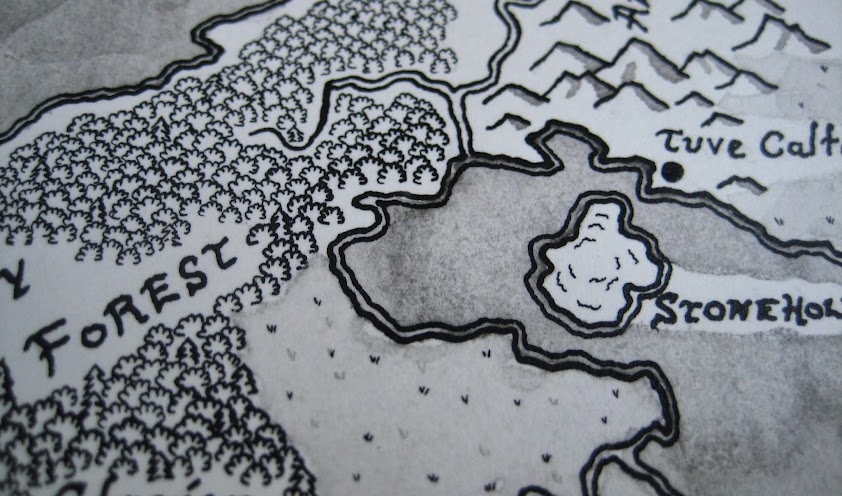
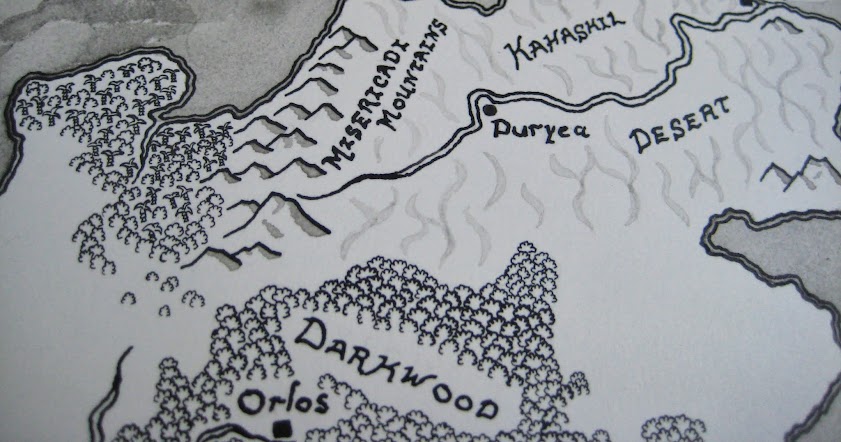
I have been working on a map. It looks something like this:

Map Detail

The map consists of India ink laid down on top of a set of watercolor washes. (Well, technically, washes from some Derwent Signature Watercolor pencils – thanks to Robin for those!) This is actually my first excursion into something like this. I like the way the India ink sits on top of the paper, while the watercolor soaks in.

But now I have a dilemma: I’m trying to decide how, or even if, to label the map with place names. I have already digitized the map (eh, roughly…what I really need is a large-format scanner!) and have been playing around with labeling schemes on the computer. The easiest and clearest thing to do in digital form is to (at least partially) desaturate the map such that the colors are duller and the ink is perhaps 60% gray and then scrawl my labels over it. However, the physical map has fairly bright colors and the ink is, of course, nearly always black, which means that a sweeping label over those mountains or forests will not come out well. I think more experienced cartographers of fantastical lands than I would have done the labeling and the cartography simultaneously, so they could shape the trees and mountains around the words if necessary. But no, I had to go ahead and ink in all the forests and mountain ranges first.

Here is what I am wondering: if I get some, say, red ink and use my pen to write a sprawling label over one of those forests, will the ink sit on top of the black-inked trees and be generally legible? Clearly, doing that with black ink would result in an unreadable jumble, but would red cut across the existing features with enough contrast? Should I just stick with doing it all by computer? Or does anyone out there have a better idea?


Why I Think a “Hobbit” Movie Might Not Be Such a Great Idea

February 5th, 2011


Fiction: Tareidos Beyond the Edge of the World-Ice

October 24th, 2010

A legend of Zarmina

As told by Posaredes the Storyteller, this account was discovered by the great archaeological expedition of 1217, among other famously well-preserved artifacts on display in the National Museum of Geshan. Read the rest of this entry »


Constructing Oghuran

July 3rd, 2010
Figure in the Desert

Desert Winds

It was many, many years ago when I first read The Lord of the Rings and the Redwall books, and I was always fascinated by the maps in the first few pages of each novel. Ever since then, I have been captivated by the idea of fantasy and science fiction world-building. It started with maps of my own – maps of places that didn’t exist, maps of places near my Massachusetts home as I wished they could have been, permutations of Tolkein’s maps. Eventually, I started to add to the maps notes about the cultures living in those worlds, inventing religions, societies, languages, and technologies. I began to invent prominent characters to populate my worlds, and eventually started to think about the adventures those characters would have.

The desert of Oghura and the Cathedral Galaxy are my latest such world-building exercises. Both of these have gone well beyond the “doodle stage,” as they now have characters and stories to their names. But Oghura stands out as the world that is probably the furthest along, and it is the only one of my invented worlds to have a fully-fleshed-out and fully functional language. And this is no cop-out set of invented fantasy words full of apostrophes, g’s, r’s, and q’s. Oghuran is an “a priori” constructed language that I pieced together carefully, using my knowledge of linguistics, statistics, and programming, with a liberal dose of imagination. Here is how I built Oghuran. Read the rest of this entry »


Fiction: Legend of the First Tribe

May 8th, 2008

The creation myth of the Oghuran nomads, which features prominently in the first segment of the Books of Gur.

Read the rest of this entry »