Just a quick shout-out to wish the Curiosity rover team well! I plan to crash Phil Plait’s Google+ hangout and monitor Ryan’s blog closely!
All posts by josephshoer
NBC Olympics
I don’t entirely get all of the criticism that’s been leveled against NBC for its coverage of these Olympics. Oh, no, it’s a tape delay, somebody call Julian Assange – surprise! that’s how we’ve been watching the Olympics in other time zones for decades! OMG, there are stupid human-interest interviews with athletes – oh, yeah, well with the exception of a few outstanding individuals, I defy you to find an athlete give an interview that wasn’t just “I tried to win, and I {did|didn’t}” platitudes. WTF, the commentators sound stupid for not knowing a few factoids – well, gee, I am a pretty well-rounded, well-informed, and well-educated guy, but I didn’t know who Tim Berners-Lee was, either.
That said, I don’t mean to suggest that things like this aren’t funny. Or that NBC isn’t doing some things wrong. I think that cutting a memorial from the opening ceremony (especially one as well-executed as that!) was insensitive left viewers with a reduced perspective of the opening ceremony. (Plus, there’s the whole golden rule angle: if New York had won the 2012 Games, I know there would have been tributes to the World Trade Center attacks and I know that Americans would have been annoyed if the BBC cut them.)
Likewise, there are some severe shortcomings to NBC’s content delivery. I gave up on cable television and just got myself an internet package…and so now I’m not allowed to watch any of the Olympic coverage on the web or TV. Before TV went digital, I could have watched for free. Something tells me that we consumers are worse off in this new world of digital rights management…
Besides, I actually like the curated content. If I watch a raw stream, I don’t get to hear the details of the arcane rules in events I’m not familiar with. I don’t necessarily know who the athletes are, or where they are in their careers, or how close they are to a world record, or how impressive that thing they did really is. The primetime content may be oversaturated with some events (swimming, running, gymnastics, …) and light on other, equally exciting, tense, and cool sports (badminton, whitewater kayaking, water polo, archery, …) but the context from former Olympians and coaches actually does help.
I’m not sure how the networks haven’t figured out the Internet yet. Why don’t they go all the way and stream the primetime coverage online, to everyone, ads and all?
Just adding my voice in case someone at NBC is watching the trends on Google. 😉
The kind of technology that NASA needs to embrace wholeheartedly
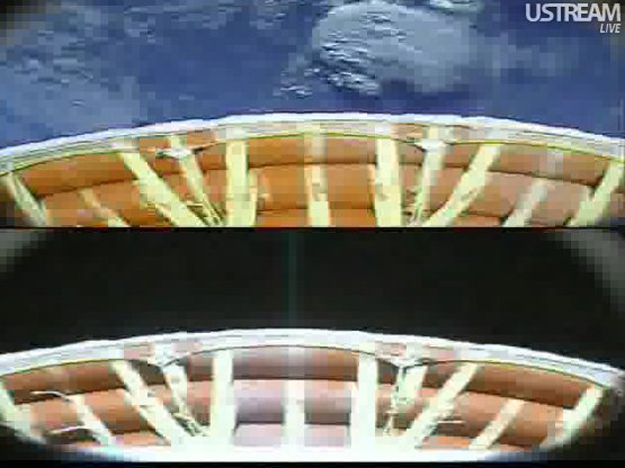
I’m always happy to learn that NASA is conducting new technology demonstrations – and the recent success of an inflatable heat shield is no exception!

Congress has determined that NASA should follow the 1960s vision of space travel: you launch in a vehicle, you travel through space in that same vehicle, and you land in that vehicle. Sounds all nice and cozy, except that the last five minutes of your trip require a heat shield, which is massive – eating into the amount of food supplies, scientific instruments, and astronauts you can launch in the first place. Until the moment of re-entry, the heat shield is just dead weight, doing nothing and eating into the mission planners’ mass budgets. This whole architectural problem is one of the big reasons why I favor assembling interplanetary exploration vehicles in space and then taxiing up and down to those vehicles with capsules, instead of trying to take capsules to the Moon, asteroids, or Mars.
How about if your heat shield didn’t have such a huge mass? And how about if your spacecraft could stow it neatly away, so that its size and shape wasn’t a design driver of the launch vehicle or capsule shape? Some of those problems wouldn’t be so bad.
This is a big step towards opening up more flexibility for mission architects. I hope the technology finds its way onto some real missions in the near future!
The 30% Spam Bot
I just found the following spam comment on my blog:
My partner and i don’t know about you men and women nevertheless for me personally the structure of your website is very important… I would personally state virtually just as much as this great article alone. In addition I’m a genuine pot intended for Youtube video lessons… or maybe, as a matter of truth, Any advertising content in any respect. Therefore, every time We get a identical write-up My spouse and i solely hope the actual embeds a number of world wide web training video anywhere. Currently, a substantial amount of weblog managers ordinarily tend not to… I cannot picture exactly why?… Perhaps this might be distinct with the topic issue… even so My partner and i continue to believe that it would created for virtually just about any content, because it might regularly be great to discover a heated along with warm and friendly deal with and also perceive the voice at the beginning go to. Regardless, I reckon that I’m a touch off of issue the following?.. Proper… The idea looks like which! Hahah… Appreciate enriching the net using this posting!
For anyone who enjoys language, syntax, or word games, this is pretty hilarious. Bits and pieces of the wording make sense in isolation, but when strung together, the thing is clearly nonsensical. This must be auto-generated. It really makes me wonder about how much effort goes into crafting the algorithms that piece together spam-text.
In a total coincidence, I just finished reading the Cory Doctorow story “Pester Power” (available in free eBook form here as part of his With a Little Help collection) – which is about someone who writes a genetic algorithm to evolve an AI by spamming forums and chat rooms until it can pass a Turing test. The idea is kind of clever, and it might actually work…which is frightening, because I figure spammers, ad agencies, and marketing firms must already be on it…evolving evil AIs whose entire purpose is to sell us things or entrap us with malicious links…
Stealth Spaceships
When I started my original series of posts on space battles, I speculated about what a combat-spacecraft designer might want to do in order to make a vehicle that could avoid enemy detection:
It would make sense to build their outer hulls in a faceted manner, to reduce their radar cross-section. Basically, picture a bigger, armored version of the lunar module.
Almost immediately, I got some feedback pointing me to the “Project Rho” website, which declares quite bluntly that “there ain’t no stealth in space.” The argument goes basically like this: any device you put on a spacecraft has to obey the second law of thermodynamics, which means that it generates waste heat. This heat will raise the temperature of your spacecraft well above the background temperature of ambient space (about 2.7 Kelvin). Therefore, the spacecraft will radiate and will be visible to infrared sensors, no matter what. Therefore, stealth combat spacecraft are impossible.
This argument is fundamentally sound. The principles are correct: you can build a detector that could locate any spacecraft. What I don’t like about this argument is its implied definition of the word “stealth” as “total invisibility.” Yes, it is possible that the detector you build will locate a stealthy space-fighter eventually. That clock is always ticking. But your adversary’s stealthiness can still pay off – if they get to launch their missiles before you spot them!
Later on, when I revisited space-battle physics, I went into a little more detail about possible stealthing technologies for spacecraft. In another post, I thought about some of the thermal concerns our hypothetical space-fighter designer would run into in trying to make the fighter hard to detect.
But the proof, as they say, is in the pudding.
There’s a military aphorism (Wikipedia tells me that Helmuth von Moltke is responsible) that battle plans never survive contact with the enemy. I suspect that, for all anyone’s speculations about what can, cannot, will, will not, or might happen in space combat, if we ever did find ourselves in a space war we would very quickly learn an entirely different set of guiding principles. Whether or not stealth spacecraft are possible will be apparent then, after the fact, no matter what arguments we make today.
However, we can get some insight by asking the question: do any stealth spacecraft exist today?
The answer, as it turns out, is “yes.”
Weather permitting, we are coming up on the launch of a Delta IV Heavy – a gargantuan behemoth leviathan giant of a rocket – carrying a National Reconnaissance Office “spy” satellite with the cryptic designation of NROL-15. Quoting a civilian military space analyst, AmericaSpace reports that the vehicle
is likely the No. 3 Misty stealth version of the Advanced KH-11 digital imaging reconnaissance satellite. It is designed to operate totally undetected in about a 435 mi. high orbit.
The article includes some description (or speculation?) about the physical appearance of the stealth spacecraft, too:
Looking somewhat like a stubby Hubble space telescope stuffed in an giant F-117 stealth fighter with diverse angles to reflect radar signals in directions other than back to receivers on the ground, Misty 3 is also covered in deep black materials designed to absorb so much light that it can not be tracked optically from the ground.
These design aspects are a huge challenge for a satellite that must also deploy solar arrays to generate electrical power and have reflective surfaces to reject heat. … The satellite may actually change shape to reflect heat when not over hostile countries trying to break its cover.
Apparently, there may also be some tricky maneuvering by the launch vehicle – to disguise the final orbit trajectory of the satellite. There is some speculation at the end of the article about the various options the vehicle might take to pull off that feat of obfuscation.
The bottom line for science fiction: cloaking devices are probably not going to work. But are stealth spacecraft possible or not? Well…we’re already doing it.
People’s Reactions to the MSL Landing System Bother Me
On 5 August, the Mars Science Laboratory Curiosity will attempt its landing on the Red Planet.
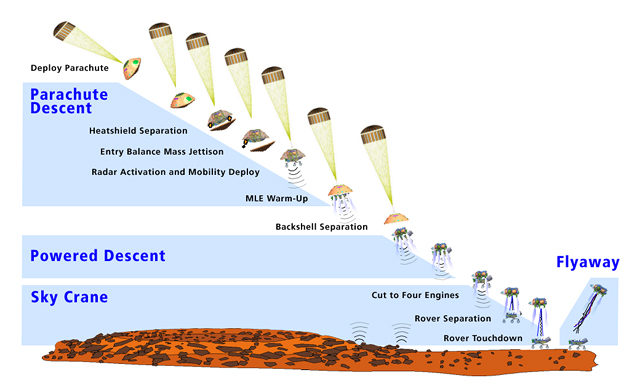
MSL is an exciting mission, the biggest rover we’ve ever sent to Mars, packed full of science experiments and capabilities, and it’s going to start things off with a daring landing detailed in this NASA PR video:
For more information about MSL, I strongly suggest these blogs.
Something that bugs me about MSL, though, is how every time the Internet hears about it, there’s a slew of commentary about how terrible an idea the landing system is. (For a good example, look at the comments on Gizmodo’s blurb about the above video.) People wonder why the system has to be so complex, sometimes asking what happened to the “KISS” (“Keep It Simple, Stupid!”) philosophy of engineering. Others lament how risky the landing system seems. Still more wonder why Curiosity can’t bounce down like the Sojourner or MER rovers did. I’ve even heard some of the mission scientists express reservations about the “skycrane” part of the landing process.
This thing is, each stage of this landing system was driven by engineering requirements. The guys at JPL didn’t just think one day, “hey, you know what would be cool? Landing by rappelling from a jetpack!” This is, in fact, the best solution that the engineers came up with for landing something as massive as the Curiosity rover on Mars.
Let’s look for a moment each successive step in the process:
- The heat shield. A lander screams in towards Mars at several kilometers per second – more than orbital velocity. Then we want to get it through an atmosphere, and, really, there’s no choice in the matter: as soon as we hit the atmosphere, we get friction with air molecules. A lot of friction. Friction that superheats our spacecraft. So, we’d better put a heat shield on our vehicle!
- The parachute. The heat shield gets our spacecraft down to about Mach 2, but if we were to rely on it the whole time we wouldn’t slow down enough before smacking into the Martian surface. We’ve got to get the speed of our vehicle down, and one of the obvious (and lightweight!) ways to do this is by deploying a parachute. (This is actually the part of the process that boggles my mind the most. Deploying a parachute at Mach 2! Yikes! Yet this is what our last three Martian rovers have all done, successfully.)
- Jettisoning things. After we deploy the parachute, the heat shield is just dead weight pulling us down. We want to get the most out of our parachute that we can, so we drop the heat shield away with some pyrotechnic charges. When we don’t need the parachute any more, we’ll similarly cut it loose.
- Retro-rockets. Mars’ atmosphere is so thin that even the combination of a capsule heat shield and a parachute doesn’t slow the probe down enough to land safely! Earth’s atmosphere – about a hundred times thicker than Mars’ – is fine for this. We can stuff astronauts in a capsule that rides the parachute all the way down, and doesn’t even need to drop its heat shield. But on Mars, even after the parachute gets our falling vehicle to terminal velocity, we still need to do something to slow it down! So we fire some rockets downward, killing off the rest of our speed. And the rover hangs in midair, about twenty meters above the planet surface. Up until this point, the MSL and MER landing sequences are basically the same.
- Rappelling. Finally, we need a way to get down that last few meters to the surface. On the Pathfinder, Spirit, and Opportunity vehicles, we popped airbags out on all sides of the lander and just let them go, inspiring egg-drop competition participants everywhere. But Curiosity is simply too big for this to work: it would be like taking our egg drop and substituting a paperweight for the egg. The rover would squish the balloons, still smashing itself against the hard ground. Another option might have been to have MSL sitting on a platform which descends on rockets all the way to the surface, like Phoenix or the Viking landers did. But the platform you would need to do that properly would end up being big enough that you’d have to go tell the JPL robot-builders to make a smaller rover. So instead, we just lower the rover down on a rope, and as soon as the rover registers touchdown, we fly the rocket platform away.
The controllers we will need to get the skycrane to work are really nothing to fear. They are not fundamentally different from the controllers that keep launch rockets pointing up when our probes leave Earth in the first place. But beyond the general terms, analogous robotic piloting happens all over on Earth – from military drones to quadrotors in research labs. As a dynamics and control engineer, I think this design would have been a challenge – but easily within our capabilities. And in terms of overall complexity, this isn’t any worse than, say, a Space Shuttle launch, or the entirely robotic X37-B.
More fundamentally, though, what bothers me about all the criticism and concern about the MSL landing system is one of philosophy. We should be giving wild ideas a shot – experimental technologies, unconventional science experiments, risky missions. That is how we advance the state of the art: by pushing the envelope. If that means that once in a while our rockets explodes or our space probe smashes into a planet, then so be it. I have no problem with seeing NASA try something innovative a fail once in a while!
You see, we didn’t ever start with the Right Stuff. We learn the Right Stuff. And this is how we learn. We simply need to be willing to accept that fact if we want to go forwards.
Why to be Skeptical of Mars One
Dutch company Mars One offers a plan to start colonizing the Red Planet by, ostensibly, 2023 – starting with a “colony” of four and growing the base every year.
There are a lot of reasons to be skeptical of this plan. Don’t get me wrong: I would love for these guys to succeed, and I think that – with concerted effort – their timeline is achievable. But there are a few technological red flags. Going from what I see as least to most severe:
- Mars One gives a rover top billing in their plan, saying that the rover will scout out the best location for the planetary base. The concept of having a robot autonomously assemble a base before humans ever arrive has a great deal of merit; however, a rover is not going to scout out the prime real estate on Mars. I once asked this guy if, since the MSL Curiosity has a much higher power budget than the MER Spirit or Opportunity, it would be able to drive at a higher speed and really cover Martian distance, to get to different science targets. It turns out that, even with more power at its disposal, there are thermal constraints on how fast motors can drive the rover’s wheels. If Mars One sends a rover, it’s not going to be scouting colony locations. It will be going to the colony’s location.
- Mars One wants to use the SpaceX Dragon capsule as a Mars lander. I’m a big fan of SpaceX, and I’m sure that they are thrilled that somebody is looking at Dragons as a Mars vehicle. However, one of the things I learned during my time at NASA is that the MSL is about at the upper size limit for things we can land on Mars using current techniques (aerobraking, parachutes, airbags, etc). Dragon is going to take a lot of development to land on the Martian surface. And it’s going to need a lot of fuel to do so.
- I’m not sure there’s enough room in their proposed colony for four people plus the equipment necessary to provide food for those four people. I think they need more inflatable greenhouses, at the least. But this is an point about which I’m not the expert.
- Mars One claims that no new technology is necessary to achieve their goals. This statement, I have to say, is bogus. They rightly identify in-situ resource utilization as the best way to provide air, water, and food for their colonists. We need to develop the technology to do that. The colonists need to be shielded from radiation while in transit. We know solutions that might work, but we need to develop and implement the technology. Furthermore, the colonists are going to need products that go beyond the most basic: How will they produce any medicines they require? How will they conduct surgeries with such a small staff? How will they maintain their colony? This project will need a very high level of automation and/or telepresence support from Earth – involving technologies that exist only theoretically today.
Tour de Cure
Hello, everyone!
I’m back from my vacation, and my next project is to spend the next couple weeks getting myself in biking shape for the 2012 Tour de Cure, a fundraising event to support the American Diabetes Association. I am personally pretty #$*@ sick of diabetes – If you would like to help support me, please visit my fundraising page!
phi ~ constant; theta ~ constant; r –> -r
I may be quiet for the next three weeks (more so than usual…). Or I may just turn this site into a travelblog photodump. I’m going to Australia for vacation!
What’s the Value of Liberal Arts?
There was an NPR article today about how the pressures of the economy are casting some doubt on the value of liberal arts colleges and liberal arts education.
I have a bit of an opinion on this, since I went to the best liberal arts college in the nation and I found gainful employment in my field immediately after I finished with graduate school.
To me, the argument about the value of a liberal arts college seems a bit silly. After all, a huge percentage – if not the majority – of the members of my Williams class majored in physics, biology, chemistry, math, psychology, computer science, or economics – all very practical things that translate directly to various industries and enterprises. A liberal arts college is a tremendous place to study those disciplines: science is a collaborative and inquisitive endeavor, and learning to work with an expert to thoroughly understand scientific principles gave me a much better experience than I think I would have received in the back of a hundreds-seat auditorium getting lectured by a TA.
But Williams did more than give me an incredibly solid grounding in physics, which I could then take towards a doctorate and career in spacecraft engineering. While I studied physics, in very demanding and rigorous classes, I also studied linguistics. And studio art. And history. And even political science. All these things did more than make me a “more well-rounded person.” Study of these subjects gave me exposure to ideas, concepts, and frameworks to help me put all sorts of things in context. So now, when I hear political candidates talk about America’s founders, or invading Iran, or health policy, I have a relevant understanding to evaluate their statements against. When I read about the economy, I have a basic understanding of the principles that govern the situation we face. When I read a good book, or see an engaging film, or view a piece of artwork, I can appreciate the efforts the artists put into those things and understand how they have the effects they do on me. In short: I have gained more than a narrow, vocational perspective on the world – I can approach many subjects from many angles. This is not merely a good thing for its own sake, but it also helps me in my chosen vocation. I’ve used my rudimentary skills as an artist and my experience with writing (Williams grads know what I’m talking about!) quite frequently as an engineer. If this also means that I have a few still lives and unfinished manuscripts in my apartment, well, that’s just icing on the cake.
For the same reasons that I appreciate having a liberal arts background in my academic training, I also appreciate that we have “pure” liberal arts majors in our society. We need historians, writers, artists, filmmakers, and musicians in our society. We need them to remember, curate, create, and teach their liberal arts so that we can keep churning out well-rounded, multi-talented workers instead of narrowly focused drones.