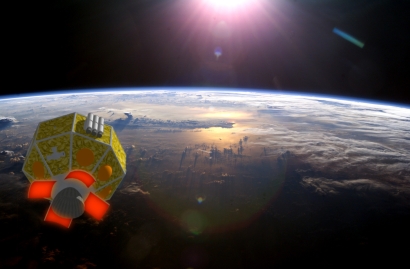
SpaceX’s second successful Falcon 9 launch has just inserted the Dragon capsule into Earth orbit!
First Falcon 9 launch (SpaceX)
The Dragon vehicle will perform a series of check-outs over the next few orbits before re-entering the Earth’s atmosphere. If all goes well, then this is a major success for SpaceX and NASA’s COTS program – which seeks to contract International Space Station supply missions to private companies after the Space Shuttle retires, so that ISS has more resupply mechanisms than the Russian Progress vehicle and European ATV. SpaceX wants to human-rate the capsule, as well, to provide astronaut transportation to orbit and even space tourism!
Today's launch (NASA)
Again, if all goes well, this mission ought to be vindication for President Obama’s vision for NASA: use commercial providers to get into Earth orbit, and then let NASA focus on the real envelope-pushingexploration. If the Falcon 9 gets to orbit, and the Dragon could take cargo or people up, then why don’t we just buy those for a fraction of the cost of the Ares 1/Orion system? Especially since that system would take many more years of development to become available to NASA. The Falcon 9 and Dragon will be ready much, much sooner!
Best of luck to the SpaceX team. And may the Congresspeople holding NASA’s purse-strings get their heads out of their pork barrels.
Update 1600 8 Dec 10:At the post-flight press conference, Elon Musk and Gwynne Shotwell of SpaceX gave an overview of the mission and a rosy assessment of its success. Apparently, the Falcon 9 second stage reached a very health apogee – well above the ISS orbit – the Dragon performed well enough in space to maintain a good lock on the TDRSS relay satellite, and it successfully splashed down within 10 km of its target and within a minute of its projected landing time. Musk stated a couple times that his “mind was blown” and pointed out that, had there been people on the Dragon spacecraft, they would have had “a very nice ride.” He thinks that all (“all”) Dragon needs to be human-rated are seats and an escape system, though he did admit that launch-escape system testing is both crucial and very hard. Apparently NASA officials told SpaceX that, if this flight went well, they would consider allowing an ISS rendezvous and docking on the next Dragon flight, so that may be a possibility for next year. Another Musk gem, on the politics of SpaceX’s activities: “any politician who wants to increase the deficit and reduce American access to space, go ahead and cut [the NASA Commercial Crew program].”
if I had to guess at what NASA is going to reveal on Thursday, I’d say that they’ve discovered arsenic on Titan and maybe even detected chemical evidence of bacteria utilizing it for photosynthesis
–and the Internet went wild with the announcement that NASA had found life on one of Saturn’s moons, including an Atlanta newspaper. Of course, nowhere in NASA’s press release did they say anything about Saturn or Saturn’s moons, but feh! Who cares about what the primary sources say. Speculation is fact!
My guess? There has been some kind of study or experiment that shows how life could evolve based on a different chemistry than familiar Earth life, and that that chemical environment may exist (or have existed) elsewhere in the Solar System. The point of such a finding would be that we’d have to make sure any future astrobiology studies don’t just look for life as we know it – that they include the new chemistries. But that’s only myguess.
If NASA had discovered life, don’t you think the press release for the upcoming news conference would be front and center on NASA.gov, and that the list of panelists would include names like Bolden, Garver, Holdren, or Obama?
(Pardon me for the hiatus. Had to fly to Houston to do some flight testing at NASA.)
I spent a pretty good weekend doing some world-building. Since discovering the maps in the first pages of The Lord of the Rings, Redwall, and the like, I have really enjoyed sketching out maps of imaginary worlds and outlining details of the cultures and histories that play out over those maps. My maps started as knockoffs of Tolkien’s (with the bad guys sequestered in a nice, rectangular wall of mountains around some barren lands) or parallel-universe versions of the terrain around my house. Since then, though, I’ve started to inject a lot more realism into the worlds I create. Want to know where the tectonic plates and prevailing winds are on my map of Oghura? I could show you!
Map of Oghura
Beyond the maps, some of my imagined cultures have fully fleshed-out languages, religions, and customs. Slowly, slowly, I’ve been compiling reference documentation on the Oghuran desert and people, the fantastical Cathedral Galaxy, and the future-universe of the Four Colonies. This weekend I was spending my time in the Cathedral Galaxy, putting together a master list of the major galactic regions and polities, along with distinguishing characteristics. Now I know a bit more about why the Imperium of the Triumvirate is split in three, how the far-from-galactic-center Traders’ Rim came to be populated by merchants and entrepreneurs, and the tumultuous history of conflict between Amseile and Shobah. I’ve also got the beginning of a couple more stories – one concerning an Imperium gladiator’s bid for freedom and another describing the Waygehn people, who evolved to sentience near the death of their star and outlived the event, leaving them homeless in the galaxy. That’s one of the most fun things about deciding to build a universe purely for short stories: I get to invent worlds, and then immediately show them off with snippets of detail!
Though the Cathedral Galaxy has some distinctly space-fantasy elements, I decided early on that it would be a universe based on hard science – though not necessarily our hard science. My short story “Conference” illustrates the point, as it shows that there are technical concepts built upon technical concepts – but at the level that Arthur C. Clarke would have described as “indistinguishable from magic.” I have no idea how the Channel Network could be set up, and building planet-size structures is clearly fantastical. (And none of you know yet what’s in The Cathedral!) But I made sure that the story was relevant to us Earthdwellers, and I lean strongly on plausible concepts to describe things like astronomical bodies or planetary orbits.
Great Galactic Map, showing major markers and the Channel Network
For example, take Heliast, the resort world on which much of “Conference” takes place. Here’s the description that conference-goers got of the world:
The tour guide explains how Heliast is an ancient world with a single moon nearly half its own size, and how that has dominated the history of the planet and made it ideal for resort paradises. A billion or so years ago, the planet spun many times under one orbit of the moon, and the energy input of ocean tides among all the planet’s archipelagoes – Heliast is over eighty percent water – gave rise to life. But nowadays, the moon orbits in tidal lockstep with one Heliast day, the prime factor contributing to the perpetual calm of its seas. The small radius of Heliast’s solar orbit leaves the planet with a reasonable day length, while the dimness of its sun places it in the liquid-water zone. Without tides, with a massive moon helping to protect the planet from asteroid impacts, and with barely any eccentricity in its orbit to create seasons, there have been few selective pressures on Heliast’s life forms. Life on the planet thus failed to diversify much, and after millions of years of evolution with few external stressors, there are now only a few ecological niches on the world. Three or four avian species, eight or ten surface-level swimmers, two or three land animals, and about six land plants are all most tourists have the chance to interact with. The rest of the planet is geological beauty for visitors to enjoy.
So, the planet’s “month” equals its “day,” but there are still many days per year and there is much liquid water on the surface. The dynamics shaped the world’s evolution. That was fun to think of! But, more and more, I am completely amazed by the strange worlds that actually exist in our own universe. Many Earth- and space-based observatories keep returning data on new exoplanet candidates, and in the last few years, the galaxy seems a lot more planet-populous than it has in the past.
This past Monday, I went to a fascinating astronomy seminar on the potential climates of Gliese 581g given by Dr. Raymond Pierrehumbert from the University of Chicago. (He’s preparing these climate models for an arXiv preprint.) Besides tying the Gleise 581 system with 55 Cancri for most number of known exoplanets around the same star (5), this planet is interesting because it falls right smack in the middle of the traditional “habitable zone,” the range of orbital radii necessary for planet surface temperatures that could support liquid surface water. Now, of course, the discovery of Gliese 581g has to be confirmed to become official – and there’s some doubt about that! – but it’s at least got scientists thinking about these dwarf-star systems in interesting ways. Continue reading World-Building and the Real Universe→
My Ice Fracture Explorer concept for getting a probe down into Europa’s subsurface ocean – one of the likely places in our Solar System to find extraterrestrial life – was just one way to dig beneath the ice crust. Other concepts often involve melting through the ice crust. However, I thought, what if we can take advantage of the places where Europa’s geologic dynamics allow access to the ocean without tunneling through the ice?
I can think of two surface features on Europa that mark potential exposure of the ocean to space. One is the “chaos,” which may be formed when ocean-floor volcanoes or rising blobs of warm water melt through the ice crust all the way to space. However, we don’t yet have a good way to predict when chaos features would form – unless the impact theory of chaos formation, my personal favorite, is correct, and we can track a large meteoroid on its way to hit Europa. The second, the double-ridge features marking cracks in the ice crust, are potentially more predictable so it makes better sense to plan a mission around penetrating the crust through these fractures.
My IFE concept involved a disposable probe landing on a double-ridge, rolling to the center, and hanging over the crack as it opens up under Jupiter’s tides. The hanging probe could then drop a penetrator into the fracture, to punch through the thin layer of ice below and dive into the ocean water.
Hanging drop concept
A number of readers left me comments here and on io9 pointing out various challenges with this design. Getting the lander to hang, suspended, in the middle of the crack might stretch our space-tether technologies a little too far. Timing transmissions to an orbiter before the closing crack crushes the lander is a problem. Communications from the penetrator are also an issue: since those have to cross a water/space boundary, I wanted to just reel out a long data line from the hanging lander to the penetrator – but the length of this cable could be an issue if the ice crust ends up being 100 km thick. And, since the probe would probably have to be powered by an RTG, when the fracture closes and squishes the probe, we’d be dropping radioactive gunk on the Europan natives. While I don’t think any of the stages of the IFE concept stretch our technologies much more than, say, the Mars Science Lab’sSky Crane, it certainly wouldn’t hurt to make things easier on ourselves!
One such idea might be to drop the miniature penetrators directly from orbit. There wouldn’t be any suspended platforms, data cables, or rolling around on an unpredictable surface. There also wouldn’t be as much of a challenge in lining up the orbiter for receiving data, since the penetrator came from the orbiter in the first place. However, determining which ice fractures are opening and closing, and timing the drop from orbit to coincide with those events, might be tricky. Landing on the surface first adds an additional safe-hold point to the mission: controllers can wait to establish good telemetry from the lander after it’s on the surface and before ordering it to commence penetrator deployments.
Another suggestion might be to keep the lander on one side of the double-ridge interior. It could shoot a cable across to the other side, and reel the penetrators out to the middle before dropping them:
Penetrator drop concept
This concept buys the IFE a number of things: first, it can drop more than one penetrator. My original concept called for several IFE’s to be dropped in tandem to several ice fractures to increase the chance of success. However, if each IFE can deploy more than one probe into the ocean, then the mission managers can get several chances to successfully drop the mini-probes as the crack opens and closes and opens again. Second, the lander won’t be crushed, meaning that we won’t have to worry about radioactive contamination of the ocean (as long as the penetrators run on batteries) and we’ll get the chance to have the landers keep performing science operations after all the penetrators are expended. Third, the lander can buffer data from the penetrators and uplink the information to an orbiter at leisure – no rushing to time the drop for an orbiter pass!
One thing scientists don’t really know yet about Europa is how wide these cracks open up. The tether-based ideas I’ve outlined work as long as the crack is big enough to admit the penetrators – but they have the advantage of working if the fractures end up being many meters wide. However, that might not be an advantage the spacecraft needs if the cracks are very narrow. In that case, why not just have the lander come down with footpads on either side of the fracture?
Straddler concept
As the crack opens and closes, damped mechanical joints in the legs could take up the motion and keep the lander centered over the crack. This lander would also be able to buffer data, survive for many tidal cycles, and be able to drop as many penetrators as it has packed into its body.
I think the biggest issue with my designs is that data line: the images and biochemical experiment results from the penetrator have to get transmitted to the lander somehow. (From there, they can get to orbit and then to Earth.) Direct transmission via radio or optical signal could be very difficult from beneath the alien waves, and speed is a factor, so I opted for a hardline. But how long does the cable need to be? At least tens of meters. Probably around ten of kilometers. But maybe as long as 100 kilometers, which could be prohibitively long! One possible solution might be to drop a two-segment penetrator into the crack: the upper segment would have floats – probably some sort of inflated bags – and a radio transmitter. The lower segment would contain the ice-shattering hard shell and all the science instruments. The two halves of each probe would be connected by an unreeling data cable. So, the probe would drop from the lander, smash through the ice, and then split into halves – with one half floating on (and them freezing on to) the ocean surface while the other half continues its plunge into the depths. The probe would collect its data, then zap that data up the cable to the surface unit. From there, the data would travel via radio to the lander, which would relay it to the orbiter and then the Deep Space Network.
Certainly, any concept for a Europa mission strains our ingenuity. But that is one reason why it’s so fun!
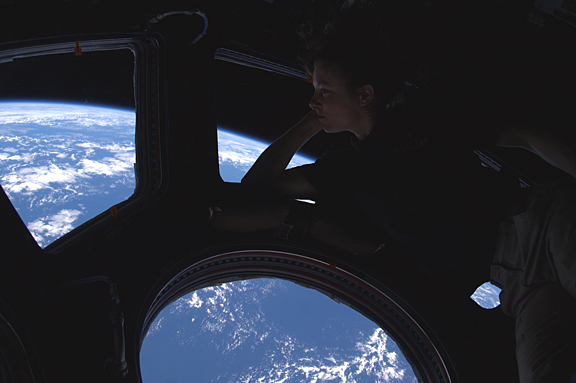
This year’s NASA Desert RATS exercise is taking place near Flagstaff, AZ. Here’s the view from inside one of the rovers after a traverse:
RATS is a program in which NASA engineers, scientists, and astronauts take prototype equipment into remote locations on Earth and practice the procedures and operations that they would use if they were actually on another planet. It’s an opportunity for the engineers to see what their creations are capable of, scientists to see how much work astronauts can get done and teach them basic skills like field geology, and the astronauts to get some experience using the equipment so they can provide feedback.
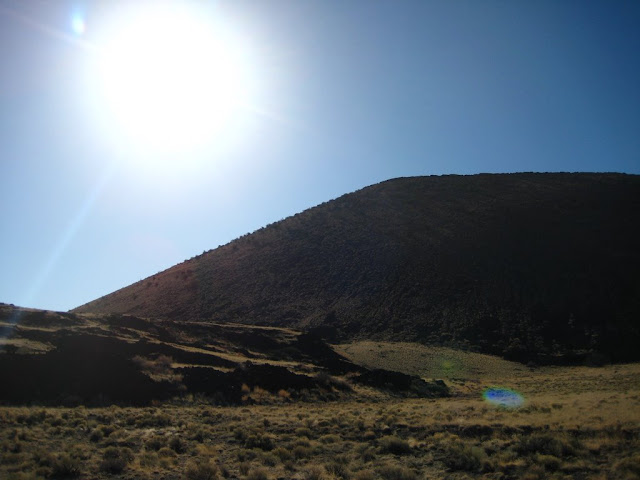
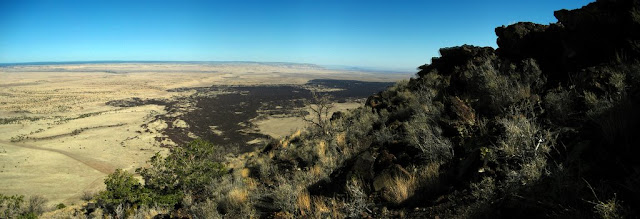
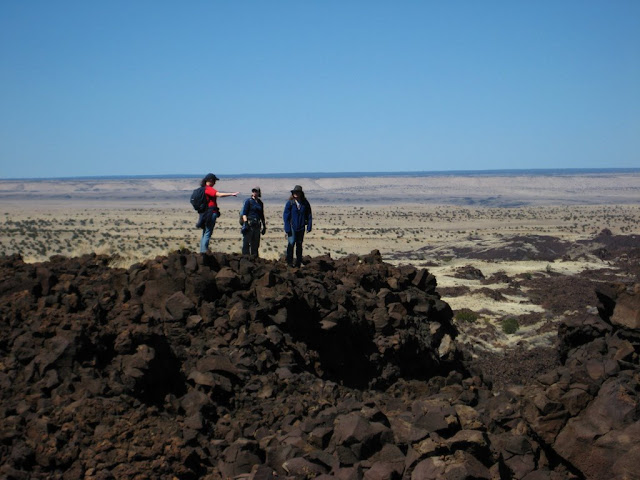
Not only is RATS showing off the best capabilities of the most successful part of the Constellation Program – the Lunar Electric Rover Concept, or LERC – but they have gone to an especially cool site, a well-preserved but little-known cinder cone volcano known as SP Mountain! As that video played, I kept thinking to myself: “that looks familiar…” Here’s my view of SP and the lava flow coming out of the base of the mountain:
SP ConeSP flow
When I was there, with a class of planetary geology grad students led by Cornell Mars scientist Jim Bell, I couldn’t help but picture the rugged a’a terrain of SP flow with astronauts picking their way along. What a tremendous place to practice exploration operations!
Europa, the second Galilean moon of Jupiter, has been my favorite planetary body for a long time. The reason I like Europa so much is that it’s a world whose orbital dynamics with Jupiter, its orbital resonances with the other Galilean moons, and its own rigid-body dynamics have a strong hand in creating its surface features – and giving it the potential to harbor life. It’s one of perhaps two or three extraterrestrial places in the Solar System where we might hope to find life. Europa is also easier to get to than Enceladus or Titan. As such, I think it ought to be one of the highest-priority exploration targets for robotic space probes. (Human exploration would be nice, too, but if you think radiation exposure on the way to Mars is hard, you don’t even want to consider putting people in the Jovian system!)
Thanks to magnetometer measurements and images from the Galileo mission, it’s pretty much established at this point that Europa has an icy outer shell over a global liquid ocean, with a rocky core on the inside.* The only question is how thick that ice shell is – I’ve read estimates ranging from 10 meters to 100 kilometers, with a pretty high confidence of ones to tens of kilometers. The ice shell gives rise to a number of interesting surface features. A particularly cool sort of feature, found with global extent across Europa, is the double ridge.
A prominent double-ridge feature on Europa, most likely a crack in the icy shell
Planetary scientists have a number of models for how these double ridges form, and they generally seem to agree that the ridges mark the locations of cracks in the ice crust. One especially well-established model suggests that these cracks occur when Jupiter raises tides in Europa’s ocean – just like how the Moon raises tides in terrestrial oceans, but much stronger, because Jupiter is frakking huge compared to Earth’s moon. Europa’s ice crust bulges out over the ocean’s tidal swell and then cracks under the incredible stress. (I like to take a moment to think about the mindbogglingness of that statement: the whole moon’s surface cracks. I’ve stood on a frozen pond when a crack pings through the foot or so of ice on top of the water – Just imagine standing on Europa when this happens!) Once a crack forms, the tides don’t go away. As Europa rotates, about once every three and a half Earth days, the tides periodically lever these cracks apart and squeeze them back together again. In this model, every time the cracks gape open the subsurface ocean gets exposed to space. The surface water boils and rapidly crusts over with ice, and when the cracks get smushed closed, all this ice gets crushed up and forced to the top and bottom of the crack, forming the ridges. The ridges appear in pairs because the crack opens up again after that. These double-ridge features are mounds of crushed ice flanking passages into Europa’s ocean!†
Dr. Richard Greenberg is a planetary scientist who thinks that these cracks in the ice shell might be potential sites for life to take hold. Unlike the rest of the subsurface ocean, they get exposed to sunlight, which means that photosynthesis could take place. The periodic in-and-out forcing of the crack would also drive strong currents, which is another energy source Europan life could use. (Those aren’t the only energy sources: other possibilities include thermal gradients in the water, volcanic vents on the ocean floor, or even induction as Europa travels through the Jovian magnetic field.) Of course, that life would also have to adapt to the crack opening and closing once every 3 1/2 Earth days!‡
Europa's possible ice-fissure biosphere (from New Scientist; click for full article)
We do at least know, from the Galileo mission, that these cracks often have accompanying veneers of organic (e.g. carbon-based) molecules and salts splashed onto the ice surface. This is why the cracks appear as brown stripes in large-scale context images. The crack/veneer combination suggests that there are organic molecules and salts in the Europan ocean, and that those compounds get pumped to the surface through these cracks.
So, let’s take stock: Europa is the only extraterrestrial world with a global liquid water ocean, there is a definite possibility for life in that ocean, and these double-ridged cracks are a possible gateway into the alien biosphere.
Well, then, let’s go diving! Read on for my concept system architecture for an ambitious Europan ocean-exploring mission, which I call the Ice Fracture Explorer.
I’m shamelessly bouncing all you readers over to the Bad Astronomy blog for this post, which is a great outline of the detective process that is planetary geology. It’s also a great illustration of how much context matters and how leaping to conclusions is…bad. AND it’s a good demonstration that, when there are several hypotheses in consideration, elements of each could be synthesized into the proper conclusion.
All things for us to keep in mind, in science and in everyday life!
(Also, way cool pictures that are reminders of TOTALLY AWESOME events in the past!)
When I wrote my original article on the physics of space battles, and the accompanying short story, I made the creative decision to speculate on how space battle technologies and tactics would play out if we built from the present day – or, at least, the very near future. The obvious thing to look at next is what a more distant future might hold – so, I’ll embrace my status as That Space Battle Physics Guy!
A possible near-future space fighter radiating excess heat between battles
I think that extrapolating or projecting space battle technologies forward in time is a difficult thing to do, even for the cleverest science fiction geeks. I say this for two reasons: first, aside from some general trends, it’s hard to predict exactly where technology will go in the next ten or twenty or fifty years; second, nobody gets to play this game against a live opponent – and that’s really how combat tactics and technology develop. Still, given the trends, it’s fun to speculate! Physics won’t change radically for quite some time, so we have some direction in which to proceed.
I’m going to proceed from the assumption that “spacecraft” are different from launch and reentry vehicles. Let’s take some possible combat spacecraft systems, think about the related problems that spacecraft engineers try to solve, and see what might (!) happen if the aliens wait till we have some operational space colonies before they invade…
I think that President Obama’s vision for NASA holds a great deal of promise. However, I seem to be in the minority – with people from Senators with NASA-associated districts to Stephen Colbert to Jesus Diaz on Gizmodo talking about the “end” of the human space program. I often wonder why they don’t see what I see. Obama has both increased the NASA budget and explicitly stated that he wants more astronauts flying in the coming decade than ever before, so he clearly is not trying to “cancel the human spaceflight program.” Given that, it seems straightforward to me that the NASA centers will still need to train astronauts, build vehicles, and conduct mission operations; NASA vehicles will still push the boundaries of capability, and NASA astronauts will explore the Solar System beyond Earth space. The only difference is just that astronauts won’t get to those new vehicles atop Ares launchers, but rather perched on something like the Falcon 9 – which is much, much closer to operation – and our targets are more ambitious. So why the enormous gap in opinion among space exploration proponents? And what might NASA administrator Charlie Bolden do to consolidate support?
I think the problem is that, without a NASA launch vehicle, critics have a hard time envisioning how the new generation of NASA astronauts will get around and what they will do. There won’t be any dramatic Space Shuttle or Saturn V launches – instead, the astronauts will be…”taxiing.” And they will taxi up to…what, exactly?
President Obama wants humans to leave the Earth-Moon system by 2025, get to Mars orbit by 2030, and develop the capability to live and work in space indefinitely. Here’s where Administrator Bolden could step in. NASA systems engineers and artists could crank away and produce concept studies to suggest a new fleet of NASA crewed vehicles. By starting right in on the design of new vehicle concepts, and setting explicit deadlines for their launch and operation, the new NASA vision could become more clear and exciting. The public will start to see what I see – a NASA program that develops dedicated space exploration vehicles, which carry astronauts for months at a time on journeys to deep space, asteroids, and other planets. Clearly, that is no end of the human spaceflight program. It’s the next step.
Below the break, I’ll outline such a possible concept vehicle fleet.