Category Archives: Space

Stealth Spaceships

When I started my original series of posts on space battles, I speculated about what a combat-spacecraft designer might want to do in order to make a vehicle that could avoid enemy detection:

It would make sense to build their outer hulls in a faceted manner, to reduce their radar cross-section. Basically, picture a bigger, armored version of the lunar module.

Almost immediately, I got some feedback pointing me to the “Project Rho” website, which declares quite bluntly that “there ain’t no stealth in space.” The argument goes basically like this: any device you put on a spacecraft has to obey the second law of thermodynamics, which means that it generates waste heat. This heat will raise the temperature of your spacecraft well above the background temperature of ambient space (about 2.7 Kelvin). Therefore, the spacecraft will radiate and will be visible to infrared sensors, no matter what. Therefore, stealth combat spacecraft are impossible.

This argument is fundamentally sound. The principles are correct: you can build a detector that could locate any spacecraft. What I don’t like about this argument is its implied definition of the word “stealth” as “total invisibility.” Yes, it is possible that the detector you build will locate a stealthy space-fighter eventually. That clock is always ticking. But your adversary’s stealthiness can still pay off – if they get to launch their missiles before you spot them!

Later on, when I revisited space-battle physics, I went into a little more detail about possible stealthing technologies for spacecraft. In another post, I thought about some of the thermal concerns our hypothetical space-fighter designer would run into in trying to make the fighter hard to detect.

But the proof, as they say, is in the pudding.

There’s a military aphorism (Wikipedia tells me that Helmuth von Moltke is responsible) that battle plans never survive contact with the enemy. I suspect that, for all anyone’s speculations about what can, cannot, will, will not, or might happen in space combat, if we ever did find ourselves in a space war we would very quickly learn an entirely different set of guiding principles. Whether or not stealth spacecraft are possible will be apparent then, after the fact, no matter what arguments we make today.

However, we can get some insight by asking the question: do any stealth spacecraft exist today?

The answer, as it turns out, is “yes.”

Weather permitting, we are coming up on the launch of a Delta IV Heavy – a gargantuan behemoth leviathan giant of a rocket – carrying a National Reconnaissance Office “spy” satellite with the cryptic designation of NROL-15. Quoting a civilian military space analyst, AmericaSpace reports that  the vehicle

is likely the No. 3 Misty stealth version of the Advanced KH-11 digital imaging reconnaissance satellite. It is designed to operate totally undetected in about a 435 mi. high orbit.

The article includes some description (or speculation?) about the physical appearance of the stealth spacecraft, too:

Looking somewhat like a stubby Hubble space telescope stuffed in an giant F-117 stealth fighter with diverse angles to reflect radar signals in directions other than back to receivers on the ground,  Misty 3 is also  covered in deep black materials designed to absorb so much light that it can not be tracked optically from the ground.

These design aspects are a huge challenge for a satellite that must also deploy solar arrays to generate electrical power and have reflective surfaces to reject heat.  … The satellite may actually change shape to reflect heat when not over hostile countries trying to break its cover.

Apparently, there may also be some tricky maneuvering by the launch vehicle – to disguise the final orbit trajectory of the satellite. There is some speculation at the end of the article about the various options the vehicle might take to pull off that feat of obfuscation.

The bottom line for science fiction: cloaking devices are probably not going to work. But are stealth spacecraft possible or not? Well…we’re already doing it.

People’s Reactions to the MSL Landing System Bother Me

On 5 August, the Mars Science Laboratory Curiosity will attempt its landing on the Red Planet.

MSL is an exciting mission, the biggest rover we’ve ever sent to Mars, packed full of science experiments and capabilities, and it’s going to start things off with a daring landing detailed in this NASA PR video:

I highly recommend fullscreen...

For more information about MSL, I strongly suggest these blogs.

Something that bugs me about MSL, though, is how every time the Internet hears about it, there’s a slew of commentary about how terrible an idea the landing system is. (For a good example, look at the comments on Gizmodo’s blurb about the above video.) People wonder why the system has to be so complex, sometimes asking what happened to the “KISS” (“Keep It Simple, Stupid!”) philosophy of engineering. Others lament how risky the landing system seems. Still more wonder why Curiosity can’t bounce down like the Sojourner or MER rovers did. I’ve even heard some of the mission scientists express reservations about the “skycrane” part of the landing process.

This thing is, each stage of this landing system was driven by engineering requirements. The guys at JPL didn’t just think one day, “hey, you know what would be cool? Landing by rappelling from a jetpack!” This is, in fact, the best solution that the engineers came up with for landing something as massive as the Curiosity rover on Mars.

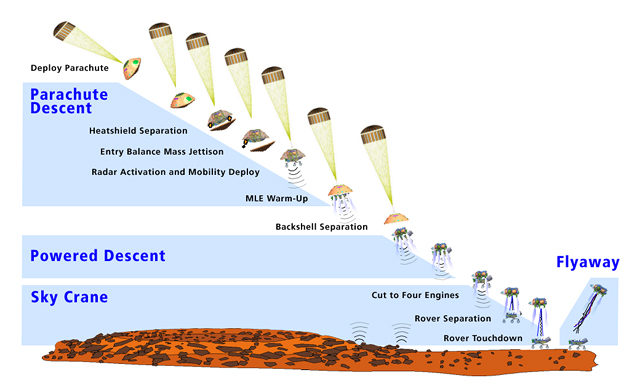
Let’s look for a moment each successive step in the process:

  1. The heat shield. A lander screams in towards Mars at several kilometers per second – more than orbital velocity. Then we want to get it through an atmosphere, and, really, there’s no choice in the matter: as soon as we hit the atmosphere, we get friction with air molecules. A lot of friction. Friction that superheats our spacecraft. So, we’d better put a heat shield on our vehicle!
  2. The parachute. The heat shield gets our spacecraft down to about Mach 2, but if we were to rely on it the whole time we wouldn’t slow down enough before smacking into the Martian surface. We’ve got to get the speed of our vehicle down, and one of the obvious (and lightweight!) ways to do this is by deploying a parachute. (This is actually the part of the process that boggles my mind the most. Deploying a parachute at Mach 2! Yikes! Yet this is what our last three Martian rovers have all done, successfully.)
  3. Jettisoning things. After we deploy the parachute, the heat shield is just dead weight pulling us down. We want to get the most out of our parachute that we can, so we drop the heat shield away with some pyrotechnic charges. When we don’t need the parachute any more, we’ll similarly cut it loose.
  4. Retro-rockets. Mars’ atmosphere is so thin that even the combination of a capsule heat shield and a parachute doesn’t slow the probe down enough to land safely! Earth’s atmosphere – about a hundred times thicker than Mars’ – is fine for this. We can stuff astronauts in a capsule that rides the parachute all the way down, and doesn’t even need to drop its heat shield. But on Mars, even after the parachute gets our falling vehicle to terminal velocity, we still need to do something to slow it down! So we fire some rockets downward, killing off the rest of our speed. And the rover hangs in midair, about twenty meters above the planet surface. Up until this point, the MSL and MER landing sequences are basically the same.
  5. Rappelling. Finally, we need a way to get down that last few meters to the surface. On the Pathfinder, Spirit, and Opportunity vehicles, we popped airbags out on all sides of the lander and just let them go, inspiring egg-drop competition participants everywhere. But Curiosity is simply too big for this to work: it would be like taking our egg drop and substituting a paperweight for the egg. The rover would squish the balloons, still smashing itself against the hard ground. Another option might have been to have MSL sitting on a platform which descends on rockets all the way to the surface, like Phoenix or the Viking landers did. But the platform you would need to do that properly would end up being big enough that you’d have to go tell the JPL robot-builders to make a smaller rover. So instead, we just lower the rover down on a rope, and as soon as the rover registers touchdown, we fly the rocket platform away.

The controllers we will need to get the skycrane to work are really nothing to fear. They are not fundamentally different from the controllers that keep launch rockets pointing up when our probes leave Earth in the first place. But beyond the general terms, analogous robotic piloting happens all over on Earth – from military drones to quadrotors in research labs. As a dynamics and control engineer, I think this design would have been a challenge – but easily within our capabilities. And in terms of overall complexity, this isn’t any worse than, say, a Space Shuttle launch, or the entirely robotic X37-B.

More fundamentally, though, what bothers me about all the criticism and concern about the MSL landing system is one of philosophy. We should be giving wild ideas a shot – experimental technologies, unconventional science experiments, risky missions. That is how we advance the state of the art: by pushing the envelope. If that means that once in a while our rockets explodes or our space probe smashes into a planet, then so be it. I have no problem with seeing NASA try something innovative a fail once in a while!

You see, we didn’t ever start with the Right Stuff. We learn the Right Stuff. And this is how we learn. We simply need to be willing to accept that fact if we want to go forwards.

Why to be Skeptical of Mars One

Dutch company Mars One offers a plan to start colonizing the Red Planet by, ostensibly, 2023 – starting with a “colony” of four and growing the base every year.

Stephen Colbert's take on Mars One

There are a lot of reasons to be skeptical of this plan. Don’t get me wrong: I would love for these guys to succeed, and I think that – with concerted effort – their timeline is achievable. But there are a few technological red flags. Going from what I see as least to most severe:

  1. Mars One gives a rover top billing in their plan, saying that the rover will scout out the best location for the planetary base. The concept of having a robot autonomously assemble a base before humans ever arrive has a great deal of merit; however, a rover is not going to scout out the prime real estate on Mars. I once asked this guy if, since the MSL Curiosity has a much higher power budget than the MER Spirit or Opportunity, it would be able to drive at a higher speed and really cover Martian distance, to get to different science targets. It turns out that, even with more power at its disposal, there are thermal constraints on how fast motors can drive the rover’s wheels. If Mars One sends a rover, it’s not going to be scouting colony locations. It will be going to the colony’s location.
  2. Mars One wants to use the SpaceX Dragon capsule as a Mars lander. I’m a big fan of SpaceX, and I’m sure that they are thrilled that somebody is looking at Dragons as a Mars vehicle. However, one of the things I learned during my time at NASA is that the MSL is about at the upper size limit for things we can land on Mars using current techniques (aerobraking, parachutes, airbags, etc). Dragon is going to take a lot of development to land on the Martian surface. And it’s going to need a lot of fuel to do so.
  3. I’m not sure there’s enough room in their proposed colony for four people plus the equipment necessary to provide food for those four people. I think they need more inflatable greenhouses, at the least. But this is an point about which I’m not the expert.
  4. Mars One claims that no new technology is necessary to achieve their goals. This statement, I have to say, is bogus. They rightly identify in-situ resource utilization as the best way to provide air, water, and food for their colonists. We need to develop the technology to do that. The colonists need to be shielded from radiation while in transit. We know solutions that might work, but we need to develop and implement the technology. Furthermore, the colonists are going to need products that go beyond the most basic: How will they produce any medicines they require? How will they conduct surgeries with such a small staff? How will they maintain their colony? This project will need a very high level of automation and/or telepresence support from Earth – involving technologies that exist only theoretically today.

Planetary Resources: Prospects and Challenges

A number of well-funded and well-connected entrepreneurs are kicking off Planetary Resources, a company devoted to harvesting materials from near-Earth asteroids.

Now before you go scoffing (or wondering how to “greatly enable” things) – this is by no means a crazy idea. Many of the technologies one might want to prospect asteroids are not difficult to conceive of today. Commercial launch services seem to be on the brink of an explosion. And, yes, there certainly are resources on asteroids! I’m eager to welcome to the space community a group that is willing to embrace greater risk in order to reap greater rewards.

I’d like to point out just a few of the challenges Planetary Resources will face, and why asteroids might be an interesting target for resource exploitation.

First of all, asteroids boast uniquely available resources, if only we can get to them. Some classes of asteroids are wholly or partially composed of metals – or even other useful substances, such as water or carbon compounds. It might be easier to access those resources on an asteroid, if it has a “rubble pile” structure, than it would be if we have to drill down into the surface of a planet or moon. We are also not likely to have to drill or dig as far. Once we get our precious asteroid resources in hand, it’s also much easier to move them to another space destination than it would be from the surface of a moon or planet: we just have to give the blocks of metal a shove to push them out of the asteroid’s wimpy gravity well!

Second, having resources available to us in space would be a tremendous boon. The biggest obstacle to the commercial, industrial, scientific, academic, Starfleet, or any other kind of development in space is straightforward to identify: launch costs. What if we could take that all or part of the way out of the equation? What if, instead of building spacecraft on Earth and launching them into space, we instead build them right where we need them, and shuttle asteroids or special components up as necessary?

The challenge preventing us from jumping right on a von Neumann-style space exploration architecture is that we will have to develop this remote-controlled manufacturing base. Figuring out how to steer robots in space is not an unsolved problem, but figuring out how to control a robotic mining and fabrication facility is something else. I don’t think it’s intractable – but there are going to be a lot of difficulties with reliability and robustness. I don’t think Planetary Resources has self-replicating machines on its immediate business plan, but it is going to face some similar obstacles: how does the robot (or human miner, even) dig into the asteroid in microgravity? How does the miner get ore to the surface? What other processing has to happen?

Then, once the resources are in hand, what will Planetary Resources do with them? It is very tempting to make statements about the value of those materials to the global market…but, remember, it’s always harder to send a spacecraft to a destination and back than it is to send it one-way. If we want to return asteroid mine products to Earth, we will have to boost them with delta-vee of the same order as that we used to send the miners on their way – which means we need to send return vehicles with the miners. Perhaps the mining can solve its own problem by providing fuel for its return rocket, but still, the cost and complexity of the mission will mount up. On top of that, once the resources get to Earth, we will have to decelerate, capture, and eventually do-orbit them. All that takes energy: de-orbiting, in particular, is tricky because we often rely on ablation to carry away the energy from an object moving at 7 km/s…and we don’t want to burn up the resources we just spent all that time and effort extracting. For that reason, I think it may make more sense to keep those resources in space and find ways to use them there.

From Planetary Resources’ descriptions of fuel depots and expanding the exploration of space, that may be what they intend.

Woah wait, what?!

If you follow space news, you’ve likely seen one of the articles on this event. Woah!

I’ve like to contribute just a couple things to the wild speculation at this point. The MIT Technology Review article concludes that asteroid mining is the only possible thing of interest in space – but really, that is just one writer’s blog. I want to point outthat there are other possibilities:

  • Space-based solar power systems: either a constellation of satellites or a system of stations on the lunar surface that collect solar energy and beam it back to Earth, with the potential to provide inexpensive (after the initial investment!), reliable electricity to anywhere on the globe. Phil Plait at Bad Astronomy correctly identified this as a possibility. Tom Jones’ involvement makes me think this possibility less likely, though.


  • Lunar mining: not only are there potential resources on asteroids,  but there are some on our nearest planetary neighbor! While the Moon had higher gravity than an asteroid – requiring a little more than a token kick to lift return vehicles – its proximity makes it a more reachable target.


  • Water mining: outer solar system moons are often covered with water ice laced with minerals or organic compounds. A robot could land on the surface, cut out blocks of ice, and thenshove them Earthward.  I’m not sure there is an economic case for this activity, but I wouldn’t rule it out as a bad idea for all time.


My bet is that they are going for asteroids or the Moon, but I think space power systems are a potential line of business for Planetary Resources. Maybe they plan on becoming a general space-based utility company! 

Wired’s “Danger Room” has an article which presents a good overview of the military’s (and NASA’s) move from expensive mega-scale spacecraft to smaller missions. It presents some interesting perspectives on the forces driving these trends in the space industry, and explores a few of the reasons why things are the way they are – and way they might be evolving in the future.

I’m a big fan of the idea that our space programs should embrace smaller missions: spacecraft that are less expensive and have a faster development cycle can explore higher-risk, higher-reward technologies and mission architectures than can monolithic “heritage” programs. I want to see technology demonstrators in space, and I want to see the fruits of those programs feeding into a robust research and development effort that pushes our space program where it has truly never gone before: robots to sail Titanian seas or burrow into Europan ice, observatories to unveil Earthlike planets in other star systems, and ships carrying humans to our neighbor worlds.

E-Week and Legos

This coming week is National Engineers’ Week, a combined celebration of engineers’ technical accomplishments and outreach event designed to promote STEM field awareness. A couple of my co-workers and I visited a local high school to talk to some of the students about what we do as aerospace engineers. (I used my favorite, and not entirely inaccurate, job description phrase: I steer spaceships.)

As a guidance and control engineer, a lot of what I do requires a solid grasp of the motion of a spacecraft; the orientation of various sensors, thrusters, solar arrays, and transmitters; and the geometry of the spacecraft, the Earth, the Sun, and other things in the space environment. Some of the control algorithms I work with, for example, might be designed to point the solar panels at the Sun while a camera or transmitter stares at a spot on the Earth – all while the satellite zips along its orbit at several tens of thousands of miles an hour. Visualizing all this stuff going on can be tricky. We have some 3D graphical tools (a few written by me, as I was trying to puzzle all this stuff out). We do a lot of vector math and look at plots of vector components in various reference frames. But, often enough, we just can’t beat a good, solid, hand-held model of the spacecraft to swoosh around and help us try to picture what’s happening on the real thing.

As a result, just about everybody in my group has a little cube made out of paper, or cardboard, or foam board, that is labelled with relevant features of the satellite. I have this:

I used the free Design by Me software from Lego to design myself a model of our spacecraft, and then order all the parts I would need. (I was sure to get myself lots of extra doodads to be antennae, reflectors, sensors, thrusters, and other such stuff!) What you see in the picture above is a generic configuration of the spacecraft, representative of the class of satellites that I work on, rather than a specific spacecraft. Of course, at work I have lots of extra flat plates which I have labelled with various details!

While it’s certainly not to scale or completely accurate, it’s about the right shape and size and – important for visualization – I can move the solar panels around. It’s pretty easy to think to myself, “okay, the Earth is down there and the Sun is over there, so my satellite is doing this…” Legos give the model just the right amount of heft. And they are just plain fun!

This model is not just helpful at work, but it’s also a tremendous attention-getter. I find it valuable to make my work more concrete. So I certainly made sure to bring it with me on that school visit.

In the Arena

Well, since I just had some discussion about orbits and other fundamental physical concepts in science fiction, here’s a short scene I’ve been sitting on. It’s set in the Cathedral Galaxy, and I’m not quite sure what I want to do with it yet.

~

The Kite stretches his solar wings wide, spanning over five hundred meters. He fans out his array of electromagnetic membranes, thermal structures, transceiver antennae, and weapon emitters, flourishing. The Kite’s voice booms out over the electromagnetic spectrum, mingling with the others in the Coliseum, as they announce themselves to the assembled spectators:

“In salute, we die and live by the will of the Imperium!”

The Kite pulls one solar wing out from the light flux to tack. He wheels around, scanning and assessing his competitors. He catalogues their capabilities but pays special attention to their faces – distended from all the grafts and alterations, stone-gray and glassy-eyed from the environmental treatments, yet still faces. The younger competitors growl and sneer at him, while the more experienced repay his cool appraisal in kind. Today, The Tiger and The Worm worry him.

Silence falls across the EM bands, leaving The Kite with only the intermittent discharges from the Coliseum walls. His stomach (though no longer really a stomach) lurches in anticipation. A moment drags on in the flickering silvery shell of the Coliseum, buried in the sparse mist of an orange nebula. This could be the day, thinks The Kite, when I die. Again.

The call:“Begin!”

The Kite pulses an electromagnetic field, launching himself away from the spherical inner surface of the Coliseum. The others do the same. Continue reading In the Arena

Global Physics Department

Yesterday I was invited to give a presentation to the Global Physics Department, and online group of college and high school physics educators moderated by Prof. Andy Rundquist from Hamline University. The group gathers to hear virtual speakers on math, physics, science, and education on a weekly basis. Andy found my blog (hi!) and asked me to work up a presentation on science and its presence (or absence) in science fiction. You can see the recording here. (There are lots of other interesting presentations on the site, too.)

I spent a while thinking about the approach I wanted to take with this presentation. Of course, the easiest thing to do would have been to pick some choice examples from science fiction and pick them apart, criticizing the presence of sound in space or starships that move like boats and airplanes. I did a little of that, but I also wanted to bring up some other approaches that might encourage students to explore the intersections of science and science fiction, including looking at some of the things that science fiction gets mostly “right,” examining what it would take to give us science-fiction gadgetry using current knowledge, and trying to extrapolate realistic scenarios using scratch paper and our imaginations.

All in all, I think it was a fun evening – but I barely scratched the surface! My only “disappointment” was that it would have been fantastic to really open things up for discussion at the end. But with a topic so rich, it’s hard not to run into the time limit!

This makes me a *little* happier about the SLS

NASAspaceflight posted an article about the human spaceflight “exploration roadmap” using the Senate Space Launch System rocket. It makes me feel a bit better about the SLS situation.

I’m glad to see that the roadmap revolves around interplanetary vehicles assembled in space, and I’m glad to see that there’s some careful thought here about how to move the human presence throughout the Solar System in a more sustainable way than flags-and-footprints missions. Still, I’m not convinced that the SLS is an efficient or effective way to do that compared with, say, a cluster of Falcon launches. Remember: the SLS is not going to be up to its peak design payload capacity until 2020 2030, and it will likely fly once a year, which doesn’t bode well for the parts of this roadmap that call for a “fleet of SLS” launches.

The best apart about this article is that it demonstrates that NASA is still thinking about how it can achieve human spaceflight capabilities – regardless of what a petulant Congress insists on.