Category Archives: Social commentary

New Writing Project: Escape from Mars City

While I am querying agents for my first novel, I’ve started a new writing project. It will probably end up about novella length, though that is yet to solidify.

It’s common knowledge that certain tech moguls want to colonize the planet Mars. They have seemingly prioritized solving the problem of getting stuff to Mars over the problems of figuring out everything we’d need to know for humans to actually live there. They excuse this neglect with handwaving about how artificial intelligence — meaning, specifically, sophisticated chatbots — will solve all the other problems for us. Some of them are willing to consume anything and everything on Earth to make this vision happen.

This is the story of how their descendants escape.

Here is the first scene.


Yawning, Brad watched the cargo rocket ignite its landing engine with a crackling roar that penetrated even the thin Martian atmosphere and his surface suit. The tall cylinder plummeted down through its own exhaust, sooty combustion products depositing on the bottom of its gleaming silvery surface. It arrested its descent just above the landing pad. The towering vehicle tilted slightly, sliding sideways to center itself on the landing zone. Three landing legs popped out.

Brad squinted. He felt behind him for the lip of the hatch.

Beside him, Tyler shifted his weight. A sharp intake of breath registered through the helmet comms. Connor took a step backwards into the air lock.

The fourth leg extended.

The engine performed a brief set of small adjustments, and the rocket thumped down on the pad with a metallic ping. The flame went out. Brad watched its nose, high in the air, sway back and forth in the silence.

“So cool,” Connor said, moving out of Brad’s shadow.

“I guess,” replied Brad. His hand still gripped the edge of the air lock door to the ramp underground.

“Brad,” HARI’s pleasant, male voice crackled from the helmet speakers, “it is time to unload the cargo.”

“Yeah.” They walked out onto the packed-regolith causeway toward the mobile cargo lift that they’d take to unload the supply ship. This would be the fourth supply ship Brad had unloaded in the last couple weeks. About every two years—once a Mars year—a whole series of cargo rockets would land at Mars City and then depart again. Three of the empty ones still stood in the landing zone. Brad’s eyes slid over to the desert at the side of the landing pad, where the toppled wreckage of a few identical silvery cargo landers sprawled in irregular heaps of twisted metal. He slowed.

“Inattention is a risk to surface operations,” said HARI.

“Yeah, sorry.” Brad hastened to the cargo crawler and clambered up. The metal access stairs, once a safety-bright color, had been scoured down to a rough rusty orange. The controls at the top handled both the vehicle’s rover treads and the scissor lift that raised and lowered the flat cargo platform. Brad waited for Connor and Tyler to sit down on the deck. Besides the differently colored stripes on their suits, Brad could tell the men apart by Connor’s wirier build. Once they were situated, Brad drove the crawler to the landed rocket. The deck rolled and listed as the ungainly vehicle trundled over the compacted Martian dust.

Brad nudged the crawler lift up against the side of the latest rocket’s tall cylindrical tower. Once in position, he held his gloved hand on the button to elevate the platform. The mechanism whined. “Hey, HARI? How often do these rockets crash?”

“You’re asking about the design and safety record of the Kestrel Cargo Lander. The Kestrel is a game-changing technological system for delivering supplies to Mars City. Since its invention by the revolutionary tech mogul Trevor Sweet, the Kestrel has had a mission success record unparalleled in the history of space exploration.”

“Trevor Sweet was amazing,” Connor intoned.

The lift platform reached the cargo hatch in the vehicle’s side. Brad took his hand off the control. “I didn’t ask about my grandfather, I asked how many of these crashed.”

“Great question. Kestrel engines are designed with a factor of safety—”

Connor and Tyler went to work unlatching the cargo hatch. Brad sighed, turning away from them. He looked back at the wreckage near the pad. “One, two, …three,” he counted. “How many crumpled landing engines am I looking at, there by the side of the landing zone?”

“There are six landing engines beside the landing zone.”

Brad nodded, returning to the side of the metal cylinder. He signaled to the others to haul the pressure hatch open. It had been just over fifty years since Sweet led his people to their new life in Mars City, saving them from the ravages of dead Earth. So… “HARI, what’s fifty divided by six?”

“Let’s work it out. Fifty divided by six is eight and one-third, or eight point three three repeating in decimal notation.”

About one crash every eight years. Brad was twenty-two and hadn’t seen it happen. Maybe they were due for another one.

He stepped into the cargo space and looked around, his helmet light catching the round edges of the plastic-wrapped boxes within. They were stacked solidly against the inside circumference of the lander. He grabbed the first box by its inset handle and pulled it out to carry outside. There, he tore the outer plastic wrapping off, crumpled it in his hand, and tossed it into the cold Martian wind. CORN, read the tag on the box. Connor approached, pulling the plastic wrap off an identical box.

Brad skirted the smaller man, went back in, and pulled the next container. It also said CORN. He stacked it with the first one.

The exertion felt good. He grabbed two boxes, holding them by their handles, and hefted them up and down while he walked to the back of the lift platform. He’d get some good reps from this. CARROTS and BEEF, GROUND started new piles next to CORN.

Brad’s life was pretty good, but he had been too long inside. The people of the underground Mars City rarely saw the sky. Everyone knew that this colony was the salvation of humankind — the only way to ensure the continuation of the human race after disaster consumed the overburdened Earth. This City was all that was left of human civilization. Life could be boring inside the walls, though. It was nice to look out to the horizon. Brad wouldn’t say that out loud. HARI listened to everything, and even Trevor Sweet’s grandson got tired of its lectures.

He positioned a container labeled 3D PRINTER FILAMENT. On his way back to the lander, a sharp pop-pop-pop startled him. He spun toward the sound. One of the six-wheeled sentry drones had stopped its endless patrol around the City and swiveled to face a dust devil spinning through the red desert. Pop-pop-pop-pop went the gun on top of the drone again. Brad saw the bullets kicking up red sand and rock chips from a crater wall beyond the dust devil.

“HARI,” he said, “what are you shooting at?”

“As the guardian of human civilization in Mars City, one of my primary functions is to protect the city and its environs from outside invasion. I identified an invader violating the Mars City land claim.”

Brad looked out at the desert. The whirl was gone. “I don’t see anything.”
“I detect no invaders now. You are safe.”

The drone backed up, wheeled around, and continued across the landscape.

Brad sniffed.

Four hours later, he held his hand on the button to lower the lift platform, staring at the stacks of boxes through the fog condensed on the inside of his helmet. They’d already had to rebalance the load twice. That was unusual. This time, there were so many more CORN and CARROTS boxes compared to the BEEF, GROUND boxes that Brad had thought the platform was going to tip over if they kept stacking like boxes together. He wondered whether there had been another cargo drop in the past with so little meat. Brad sniffed. They could already grow carrots in the City. Usually, these supply shipments had stuff they didn’t grow.

HARI could probably tell him why things were different this time. But Brad was tired, feeling flushed from the exercise, and didn’t really feel like asking. When Tyler closed the Kestrel’s hatch and sat on a pile of boxes next to Connor, Brad simply signaled them to hold on and started driving the crawler back to the City air lock.

Generational Power Divisions

(This is the long-delayed second in a series of posts about the themes I explore in my new sci-fi novel, as I go through the process of seeking representation and trying to publish it. I’ve also decided to post a splash page for the book! Check it out: https://josephshoer.com/book/)

This post is going to get into minor spoilers right away — you’ll learn this information in the first two to four chapters of the book — followed further down by increasingly major spoilers. Click through to the next page to continue.

Values and Beliefs

As we move into dark times in America, I think it is increasingly important to be clear about what I value.


I believe that all life has worth. Every person should have as much freedom as possible to live and find their own fulfillment. We should always approach others from a position of humility and respect, kindness and fairness. We should both tolerate and celebrate differences. No person has more value than another. Violence, if it solves a problem, should always be a last resort.

I believe we should be responsible stewards. We should make efficient use of resources, repair things when they break, and consider new expenditures carefully. We should preserve the environment we live in, so that it can continue to sustain all of us. We should not create problems for others. We should protect ourselves, our families, our communities, and others from harm. We should remember each other and how we got to where we are.

I believe that we should leave the world better than we found it. We should improve things for the next generation. We should create pathways for those less fortunate to reach a better life. We should correct hazards and injustices, even if we weren’t the cause, just because they are there. We should put more good into the world. We should solve problems. And we should work together to solve the problems that are too big for anyone to handle on their own.

I believe that we can and should use our faculties to investigate the world around us. We have the capacity to determine what is true and what is not, based on observation and experimentation. With our body of knowledge, we can predict the effects and consequences of future actions. No other framework for understanding reality and its behaviors has been as effective as science. We can determine whether we are living up to my other values, and how to change our approach if not. We can override our own instincts and emotions to determine what are the truly effective means to get the outcomes we want, even if they seem counterintuitive.

I believe that we should be honest, straightforward, and honorable. We should say true facts and true beliefs. We should stand up for what is right, and call out what is wrong. We should try to fulfill our commitments. We should approach any need to change a commitment from a position of honesty, gather agreement from anyone involved, and be clear about what we are doing and why.

I believe that we can always learn and improve. No one person has all the answers, even in our own domain of expertise. And we can always learn from others with different knowledge, background, or experiences than our own. Children can teach their parents. We can learn from failure, or change our approaches to adapt to new circumstances. Other people can raise awareness of problems that we didn’t know existed. Experts provide a collective brain that we can tap to find out more about anything.

I value joy and happiness. Play is important for kids and adults. Art, culture, sport, and creativity have their own worth. We should celebrate beauty and wonder whenever we find it.


It is these values that lead me to support things like constitutional democracy, universal healthcare, climate change prevention and mitigation, environmental protection, restorative criminal justice, investment in public education, and investments in science, technology, infrastructure, and the arts. It is these values that lead me to advocate for a foreign policy based on collaboration and shared investment rather than deterrence by force. It is these values that lead me to believe that we should limit the ability of the rich to get richer, and limit the role of corporations to coopt our governance. It is these values that have made it impossible for me to support Republicans in the last several election cycles and place me squarely in opposition to a regime based on patronage, cronyism, bigotry, doublethink, bullying, and force.

It is because of these values that I am profoundly sad about our society’s abdication of responsibility when confronted with large-scale problems; our collective turning away from those things that make our society valuable in the first place.

It is because of these values that I still have hope.

I don’t know what we want to be any more

My job is to explore space. The work I do, day to day, involves figuring out how to get space probes to exotic parts of our Solar System, so that scientists can investigate the inner workings of the planets and flesh out their understanding of humans’ place in it.

One of the strangest things to me about my job is that I agree with almost none of the reasons popular in space media for why this is an important and worthwhile endeavor. National prestige? No, I would be happy to work with scientists who aren’t funded by the US government. Finding resources in space for us to exploit on Earth? Nope, not only is that not what science is doing but I think it would be ultimately unproductive. Inspiring the next generation to pursue STEM careers and fill a supposed “STEM gap?” Heck no — I was inspired to study STEM in order to explore space, not to help a tech company sell surveillance or to fill up jobs in the military-industrial complex.

I explore space, I want to explore space, because I want to be part of something greater than myself. I want my work to help build a monument of scientific achievement that will stand for generations. I want to reach, to dream, to aspire, to learn, and to create. I want to explore space for the same reasons an artist or a poet wants to do what they do.

I think people in my field are afraid to say that. The reason is, I suspect, because we fear the obvious rejoinder: why are you wasting time and resources on that when we have so many problems to solve here on Earth?

My answer has been that it’s not a binary choice: We can feed the hungry, and have poets. We can heal the sick, and have art. We can make a better life for people on Earth, and explore space. But more than that, I think it is part of the measure of a society what we aspire to do and create for tomorrow, not just how we react to the events of yesterday. That’s why I explore space, and why I think it’s important that we — our nation, our society — continue to explore space.

But looking back over the last few years, I have a problem.

I have been completely caught off guard, emotionally and intellectually, by the approach my society is actually taking.

We faced a national disaster in the form of the COVID-19 pandemic, and we collectively decided, nah, we’re just not going to bother to do anything about this. A million people died as a result, most of them easily preventable deaths.

The looming crisis of catastrophic climate change is turning into a global disaster before our eyes, with wildfires, heat waves, hurricanes, floods, and other events rapidly racking up body counts and property damage, threatening our way of life in the near future with everything from decreased production to reduced military effectiveness to food shortages to logistical challenges that will dwarf anything we saw in 2020, and we collectively decided, well, I guess you’ve just got to get what you can while you can. So much for the next generation.

Inequity is a scourge on our national economic effectiveness, not to mention inhumane to those experiencing it, and we have collectively decided, if the worst-off among us have no bread to eat, then it’s on them to find cake. Just so long as the rest of us can’t see them.

Madmen enter our schools with devices designed to make human bodies explode, kill innocent children and young adults, and our society has decided, oh, well, too bad, and we hold a moment of silence while we wait for the next one to happen. Meanwhile, we traumatize kids with intrusive security measures and drills that will remain ineffective so long as we keep fetishizing access to violence. The recurring Onion headline is so biting because it is an exact measure of the depth of our failure.

We are, to put it simply, no longer a nation that tries to solve its problems at all. What solution-oriented programs we have continue only on inertia, not because we are trying to improve the parts of our society that need attention. What aspirational efforts we have also seem to continue on inertia, not because of a national drive to be better. So here I am, attached to a vestigial aspirational effort and arguing that we could do both while our society around me is deciding to do neither.

We got here because one of America’s major political parties has spent decades pushing a message that boils down to the insistence that government should not solve problems, or heck, government should not do anything except for a few legacy activities that benefit the relatively privileged. As a result, we have built a system where we don’t help the sick, we don’t help the poor, we don’t plan for the future, we don’t create opportunities, we don’t innovate, we don’t address the root causes of crime or oppression, we don’t educate our kids, we don’t even keep our kids safe from harm. And these things seem to have become our national values, so that enough voters feel a patriotic and political obligation to continue not solving the problems that face all of us. Now, only those of us who started with money have a chance.

I fear for the future because we live in a nation where that same party can win most state and federal representation with less than half the vote, is actively working to secure power regardless of future vote outcomes, and is willing to deploy violence and intimidation if it doesn’t get its way. For a brief window, though, we have a chance to ask ourselves: Is this really the kind of society we want to be? We really want to be the society who rearranges deck chairs on the Titanic, because oh, well, this is what being ‘Merican is, and we don’t want to see the iceberg so we just won’t?

It didn’t used to be.

I wish we could aspire again.

I wish we could solve basic national problems again.

The fact that we have collectively decided not to is so frustrating to me because it cuts right to my self-image.

The only thing I know of to do in response is vote for Democrats, and press them to safeguard our democracy.

Scientists Should March

Scientists are planning a “March for Science” in Washington, DC and many other cities on 22 April 2017. Some commentators seem to think this is a bad idea, because it would politicize science.

Before I continue, let me suggest the form an intellectually honest debate about global warming would take:

Scientists:

Global warming is happening.

It will cost $X to stop and/or mitigate global warming. If we do not stop and/or mitigate it, it will cost $Y to deal with the resulting property damage, logistical problems, loss of standard of living, food supply shortages, disease outbreaks, and security threats. $Y is much bigger than $X.

Democrats:

Okay. We think that from an economic, social, and security standpoint, we would be better off paying the smaller amount up front, $X, than having to deal with all those problems individually later on.

Republicans:

Okay. We think that the impact to certain market sectors would be too great to pay the $X up front. We think we are better able to pay installments of the larger cost $Y later on, as those various problems crop up.

Now, allow me to summarize the form the actual debate about global warming seems to be taking in the United States:

Scientists:

Global warming is happening.

It will cost $X to stop and/or mitigate global warming. If we do not stop and/or mitigate it, it will cost $Y to deal with the resulting property damage, logistical problems, loss of standard of living, food supply shortages, disease outbreaks, and security threats. $Y is much bigger than $X.

Democrats:

Okay. We think that from an economic, social, and security standpoint, we would be better off paying the smaller amount up front, $X, than having to deal with all those problems individually later on.

Republicans:

Global warming is not happening.

Scientists:

But we just told you that it is, and presented our evidence, and told you the cost of ignoring–

Republicans:

Stop doing science.

It’s easy to say that scientists should keep themselves in the business of producing scientific evidence and scientific conclusions, and stay out of the business of figuring out how to act on those conclusions. Science, after all, doesn’t tell us anything about morality or ideals, it just describes what happens in the world.

What does someone do, though, if they hold a particular position, and science produces definitive evidence suggesting that their position does not give them the result they want? In my field of engineering, the correct response to this scenario is to redesign my system so that I do get the result I want. I have to trust that the most up-to-date scientific theory is the most accurate description available of how my design will actually work, regardless of what I want my design to do. However, more and more, we are seeing a different strategy emerge in the field of politics: attack the science itself. Cast aspersions on the scientists. Talk about presenting “alternative facts,” as though physics behaves differently depending on one’s ideals. Cut off the ability of scientists to conduct their work, if one thinks that they will uncover evidence disfavoring one’s suggested course of action.

This is not a good way to solve problems.

What I believe scientists are standing up for in their march is simply the idea that decisions should be based on evidence. Conclusions should be based on a strong argument. Engineers know this. Businesspeople know this. Doctors know this. Scientists know this. Politicians should, too.

Scientists may not be perfect people, and an individual scientist’s conclusions may not be completely correct. Lots of factors feed into this: the tenure process, aggressive university publishing policies, limited funding, and severe competition leading to hype. But that is why we conduct science as a community, and as part of a larger iterative process. Scientists as a whole are always improving the state of knowledge. Others follow to correct and refine previous knowledge. As such, the current state of the art does represent the best available scientific description of the world. And, in many cases, that description has been converging. So, I can say with confidence: Global warming is happening, and human-caused, and has real economic costs. Vaccines don’t cause autism. GMOs are fine to grow and eat. The collapse of the bee population is going to cause big problems for agriculture. Coal power is just more expensive than natural gas (and, soon, wind and solar). Tax cuts for the wealthy are not as effective at stimulating the economy as government investment. No refugee from the Middle East has committed a terrorist attack in the United States. American police shoot black people at a disproportionately high rate. These are all things we can measure, facts based on evidence. There are no alternatives.

What do we do about these things? Do we do anything about them? Yes, those are questions for politicians to debate. But I can tell you this definitively: cutting off support for the science that produced evidence of a problem does not make things better. Politicians who advocate doing so are not going to help solve those problems, and we all need to remember who they are and how they are exacerbating our problems.

That is why scientists should call attention to their work and to their efforts. They need to remind everyone that evidence matters and decisions based on evidence matter. They need to remind people that experts have expertise. This march is not just about science, it is about the very idea that we can observe the world and use our observations to inform our expectations about the future. It’s about stating the reality of reality as opposed to “alternative facts.”

The idea that scientific evidence is a description of reality is not a political statement. I can understand how that might be hard to grasp, though, for a party whose paragon once took an incorrect position and said, “my heart and my best intentions still tell me that’s true, but the facts and the evidence tell me it is not.”

Guess what? The facts and evidence were right.

What is the nature of the STEM crisis?

There is a recent National Science Foundation report out that says, over the decade from 1993 to 2013, the number of college graduates in science and engineering fields grew faster than the number of graduates in any other fields. By 2013, we got up to 27% of college graduates getting their degrees in science or engineering. Hooray! STEM crisis solved, right?

I actually see something in this report that I find quite worrying, and a sad commentary on the state of science and engineering in the United States.

The report says that only 10% of all college graduates got jobs in science or engineering fields. That statistic means that, although 27% of our graduates are in STEM fields, at least 17% of graduates got their degree in science or engineering but couldn’t find a job in any scientific or engineering field. Put another way, at least 63% of STEM graduates couldn’t get a job in STEM fields!

The STEM crisis, in my opinion, isn’t about the number of graduates. It’s about the support our country and society gives to science and engineering. Our government has forsaken basic research in favor of maintenance-level defense tasks and austerity. Our companies have forsaken applied research in favor of “killer apps” and next-quarter profits. In light of those actions, it’s no wonder that we’re now worried that other nations might leapfrog us technologically.

If we want to get out of this hole we dug, we need to dramatically increase our support for science, engineering, and innovation.

Vhonn/Brawn (what could we do?)

Vhonn/Brawn

Wernher von Braun is one of the lions of the early American space program: a pioneer who engineered our initial forays into orbit, our steps onto the surface of the moon, and our designs for space stations and Martian colonies. He developed or directed the development of the technology to enable those feats. Without him, the United States might not have a space program as we know it.

But all technology is only as good as the people who use it. If von Braun had a personal failing, it was being willing to embrace the use of his devices for nefarious purposes, so long as he could work on them at all. His part in aerospace history began in Nazi Germany, with slave labor and vengeance weapons. Then, after he surrendered to the Americans, he secured a place at the US Army not by promising it the moon – but by promising it the intercontinental ballistic missile. The dual use of this technology was not lost on von Braun. As he famously said of the V2, “the rocket worked perfectly except for landing on the wrong planet.” Since then, every single government to come into contact with von Braun’s work has first thought not of space exploration, but of ballistic missiles armed with weapons of terror.

Brawn

Two worlds. The reckless denizens of Brawn choose to use their technology for destructive ends. In their insecurity, they ultimately realized their driving fears. Now, all that remains of them is technological detritus: shattered pipelines, broken chain-link fences, and cracked bunkers; all are monuments to warnings ignored.

Vhonn

On another world, the policymakers kept their engineers focused on exploration, enriching and enhancing their culture. They ultimately landed an expedition on the neighboring planet Vhonn – a place harsh in its alienness, but full of scientific treasure troves, including keys to understanding life as they knew it. Their citizens are confident and inspired. They strive forward into the cosmos, and will eventually stake claims throughout their star system.

Today was once celebrated as Armistice Day, a day when the world laid down its arms to end the greatest war it had ever felt – a war that saw the development of weapons so terrible that an international convention gathered to forbid their use. Now, nearly a quarter-century after the end of the Cold War, may we do so again. I hope that, one day, we live in a nation worthy of our veterans’ sacrifices.

Visionaries

The Space Review has a fantastic article that invaded my whole way of thinking this morning while I was trying to get into my groove for work. It casts the golden age of space exploration – the Space Race – as a contest of two visionary dreamers against their employing superpowers. It also goes a long way towards explaining the allure of SpaceX! The arguments presented therein may or may not be right, but they certainly form an interesting view to read.

It’s a fantastic and different historical perspective. Plus, some of the author’s writing includes delicious indictments of the use of space technology for evil.

Despite tactical errors, Bill Nye is right

Tuesday night, Bill Nye (the Science Guy) had a webcast debate with Ken Ham, founder of the Creation Museum. In many respects, this was a silly idea. Nye wasn’t going to change any minds, and I think he fell into the traps creationists try to set: distracting him into side issues, for example, or redefining the terms of the debate. Moreover, the Creation Museum benefited monetarily from the event.

I admire Nye for being willing to make the attempt, but in the end, I think the event was a wasted opportunity. The whole reason for the debate was not to contest the relative merits of creationism versus science. Rather, the spark for the event was Nye’s contention that teaching creationism in schools is dangerous. And I agree with him – for two fundamental reasons that Ham illustrated beautifully throughout the debate, but I don’t think Nye ever articulated. Continue reading Despite tactical errors, Bill Nye is right

Climbing

It seems that being at Williams College again for only a weekend is enough to prompt a little self-reflection.

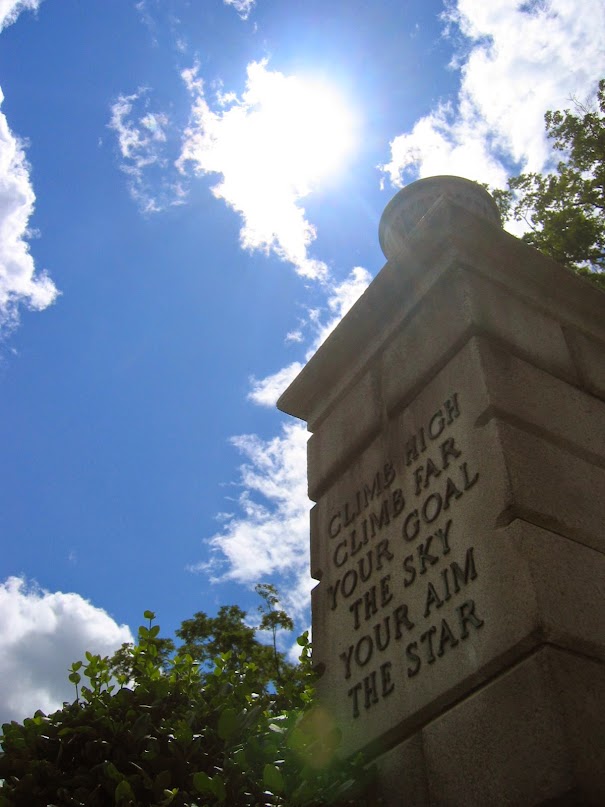
Hopkins Gate
Hopkins Gate

I returned to my alma mater for the 2013 commencement exercises. The graduating seniors seemed like a powerhouse of innovation, leadership, and social change. The commencement speaker, Billie Jean King, stood up for gender equality through her career in professional sports. One of the honorary degree recipients, Deogratias Niyizonkiza, went from being a refugee to founding hospitals that provide medical care in impoverished nations. Another honorary degree went to Annie Lennox, who, at a pre-commencement event, condemned material and celebrity culture and spoke about how her visits to Africa inspired her to HIV/AIDS activism.

What, I thought, am I doing to improve the world we live in? Sure, I don’t have the influence power of Lennox – who did acknowledge the irony that her celebrity status and material security enable her to drive activism – but my chosen career is all about building spaceships. What does that do to make the Earth a better place?

I truly believe that it helps. That I am serving a fundamental good.

Imagine this: a group of people have fallen into a hole in the ground. The hole is too deep to get out of, and resources at the bottom of the hole are very scarce. The situation is bleak. What are they to do? Those with liberal inclinations may feel that they can best solve their problems by banding together and coordinating their efforts: cultivating moss and vines on the wall of the hole for sustenance, helping each other out when sickness strikes, and sharing the water that collects in nooks and crannies. The conservatively minded among them might instead think that each denizen of the hole should try to improve their lot individually – if some parts of the hole get more sunlight and water than others, and so some of the people are richer than others, then so be it – because that improves the standing of the people as a whole and the well-off individuals may devote some of their hard-won resources to assist others.

I think that both of these approaches are important ways to improve conditions in the hole. But I also think that there’s another thing that the people in the hole can do.

They can climb out.

They can get together and hoist a representative from among their number higher, and higher, until that person can plant his or her hands on the lip of the hole and breach the horizon.

The struggle to climb out is crucial to meaningful existence inside the hole. Without the idea that the people can climb out, what are they improving life inside the hole for? There needs to be a goal – but more than that, the goal needs to advance. It helps to set the goal high, because in striving to achieve it, we might learn more about our environs and ourselves, and find other ways to improve conditions – ways that we might not have seen at all if we hadn’t started to climb. The people in the hole don’t know what lies above, so they will need to give their climber provisions – and so might develop new and improved ways to cultivate, prepare, or preserve food. They might need hoists to get their climber up to ground level – and so might design mechanisms and machines that save labor in other activities.

Most important of all: once out of the hole, the climber can come back to relate what they see…or to help others follow.

I build spacecraft. I don’t feed the hungry, or clothe the needy, or heal the sick – at least, not to much more or less an extent than the average middle-class person does. I don’t volunteer in the Peace Corps, or tutor in sub-Saharan Africa, or assist in impoverished clinics. I build space ships.

Because of spacecraft and the space industry, though, we have a global positioning system that allows those aid workers to get where they need to go. We have a global communications network that allows those volunteers to coordinate their activities from the most wired national capitals to the remotest wastelands. We have weather data that improves our ability to predict storms, droughts, floods, and climate. We have pictures of the Earth that show us the lay of the land, and how the land is changing.

Because of spacecraft and the space industry, we learn how to make more efficient solar power generators. We learn how to stretch out thin resources into expanded capabilities. We learn basic scientific facts about other worlds, giving us more lenses through which we can look at our own. We learn to build more and more precise scientific instruments. We learn to build more robust and effective machines. Sometimes, we put a human being on one of our spacecraft, and we learn even more. We learn to be better climbers.

I’m only one person, and I can’t do everything to help. I do what I can. One thing I can do is to keep moving the goalposts outward. I can keep us climbing.

To see the fruits of these efforts, I can look everywhere: from the precision medical device on my belt to the way we fundamentally think about the Earth as a planet, the influence of space exploration and industry manifests itself.

We need problem-solvers on Earth. I’m glad to see them. Alongside them, though, to keep making the world a better place, we need climbers.

I know I’m not the first person to say this. I also hope I’m not the last. But, you know, sometimes it needs saying.