All posts by josephshoer

Ithaca BrewFest 2009 highlights

Why didn’t I do this before? Oh, right, “before” was when I had just had a lot to drink. Heh. Anyway, BrewFest in Ithaca is great. Here were some of my favorites this year, mostly because I want them written down somewhere so I can remember them:

Bellwether Hard Cider – I just love their ciders in general, particularly their Original and Liberty Spy. Can’t wait to see them again at Apple Fest!

Horseheads Pumpkin Ale – This was absolutely delicious last year, and didn’t disappoint this year, either. I got many of my friends to go over for a visit, and every one loved this pumpkin ale, which tastes more like liquefied pumpkin pie than pumpkin-flavored beer.

Ithaca Beer Company Cold Front – A smooth dark beer that I can’t wait to pick up in a growler this winter. Man, that will be great on a snowy evening, right when it snows enough that all the sounds are muffled and your feet go crunch on the ground…

Roosterfish Hop Warrior – Very flavorful hoppy beer, but not totally ridiculous (I’m looking at you, Dogfish 120 -minute IPA). Tasty when sipped.

Stone Levitation – A pretty good all-around contender, though it didn’t stand out too much for me.

Wolaver’s Oatmeal Stout – Definitely a delicious heavy stout, and easy to find at Wegmans. I’ve gotta agree with Sean on this one.

Good signs from inside NASA

Apparently a group in the Exploration Systems Mission Directorate put out the following white paper. If true, I have to say I agree with it and I think it’s in line with the “Mars First” option likely to be put forward by the Augustine Commission as one of several options. Hopefully these broader, more visionary options will trump the “Save Ares” crowd.

http://www.spaceref.com/news/viewsr.html?pid=32268

New Space Shows

Recently, ABC’s new series “Defying Gravity,” starring Ron Livingston of “Office Space” fame, has caught my attention. All the current episodes (1-6 as of this writing) are available on Hulu. I think it’s been interesting enough for me to keep following it. I have a couple points of interest about the show:

Ron Livingston as astronaut Maddox Donner

First, I am impressed with how much the show’s creators, writers, and artists have paid attention to the probable operation of a near-future space program. Of course, the show makes the usual sci-fi physics gaffes. “Defying Gravity” goes to unusual lengths to rationalize shooting a space series in terrestrial gravity (“centrifuge” is a fine explanation for me, “magnetic nanospray” and “electrostatic nanofibers,” eh…not so much – novel attempt, though), there are silly numerical issues like pressurizing a spacesuit to 5 atm (never mind the entirely ridiculous  idea of a human-rated “Venus suit”), and this show, like almost every other sci-fi, doesn’t come close to getting the physics of tethers right. However, I’ve just come from a summer at NASA Johnson Space Center, and I am incredibly impressed with this show’s depiction of mission control, the MCC/spacecraft communications, space jargon, uniforms and suits, the art of the spacecraft interior, potentially realizable space technology, and the fact that they do depict zero gravity with much greater frequency than most other sci-fi. From my (albeit limited, but still quite extensive compared to the general public) exposure to the astronaut office at JSC, it seems to me that this show’s depiction of the Astronaut Office and the experience of being an astronaut is about as spot-on as it could be.
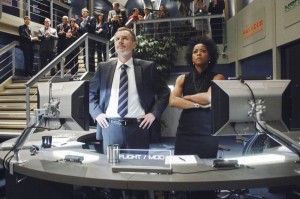
"Defying Gravity's" Mission Control

Second is the point that this series was apparently, according to Wikipedia, pitched to the networks as “Grey’s Anatomy in space.” I couldn’t care less about the soap-opera-y who’s-sleeping-with-who dynamics of a show like that, but there’s plenty more going on that make “Defying Gravity’s” characters fun to watch. In contrast to shows like “Star Trek: (pick your favorite)” – which highlights some aspect of human nature or morality by having our intrepid characters encounter a planet peopled by a species that embodies a single, streotypical trait – and “Battlestar Galactica” – which explores the interactions between its characters against the backdrop of larger questions about what it means to be free, human, just, etc. – “Defying Gravity” is a show almost purely about the interactions between the characters and how their past experiences impact those relationships. Certainly, Trek and BSG include those elements, but “Defying Gravity” removes most of the external influences on the characters. (Not all, of course, because external stressors are great for getting characters to look at themselves or their companions.) Now, using a long-duration spaceflight with astronauts cooped up in close quarters, millions of miles from assistance, communication, or rescue to set up a character study is absolutely nothing new to science fiction in general (see, e.g., Poul Anderson’s Starfarers and Tau Zero, many of Ben Bova’s novels, and the beginning of Kim Stanley Robinson’s Mars saga) – but it is new to mainstream movie and television sci-fi. Fortunately, these are pretty interesting characters, they seem like three-dimensional people, and the show so far has been about how they each come to terms with their own past at the beginning of their six-year voyage. I definitely like seeing the space program as the setup for such drama. Which brings me to…
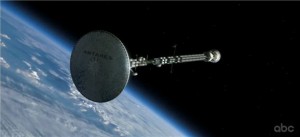
The "Antares"

Last, and certainly not least, this show is extremely pro-space. (Just listen to Maddox Donner’s voiceover monologue at the close of the pilot episode!) I love what it says about viewing audiences: the mainstream media is comfortable with, and thinks the public is comfortable with, a relationship drama set on a spacecraft against a background of mostly-real physics and operations. It helps to make astronauts feel not just like heros, but like real people. As if – gasp – we could grow up wanting to be an astronaut and hold on to that dream even if we don’t picture ourselves as the perfectly polished John Glenn or Neil Armstrong type. We can be good at things, bad at things, have our own flaws, and still go become astronauts, mission controllers, and engineers. That is a message that I really, really want to get out into the public. If we can get the more adult audiences likely to watch “Defying Gravity” thinking that it’s okay to keep dreaming to be an astronaut, then we’ll raise a generation of kids who are willing to hold on to that dream and become the scientists, engineers, and space explorers of the future. Augustine Commission, NASA management, and politicians, please take note!

My version of Constellation

I’ve been thinking all summer about NASA’s Constellation program. In general, I think it’s great to be getting out of low Earth orbit…but I think the strategic goals of the Vision for Space Exploration and the technical solutions in Constellation are somewhat lacking. My experience this summer at Johnson Space Center, and the Augustine Commission’s generally open mind, have made me very hopeful – I’ve noticed that the people at JSC aren’t as gung-ho Orion-is-the-best-thing-to-hit-space-since-John-Glenn as I feared they would be. (That seems to happen more at Marshall Spaceflight Center, where they are building Ares, and in the mind of Mike Griffin, who has called anybody who wants the current architecture to change “ignorant.” Note that that includes famous people like Buzz Aldrin and a lot of top-flight engineers.)

The current Constellation architecture is a result of basically two factors:

(1) A knee-jerk response to the Columbia disaster. NASA wanted safety during reentry, and it decided that capsules never burn up in reentry. (Never mind that while Shuttle had two major disasters in ~130 missions, Apollo had two major disasters in ~20. The tildes are because both numbers depend a little on how you count.)

(2) The Vision for Space Exploration, which sets a “Moon sorties first, then Mars sorties, and I guess we can support ISS until it’s just barely finished” mission for NASA.

That first item is a terrible point to be feeding directly into strategic planning and design work, because it limits creativity and ingenuity. Right now, Constellation is operating under the assumption that it should use as little new technology as possible. Compare that to the Apollo design days, when engineers designed their spacecraft with materials that had yet to be invented. The second item takes away from Constellation the kind of grandiose vision that could really attract attention and acclaim to NASA. We have gotten complacent with our space program; it seems routine to the ordinary Earthling. That’s the exact opposite of what we need to nuture strong public support of the space program (and science and technology in general): astronauts, flight controllers, scientists, and engineers need to be heroes again.

So where do I think NASA should go, and what should it do to get there? First of all, let’s take a look at the capabilities that NASA has now.

NASA has an incredible low-Earth-orbit capability. The Shuttle lets us bring a lot of mass into orbit. It also lets us bring a lot of mass down from orbit, which is crucially important for the Space Station’s science architecture and is a capability that Orion ignores. We also have a lot of experience with rendezvous, capture, and docking, from the assembly of ISS, Hubble servicing missions, and the like – going all the way back to Gemini – also a versatile capability virtually ignored by Orion. Finally, ISS has given us a lot of long-duration spaceflight experience.

NASA is also very good at getting robots to and operating them on Mars. Sure, several missions failed, but each of those did so because of a specific technical reason which all have known fixes. The last four major missions (Phoenix, MER1 and 2, and MRO) were all – or still are! – rousing successes.

Now let’s look at what’s problematic about today’s space program. The Shuttle is horrendously expensive to operate. It is also unsafe, not because its design is inherently flawed, but because each launch requires a total refurbishment of the vehicle and the vehicles are effectively 20-30 years old.

Here’s what I think NASA ought to do strategically, and (without doing any detailed trade studies, because though I’m a Ph.D. candidate in spacecraft engineering, I am acting as but a humble blogger here) how I think it could get there.

Continue reading My version of Constellation

I love the Daily Show

Red and blue states agree: Jon Stewart is America’s most trusted newsman, according to a Time.com poll.

I had to wonder after learning this. The man is a satirist, after all. His delivery is sarcastic, his graphics are built around smarmy puns, and his style might be described as, perhaps, “theatrical antics.” He’s a comedian first, not a newsman!

However, on further consideration, I did realize something that probably factored into the poll: Stewart seems to have a knack for pointing out the obvious in a convoluted political situation. And sometimes it just takes someone pointing out some straightforward implication for us to keep our perspective on the twisting world of politics. And I, for one, am glad to have a guy around who will keep pointing out how childish and inane Sarah Palin is.

My first realization, though, on seeing that poll result was that it’s mostly a commentary on the demographic that is most likely to respond to Internet polls.