I’ve been a delinquent spacecraft engineer, and didn’t see “Gravity” until today.
In short: it was awesome. It’s a tremendous story about courage, fear, perseverance, the human spirit, our ability to solve the most insurmountable problems, and triumph in the face of adversity. It’s also visually, sonically, musically, and generally aesthetically breathtaking. The integration of the stunning visuals, physically accurate sound, camera movement through space and spacecraft, and music was extraordinarily well integrated into a complete artistic whole.
And, although the events depicted in the movie would not (or could not) play out exactly as shown, they are all plausible from a physics standpoint.
Everyone should go see it. And, yes, see it in 3D – because this is the first movie I have ever seen in which the 3D adds to the visuals and the drama.
Don’t let go.
Before I read any other physicists’ reviews, I’m going to go through some of the concepts and sequences in the movie, make a few points about the physics involved, and then explain why I am totally fine about it all.
Let’s say I have a 500kg balloon floating in the stratosphere at fixed altitude with solar cells collecting 10kw from the sun, then my computation shows that if this energy can be converted to horizontal magnetic propulsion by repelling against the earth’s magnetic field at 100% efficiency then it could reach escape velocity in about one month. This is possible because at this altitude the air resistance is quite small so it is almost like pushing at an air hockey which does not require much force to get it to speed up horizontally. … My question for you here is that in reality how close to practicality is the design of this ‘spacecraft?’
Launch costs are one of the big drivers in the space industry, and the propellant required to get a spacecraft up to orbital speed is a major part of that cost. If we could use some sort of “propellant-less” means to get a vehicle into orbit, we could revolutionize the whole space industry. In fact, this is an idea that my grad school research group once brainstormed about during a lab meeting: push on the Earth’s magnetic field. If we start pushing from high altitude, where air resistance is small, then we just have to wait long enough to accelerate our spacecraft up to at least low Earth orbit speed (about 7 km/s). Launches might take a long time, but they would be far cheaper and easier.
As long as we can push on the spacecraft with a net force in the direction of its velocity, then it will accelerate. So, the first question we come to is this: how much drag force do we need to overcome? That force will provide us with an estimate of the minimum force our electromagnetic device needs to produce.
Air resistance causes a force in the opposite direction to an object’s velocity. For a sphere moving through the air, this force has a magnitude equal to 1.1 d A v2, where d is the air density, A is the cross-sectional area of the sphere (pi r2), and v is the object’s velocity. Let’s suppose we mount our 500 kg spacecraft on a high-altitude balloon that can get all the way up to 30 km altitude before we engage the magnetic propulsion device. At that altitude, the atmospheric density is in the ballpark of 0.02 kg/m3. (I’m reading off of the 1962 US Standard Atmosphere graph on Wikipedia, since I can’t look at NASA’s web resources. Thanks, Tea Party!) Now we have d.
Next question: how big is the balloon? Way back in Ancient Greece, when Aristotle had the original “eureka!” moment, he realized that objects float in a fluid when they displace a weight of fluid equal to their own weight. (Equivalently, they displace a mass of fluid equal to their own mass.) So, our 500 kg balloon-based vehicle has to displace 500 kg of air – and if it’s floating at a level where the air pressure is 0.02 kg/m3, then that means the balloon takes up a volume of at least 25,000 m3. That’s a sphere 36.3 m in diameter. (Note that here I’m assuming that the mass of the vehicle includes the mass of the balloon and of the gas we pumped in to inflate the balloon. What finally gets to orbit will be less than 500 kg.) So: A is about 1035 m2.
Now we have an estimate for the drag force magnitude on our electromagnetic launch vehicle at 30 km altitude, of about 22.77 v2. If we start our electromagnetic devices pushing, the spacecraft will start to move – but it will eventually settle on a steady-state speed at which the drag force and propulsive force balance each other. Here’s the bad news: even though the atmosphere is not very dense 30 km up, that v2 in the drag equation will really get us as we reach higher and higher speeds. If the balloon gets going at 1 m/s, the drag force will be 22.77 N. If we reach 10 m/s (about normal human sprinting speed), the drag force is 2,277 N. If we tried to accelerate the balloon all the way up to 7 km/s at this altitude, putting the vehicle in orbit, then the drag force will get to over onebillion newtons! It’s not feasible to build a compact device that could push on the Earth’s magnetic field and generate this kind of force.
You might get the idea that as we accelerate, we can also gradually increase the balloon’s altitude. After all, if the air gets less dense, that drag force will decrease. With less resistance opposing our spacecraft, we don’t have to work as hard to accelerate it.
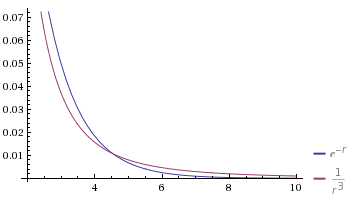
There are two problems we’ll run into if we follow this idea. First, while going up in altitude makes our spacecraft encounter less atmospheric density, it also has a weaker magnetic field to work with. At these high altitudes, atmospheric density is very much like an exponential decay. But the magnetic field from a dipole (like the Earth’s) falls off with distance from the dipole as 1/r3. How do the two functions compare?
This is good news. While at first, the magnetic field is lower than the density, eventually we come to a point where the magnetic force will be stronger than the drag force for fixed velocity. (This makes sense, because some spacecraft use magnetic forces to orient themselves when they are well above the levels of appreciable atmospheric density.) Suddenly, this idea doesn’t seem so crazy.
The second, problem, though, is tougher. Remember buoyancy? Once we get up to about 34 km altitude, according to that graph, the air will be about half as dense – which means our balloon will need to take up twice as much volume in order to stay afloat. The higher up our spacecraft goes, the bigger than balloon has to be. Eventually our balloon is going to need to be kilometers in diameter, since we won’t yet be up to orbital speed and gravity will just pull the spacecraft down unless we keep our spacecraft buoyant. (This is why high-altitude balloons always eventually pop!)
Because our vehicle has to solve both problems simultaneously – staying afloat and accelerating – I don’t think it’s feasible to get a large satellite into orbit this way.
However, if we move to a size scale where some of the physics behave differently – say, if we make our spacecraft very small – then perhaps we won’t run into this problem with the balloon. A few years ago, one of the researchers in my old lab took a look at some of these very questions of drag and magnetic forces on tiny spacecraft, though not with the goal of launch in mind. But one could, theoretically, make tiny spacecraft capable of accelerating to high speed by interacting with a planetary magnetic field. One could also, theoretically, make spacecraft tiny enough to flutter down through an atmosphere unharmed. Combining and reversing these ideas would be an interesting long-term research challenge!
Just a quick note to share some exciting news: the first spacecraft to come out of my graduate research lab – Cornell University’s Space Systems Design Studio – launched with the SpaceX Falcon 1.1 debut yesterday. SpaceX says that the CUSat technology demonstrator vehicles deployed nominally. You can read more about the launch here. I did only a tiny bit of work for CUSat, but I know other students who did a lot more! Congrats to the CUSat team. It’s been a long wait.
The next launch out of my old stomping ground lab will be KickSat, going up on the next Falcon to carry supplies to the International Space Station.
It’s that time of year again! That is, it’s NASA Authorization Act time.
Mostly, I agree with Dr. Steve Squyres’ views. NASA does need a clear long-term goal, it is getting too little support for its missions, and it would be best to leave implementation details up to the space agency’s own program management. But that’s not what I want to discuss here.
What I want to write about is the troubling effect NASA budget and mission discussions has on space advocates. They get the Mars people at the throats of the human exploration people, as the space technologists snipe at Earth science supporters. Meanwhile, the pro-aeronautics camp trashes the education outreach groups and the outer moons proponents try to make off with the fundamental scientists’ stuff.
Everyone wants a piece of the pie, and there’s not enough to go around.
The resulting NASA policies over the past several decades years have been on the incoherent side, and I think that is because the space community shies away from a really difficult question – a question that we currently cannot answer well. The crucial thing that we have to pin down is this:
What is the driving purpose of our space program?
I don’t mean to ask whether we should or should not have a space program. Suppose the answer is “yes.” Now, we need to identify what it’s for. What do we want out of NASA?
The reason why I want to ask this question is because NASA’s short- and long-term goals should fall out as consequences of our answer. We need not bicker over whether we should build a Space Launch System or wrangle an asteroid into lunar orbit. The value of those items should be clear when we measure their contribution to the overall NASA mission.
I also don’t mean to ask whether NASA’s goal should be the Moon or Mars. Those are points on the map, and they are not ends in and of themselves. They are destinations, not purposes. Even if we get to the destinations, the space program will not thrive without a purpose. We’ve seen that before.
So let’s ask ourselves the big question. The one that space advocates don’t want to talk about, I think, because they are afraid of sounding a little crazy when they answer.
Is the answer, for example, that we want NASA’s purpose to be to find extraterrestrial life? Should the space program’s goal instead be to expand human life to colonies beyond our home planet? Or ought NASA’s biggest prerogative be defending the Earth from asteroid impacts? Do we have such a need for tangible short-term benefits that space technology development is the best answer? Should cranking out fundamental scientific research be the main goal of the space agency?
I contend that each of these answers implies that some destinations, missions, and technologies would be better choices than others. This is a good thing, because then our overall purpose for NASA will clear up the annual muddle. For example:
If NASA’s purpose is to find alien life, then we ought to be sending as many robotic probes as we can to get under the ice of Outer Solar System moons like Europa, Enceladus, and Titan.
If the goal is sustaining human colonies on other worlds, then human exploration of Mars and/or the Moon should get the lion’s share of NASA attention.
If planetary defense is the motivating goal, then the space program should be doing all it can to characterize, explore, and learn to manipulate asteroids and comets.
If space technology is the purpose, then NASA probably ought to be developing and expanding on the International Space Station.
For basic scientific research, the agency should be putting up all manner of space telescopes and sending probes to easy-to-reach targets, like Mars.
I don’t mean to suggest that NASA should do nothing else. But the main thrust of NASA activity really should support the overall goal directly.
Personally, I think the main purpose of the space program should be to locate extraterrestrial life (with human colonization a close second). Discovery of alien life would be a world-changing event. I think that’s the kind of impact we should be trying to achieve. Locating extraterrestrial life wouldn’t be the end of the story, either – if it is found, then other goals will quickly ensue. So, I see that as a good self-perpetuating purpose for the space program. (Human colonization of space is a close second.)
I want a big, ambitious purpose for NASA. I want that purpose to be unambiguously clear. And I want the purpose to be persistent enough to drive budget authorizations for enough political generations that we actually see progress towards the goal. In order for all that to happen, though, the space community needs to first identify the goal!
It seems that being at Williams College again for only a weekend is enough to prompt a little self-reflection.
Hopkins Gate
I returned to my alma mater for the 2013 commencement exercises. The graduating seniors seemed like a powerhouse of innovation, leadership, and social change. The commencement speaker, Billie Jean King, stood up for gender equality through her career in professional sports. One of the honorary degree recipients, Deogratias Niyizonkiza, went from being a refugee to founding hospitals that provide medical care in impoverished nations. Another honorary degree went to Annie Lennox, who, at a pre-commencement event, condemned material and celebrity culture and spoke about how her visits to Africa inspired her to HIV/AIDS activism.
What, I thought, am I doing to improve the world we live in? Sure, I don’t have the influence power of Lennox – who did acknowledge the irony that her celebrity status and material security enable her to drive activism – but my chosen career is all about building spaceships. What does that do to make the Earth a better place?
I truly believe that it helps. That I am serving a fundamental good.
Imagine this: a group of people have fallen into a hole in the ground. The hole is too deep to get out of, and resources at the bottom of the hole are very scarce. The situation is bleak. What are they to do? Those with liberal inclinations may feel that they can best solve their problems by banding together and coordinating their efforts: cultivating moss and vines on the wall of the hole for sustenance, helping each other out when sickness strikes, and sharing the water that collects in nooks and crannies. The conservatively minded among them might instead think that each denizen of the hole should try to improve their lot individually – if some parts of the hole get more sunlight and water than others, and so some of the people are richer than others, then so be it – because that improves the standing of the people as a whole and the well-off individuals may devote some of their hard-won resources to assist others.
I think that both of these approaches are important ways to improve conditions in the hole. But I also think that there’s another thing that the people in the hole can do.
They can climb out.
They can get together and hoist a representative from among their number higher, and higher, until that person can plant his or her hands on the lip of the hole and breach the horizon.
The struggle to climb out is crucial to meaningful existence inside the hole. Without the idea that the people can climb out, what are they improving life inside the hole for? There needs to be a goal – but more than that, the goal needs to advance. It helps to set the goal high, because in striving to achieve it, we might learn more about our environs and ourselves, and find other ways to improve conditions – ways that we might not have seen at all if we hadn’t started to climb. The people in the hole don’t know what lies above, so they will need to give their climber provisions – and so might develop new and improved ways to cultivate, prepare, or preserve food. They might need hoists to get their climber up to ground level – and so might design mechanisms and machines that save labor in other activities.
Most important of all: once out of the hole, the climber can come back to relate what they see…or to help others follow.
I build spacecraft. I don’t feed the hungry, or clothe the needy, or heal the sick – at least, not to much more or less an extent than the average middle-class person does. I don’t volunteer in the Peace Corps, or tutor in sub-Saharan Africa, or assist in impoverished clinics. I build space ships.
Because of spacecraft and the space industry, though, we have a global positioning system that allows those aid workers to get where they need to go. We have a global communications network that allows those volunteers to coordinate their activities from the most wired national capitals to the remotest wastelands. We have weather data that improves our ability to predict storms, droughts, floods, and climate. We have pictures of the Earth that show us the lay of the land, and how the land is changing.
Because of spacecraft and the space industry, we learn how to make more efficient solar power generators. We learn how to stretch out thin resources into expanded capabilities. We learn basic scientific facts about other worlds, giving us more lenses through which we can look at our own. We learn to build more and more precise scientific instruments. We learn to build more robust and effective machines. Sometimes, we put a human being on one of our spacecraft, and we learn even more. We learn to be better climbers.
I’m only one person, and I can’t do everything to help. I do what I can. One thing I can do is to keep moving the goalposts outward. I can keep us climbing.
To see the fruits of these efforts, I can look everywhere: from the precision medical device on my belt to the way we fundamentally think about the Earth as a planet, the influence of space exploration and industry manifests itself.
We need problem-solvers on Earth. I’m glad to see them. Alongside them, though, to keep making the world a better place, we need climbers.
I know I’m not the first person to say this. I also hope I’m not the last. But, you know, sometimes it needs saying.
It’s been a little while since I checked in with the goings-on back at my Cornell research lab. Totally unsurprisingly, some very cool things are happening there!
One is that the Sprite and KickSat project has gone all the way from a back-of-the-envelope concept when I was at the lab to a flight manifest! Sprites are tiny spacecraft – think the size of a coin – that consist of little more than a solar cell, a little CPU, and a diminutive radio. They are pathfinders for an idea that, rather than relying on a single monolithic (and super-expensive) spacecraft, instead we could just run off a batch of a million tiny satellites and fling them all out into space to cooperatively complete a mission. Some of the applications we talked about included integrating basic lab-on-chip functionality to test for biomarkers, and then rain a bunch of the Sprites down onto Mars or Europa. They wouldn’t return the same wealth of data of a NASA flagship mission, but they would tell us where the interesting things are. Another reason why tiny spacecraft are cool is because they interact differently with Solar System objects than large vehicles do – so they might be able to take advantage of light, magnetism, or planetary atmospheres in different ways.
The KickSat project was the brainchild of grad student Zac Manchester. It’s a simple CubeSat design with a spring-loaded deployer, designed to release a couple hundred Sprites. On the ground, Zac can then track the intermittent radio signals from all these mini-spacecraft, and evaluate how well their unshielded components survive in space. Radiation will eventually kill them, but with many copies of the same spacecraft, we’d expect to see them die out statistically. They’re spacecraft with a half-life, and as long as the half-life is long enough to complete the mission, we don’t care that a huge number of Sprites burned out.
When I left the lab, Zac was applying for grants to build the KickSat hardware. But – despite the cool concept – there weren’t any takers. Eventually, he decided to turn to KickStarter to see if he could crowd-fund some spacecraft research. He ended up raising almost three and a half times as much money as he asked for, and become something of a pioneer for crowdfunded space activities! Zac is now working at Ames Research Center to perfect the Sprite and KickSat designs. They will be launching on the same SpaceX Falcon 9 rocket that will carry supplies to the International Space Station in September. This is actually the first CubeSat from my lab to make it all the way to launch, so I say: Go Zac!
Second, a project that is perhaps a little less flashy but a little closer to my heart has been making some great strides. Ben Reinhardt has been squirreled away in the same basement lab I remember, working on what he calls “eddy-current actuators.” The more fanciful – and very nearly accurate – name for the devices he is working on would be “tractor beams.” He wants to use these to grab onto defunct satellites, the outside of the Space Station, or maybe even some asteroids and comets, all without mechanical contact.
I was still active in the lab when this project got off the ground. In fact, I put together one of our first tabletop demonstrations of the principles involved: a changing magnetic field generates eddy currents in conductive materials; these currents have their own magnetic fields which we can push or pull with magnets. That’s where I left the project, though…a quick video where I waved a magnet around, some rough number-crunching to show that the induced forces were feasible for applications, and then I was out to let other members of the lab hash out the details. (That’s the fifth-year grad student for you!)
The cool news is that Ben has gone from my rough video to a much more carefully controlled demonstration. He’s generated attractive and repulsive forces in a bare piece of aluminum (not unlike the skin of a spacecraft), without touching it, and he’s working on characterizing the design space of his device. This is a critical step in figuring out how to go from proof of concept to a useful technology, and it’s a step I remember quite well. While Ben’s twitching pendulum might not look to you like the tractor beams from Star Trek, it is a clear and measurable experiment illustrating the device. I went from similar experiments in my first two-ish years of grad school to flight demonstrations in my third and fourth; I hope Ben follows a similar trajectory. And who knows – if some companies or space agencies take an interest, we may soon see spacecraft grappling asteroids and assembling components with eddy-current tugs!
Ben and some of the other Cornell Space System Design Studio grad students are keeping a blog about their technology research projects, which you can read here. I think it’s very cool to see what’s going on in the lab!
Way back when I was looking at grad schools, I visited an MIT space propulsion lab where students and faculty were developing something called an electrospray thruster. This is a device consisting of a plate covered in tiny spikes, with a tiny grid layered on top. You feed an ionic liquid onto the plate, where surface tension wicks it up to the tips of the spikes. (Ionic liquids – and this kind of boggled my mind when I first learned about them – are salts that are in their liquid state. They’re just a bunch of sloshing positive and negative ions. Wild!) Then, you apply a voltage to the grid sitting above the spikes. The potential difference between the spikes and the grid yanks ions up and hurls them out through the holes in the grid, and voila – ion thruster.
The MIT Space Propulsion Lab has been developing these as little patch thrusters that they can put on CubeSats. The thrusters are 1×1 cm patches and seem to generate forces in the range of ten or so micronewtons. (That would be, say, 1% of the weight of a postage stamp.) These are very small forces, but we are talking about very small satellites and we can leave the thrusters on for a very long time.
The idea that stuck in my head when I learned about these devices, though, is that they are mechanically very simple: all we have to do is texture a surface appropriately, touch the ionic liquid to it, and energize part of it. We could probably develop a fabrication method to print the thruster “texture” onto a flexible membrane or fabric of some kind.
And then we could deploy it like a sail.
10 micronewtons from a 1×1 cm thruster gives a thrust density of 0.1 N/m^2. So a 1×1 meter sail would produce a thrust force of about a tenth of a newton. On a standard 3U CubeSat, this corresponds to an acceleration of 3.4 milligees – which is actually getting up to the acceleration regime of the chemical thrusters on large spacecraft! With such acceleration, it would take five minutes for the CubeSat to add one meter per second to its velocity. Starting from low Earth orbit, this miniature sailing vessel would need only twenty minutes to hit Earth escape velocity!
3U CubeSat with 1 meter sail
What probably makes the most sense from a propulsion perspective is to deploy the membrane engine behind the spacecraft, maximizing the engine area and minimizing any adverse effects of the ion exhaust. (All those high-energy ions might eat away at the spacecraft’s solar cells or other surfaces!) However, there might be some challenges in running the ionic liquid down to the sail.
A good compromise would be a sail mounted to the back or middle of the CubeSat – think of the NanoSail-D configuration – where a reservoir of ionic liquid could supply a steady stream of propellant to the membrane and most of the zooming ions will miss the back of the spacecraft. The forward-facing part of the membrane might also be usable area, for things like solar cells. Or CCDs.
Ion engines caused a shift in the way spacecraft engineers thought about propulsion: instead of brief, impulsive maneuvers, they could use a gentle but steady acceleration for a long period of time. The ability to spread an ion engine over a large area might be a way to create a high-efficiency thruster that also produces a large force, and with few moving or complex parts. That’s the kind of device we might use to send a small spacecraft to the outer Solar System. Of course, we’d need a lot of electrical power, but that’s why the DOE is starting plutonium refining again…
This weekend was full of excitement for commercial space fans. Orbital Sciences Corporation launched the Antares rocket, making them only the second private company to put a vehicle into orbit. Like the SpaceX Falcon 9, Antares is intended to carry cargo to the International Space Station. Antares is cool for a couple of reasons – partly because it represents a further gain in the United States’ launch capability, but more notably because the target market for Antares commercial launches are smaller spacecraft than the usual several-thousand-ton geosynchronous birds.
Smaller spacecraft are particularly cool because – since their design, fabrication, and launch costs are lower than big satellites – satellite manufacturers are more willing to take risks with their design. I don’t mean “risks” to imply that these spacecraft are unsafe. I mean that they are not quite as tried-and-proven. In other words, they can be more cutting-edge. More innovative. More likely to push the envelope.
In that vein, what I find most exciting about the Antares launch is that the vehicle carried three NASA CubeSats specifically designed to puncture the conventional wisdom about how conservative spacecraft designs need to be. They are called “PhoneSats,” and what makes them special is that their flight computers are off-the-shelf Android cell phones. Their on-board avionics software is an app.
The idea behind these CubeSats is to test how robust spacecraft really need to be. Commercial spacecraft engineers design huge margins into their vehicles. We tend to be very careful and conservative. But since many spacecraft last well longer than their quoted design lifetimes…maybe we’re too conservative. The PhoneSats will help answer the question: If we just get commercial computer hardware and design a system that works – without so much conservatism – how long will it last in space? Maybe it will operate long enough to complete its mission.
If the PhoneSats stayed in orbit forever, they’d be likely to burn out. Their Android processors and flash memory would fail under the onslaught of cosmic rays. But, at under $7000 each, maybe even the short mission of these satellites would make them competitive with the longer-lasting multi-million-dollar vehicles.
I’ll be very interested in the results of the PhoneSat project!
The Lockheed Martin corporation recently conducted a poll in which they asked members of the public to choose the company’s “ultimate innovation.” There were a lot of fancy gizmos in the poll, including some very recent ones that definitely qualify as “innovations.” The Joint Strike Fighter, for example – a jet that can take off vertically and then fly at supersonic speed – is pretty damn cool. The SR-71 is almost mythic in the aerospace world. There were underwater robots and fighters that helped us win World War II.
But what won the poll, in the eyes of the public? What was the “ultimate innovation?”
A twenty-three-year-old clunker of a machine. A device that was once universally panned as myopic and wasteful.
The Hubble Space Telescope.
These high-profile space exploration missions simply soar in the public imagination. More than any other aerospace or engineering innovation, they capture people’s attention and fire their spirit.
Clearly, we need more of them.
Not only is it good policy…it’s just good public relations!
I just picked up the latest Humble Bundle sale entirely because of the gameplay video of Flotilla. Flotilla is a terrific little gem of a game that puts players in tactical command of a small squadron of combat spacecraft, with a little irreverent stomp-around-the-galaxy exploration to frame the battles.
Screenshot from the Flotilla web site.
What it gets right
Spacecraft physics-wise
The simultaneous turn-based mechanic. I’ve written before that a realistic movie depiction of space combat would play out like a submarine movie: long periods of tension between scenes of rapid action. Flotilla only allows players to issue orders every 30 seconds, and then watch how their tactics play out – which plays right into that tension/action dynamic. It also is probably pretty close to how communications lag and astronomical distances would force a true space fleet commander to operate.
The focus on both spacecraft position and orientation. Ships have well-defined firing arcs, strong points, and weak points. These features make it essential for players to consider the 3D orientation of their spacecraft and their targets: I learned very quickly that the basic orientation control mode (in which you specify an enemy for your ship to face) was not sufficient if I wanted to get through combat unscathed. The advanced mode (which lets you specify yaw, pitch, and roll Euler rotations for each ship) let me perform much more advanced maneuvers; faking out my opponents so that they exposed their vulnerable points to me while I absorbed incoming fire with armored surfaces.
Gameplay-wise
The simplified interface. The game is very clean, stylish, and accessible. It’s easy to set up complex tactics in the fully 3D environment. I also appreciate that you don’t have to keep track of a bazillion unit types and special abilities – but, at the same time, each ship class has particular strengths and weaknesses.
The combat balance. It’s possible to approach a battle with a large fleet and blast your enemies into space dust…and it’s also possible to slip in with a single destroyer and land surgical hits to wipe out a superior force. (It took a while, but about half a hour ago I took down two destroyers and four dreadnoughts with a single destroyer. I even tricked two of the dreadnoughts into colliding – that was very satisfying!)
What it gets wrong
Spacecraft physics-wise
The specifically top/front armor design. All ships have strong armor on their “tops” and “fronts,” with weak armor on their “bottoms” and “rears.” I think it’s great to have weak and strong faces, but if the engineers who designed these ships knew that they were going into space – where only the enemy’s gate is “down” – why would they make all ships the same in this regard? It would make more sense for the different ship classes to have different strong and weak faces.
Forces do not exist. There is no gravity, and no orbital motion. All battles take place in deep space. Orbital dynamics would certainly complicate the gameplay – but the cool thing about including orbits would be to add complexity to players’ tactical options. (In orbits, it’s actually easier to move in some directions than others. That’s a phenomenon that players could manipulate.) More importantly, the direction a ship’s engines are pointing has no effect on its motion. It would have been neat to see some coupling between the 3D positioning and spacecraft orientation, instead of letting vehicles slide “sideways” at the same speed that they move “forward.”
Gameplay-wise
No collision warnings. The movement hint lines really need to turn red or something when you accidentally drive them through an asteroid. Or when two ships’ movements will lead them into a collision halfway through your turn. Even after I knew to look out for these situations, I still sometimes drove my own spacecraft into each other. Those are real facepalm moments!
Orientation can be tricky. While I love the abstracted spacecraft graphics because they make me feel like a fleet admiral looking at a tactical display, it’s sometimes hard to tell at a glance which spaceship faces are “up.” A little extra coloration or something would help indicate the weak and strong spots. In addition, Euler angles are not my favorite way to represent and manipulate orientations of spacecraft. I would prefer to use the same planar/vertical interface that sets 3D motion to specify the front-facing direction of my ship, and then roll the spacecraft about that axis.
What it gets hilarious
Everything about the Adventure Mode. That owl warlord will rue the day he challenged my karaoke championship!