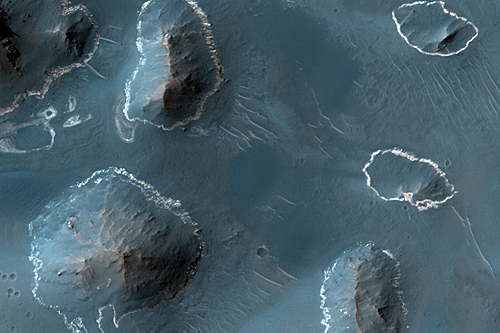
I know I am not at my blogging best when I just write, “hey, look at these spectacular images!” But…look at these spectacular images!
An image-of-the-day gadget on my iGoogle home page showed me this picture, which I subsequently spent about a half hour trying to locate at a primary-source web site. It is wicked cool.
Possible Cyclic Bedding in Arabia Terra (HiRISE/MRO)
Click to go to this image’s description page on the University of Arizona HiRISE site. (Be sure to bookmark the 2560×1600 wallpaper version!!!)
I really want to know how these terraced buttes got to be the way they are…it looks like they must have been eroded in stages, with each layer from the top getting peeled back successively, but somehow the individual layers hold together – those are some pretty steep walls. I can see in the southwestern portion of this image that some of the terrace walls are eroding away in chunks; there are a couple good fallen boulders over there. The layers might be some kind of sandstone, because they haven’t eroded away in lots of rocks and boulders, so they don’t seem very friable, but there’s obviously a lot of source material for dunes in this area so the butte walls might be getting ground down into very small grains. I’m not sure what the fluvial history of Arabia Terra is – on Earth, that would be bound to play an important role in creating landforms like this.
I also really love the expression of the more recent aeolian features in this area. Looks like there are prevailing north-south winds on the east side of this image (I’m going to say the wind blows to the north because the north sides of the dunes look more like slip faces to me), but from the east-moving dunes in the terraced valley-like feature at center bottom and the east-west oriented ripples on the larger dune field, the winds are apparently going in rather circuitous routes around these buttes. There are also some confusingly-oriented dunes and ripples in the southwest portion of this image, probably from the wind winding around all the rocky towers. (In my mind, I can hear it whistling.)
Looks like the valley from which the east-going dunes have traveled is an exposed outcrop of one of the terrace layers. This image can resolve objects less than a meter in size, so the various crisscrossing dark lines in the light-toned outcrop might be joints or something.
Anyway, this is not a new image and I haven’t studied or researched this stuff…I just saw it today and wrote a little stream of consciousness of geological ideas. I just think this image looks beautiful and I want to send some rovers/people there. Any planetary science guys want to comment?
Last, and just for grins, here are some goodies I turned up in my search for that image on the UA HiRISE site. Here we have some dramatic contrast between dunes and some lighter, rockier topographically high areas:
Pitted Layers Northeast of Hellas Region
Here’s some great layer exposures around some hills – and if you zoom into the large version of this one, you can find some wild and interesting ripple patterns:
I was very encouraged to read that Sen. Bill Nelson (D-FL) expressed some thoughts on the new NASA budget this past week that agrees pretty well with my own view. I’ve generally been worried about the Senators and Representatives from Florida, Alabama, and Texas; since I am very much a proponent of the new NASA programs, I don’t want to see politicians trying to drag out the generally defunct Constellation program just to get some pork for their districts.
Some of Sen. Nelson’s comments:
“I think they made two tactical mistakes that gave everybody the wrong impression,” the Florida Democrat said. “The first one is that the president didn’t set what the goal is, and everybody knows the goal and that’s to go to Mars.
“The second mistake was that they said they are canceling the Constellation program. That sounds like they were canceling the manned (spaceflight) program, when in the same breath he said we’re doing the research and development for a heavy lift vehicle, and they were putting all their eggs in the same basket of getting to the space station with the commercial boys.”
The most frustrating thing to me about the general space-blogger explosion in response to the new NASA budget and programs is that they all seem to have been screaming, “Obama cancelled the manned space program!” That has never been true; he cancelled the already-way-behind-Constellation program. Cancelling the human spaceflight program would look something more like erasing NASA’s Exploration Systems and Space Operations Mission Directorates. ESMD is, in fact, getting the large bulk of the new NASA money, and it’s earmarked specifically for new human space programs and technology. I have even seen news reports that talk about the NASA “budget cut,” when in fact the budget is increasing by a phenomenal $6 billion in the next five years.
What gives? Why do all the commentators think that what’s going on is the exact opposite of what’s actually happening? It could just be the people at Marshall SFC and the fans of Mike Griffin (who frequently pontificates that CxP’s thrown-together-knee-jerk-Columbia-reaction approach is the best and only way to get into space) don’t want to see Constellation’s vehicles go, but that is hard to understand given how far behind schedule Ares I is, how Ares V and Altair don’t exist yet, and how Orion keeps shrinking in capacity and capability. They’re also not everybody in the space community…and I’d expect the rest to be excited about the expanded budget and the new mandate for NASA to go ahead and put modern technologies on their vehicles, instead of sticking to Shuttle-era (that’s the 70’s, folks) stuff. I think Sen. Nelson hit the nail on the head – most of the media have conflated “Constellation Program” with “Human Space Program,” and the lack of an explicitly articulated space goal direct from the President is hurting right now. NASA Administrator Maj Gen Charlie Bolden clearly thinks that the goal is to get people to Mars by about 2030, and President Obama even asked, in his call to ISS astronauts last week, what it would take to get to Mars and beyond.
So I think President Obama desperately needs to give a Space Address, in which he articulates The Goal and expresses American spaceflight ambitions in a way that deals with the issues that Sen. Nelson identified. I think I know, from the budget documents, Bolden’s remarks, and what little we’ve heard from the White House, what would be in this address (again, see my post “NASA, unleashed!“). So, here’s what I think he should say. Everything here is factually accurate, based on the budget numbers and Bolden’s statements. The dramatic difference is that it leaves no ambiguity as to the positive position of our human space program. Obama could give this speech, or something like it, tomorrow. And he should! Continue reading Solving the CxP-cancellation image problem→
“Mike, if you’re CapCommin’ and you’re lookin’ for folks and you can’t find ’em…they’re probably in here.”
That was a radio call from the STS-130 crew to Mission Control in Houston from early on Wednesday, after all seven windows in the ISS Cupola were opened for the very first time. I have been watching NASA TV and trawling their multimedia galleries all the time I’ve been at my desk today…the views out the Cupola – of Earth, the Moon, the Station, and the Shuttle – are simply spectacular. Here is a small selection of the currently available images, available here. (I can’t wait till they release some of the photos looking out at the Shuttle cargo bay and the Soyuz spacecraft on the ISS exterior. Future robot arm work is also going to look amazing.)
S130-E-007858 (14 Feb. 2010) --- NASA astronaut Robert Behnken, STS-130 mission specialist, participates in the missionISS022-E-067184 (17 Feb. 2010) --- NASA astronauts Robert Behnken (left) and Nicholas Patrick, both STS-130 mission specialists, participate in the missionISS022-E-066963 (17 Feb. 2010) --- This image is among the first taken through a first of its kind "bay window" on the International Space Station, the seven-windowed Cupola. The image shows the coast of Algeria featuring (in the Cupola's round window) an area between the cities of Dellys and Algiers. The image was recorded with a digital still camera using a 28mm lens setting. The Cupola, which a week and half ago was brought up to the orbital outpost by the STS-130 crew on the space shuttle Endeavour, will house controls for the station robotics and will be a location where crew members can operate the robotic arms and monitor other exterior activities.ISS022-E-066964 (17 Feb. 2010) --- NASA astronauts Terry Virts (left), STS-130 pilot; and Jeffrey Williams, Expedition 22 commander, pose for a photo near the windows in the newly-installed Cupola of the International Space Station while space shuttle Endeavour remains docked with the station.ISS022-E-066976 (17 Feb. 2010) --- NASA astronauts Terry Virts (left), STS-130 pilot; and Stephen Robinson, mission specialist, pose for a photo near the windows in the newly-installed Cupola of the International Space Station while space shuttle Endeavour remains docked with the station.
or, The “Apollo on Steroids” Critics Have Their Way
or, President Obama Comes Through On Space
I am simply thrilled at the prospects offered by the NASA budget released earlier today. In that budget, President Obama directed that NASA’s mission shift in scope in a dramatic way – a new paradigm, as all the media proclaim. That paradigm is this: NASA is going to stick its neck out. The space exploration business has grown to become incredibly risk-averse. NASA is now going to start experimenting more, trying new technologies, pushing the envelope, and playing with new strategies while leaving the more conservative aspects of spaceflight to others. NASA is going to lead while others follow. This ends a decades-long effort in which NASA was, essentially, playing catch-up with itself.
Pre-State of the Union buzz is that NASA’s Constellation program is dead.
Now, I haven’t really seen the White House rationale for this, but I suspect it goes something like this: “This country is in a pretty crappy economy right now. We’re bogged down with health care policy in Congress. And global climate change will be a more pressing problem in the future. We don’t have the time, money, or resources to devote to something like space exploration that doesn’t return any direct benefits.”
If you’ve been reading my blog since my time at NASA last summer, you know that I am a big fan of manned space exploration, but not necessarily a fan of the current Constellation architecture. I’m fine with seeing Constellation go, but only if we replace it with something gutsier. So I am not okay with axing Constellation and flatlining NASA’s budget. (Though Constellation was pretty much crippled in the first place by the “do it on the existing budget!” directive in 2004.)
The argument against NASA will likely be one of limited resources and the perception that space exploration doesn’t return anything for the average US citizen. As a counter, let’s start writing the White House and our legislators in the Senate and House, and ask them which terrestrial problems can NASA solve for us? The answer is a laundry list – and a compelling one, just off the top of my head!
Want to grow the US economy and create jobs?
— Give NASA a strong mandate and plenty of resources!
Funding NASA is one of the very few sure-fire ways for this country to glean direct economic benefits. For every $1 that the United States government puts into NASA, the US economy grows by as much as $8. (One source here). This makes it one of – if not the – most effective ways for the federal government to have a positive effect on the economy. That’s a gain of 800%. Compare that to the ambiguous and uncertain economic growth from bailouts, tax cuts for the richest 2%, two wars, unspent stimulus funds, or Congressional shenanigans. NASA creates high-tech jobs, administrative jobs, IT jobs, engineering jobs, research jobs, custodial jobs, manufacturing jobs, analysis jobs. NASA creates technologies, hardware, and software, and puts out contracts for the development of more technologies, hardware, and software. Money going to NASA boosts the economy of every state in the union, some by hundreds of millions – or even billions – of dollars.
Economic growth by state from federal NASA funding (click for full size)
NASA can best provide these economic benefits if it has an ambitious, driving goal – pushing it to turn out as much of a return on the investment as it can – and sufficient resources to pull it off. If it’s the economy we’re worried about, we should be afraid of not funding NASA enough!
Want to keep this country competitive in technological development and scientific progress?
— Fund NASA!
The White House web site recognizes that “the United States is losing its scientific dominance.” Are iPod apps and Twitter really going to carry the tech sector of the US economy in the future? Especially when we are exporting a lot of tech jobs and highly educated workers to other countries? If we want to secure our national future, we need to make sure that we produce plenty of high-powered brains in our own country, and that we work on the latest in science and technology in the research labs and R&D centers available to us. Down the line, if Americans stop caring about science and technology, we are going to be producing smaller quantities and lower quality goods and services. Our development will stagnate when compared to other countries. We will have to look abroad for solutions. Even if that’s not a bad thing outright, why wouldn’t we want high-tech developments and cutting-edge science produced close to home?
We can only derive so much benefit from all the MBAs and lawyers we churn out. But technological and scientific fields develop whole new markets and whole new disciplines that we can use to create better products, better services, better knowledge, and a better society. Remember that when President Kennedy directed NASA to land on the Moon, we had a grand total of 15 minutes of human spaceflight experience. New industries, spun off by fields from specialized materials science to computer technology, that had not even been conceived yet had to be invented. The very foundations of the US manufacturing industry had to be advanced forward a decade to meet the tolerances required for the Apollo vehicles. Imagine what could come out of a similar program today!
NASA is a leading agency in funding both basic science research and technological development. The conclusions from this research percolate into the biotech, electronics, computer, aviation, communications, materials, chemical, defense, and medical industries – just to name a few! The science funding goes to universities and research labs all over America. Technologies developed in the course of pursuing the space program find their way into cars, airplanes, traffic control systems, manufacturing, construction, the food services industry, and even the average American home. If that money keeps flowing, those industries keep growing – and new industries sprout up!
Want to keep the next generation interested in science and technology, so we – and they – invest in their education?
— Give NASA an exciting mission and the money to pull it off!
President Obama has made appreciative statements in the past about the role NASA plays in inspiring American youth to pursue higher education, especially in challenging scientific and technical fields. This must continue. We cannot let children think of science and engineering as the sole domain of nerds and geeks, unpopular kids or unrelatable kids. For the US to be competitive in science and engineering, we need scientists and engineers. That means we must have children who develop and maintain an interest in science and engineering. So we need to make science and engineering, and education in those fields, popular. Fun. Invigorating. Sexy.
But NASA can’t simply “inspire the youth” just by its mere existence. It needs to be in the news. In the news, doing cool things. In the news, doing cool things, constantly. For that, NASA needs a really high-profile, risky-yet-achievable, demanding, sense-of-surmounting-the-impossible mission. As if this nation had dedicated itself to a goal, before this decade is out, of something on par with landing a man on the Moon and returning him safely to the Earth. Something that captivates a youth with an Internet-induced, ever-shrinking attention span. I propose establishing a permanently crewed base on Mars within the next 15 years, by 2025. Such a mission will not only keep the young scientists and engineers of our nation rooting for the space program, and interested in the space program, while they are learning – it will also give them something productive to work on when they finish! NASA is both a means and an end, but only if it has sufficient resources and a mission far more ambitious than the 2004 Vision for Space Exploration.
Want to find ways to feed the hungry?
— Tell NASA to put a permanently crewed base on Mars!
If we try to establish a self-sustaining colony on the Moon or Mars, we need to feed the crew. And if we go for Mars, a self-sustaining base is pretty much a requirement to make the launches feasible. The astronauts would not be able to rely on regular resupply missions.
This means taking what we know about how things live and grow, and finding a way to develop food sources in a space outpost. We would have to leverage everything we know about hydroponics, algae growth, genetic engineering of bacteria, nutrition – the alchemy of turning raw materials into nutritious, palatable food for humans. And since launches to Mars would have severe mass limits, all this will have to be packed into as lightweight and small a package as possible.
Once developed, those technologies would be perfect for taking to the Third World, to the deserts, to impoverished nations and soup kitchens on Earth. We could solve global hunger once and for all, by finding ways to provide families with self-sufficient food-generating equipment. The kind of equipment that comes from NASA ingenuity and NASA money – but it will only do so if the government directs NASA to tackle the problem!
Want to get medical care to as many people as possible in poor, remote countries with little infrastructure?
— Send NASA astronauts to Mars!
If we send astronauts to Mars, they are going to be completely out of reach of medical care. The nearest emergency room will be – at minimum – 45 million miles and half a year away. The Mars base crew are going to have to take care of themselves. This means that, not only is at least one of them going to have to be an ER surgeon or something, but they are going to need medical equipment. Not just any medical equipment, either; ultra-rugged equipment that functions on little to no power with near 100% reliability. Equipment that gives fast, comprehensive test results. Equipment that is easy to use and understand. Equipment that is, or folds up to be, very small and ultraportable. You know – tricorders.
The Mars base is also going to need treatments. Treatments that are easy to administer. Patches, drugs, capsules, ultra-miniaturized subcutaneous infusion pumps, and the like. But again, getting things to Mars requires that they be small and low-mass – five years’ supply of daily vitamins for a dozen or so astronauts would hardly fit the bill! So, they are going to need rugged, reliable equipment to manufacture those drugs on Mars with super-limited resources.
Imagine if Doctors Without Borders could get their hands on all that. Or the Red Cross. Or the Peace Corps. They could…but only if we tell NASA to go to Mars and give it the means to do so!
Want to solve global climate change?
— Tell NASA to keep people permanently in space!
Yeah, that’s right – I didn’t say “mitigate” or “delay.” I said solve.
NASA drives innovation in batteries, photovoltaic cells, Stirling converters, fuel cells, and nuclear power. NASA has to squeeze every last drop of electrical power out of every battery on every spacecraft. NASA has to build their electronics to take meager power supplies.
Crewed spacecraft are closed environments that must support human life. They have to recycle, to reuse, to be careful what they bring in and out. They have limited supplies, limited fuel, limited electrical power, and they must accomplish ambitious science and exploration goals.
Send astronauts to Mars, and they will have to make more use of the scarce resources of the Red Planet than even Space Station astronauts do on ISS, because they will be so far from assistance. They are going to have to maximize what they can do for any input of solar power or raw material. Everything that comes from Earth is going to be incredibly precious, and will have to stretch out its useful lifetime for months or years. The astronauts are going to have to recycle their air. And they’re not going to be able to rely on taking their equipment to the shop every few months or replacing it every few years – it’s all got to work reliably for decades.
Those high-efficiency solar cells, low-power electronics, extreme-reliability equipment, 100% recyclable materials, CO2 scrubbers and chemical recyclers are sure going to come in handy for replacing coal and oil here on Earth.
So let’s solve some problems here on the ground. Let’s go out into space!
What are a long car trip and hosting boring virtual office hours good for? Thinking about how our science and society would be different if the Earth had rings. Science fiction writers, take note.
As I was writing that earlier post, my officemates and I got into a discussion about some of the implications to (at least Western) science and philosophy of such a ring system. One of them suggested that the rings, which would be mostly aligned with the Earth’s equator but would precess with the Moon, would be quite obviously separate from both the purported “celestial spheres” and the Earth, so maybe the ancient Greeks could have dispensed with that destructive Platonic notion much earlier in the history of Western science.
I got thinking and realized that, in addition to their own dynamics, the rings would have a few other obvious effects on the science of those cultures at high enough latitudes to get a good view of the ring system, without seeing them edge-on.
First, the shadows of the Earth and Moon would be visible on the rings. These shadows would be shaped like portions of circles, and would vary in size and shape with time of day, month, and year. From observations of these shadows, easily possible with the naked eye, the Greeks, Egyptians, and Chinese ought to have been able to show without any doubt that the Earth and Moon are spherical. They may have been able to deduce the position of the Earth’s spin axis and axial tilt by comparing the shape of the rings and the shadows on them to the time to year. (These experiments could be quite simple: make a stiff, lightweight circle or hoop, hold it at arm’s length at night, move the circle in and out and tilt it back and forth until its edges line up with the shadow on the ring. Add a little simple geometry, and BAM: I would have just found the axial tilt of the Earth.) They should also have provided some kind of estimate of the distance to the Moon, as observers could compare the size of the Moon with the size of its shadow. And comparing the Earth’s shadow on the rings to the positions of the background stars would have given the ancients an incredibly accurate nighttime clock.
Second, and perhaps most importantly of all, the rings would vary radially in opacity. This would make them beautiful to behold, yes, but it would also give naked-eye astronomers an absolute scale for photometry. Annuli of the rings would block out the light from some stars, but not others. The thicker rings would block more stars than thinner rings, giving a gradation of occultation scales. By comparing which rings block out which stars, observers would have been able to make statements about the relative brightness of the stars with a degree of precision unknown until Christian Huygens arrived on the scene – even surpassing the precision of that experiment. Still more exciting, if the ring was able to occult the Sun, that same method could have been used to measure the light output of the Sun. Now, coupled with the insight that the Sun is a star and a crude estimate of the Earth-Sun distance, an observer should have been able to deduce from naked-eye observations approximate distances to the stars.
I’ll say that again: If the Earth had rings, the ancient Greeks, Chinese, and Egyptians might have had a sense of the scale of the Cosmos. The Romans and Indians might have known what a parsec is.
Furthermore, this photometry could have been used on the visible planets as well as stars. That would have told the ancient astronomers that Mercury, Venus, Mars, Jupiter, and Saturn were a lot closer to the Earth than the stars. In fact, if the ancient photometers tracked the brightness (and, therefore, distance from the Earth) of each planet over time, they would have noticed something interesting: the planets move in circles about a point that is not located within the body of the Earth, but is rather in the Sun. The heliocentric model for the Solar System would have been adopted in ancient times.
Now, knowing that the planets go around the Sun, and the stars are all rather a long way away from the Sun and from each other, ancient astronomers might have realized that other stars could have planets just like the Sun does. Think about what that idea might have done to Western philosophy and religion in their formative years: other Earths? In the sky?! Going around other Suns?
Here’s a possibility I’m not sure about: if the ring was thick enough, it’s possible that it might dim the Sun enough that an observer could safely look at our star with their naked eyes. If so, then sunspots might have been visible to the ancient civilizations. In that case, they might have known that the Sun is not a perfect glowing sphere, and that it rotates. They might have known about the 11-year solar cycle.
And then, imagine what could have happened once Galileo stormed onto the scene with his telescope. When he looked at Saturn, he would have known exactly what he was looking at. “Ears” indeed! By watching Saturn’s rings wax and wane with each Saturnian year, he would have identified the orientation of Saturn’s ringplane to the ecliptic. Knowing that Saturn has rings would have told scientists that Earth’s features are not unique to our own planet.
Early telescopes might have been powerful enough to identify some of the larger rocky chunks making up the Terrestrial rings. Observing their orbits at different radii within the ring could have lent a lot more data to scientists like Kepler and Newton, who were trying to figure out what forces kept the planets in orbit. Armed with data on the orbits of ring particles and Kepler’s Laws, early scientists might have been able to get a pretty good estimate for the mass of the Earth and fix the Earth-Sun and Earth-Moon distances pretty accurately.
I’m thinking that, given how great a dynamical laboratory the Saturnian ring system is, rings around the Earth would have allowed the progress of science to advance much more rapidly, as the rings would provide a precise tool for measurements of position, time, and distance of celestial bodies. If the laws governing those bodies had been puzzled out, say, before Christianity dominated Europe, imagine what society would have resulted….
I’m home for Thanksgiving, and at my mom’s suggestion, I just listened to storyteller Jay O’Callahan perform part of his work about NASA, “Forged in the Stars,” on the “Living on Earth” program for NPR. If you’re at all interested in space exploration, NASA, or just hearing a good story, it is well worth listening to this performance, which you can do by clicking the download link on this web page.
NPR will air the full performance of “Forged in the Stars” during the last week of December. O’Callahan has performed the piece at JPL and JSC, and received standing ovations for it. Here’s to him for doing a little bit to capture the public interest once again.
One of the most majestic and awe-inspiring structures in the Solar System is the Saturnian ring system. My sister sent me this video, which imagines what that same ring system would look like around the Earth – and what it would look like in our sky when viewed from the surface. The result is pretty wonderful to imagine:
However, sciency guy that I am, my very first thought on seeing this video translocate the Saturnian rings around the planet Earth was, “Hey! The Cassini Division’s still there!”
The significance of that gap between Saturn’s A and B rings is that it’s one of the most clear markers of the interaction between Saturn’s moons and the rings. All of the various gaps and spaces between the rings come from orbital resonances between the rings particles and various moons. If, for example, a ring particle orbits twice around Saturn for every orbit of the moon Mimas, then Mimas will pump energy into the orbiting particle and it will move into a higher-energy orbit with a larger semimajor axis – thus clearing a space in the rings (for the 2:1 Mimas resonance, the Huygens Gap).
That made me wonder just what a Terrestrial ring system would look like. We have only one moon, but it’s incredibly massive compared to the Earth. In fact, the Earth/Moon system has the largest moon-to-planet size ratio, by any measure, in the Solar System. (Sorry, Pluto/Charon!) Our single moon compared to Saturn’s dozens means that our ring system would be much more orderly, with many fewer and much more regularly spaced gaps. However, the huge size of the Moon means that the weaker resonances would have a stronger effect. The Saturnian rings show evidence of weak resonances all the way out to the double digits – like, say, 9:14 resonances – so I’d argue that weaker-still resonances would still be visible in the Earth-Moon system.
So, I wrote a little Matlab script. Clearly, this was more important today than getting my work done.
As in that video, I placed the outer limit of my hypothetical Terrestrial ring system at the Roche Limit, ~2.86 Earth radii from the center of the orbit. This is the innermost limit at which a fluid satellite could hold itself together, by its own self-gravity, against being ripped apart by tidal forces fromt he Earth. Outside this limit, the rings could start to aggregate together into moonlets. I bounded the inside of the ring at 1.59 Earth radii on the inside, coinciding with the definition of the outer limit of the exosphere. Even in low Earth orbit, atmospheric drag would eventually cause ring particles to fall into the deeper atmosphere, so I felt this would be a good value to pick to ensure that the ring would have a long enough lifetime to persist for millions or billions of years.
I started my script with a ring opacity of 100% at all radii and put a fuzzy boundary on the ring system at either end. Then I had Matlab calculate the orbital radii of every ring-Moon resonance from 1:1 to 100:100 using Kepler’s Third Law. For each resonant semimajor axis that fell between the Roche limit and drag limit, I subtracted a narrow Gaussian from the ring opacity as a function of radius. Since my big 100×100 matrix of resonances had some repeats (like 3:4 and 6:8), several of these Gaussian functions would add together and decrease the ring opacity further, crudely estimating the effect of stronger resonances. Finally, I lowered the albedo and tweaked the color of the rings from what they are at Saturn, to make them look more like they’re made of rock rather than ice, which sublimes away in space at our distance from the Sun. This is what I got:
The Earth's hypothetical rings
Earth's Rings in a more Moon-like color
The rings in this image go around the Earth’s equator, inclined 22 degrees with respect to the field of view because of the Earth’s obliquity. Sadly, my Matlab graphics cannot handle casting the shadow of the rings onto the Earth, and I had to Photoshop in the shadow of Earth on the rings for effect. Still, pretty cool looking. Here’s the punchline: the ring system viewed from directly above the ring plane, with a white background so you can easily see the pattern:
From directly above the ring plane and backlit
You can see that the lunar resonances don’t start to have a major effect until about halfway through the ring system. This pattern, and the coloration, are mainly what that video was missing.
Of course, I don’t have the complete story, either. Again, our Moon is huge and that will do even more to the rings’ shape. The Moon’s orbit is inclined 5 degrees to the Earth’s equator, so the tidal torques from the Moon should make the rings precess around the Earth with a one-month period. (That precession would lag the Moon, so we wouldn’t always see the rings piercing the Moon in our night sky.) In addition, I suspect that the lunar tides would twist the rings a bit, pulling them into a spoked configuration like Cassini has seen at Saturn.
It’s definitely fun to think about how these rings would look from vantage points on the Earth. Actually, since my ring system starts well above low Earth orbit, I have to wonder what they would look like to spacewalking astronauts…