After buying my third computer (I have a work desktop in my office, a personal laptop, and a personal tablet), I became a big fan of Dropbox. The service is a paradigm of cloud computing: I get a folder on all my computers that acts like a normal Windows folder, but syncs up with a remote server every time a file changes. I immediately started using the service for, say, my dissertation-related files – which are now accessible from all three computers. As a plus, Dropbox downloads and keeps a local copy of all files in the folder, so my dissertation exists in four identical copies (all my computers plus the Dropbox server – which gets backed up on its own!) so I don’t ever have to worry about that work disappearing into some black hole if my hard drive crashes. And since I got a Droid Incredible, I can even access files in my Dropbox from there. Yippee!
I just came up with a devious new use of the software to add to all that. I do a lot of Matlab simulations these days, and they run fastest on my work desktop. However, these simulations take a long time, so I’d like to be able to set them up and get their results in short, intermittent checks while I’m traveling for the holidays. (Hey, I’m trying to move my research along efficiently and finish up my degree! Really!) But I haven’t been able to get Windows Remote Desktop to work – it seems that my department at Cornell keeps those ports closed and I haven’t been able to find a way around it.
So here’s what I did: I wrote a Matlab script that checks for the presence of other Matlab scripts in an input folder in my Dropbox. It then runs any scripts it finds, captures their output, and deposits that into another folder in my Dropbox. (I encapsulated the run command inside a try/catch block which also plops any errors into the output folder.) The script then deletes the file from the input folder and loops. If I put a file named “stop” in the input folder, the script cuts itself off. I think next I will add some code looking for a file named “clean” and responding to that by clearing all variables except those used in the wrapper loop.
From any of my computers, I can now write a Matlab script to do some simulations and copy it into the “input” folder. When my work desktop syncs up with Dropbox, the Matlab loop catches the script and runs it. I can check the Dropbox output folder later, again on any of my computers, to see what happened!
Maybe this little trick will be useful to someone else out there, so I decided to share it. Happy Hanukkah, grad students of the world!
I wish I were kidding. I really, really, do. I recognize that the way political parties supposedly work is to offer different solutions to problems – not “good” or “bad” solutions: they are all patriotic, and none of them are evil. They’re just different.
The way incoming Republican Whip Eric Cantor’s web site explains the idea is:
We are launching an experiment – the first YouCut Citizen Review of a government agency. Together, we will identify wasteful spending that should be cut and begin to hold agencies accountable for how they are spending your money.
First, we will take a look at the National Science Foundation (NSF) – Congress created the NSF in 1950 to promote the progress of science. For this purpose, NSF makes more than 10,000 new grant awards annually, many of these grants fund worthy research in the hard sciences. Recently, however NSF has funded some more questionable projects – $750,000 to develop computer models to analyze the on-field contributions of soccer players and $1.2 million to model the sound of objects breaking for use by the video game industry. Help us identify grants that are wasteful or that you don’t think are a good use of taxpayer dollars.
(And, of course, Rep. Smith’s introductory video makes reference to those terrible “university academics” who receive this money. But the whole issue of why learning, academia, and universities are becoming more and more vilified in the political arena is a discussion for another day.)
At the bottom of the web site, there’s a form in which you can enter an NSF award number and comment on how that award is wasting your money. Anyone with an email address can do this. The thing is, while I do believe that transparency is a good thing, I don’t think that the average citizen is going to give any NSF grants the full consideration that they would need to devote to them before decreeing the grant a “waste” or not. They are more likely to make snap judgments based on descriptions like “$750,000 to develop computer models to analyze the on-field contributions of soccer players.”
What do I find so objectionable and anti-science about this?
First and foremost, this is a gross oversimplification. Scientific findings can have applications across many different fields that may or may not have anything to do with the original study or proposal. So, it’s entirely possible that the $750k grant had nothing to do with soccer, but the study turned out to have applications to analyzing soccer-player dynamics. And it’s entirely possible that a materials science group was interested in mechanical models of acoustic waves, but that research was more likely to be funded if done in partnership with a Hollywood effects studio than not, so they got $1.2 million to investigate the sounds of breaking objects. But even if the grants were explicitly for the study of soccer players or improved smashing noises in movies, they still might be worth doing because those findings might have applications to something that matters in our everyday lives, cures disease, enables new technologies, or opens up some other field of endeavor. In fact, every NSF grant proposal must include a substantial section on the “broader impacts” of the research in question, and many proposals get rejected for suggesting research that is too narrowly focused. Rep. Smith is asking people with a few minutes to kill to evaluate what NSF committees with many more qualifications have already evaluated and judged sufficiently broad-ranging.
Here’s an example of research that sounds crazy but has useful applications: a group of collaborators in Canada published a paper on the mathematical modeling of a zombie outbreak. (The paper is available online here, and is a hilarious read for anyone familiar with scientific writing!) Your first thought might be that this is a terrible waste of money, effort, and university resources; or perhaps that the journal ought to be discredited for publishing such a paper; or perhaps you think that this was a total failure of the peer-review process and that all scientists have lost their sense of perspective. But here’s the thing: the zombie modeling research actually has real-world applications. From the paper’s discussion section:
The key difference between the models presented here and other models of infectious disease is that the dead can come back to life. Clearly, this is an unlikely scenario if taken literally, but possible real-life applications may include allegiance to political parties, or diseases with a dormant infection.
This is, perhaps unsurprisingly, the first mathematical analysis of an outbreak of zombie infection. While the scenarios considered are obviously not realistic, it is nevertheless instructive to develop mathematical models for an unusual outbreak. This demonstrates the flexibility of mathematical modelling and shows how modelling can respond to a wide variety of challenges in ‘biology’.
[Munz, Hudea, Imad, and Smith, “When Zombies Attack!: Mathematical Modelling of an Outbreak of Zombie Infection,” Infectious Disease Modelling Research Progress, 2009]
So, yes: these scientists recognize that they worked on a project that is, on the face of it, somewhat silly. The important thing, though, is that these researchers got together, thought it would be interesting to apply their methods to a problem, and got results that have multidisciplinary impacts.
Another great example is the study of synchronicity. Scientists in the fields of mathematics, biology, physics, engineering, and computer graphics have been interested in synchronicity among many discrete entities and how it could arise without central control, just from a few simple rules that each entity follows. An example is “flocking” behavior, exhibited by groups of birds or fish. A computer graphics expert named Craig Reynolds published a paper in 1987 explaining how three simple rules could explain how birds flock together. One of the dramatic consequences of this research was better computer modeling of large groups of animals, which, of course, found its way straight into the special effects industry. Here’s a famous example that uses computer simulation of flocking behaviors to make more realistic animated animals:
So, by Rep. Smith’s logic, if any synchronicity research received NSF funding, he could put it up on the Republican Whip’s web site and say, “university academics got hundreds of thousands of tax dollars to develop computer graphics of a wildebeest herd for a Disney movie.” Shameful, right? The thing is, this application is one aspect of the research. There are many more, ranging from behavioral biology to architecture to sociology to crystallography. Yes, applications include better computer renderings of schools of fish in “Finding Nemo.” Yes, applications include being able to explain how humans at a concert can all clap in time with one another. But this research also gives us better bridges, self-assembling chemical structures, and more capable robotics. You don’t have to take my word for it – here’s a fantastic TED video of Cornell Prof. Steve Strogatz, a gifted communicator, talking about the study of synchronicity and its many applications.
Second, people submitting NSF awards to the Republicans through this program are going to end up nominating as “wasteful” awards that have to do with policies they disagree with. One of the tricky things about science is that scientists don’t get to choose what results they get; sometimes they get results that they – or politicians – don’t like. But that doesn’t mean that those areas of study aren’t deserving of scientific attention!
Anyone with an email address can submit an NSF award to this Republican web site. It would take about 30 seconds for a lobbying corporation to get a Hotmail or Gmail address that wouldn’t be traced back to the company and submit all kinds of grants that have the potential to damage them politically. How many fast food chains do you think will nominate NSF-sponsored studies relevant for obesity prevention? How many oil and gas companies will nominate research into solar cell technologies or further confirmation of climate change? How many religious nutcases will nominate research that impacts evolutionary biology? How many companies will use this as a means to try to shut down research that might make their products obsolete or less desirable?
Humans have a natural tendency to try to ignore problems unless they pose a clear and present danger. This is probably a survival instinct: focus on what’s in front of you, solve the problems you can, and whatever goes on over there is someone else’s issue. However, at some point, we do have to recognize when an issue goes from “not our problem” to “we need to solve this.” Climate change is a perfect example: among the scientific community, there is no doubt that it is happening (though there may be disagreements about the details). But for a politician, it would be unwise to say, “yes, climate change is real; no, I don’t think we should do anything about it.” A statement like that would run the risk of sending voters the message, “I don’t care about you.” Much easier (and safer at the polls) to say, “no, it’s not happening at all.” As such, these politicians will latch on to any tiny weakness in the scientific work, so that they don’t have to commit to a course of action. So how many NSF-sponsored projects into determining what the impacts of climate change might or might not be get submitted to this web site, not because we shouldn’t find out about those impacts, but because some people don’t want to know that a problem exists?
Asteroid impact!
On a related note, one thing that NSF does is fund some of our programs to identify near-Earth asteroids. These are the kinds of asteroids that we have to worry about – the kind that could crash into our planet and destroy things in a cataclysmic way. What are the chances that that could happen? Any astronomer will tell you that they are, well, astronomically tiny. Still, there is value in the search – because if an asteroid is on its way to impact the Earth, we had better know about it! If we ignore the problem, then there’s a large chance that nothing happens but a small chance that we all die. If we address it, then we can try to mitigate the issue. But how many ordinary citizens will look at these programs and think, “I don’t even know what asteroids are. Are they real? What is this? My tax dollars are paying for this. Why should they?”
Third, NSF-funded research pays for graduate students! We cost money – not just our meager stipends, but also our university tuition, university overhead, and mandatory health insurance for those of us who work in labs. We also need capable computers and precise equipment to do our research. And we need to present our findings to the scientific community at research conferences. Even if our current project happens to be on better modeling of the sound things make when they break, and even if the obvious applications are in the movie and gaming industries, that’s not what we’re going to spend our whole career on. We’re learning advanced skills – skills this country desperately needs to develop. We’re pushing the boundaries in advanced fields – fields that are relevant to a wide range of applications.
What if the grad student modeling the sounds of breaking objects goes on to develop software that can analyze a terrorist’s tape of demands to determine what other activities are going on in his cave, and lets us pinpoint him and stop him? (Yeah, that’s right, I just called House Republicans soft on defense because of this NSF-skewering project!) What if the grad student modeling soccer players is talking with a friend who is doing medical research, and finds out that his soccer-player algorithms could help his friend develop a cure for cancer?
Even if our research project has limited applications, it still has the function of giving us grad students the skills, tools, and abilities that we need to become fully-functional scientists and engineers in our own right. Today, I work on algorithms to control reconfigurable modular spacecraft. But if I never touch another spacecraft-related problem again in my life, I have still learned a lot about computer programming, mathematical modeling, control strategies, physics, critical thinking, project management, systems engineering, technical paper-writing, and communication. Whether or not I keep working on spacecraft, all those things will continue to be useful. Maybe someday I will even become a professor and start making little baby scientists of my very own. And regardless of what research projects they work on, no matter how silly it seems, there is value in simply teaching them to be scientists, engineers, mathematicians, and thinkers.
For science to work properly, scientists need to be able to proceed with free and open inquiries. They need to be able to exercise their wits and apply their knowledge to all sorts of problems. Science is about looking at something in the world, watching it, and thinking, “if I put my mind to it, I can figure that out!“ It doesn’t matter if the phenomenon in question is how soccer players move on the field, why things make the sounds they do when they break, why fish school together, or even how hypothetical zombies spread their infection. It also doesn’t matter if the research has immediate applications to movies, video games, sports, or anything else. We can explain the phenomena of the universe. Working to expand the scope of our knowledge enriches us, little by little, for as long as the human race exists.
That is a philosophy that the House Republican leadership opposes with this NSF review site. If your congressperson has anything to do with it, I urge you to write them about it.
I have started collecting my materials and papers into a dissertation draft, and today came up with a pleasant surprise. I visited the web site of the AIAA, an organization that publishes some of the journals I’ve submitted to, to take a look at some of the information on one of my papers. When I searched for my name, one of the hits returned was not one of my papers. Nor was it even one of my research group’s papers. It was from another author!
Naturally, I downloaded the paper straightaway. It appeared in the Journal of Guidance, Control, and Dynamics this month, and is on the subject of satellite formations held together by actively controlled electromagnets. Right in the second paragraph was a reference to my work with my advisor at Cornell:
And, sure enough, reference [3] is to, as it turns out, my first conference paper on this project!
(As an aside, by now I’ve done much better work than that paper – and as I edit my dissertation material, I keep thinking, ugh, how could I have written some of that stuff! – but I won’t be picky, because I understand how long the publication process can take!)
To my knowledge, this is my first outside-my-group citation. That’s a grad school milestone!
For those of you not familiar with science and engineering papers, let me explain a little. Even if this is only a sentence in the literature review, it’s still pretty important. It shows that the authors included my work within the scope of the field; it’s a sort of measure of acceptance into the community. This citation is especially cool because the MIT group that published this paper has been working on electromagnetically controlled satellite formations for a number of years, and we’ve seen our work as complimentary to theirs in a number of ways. It’s nice to see the recognition, and to see our work mentioned in the same section as other related research projects. (And I did some work out of one of Schaub’s textbooks recently.)
All right! Now I guess it’s time to try and get back to the grad studentry…
This year’s NASA Desert RATS exercise is taking place near Flagstaff, AZ. Here’s the view from inside one of the rovers after a traverse:
RATS is a program in which NASA engineers, scientists, and astronauts take prototype equipment into remote locations on Earth and practice the procedures and operations that they would use if they were actually on another planet. It’s an opportunity for the engineers to see what their creations are capable of, scientists to see how much work astronauts can get done and teach them basic skills like field geology, and the astronauts to get some experience using the equipment so they can provide feedback.
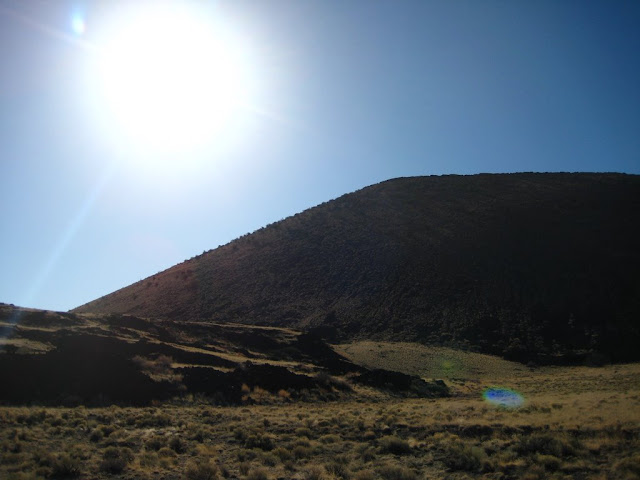
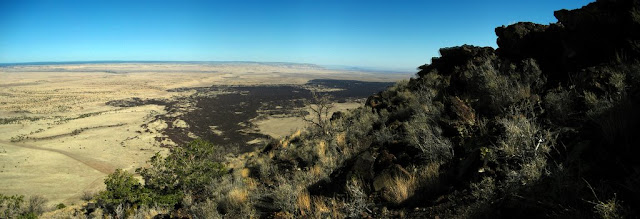
Not only is RATS showing off the best capabilities of the most successful part of the Constellation Program – the Lunar Electric Rover Concept, or LERC – but they have gone to an especially cool site, a well-preserved but little-known cinder cone volcano known as SP Mountain! As that video played, I kept thinking to myself: “that looks familiar…” Here’s my view of SP and the lava flow coming out of the base of the mountain:
SP ConeSP flow
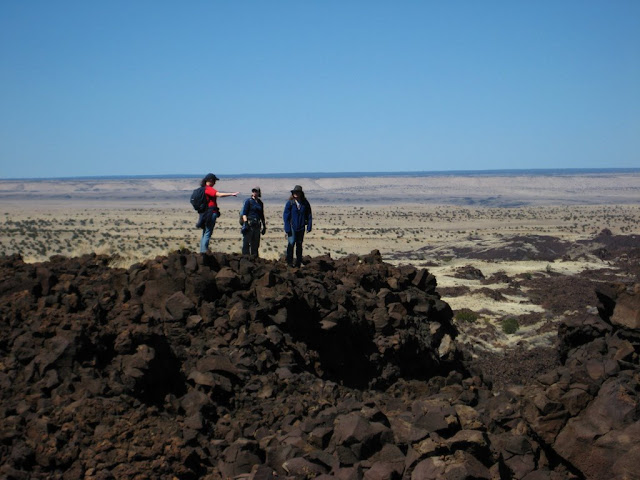
When I was there, with a class of planetary geology grad students led by Cornell Mars scientist Jim Bell, I couldn’t help but picture the rugged a’a terrain of SP flow with astronauts picking their way along. What a tremendous place to practice exploration operations!
Since last February, I have been trying to get my sci-fi short story, “Conference,” published. So far, the score is 0 for 4.
Asimov’s Science Fiction sent me a form-letter rejection.
The Magazine of Fantasy and Science Fiction sent me a personalized letter. The editor wrote that “this tale didn’t quite work for me, I’m afraid,” and thanked me for sending it along. I appreciated the thought, at least.
Analog Science Fiction and Fact sent me a two-page form letter containing, basically, their submission guidelines. The editor scrawled a note at the bottom in blue pen, though: “PS: Present-tense narration tends to call excessive attention to itself and is generally best avoided unless a particular story requires it.”
I just heard back from Strange Horizons. They sent a short note that said thanks, but they decided not to publish the story.
I happen to really like this story, and I’d love to see it published. It takes place in the Cathedral Galaxy, a universe I hope to expand with many more stories, but it grew out of my experiences as a grad student. The mundane bits of researcher life. Giving a presentation to a research community. Camaraderie among grad students. Taking advantage of conferences to go sightseeing – and grinning at the crowds of other scientists doing the same. Research advisors, good and bad; on-the-ball and absent-minded. Having different impressions of a scientist from reading their papers and from actually meeting them. Reacting to the presence of the “big names” in a particular field. Even finding love within a technical community – though it certainly didn’t happen to me the way it happened to Ceren Aydomi.
So, readers, since I like this story so much, I’d like to workshop it a little. If you can, take a look. Is it too long? (It’s almost 10,000 words, which is on the big side for a short, but when I read it, it doesn’t feel too bad to me.) Does the present-tense narration bother you? Is the action too slow or too fast in places? Are the characters strong enough, and do they interact naturally enough? If you’ve been to a research conference before, how does this feel as a depiction?
Yesterday was the fourth annual Ithaca Brew Fest. This is an amazing event in which guests get to taste enormous amounts of beer from nearly 50 breweries ranging from New York State micros to national brands. It’s a fantastic way to try lots of different brews; for a novice at the beer snobbery game like myself, it’s also a great way to compare many qualities of beer so I can better put my finger on what I like and what I don’t, or what would be good with various foods, or moods, or what have you. Especially fun this year was that my best friend from college joined me – he’s a bit more experienced with the nomenclature for beers and has tried some homebrewing, but he’s never been to the Ithaca area or sampled our local stuff. So, it was fun to compare notes. (Besides having a great little mini-Eph-physics reunion!)
As I mentioned above, I’m an amateur at the beer review process; but at least this is my 3rd Brew Fest, I like trying things, and I can make a stab at putting some of my thoughts into words. Here are some of the highlights that stand out in my mind after Brew Fest 2010:
Ithaca Beer Co.: CascaZilla and Cold Front
We are fortunate to have a really good brewery here in town, and I’ve just got to bring them up first. My friend was especially a fan of CascaZilla, IBC’s red ale. It’s a nicely balanced beer, between hoppiness and maltiness. At my insistence, our first tasting of the day was the Ithaca Beer Co.’s Cold Front, a Belgian-style amber ale. I first tried Cold Front at last year’s Brew Fest and it rapidly became my favorite beer of the fall and winter. It’s got a complex combination of several smoky flavors and gives me a very nice warm-and-fuzzy-inside feeling. Goes wonderfully with pizza from The Nines in Collegetown, or a Guinness burger at the Ithaca Ale House!
Weihenstephan: Korbinian
Weihenstaphen is from Freising, Germany and has been in business since 1040 C.E., so we kind of figured that they probably knew what they were doing! Korbinian is a doppelbock – which is, I think, my favorite kind of beer. Korbinian was particularly caramely and chocolately, with a strong, delicious smell to it. It was a very heavy beer – not really bready, but still not the kind of thing you can just drink; you have to take it in sips. We tried to come back for seconds on this one!
Wagner Valley Brewing Co.: Sled Dog Doppelbock
We continued a round of dark beer tastings with another doppelbock, the Sled Dock from Wagner (a NY local). This doppelbock was second only to the Korbinian, I thought: it also had rich caramel flavors, though it felt a bit lighter, making it easier to drink in larger sips.
Anchor Brewing: Anchor Porter
I do like a good porter, and this one hit the spot: a nice, rich, dark porter; a bit more bitter than all the doppelbocks we tried.
Here we are with the Anchor Steam Porter: it had the perfect color for a Brew Fest photo!
Bellwether Hard Cider: Liberty Spy and No. 4
Bellwether overcomes the disadvantage of its owner’s amHerst College heritage to produce some very tasty hard ciders, and is the establishment that introduced me to fine hard cider on par with all the craft breweries and many upstate NY wineries. I prefer their Original and Liberty Spy hard ciders to the fancier things like Cherry Street and Black Magic, which get augmented with cherries or black currants. Liberty Spy has clear apple flavors coming through; it’s fruity without being too sweet. New to me this year was No. 4, which had more sour-apple notes. Tasty without the flavors being overpowering!
Brewery Ommegang: Abbey Ale and Kup O Kyndnes
Ommegang’s Abbey Ale is brewed in the Trappist style; it’s got a lot of strong brown-ale flavors without being as chocolate- or caramel-dominated as the doppelbocks. Ommegang is a regular and Abbey Ale was a Brew Fest favorite among most of the people I talked to; it topped my friend’s list enough that he said he’s going to make a point to look for it back where he lives in the Boston area. That brew is something to be careful of, though: it’s delicious, but over 8% ABV! I tried their Belgian-style Scotch ale, Kup O Kyndnes, for the first time this year, which successfully combined a number of flavors from other beer styles.
Flying Dog Brewery: Raging Bitch
Whoo! This was the most punch-in-the-faceiest hoppy beer I have ever had. If you like hops, you should try it. It was definitely not my favorite, but I mention it because some people like their hops.
Roosterfish Brewing: Hop Warrior
Roosterfish’s imperial IPA is an extremely hoppy beer, rating 120 IBUs (whatever those are). However, what distinguished it from the Raging Bitch was that its full-on hoppiness was very well balanced out with malts, making it much easier to drink and giving it a full-bodied flavor. It compared nicely with Ithaca Beer Co.’s CascaZilla red ale, only more so.
I spent last week in Toronto at the annual AIAA Guidance, Navigation, and Control Conference. This is a huuuuuuuuuuge conference of engineers from academia, military, and industry all presenting papers about their research. So, I got to see a lot of Powerpoint presentations. (Okay, okay, supernerds, there were some PDFs and Keynotes. But “Powerpoint” is pretty much like “Kleenex” these days.) And an awful lot of the presentation slides I saw looked something like this:
Fine, right? I mean, this is a technical venue, full of super-brainy engineers. We want the facts, ma’am, just the facts, in all their glorious mathematical detail, and style means nothing. Right?
WRONG!
The first rule anyone will ever tell you about giving any kind of presentation is to know your audience. And if I’m in the audience at a conference like this, then I’m spending a full day listening to technical talks and you have only twenty minutes to make me think that your research is as cool, interesting, or relevant as the title made it sound when I picked it out of the lineup that morning. Because I’m still holding the conference program in my hand, and I have a notepad and pen ready to jot down research ideas the last cool presentation made me think of, and I might have my laptop in my bag, so I’m not at a loss for things to do if you’re not very exciting. In other words, not only do you need to convey your technical material, but you also need to keep me interested and/or entertained, at least enough to keep me listening to your technical stuff.
It’s a tall order.
I’ve been told that I do a good presentation, though, so I’m going to share a bit of my philosophy for what a technical presentation should be like. Here are the points that I start from:
Nobody wants to see lots of equations. Some are necessary, sure, and they can be a great way to add technical gravitas, but a 20-minute presentation is a much better time to show off results, pictures, movies, hypotheses, conclusions, possibilities, tricks, and excitement. And if the conference is like GNC, requiring a paper with each presentation, then all the equations go in there, anyways. The oral presentation is for highlights, not derivations.
These presentations come in the middle of a solid block of otherwise identical presentations that are going to blur together in the audience’s minds. So, they need to be distinctive. In other words, a bit of flash and polish goes a long way. Also, attention-grabby things like pictures and movies are good, but not if they’re just thrown together in a clip-art sort of way. (There’s good attention to grab, and bad attention to grab!)
Slides are visual aids. I mean both “visual” and “aids.” Think about both of those terms: slides are supposed to be for showing the audience things. And the slides in a live presentation are not supposed to be completely independent of the presenter: you should refer to them, but you are the one giving the presentation.
As an example of my own style, allow me to go through my recent GNC presentation slides and point out my thoughts on their layout, style, and content. If you want to follow along, most of the presentation itself is here on YouTube:
When I’m not doing silly things like constructing languages, writing science fiction, or biking through the Great Smokey Mountains, I have a research job in a Cornell spacecraft engineering lab to maintain. Mostly, that stuff doesn’t go on my blog because it ends up on our research group web site or in published journal articles and conference papers. But I’ve hit a milestone, and I think it’s pretty cool.
I recently spent over a week in full research-promotion mode, and I’m finding it tough to switch back into research-doing mode. Coincidentally, I don’t think I’ve actually written a blog about my graduate research yet, though I’ve put descriptions of it on both my personal web site and Cornell group web site. So, I’m going to try and get it all out of my system…
Suppose you ask: Hey, Joe! What’s your research about?
Well, it’s about building Transformers in space out of Legos connected by tractor beams. Seriously. Okay, fine, they’re not “tractor beams,” more like…”tractor fields.” But other than that, not a bad description. Here’s an old-ish video version:
I demonstrate flux pinning
First: Why?!
There are a lot of possible reasons why we ought to be thinking about building large-scale structures in space. Imagine assembling a huge space telescope out of hundreds of mirror segments, giving the telescope an effective light-gathering area of hundreds of meters and letting us peer into the dimmest corners of the Universe – from the most distant objects to extrasolar planets. Or, if we’re interested in space-based solar power (putting solar power collectors in space, where they could gather sunlight 24 hours a day without atmospheric filtering, and then beaming that power down to Earth) we would want to make the biggest collector area we can. Proponents of geoengineering approaches to climate change mitigation have been seriously considering constructing a giant sunshade to reduce solar incidence on the Earth, a short-term solution that could stave off environmental impacts while we work up longer-term fixes. And finally, if we want to maintain a long-term human presence in space – from Mars explorers to microgravity research and manufacturing technicians to paying space tourists – we will need vehicles and stations with enough room to accommodate many people, hold life support and other supplies, and provide equipment to stave off the detrimental effects of microgravity on human physiology.
All of these possible applications – any one of which would have tremendous implications for our lives on Earth – demand that we build a large structure in orbit out of smaller components. The reason for this is simple: launch vehicles can only carry so much mass and volume into orbit. Those limits are on the “stowed” size of spacecraft, so we do have the option to build craft that deploy, or unfold, out of their tightly-packed, mostly cylindrical launch configuration and into some more spindly and useful shape. For example, most Earth-orbiting satellites get their power from large solar panel “wings” that would not fit into a launch vehicle fairing unless rolled up in some clever way. There’s a lot of research these days on inflatable spacecraft, that could expand to many times their stowed size and get structural support from their internal pressure, but even those balloon-like craft cannot get indefinitely bigger than their launch envelope. Deployments and inflatables only make the volume or length of the spacecraft larger – so, for the same mass, you end up with spindlier structures, which might be fine for some applications but not others. So, in order to get the really big spacecraft, we must assemble smaller pieces to make the final system. Think of the International Space Station assembly process. Continue reading Hey, Joe! What’s your research about?→
I’m trying to write a conference paper manuscript for the AIAA GNC conference right now (why, oh, why isn’t it just an abstract, or even an extended abstract? a full manuscript at this point is going to be slathered with “TBD” and “preliminary” and “temporary” and promises for the future!), but I just discovered something that I had to write down for the benefit of other academic users of Microsoft Office since this has been bugging me since I got Office 2007:
I, personally, rebel against using TeX or its derivatives in my academic work. Yes, I can program in Matlab and Mathematica, and yes, I can create some pretty snazzy HTML/CSS web pages, so I’m not foreign to coding and markup languages, but really, I’m trying to concentrate on the science and engineering when I write a paper. I want to see what I will get. There is no reason at this point in the history of computers for me to have to use a command-line word processor that I have to compile. That sort of thing is for numerical scripts, not for documents.
Word 2007 took some great strides in the direction of making Office easier and better for technical purposes, with a WYSIWYG equation editor that you can control almost entirely from the keyboard using common operators and that automatically prettifies the equations as you write them. It’s way cool.
Word 2007 also has, from the beginning, included some automatic citation generating and outputting features. It’s almost like EndNote or BibTex and such, except that I don’t have to pay extra for them. However, it’s HUGE shortcoming was that it contained only 10 citation formats, and didn’t include some common technical formats. Right around the release of Office 2007, Microsoft blogs touting Word went on and on about how easy it would be for users to generate their own formats, since they used open XML files to create them. However, it turns out that those XML files are totally opaque to my understanding, and when I did try to change some things, I didn’t get what I expected. And it seemed like the rest of everybody agreed with me, because downloads for new citation formats did not immediately appear on the Internet.
I have finally, finally, finally found a web site with a small library of citation format files. It is here.
They unfortunately don’t have the AIAA format, which is what I use most often, but maybe they have something close. And, anyway, it adds to my options for the future. 🙂