All posts by josephshoer

Back to the Future

This week, NASA launched the Orion spacecraft on a test flight. I have a conflicted viewpoint about this event. To me, Orion is both exciting and deeply disappointing.

On the one hand, Orion is NASA’s first entirely new spacecraft for human crews in over twenty years. There have been only seven in American history: Mercury (first successful flight in 1959), Gemini (1964), Apollo (1966), Skylab (1973), Space Shuttle (1981), Space Station (1992), and Orion (2014). Those dates have been getting unacceptably distant from one another, and it is wonderful to see NASA getting its game back on. Test flights are NASA’s business. The agency is supposed to operate in the proving ground of technology. I want to see it doing new things, and the Orion flight was a reasonable first step towards NASA getting back to its roots. Those roots, after all, were triumphant!

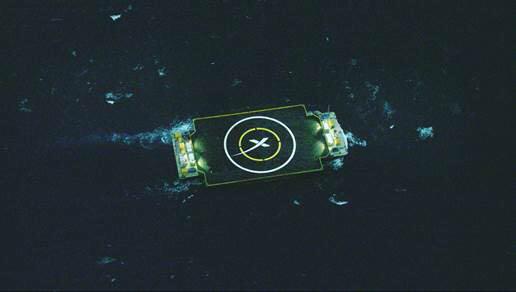
On the other hand, though, Orion falls far short of what NASA could, and should, do. The spacecraft is an improvement over the last capsule NASA designed – the Apollo Command Module – but it is an incremental improvement rather than a revolutionary one. As an example, one of the technological advancements NASA has been touting about Orion is its glass cockpit. But this is the era of the iPad: in such a mass- and volume-constrained environment as a space capsule, the glass cockpit is simply not innovative – it is obvious. (For examples of innovation in space vehicles, try inflatable habitatsrockets that fly back to their landing pads or crew shuttles that could land at any normal-sized airport runway.) To make matters worse, not only is Orion an incremental step in capability from the early ’70s, but its development is horrendously stretched. For reasons that are political, programmatic, and cultural, rather than technical, the next flight of Orion will be in 2018. A human crew will not use the capsule until after 2021, at which point it will be almost a decade old itself.

I think the most bitter disappointment is the concept of what Orion will do when it finally does have astronauts on board. The current plan is to build the world’s biggest rocket, the Space Launch System, and use it to send an Orion crew to asteroids and Mars. I’m all for visiting those places, but the “giant rocket with space capsule” architecture – the architecture of Apollo – is a recipe for one-shot visits to other worlds. After the first astronauts return from such “flags and footprints” missions, there is a very strong risk of program cancellation. I don’t want to see our space program cancelled.

An Orion capsule riding a Space Launch System rocket is not even close to how I would design a sustainable, long-term space program. A much better approach is to use many different spacecraft, and specialize them for individual purposes. Think of the Apollo Lunar Module: it was a flimsy, silly-looking vehicle that was exactly suited for the prospect of landing and taking off from the Moon’s surface. Instead of building on Apollo and Space Shuttle heritage to make an “all-purpose” space capsule, I would like to see NASA lean on its Space Station experience to design a set of interplanetary transport spacecraft. These vehicles would stay in space for their whole lives: we would assemble them in space, launch them out of Earth orbit rather than from Earth’s surface, and we’d never use them to carry astronauts up from and down to the ground. Whenever they need more fuel, we’d send only the fuel up to them – not a whole new vehicle. When we need to rotate astronaut crews, we could always hire SpaceX.

That sort of multi-vehicle concept offers some big advantages. First of all, it’s much more flexible than giant, infrequent, one-shot missions. Second, it’s far more efficient and cost-effective. Think about this: 20% of Orion’s mass is its heat shield, a component only needed for the last ten minutes of its mission. If Orion is returning from Mars, then that means our Mars return rocket needs to be huge in order to push that heavy heat shield on its half-year-long journey back to Earth. And if the heat shield and Mars return rocket need to be huge, then the Earth departure rocket needs to be enormous. Instead, though, we could forget sending the heat shield to Mars in the first place. Forget having the vehicle that goes to Mars also be responsible for landing on Earth. When the astronauts come back from Mars, you just send a little rocket with a little capsule into Earth orbit – just enough to bring the astronauts to the ground. The lightweight interplanetary spacecraft stays in space.

In 2011, when Congress ordered NASA to begin work on the Space Launch System, internal NASA studies came out that agree with my assessment. Multi-vehicle approaches that we can re-fuel and re-use in space are more efficient and cheaper than SLS. They will also get astronauts to other worlds much sooner. Most importantly, such approaches won’t be reliant on one-and-done missions. They will be much more likely to keep our explorers in space.

That is why, while I applaud NASA’s successful demonstration of the ability to launch new vehicles, I hope the agency moves on quickly from Orion, and begins work on a new fleet of exploration vehicles to stay in space.

Vhonn/Brawn (what could we do?)

Vhonn/Brawn

Wernher von Braun is one of the lions of the early American space program: a pioneer who engineered our initial forays into orbit, our steps onto the surface of the moon, and our designs for space stations and Martian colonies. He developed or directed the development of the technology to enable those feats. Without him, the United States might not have a space program as we know it.

But all technology is only as good as the people who use it. If von Braun had a personal failing, it was being willing to embrace the use of his devices for nefarious purposes, so long as he could work on them at all. His part in aerospace history began in Nazi Germany, with slave labor and vengeance weapons. Then, after he surrendered to the Americans, he secured a place at the US Army not by promising it the moon – but by promising it the intercontinental ballistic missile. The dual use of this technology was not lost on von Braun. As he famously said of the V2, “the rocket worked perfectly except for landing on the wrong planet.” Since then, every single government to come into contact with von Braun’s work has first thought not of space exploration, but of ballistic missiles armed with weapons of terror.

Brawn

Two worlds. The reckless denizens of Brawn choose to use their technology for destructive ends. In their insecurity, they ultimately realized their driving fears. Now, all that remains of them is technological detritus: shattered pipelines, broken chain-link fences, and cracked bunkers; all are monuments to warnings ignored.

Vhonn

On another world, the policymakers kept their engineers focused on exploration, enriching and enhancing their culture. They ultimately landed an expedition on the neighboring planet Vhonn – a place harsh in its alienness, but full of scientific treasure troves, including keys to understanding life as they knew it. Their citizens are confident and inspired. They strive forward into the cosmos, and will eventually stake claims throughout their star system.

Today was once celebrated as Armistice Day, a day when the world laid down its arms to end the greatest war it had ever felt – a war that saw the development of weapons so terrible that an international convention gathered to forbid their use. Now, nearly a quarter-century after the end of the Cold War, may we do so again. I hope that, one day, we live in a nation worthy of our veterans’ sacrifices.

Prints!

Hey there, anybody who has been a fan of my maps! I am proud to announce that I’ve uploaded 18 megapixel images of several of my favorite maps to Imagekind so that you can buy prints.

Prints of Archipelago, Zarmina, and Legends!

There are four maps available: Zarmina, Inkwash, Archipelago, and Legends. I’m pleased with how they came out! Of course, the tiny features on Legends are much better in the original…

There are also a couple details of Archipelago, which lent itself well to close-ups: a lone island in the sea and a colorful snippet with several islands.

Personally, I like the “small” size for the full images, and the smallest size Imagekind offers for the two details. The large sizes, and above, are an up-sizing from the original, and while I’m sure they will make a fine image, I don’t know that the smallest of my details will scale well digitally.

I’m looking forward to the experiment to see how much interest people have in these maps! I can tell you that I’ll be posting more, and I’ll be uploading them to Imagekind as I do.

Visionaries

The Space Review has a fantastic article that invaded my whole way of thinking this morning while I was trying to get into my groove for work. It casts the golden age of space exploration – the Space Race – as a contest of two visionary dreamers against their employing superpowers. It also goes a long way towards explaining the allure of SpaceX! The arguments presented therein may or may not be right, but they certainly form an interesting view to read.

It’s a fantastic and different historical perspective. Plus, some of the author’s writing includes delicious indictments of the use of space technology for evil.

Legends and Histories

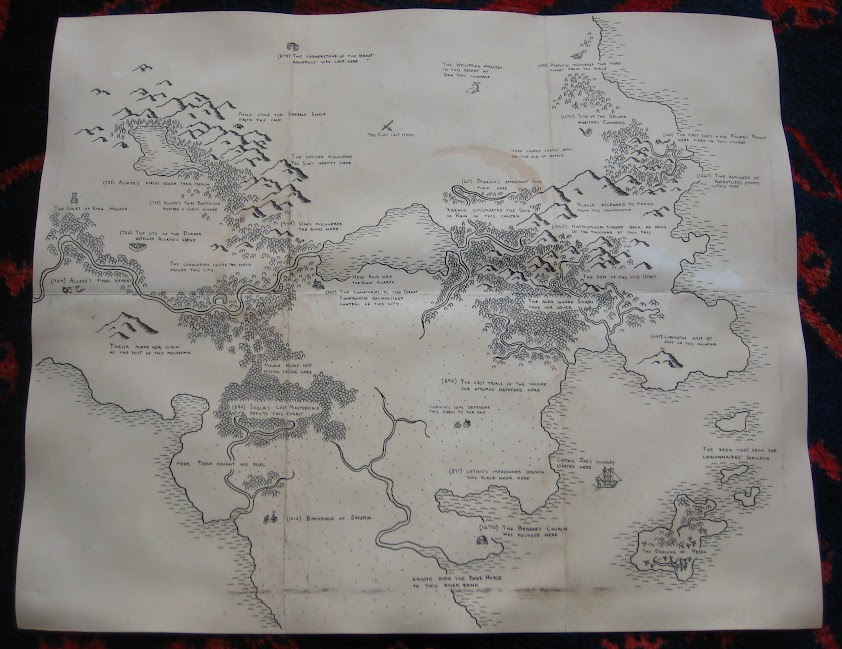
I wanted to try drawing a map full of labels, but no place names. Instead, I would fill it with events and stories suggestive of the cultures living in the lands I depicted. This is the result:

The Map of Legends

Much of the importance we place on a location comes from the stories associated with it. So, this map is covered in people and actions identified with places. Their struggles and triumphs fill the lands, drawing us into chains of associations.

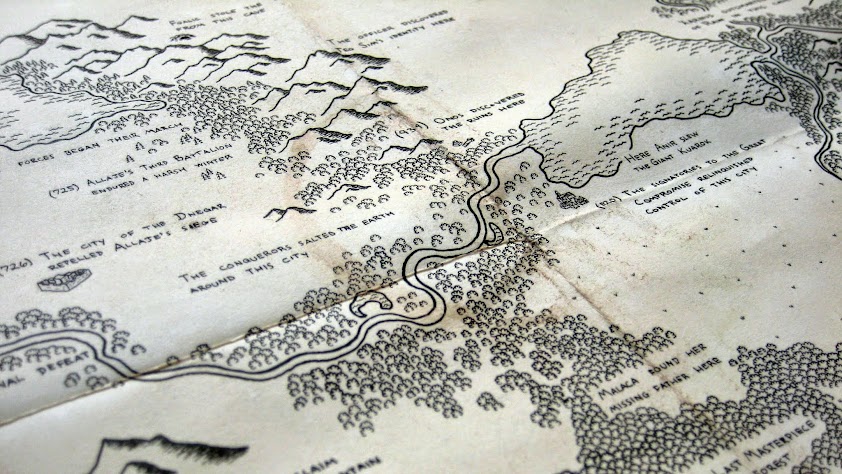
Here camped Lastos’ army on the eve of battle. Sfola’s Last Masterpiece depicts this forest. Foalic stole the Emerald Shield from this cave. Here was the site of the Second Arbiter’s Congress – possibly related to the Fishers’ Revolt, the first shots of which were fired in this nearby village.

Lands of Allaje and Malaca

Looking at the labels, you may notice that roughly half of them have a preceding number in parentheses – what might appear to be a year. These labels speak of military campaigns, scientific exploits, political victories, founding of religions, and significant personages. The other half, without a corroborating date stamp, mention more dramatic exploits: giant creatures, heroic duels, stolen artifacts, and encounters with the supernatural. Are these myths of the local culture? Or do they hold some kernel of truth? Continue reading Legends and Histories

Bright sci-fi

From Battlestar Galactica to Gravity, it’s easy to think that the current generation of science fiction has to be “dark” in order to be good. But we shouldn’t confuse ourselves! Just because there are so many dark and good pieces of sci-fi out there doesn’t mean that darkness makes the sci-fi good.

I was looking for a picture of Adama with a flashlight, but couldn't find on on Google. Oh well.
It’s dark on a Battlestar

In fact, I think it’s important to remember that science fiction, at its roots, is the most inherently optimistic genre of fiction! Sure, says science fiction, the people of the future have problems. Sure, some of those problems are the same as the problems we have now. But the people are still there! They are still recognizable! And they are still solving their problems!

Even science fiction stories that seem the most bleak have kernels of optimism. Consider Poul Anderson’s short story “In Memoriam” (it’s available in the collection All One Universe). A short summary: Some cataclysm happens, and humans die out. Over the eons, our cities crumble and the evidence of our lives passes into archaeology and, later, paleontology. New civilization arise on Earth. Then they die out. Eventually, the Sun expands into a red giant, cooks the Earth to a cinder, and then sloughs off a planetary nebula and collapses into a white dwarf, leaving the Solar System lifeless and barren. But, in the final paragraph of the story, we visit four spacecraft – Pioneer 10, Pioneer 11, Voyager 1, and Voyager 2 – that have left the Solar System on an infinite journey into the stars.

Anderson doesn’t say it, but it’s easy for me to add the epilogue. All four of those space probes carry evidence of human civilization, including depictions of human beings and libraries of our language and culture. Anderson’s story tells us that through those vehicles, from a certain point of view, human civilization has already achieved a measure of immortality. Chuck Berry’s music will live on until the heat death of the universe. Sad as the extinction of our species would be, I find that an uplifting thought.

(A publicly available story with a similar theme is Isaac Asimov’s “The Last Question,” which you can read online here.)

Still, it would be nice to have some more bright science fiction out there. That would certainly be helpful for space advocacy, as Dwayne Day of The Space Review points out in this provocative essay!

Maybe it’s time for Star Trek to get out of the theaters and back onto the air. Or maybe we can just turn to…science.

Threat assessment

Sometimes, I wish I had more Republican Congressmen to write to.

Human-caused climate change is a national security issue. It threatens our lives, our property, and our way of life. And it is the only thing that we know, for a scientific fact, will threaten the American people in the future. We ought to start treating it as such, and start investing, on a national scale, in stopping it.

Ignoring the problem is, in my mind, tantamount to embracing Chamberlain’s security strategy in the late 1930s: a course for further destruction and calamity.

After Inspiration

We space exploration fans and practitioners live in heady times! But I’m going to take a step back from all the SpaceXes and KickSats of the moment to do some philosophizing. Let’s start with the adage that the military is always fighting the last war: I think the saying may be true of science and space exploration advocates, too. Just hold that thought…

Over the last several weeks, I have been enjoying the “Cosmos” reboot. One of the justifications put forward for the show is the need to inspire a new generation to pursue scientific and technical careers, as Carl Sagan’s original did in the early 1980s. Airing prominently in support of “Cosmos: A Spacetime Odyssey” is a Boeing advertisement, perhaps suggesting a career path to those young Americans inspired by Neil deGrasse Tyson in the show proper. It portrays engineers hard at work building – among other key Boeing-associated products – communications satellites, rockets, and solar panels. As the music crescendos, it displays footage of the International Space Station while the narrator declares that Boeing engineers have built “something the whole world can share.” The way the ad spot is cut, one might almost get the impression that the aerospace giant puts forth equal effort – and promises equal opportunities – in civil space exploration as it does in the areas of military aerospace and commercial aviation.

There’s a problem with STEM (that’s “science, technology, engineering, and math”) in the United States, but this “STEM crisis” isn’t really what it’s made out to be. There’s not really a shortage of STEM graduates. There’s a shortage of jobs for STEM graduates. This fact raises a question: suppose “Cosmos” inspires a large number of young Americans. Suppose it makes them want to learn the fundamental science underpinning the physical processes of the universe. Suppose it encourages their passion to build space telescopes and Mars rovers. Suppose it pushes them to wonder if there is alien life on Europa, or Enceladus, or an exoplanet. What do the newly minted young engineers and scientists go on to do?

The things we value as a country, and how much we value them, are effectively determined by the budgets set in Congress. In 2013, Congress spent about $63 billion on science and technology research of any kind. Yet the Department of Defense gets ten times that amount, and about 25 times that dollar value goes toward nondiscretionary entitlements. On top of that, over half of what little federal R&D funding there is goes toward defense programs (which means the fruits of that R&D don’t really percolate out into wider society). NASA does everything that it does on a paltry $18 billion dollars annually – about half a percent of the federal budget.

The message is clear: our country values keeping its social obligations. Fine, good. But the next thing on our national priority list is defense. (And, of course, much of our defense policy is based around big-ticket systems fighting a Cold War that ended when our adversary ceased to exist almost a quarter-century ago. As that adage goes…) As for research and development, fundamental science, medical advancements, or space exploration…well, according to the money, our country barely cares about these things at all in comparison. As a result, some of the most secure opportunities available to STEM graduates are in military-related positions – contrary to what that Boeing advertisement suggests.

This situation is extremely sad and problematic, both for our young engineers and scientists and for the United States as a whole. And it suggests to me that the best target of science advocacy should not be the young Americans working their way up through school. It should be Congress.

Private companies don’t produce fundamental innovation without a clear financial incentive. They don’t do basic science research, and they hesitate to invest in product development that stretches beyond the next quarter, let alone the next fiscal year. We can’t rely on private enterprise for awe-inspiring scientific and engineering feats. Most of the really blockbuster stuff – the continental discoveries and global circumnavigations and Hoover dams and Moon landings and Saturn probes – comes from governments. Not just any government fits the bill, either: only those that take the long view engage in such risky and rewarding activities. Historically, the United States federal government has been an incredible innovator. NASA is an exemplary contributor, holding 1 in 1000 US patents! (And that’s not even mentioning the tangible or intangible economic benefits.) Lest one think that academia will step in on its own to provide the fundamental research, consider that government grants support the scientists in academic institutions. We need the government to be doing this stuff.

Basic research, innovation, and exploration is potent, inspiring stuff. With their ad spot accompanying “Cosmos,” Boeing demonstrated that they have a strong grasp of this concept: giving the Space Station top billing among their projects is a sure way to tug on the heartstrings of future-minded young people. (They’re not the only “Cosmos” advertiser to capitalize on the excitement of space exploration, either.) But in a time when our Congressional leaders simultaneously don’t seem to care about science and lack the courage to close even the unneeded military bases, there’s very little chance that a young engineer gets to work on space exploration. Sadly, one probable outcome is that after their technical education our aspiring space explorers will end up doing what the military-industrial complex calls “capability maintenance” – which easily means work that has all the technical, social, and political value of a “bridge to nowhere.” To a congressperson, military pork is the most valuable and secure kind of jobs program; to a defense contractor, bloated programs are steady income.

I’m in my early career. I’m not as bitter as, say, NASA Watch yet (and the ire I do have goes straight at Congress rather than at NASA administration). I consider myself fortunate that, even though I don’t work for NASA, I am working on a NASA mission that’s relevant to civil science. But I do see that there are hard, important problems out there that we need to solve – some, problems of national import – while we divert resources elsewhere. I imagine if we decommissioned a few surplus ships, we could instead land humans on Mars. I think if we could close a few extraneous bases, we might instead determine that we are not alone in the universe. Or I wonder, if we shut down our arsenal of Minuteman missile silos – leaving our ability to combat modern threats unaffected – could we instead attack what is probably the greatest known future national security issue: climate change? I want to make the world a better place by working on those problems, and by stretching human capabilities and knowledge out into space. And I, for one, view a lack of investment in science and innovation as more relevant to the United States’ national security than many overt military programs.

We have to remember that the point of NASA is not just to inspire. And the point definitely isn’t to be a jobs program for targeted areas of Alabama, Texas, California, and Florida. Historically, it wasn’t even to explore space. The point of NASA was to move our nation forward in scientific and technological capability. Popular inspiration is a nice, and effective, bonus. But our leaders in the Capitol are clearly in more need of science advocacy than we are. If we could inspire a little more political courage from them, to move money from safe-but-unnecessary programs to critical development agencies and unleash those agencies to innovate, then the rest of America can go on to great things – after inspiration.